
Park Board Previews Wildfire Priority Map as Flow Trail Fight Escalates
Board of Directors • East Bay Regional Park DistrictOctober 6, 2026
Locunity is an independent informational service and is not an official government page for this commission. All information is sourced from public footage and an analysis of official agendas with the aid of responsible, fact-checked AI. to report an error or omission.
The East Bay Regional Park District is building its first district-wide map to decide where wildfire crews, grazing animals and restoration dollars go next. At its Oct. 6 meeting, the Board of Directors heard a 90-minute staff preview of that strategy and took no action. Earlier, an organized group of opponents and a smaller group of parent supporters clashed over the not-yet-agendized Wildcat Canyon Flow Trail.
- Vegetation strategy previewed: Staff will use three mapping models to target fuel reduction and habitat restoration, with implementation in early 2027.
- Flow trail opponents allege "pay-to-play": Five speakers sought a pause, an audit and a refusal of a $1M donation. Three parents backed the trail.
- Advisory members push back: Two Park Advisory Committee members said they were asked to "rubber stamp" a vegetation report.
- Community partners report needs: Seniors and Fruitvale families asked for translation, transit and swim lessons.
1 Big Thing: A Map to Decide Where Wildfire Dollars Go
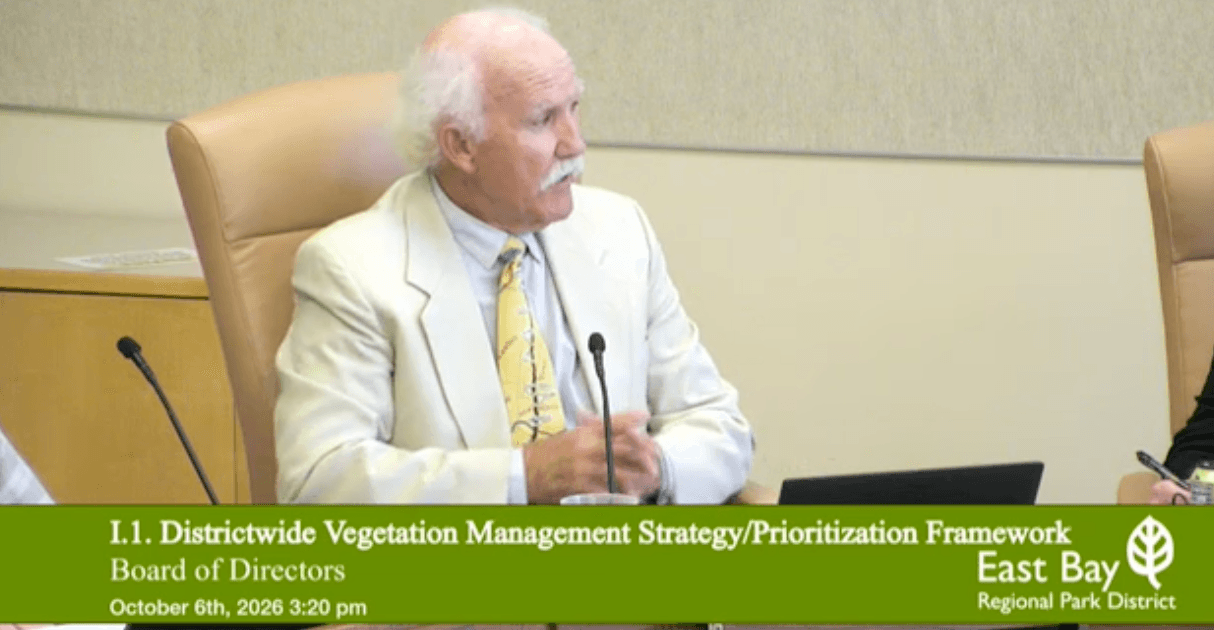
The basics: Staff presented a district-wide vegetation management strategy and a prioritization framework. The framework is a set of computer mapping models that score parkland by need and feasibility. “It is not a new wildfire plan. It is not actually a plan at all,” said Kristen Van Dam, Ecological Services Coordinator. She called the project “the first of its kind for the Park District.”
Why it matters: Wildfire is residents' top concern in district polling, according to General Manager Max Korten. The framework will steer project spending, which Board Vice President Colin Coffey said grew from $2M to $10M last year. Korten said the framework “can help us get grants.”
Where things stand: Vegetation work is currently spread across fire, operations and stewardship divisions. The district's original wildfire hazard reduction plan predates thousands of acres of land acquisitions. Korten said partner fire agencies had also notified the district that it was “out of compliance with their defensible space ordinance.”
Claire Griffing, Management Analyst in the General Manager's Office, outlined four draft goals:
- Reduce wildfire risk and protect communities.
- Protect and restore healthy ecosystems.
- Maintain safe, accessible parks and trails.
- Strengthen coordination, communication and sustainable management.
Van Dam said the framework builds on 2024 fine-scale vegetation and hazard mapping. Three logic models (community, ecology and feasibility) overlap to identify priority areas. “The map is the strategy,” Korten said.
The consultants are ARC Forestry, Tuckman Geospatial and Wildland Resource Management, with support from the Regional Parks Foundation and the State Coastal Conservancy. Grazing covers about 68% of district lands.
The other side: Director Elizabeth Echols worried that areas already treated could score low in the models. “Once you treat these areas, if you don't maintain them, then that work is wasted after a few years,” she said. Korten replied that the district is “not walking away from any of the existing places that we've treated.”
Public commenters pushed in different directions:
- Cordes Cooper of the Sierra Club Bay Area Chapter urged the district to “dramatically expand the use of prescribed fire and managed wildfire.”
- Jim Hansen of the California Plant Society East Bay Chapter warned that over-clearing could make land “a bowling alley for embers.”
- Whitney Grover of the Golden Gate Bird Alliance asked that work avoid bird breeding season.
- Norman LaForce urged keeping dead wood for habitat and called home hardening “the key.”
- An online commenter named Kelly argued that per-acre costs exceed the value of the land.
Decisions and stakeholder impacts: The item was information only, and no vote was taken. Directors added these requests:
- Board President Olivia Sanwong asked for a public-facing document and attention to ranchers. She also cited the threat the 2020 SCU Lightning Complex Fire posed to the Del Valle Water Treatment Plant.
- Director Lynda Deschambault asked for a greenhouse gas goal, a tree inventory and a mention of sheep grazing.
- Director John Mercurio asked that the presentation be shared with local fire agencies.
- Director Dennis Waespi recalled the 1991 Oakland Hills Fire and suggested “a goat herd of our own.”
Residents near parkland could see work shift toward mapped priority areas.
What's next: Van Dam said the models should be finalized by the end of October. Staff return to the Natural and Cultural Resources Committee on Oct. 28 and to the board “likely January” for acceptance of final goals.
Flow Trail Opponents Allege Pay-to-Play
Why it matters: The Wildcat Canyon Flow Trail awaits a draft environmental impact report (EIR) and is not yet before the board. It still drew the largest share of open public comment. Opponents tied the fight to voter trust ahead of a future tax measure.
Where things stand: Opponents described Public Records Act documents showing the project began in 2021 with the mountain bike community. They also pointed to a $1M donation conditioned on the trail being built and the EIR being certified. “That's pay-to-play, and that has no place in the Park District,” said Norman LaForce, speaking for himself. He demanded full public disclosure of the donation's terms.
Leslie Goldstein summarized a 50-page compilation of district emails from August 2020 to April 2023. She alleged exclusive coordination with one user group. “We ask the board tonight to pause all further planning and environmental review on the Wildcat Flow Trail,” she said. She also requested an independent procedural audit.
Janet Flint, a volunteer with Friends of Wildcat Canyon Park, said that in more than 600 conversations, “over 85% ... have not heard about the Flow Trail.” She asked staff to mail notice of the draft EIR to roughly 150,000 households, at a cost of about $39,000.
Sally Tobin read a proposed resolution. It would require every trail proposal to be planned in open meetings, restart the Wildcat project with uninvolved staff and refuse the donation.
Bara Sapir, an Alvarado Park neighbor, described online harassment of women opponents. “I'm one of those witches and a harpy,” she said. “Before the EIR review, run a real public information process for the people who live near the park,” she added.
The other side: Three parents backed the trail.
- Lauren Purcell, a North Berkeley psychotherapist, cited youth mental and physical health. “I do believe that it would keep other trails safer,” she said.
- Lucinda Bingham, a Berkeley parent, said a dedicated trail would relieve crowding on hiking trails.
- Carrie Schulman of El Cerrito said the plan removes no hiking trails and pointed to Ashland, Oregon, as a model.
Decisions and stakeholder impacts: The board took no action. The opposition was coordinated: five speakers made overlapping requests on transparency, outreach and the donation. That signals the draft EIR will be a flashpoint over donor influence and public notice. Cyclists and youth riders stand to gain a dedicated facility. Neighbors and trail critics want the process restarted.
What's next: No date was given for release of the draft EIR.
Advisory Committee Members Say They Were Rushed
Two Park Advisory Committee (PAC) members said they lacked time to shape the vegetation report.
- Irene Dieter said the committee discussed the topic at only two meetings. She noted that “trees are not mentioned anywhere, and wildlife is mentioned only once.”
- Judy Smith, the Ward 2 appointee, said members were asked at a May 26 meeting to endorse staff recommendations. “Otherwise, it just feels like we're asked to rubber stamp something that doesn't entirely encompass our views,” she said. She requested a separate full-PAC deliberation meeting.
What's next: Korten noted “it's the first year that we've done this new process” and said the PAC's next work plan is being developed with its chair and vice chair. Echols praised the committee for digging into “a meaty topic.”
Seniors, Fruitvale Families Ask for Access
Two community partners reported outreach results for the District Plan.
Charlene Nguyen, Senior Program Manager at the Vietnamese American Community Center of the East Bay, said the center conducted 160 surveys. It also took about 60 low-income seniors to Ardenwood Historic Farm. She said seniors' top priority is safe, well-maintained paved paths, and that programs were offered in English only. “What would help is really translated materials, clearer accessibility, and more programs designed for older adults,” she said.
Jeff Embolton, Executive Director of Forest and Tree, took Nazir Charter Academy students to Arrowhead Marsh. None of them had been there before. A "Scoops for Parks" survey of about 200 Fruitvale residents flagged needs for transit, multilingual signage and swim instruction. “We don't have equitable access to those green spaces,” he said. Echols requested copies of the presentations.
- Consent calendar approved: Items G1–G14, about $1.65M per Deschambault, passed by voice vote (For: 7, Against: 0, Absent: 0). The GM promised backward-looking budget reporting.
- Golden Gate Fields funding: Echols reported $125M in state budget funding for the acquisition.
- Tilden steam train: Redwood Valley Railway owner Ellen Thompson said contract renewal has stalled for eight years.
- Chenard Winery: Amelia Marshall opposed demolishing the winery for a Garin-to-Pleasanton Ridge Trail staging area.
- Alameda restroom: Ken Gonzalez said the Shoreline and Grand restroom, slated for spring 2025, remains “a pile of rubble.”
Looking ahead: Korten said forecasts show an “over 90% chance of above-normal precipitation this winter.” Crews are clearing culverts and removing hazardous trees. Deschambault requested future agenda items on a carbon sequestration inventory and a possible youth appointee to the PAC.