
Board of Directors - Mar 17, 2026 - Meeting
Board of Directors • East Bay Regional Park DistrictMarch 17, 2026
Locunity is a independent informational service and is not an official government page for this commission.We use AI-assisted analysis and human editorial review to publish information.
Board Greenlights $25M Shoreline Vision, Taps Helicopter Fund for Over-Budget HQ
The East Bay Regional Park District board on March 17 accepted an ambitious, climate-adaptive conceptual plan for the Berkeley shoreline, approved millions more for a public safety headquarters already well past its original budget, and heard an organized wave of opposition to a proposed mountain bike trail in Wildcat Canyon. Together, the actions put competing visions of the two-county park system — nature preservation, infrastructure investment, and climate resilience — on a collision course heading into 2026.
$25M conceptual plan for East Shore State Park's North Basin shoreline advances 4-0, with one abstention over transparency concerns
$2.8M more approved for the Peralta Oaks public safety headquarters, funded by deferring helicopter replacement; President Sanwong casts lone no vote
Five residents rally against proposed Wildcat Canyon bike trail as CEQA scoping period closes; draft environmental review expected late summer 2026
74-year-old Tilden steam train operator warns that 7.5 years of stalled lease talks could force closure of the privately funded attraction
Director Deschambault calls for socially responsible investment policy, flagging fossil fuel holdings in the district's portfolio
A $25M Climate Blueprint for the Berkeley Shoreline
The board voted to accept a sweeping conceptual plan for the North Basin Strip at McLaughlin Eastshore State Park — a stretch of shoreline between University Avenue and Gilman Street in Berkeley that would be reimagined with seasonal tidal ponds, nature-based erosion control, and a raised promenade designed to withstand five feet of sea level rise through the end of the century.
Why it matters: The plan introduces innovative adaptation techniques — artificial islets that create tombolos to slow wave action, managed retreat along the Virginia Street extension, and a promenade elevated to 14 feet — on one of the district's most heavily visited Bay Trail segments. If funded and built, it could become a regional model for how park agencies confront rising seas.
Where things stand: Project Manager Scott Stoller walked the board through the three-phase design: a Sunset Promenade on the north end, a Central Beach area, and a Pollinator Meadow to the south. The estimated cost is $25M in 2028 dollars. Six community priorities shaped the plan, including habitat conservation, quiet-space preservation, safety and access (including a paved Bay Trail alternate), social gathering areas, climate resiliency, and stewardship partnerships with mountain biking and native plant groups.
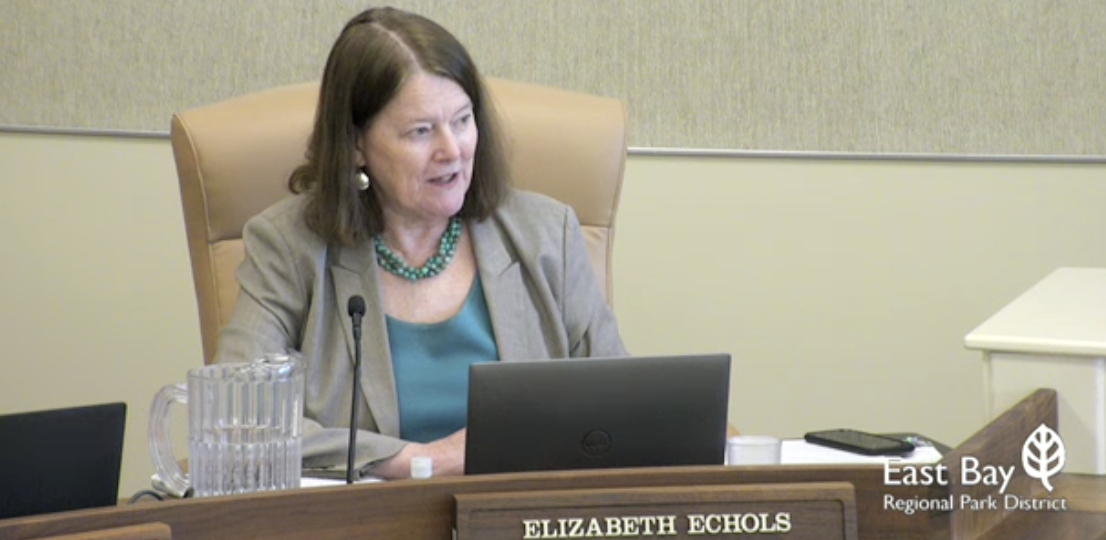
The project was developed through a "New Voices" partnership that brought 10 community-based nonprofits into a capacity-building engagement process — an approach that earned a merit award from the California Trails and Greenways Conference. Director Elizabeth Echols praised the outcome: "Advocates I've known who have extremely strong and impassioned views really accepted the plan as a whole because they felt that, even though it may contradict what they were looking for, it's a good plan."
The other side: Director Lynda Deschambault abstained, arguing the board lacked critical information. She said comment letters from the Sierra Club and Friends of Five Creeks were not included in board packets and that the district's project website failed to notify stakeholders about the meeting. "This truly is the first public hearing on this," Deschambault said. "When it comes to us as the policymakers, this is truly the first time we've seen this."
Board President Olivia Sanwong reinforced the concern, noting she was on the project website during the meeting and the hearing was not listed. "I'm on the website right now and today's meeting is not listed on here," President Sanwong said. She also raised questions about the historical shoreline, Schoolhouse Creek, and whether Caltrans could be a funding partner given the freeway's vulnerability to sea level rise.
Decisions: The board accepted the conceptual plan 4-0 with one abstention (For: Echols, Mercurio, Coffey, Sanwong; Abstain: Deschambault; Absent: Espana, Waespi). Acceptance does not commit funding — the project now enters the capital projects prioritization process and would require separate CEQA review and board approval before construction.
What's next: Staff will compete for grant funding, including from the San Francisco Bay Restoration Authority. A full environmental review lies ahead. Director Deschambault's abstention signals that process concerns could resurface when the project returns for design and funding approval.
Helicopter Fund Tapped to Cover Public Safety HQ Overruns
The board voted 4-1 to authorize $2.8M in additional construction contingency for the Peralta Oaks North building renovation — the district's 107,000-square-foot future public safety headquarters and administrative offices in Oakland — deferring helicopter replacement to cover the gap.
The basics: The district purchased the 1983-vintage building in 2019 and began a design-build renovation under a $59.8M contract with Swinerton. As work progressed without complete plan sets, the project encountered unforeseen structural problems, additional permitting requirements from the City of Oakland and EBMUD, and scope changes that consumed contingency funds.
Why it matters: The district has no unallocated budget remaining, forcing staff to cobble together the $2.8M from two sources: interest on 2012 and 2020 promissory notes and $2.6M redirected from the Eagle 7–to–Eagle 9 helicopter replacement project. The district is effectively delaying replacement of its aging helicopter to finish a building that has come back to the board repeatedly for more money — and staff disclosed that additional IT occupancy costs of several million dollars are still forthcoming.
Where things stand: Acting General Manager Max Korten told the board staff scrutinized every cost item. "We've really been looking at this with the fine-tooth comb and trying to figure out how do we get this across the finish line with encouraging as few additional costs as possible," he said. He added: "We recognized there's not any additional funding in our budget that's unallocated that we could bring to this project. And so we needed to look at our existing funding sources."
The building is 18 months into an approximately 24-month construction schedule, targeting substantial completion this summer and staff move-in by fall 2026. Toby Perry and Ren Bates of the district's Design and Construction division walked the board through specific cost drivers including underground utilities and permit-related modifications.
Vice President Colin Coffey, who toured the building, praised its customization: "What was amazing to me is the degree of customization of nuance that was addressed in every single room to create what just appears to a civilian, just a fabulous environment setting for our public safety folks."
Director John Mercurio commended the creative budget work: "I want to say it again, how much I appreciate the flexibility and the creativity that went into reallocating the Eagle 7 to Eagle 9 project money."
The other side: Director Deschambault acknowledged the building is impressive but questioned whether the district would have been better off building from scratch near public transit. "The horse has left the barn for me, for the agency," she said. "There's been so much going on. It's come to us a number of times for different changes, contingencies, additions."
GM of Public Safety Roberto Felice explained that security and evidence-handling requirements prevent sharing the facility with other agencies. "We cannot move another agency in with us," he said.
Decisions: The motion, moved by Director Mercurio and seconded by Vice President Coffey, passed 4-1 (For: Echols, Mercurio, Coffey, Sanwong — wait: Sanwong voted no). Correcting: (For: Echols, Mercurio, Coffey, and one other; Against: Sanwong; Absent: Espana, Waespi). Per the roll call, the vote was: Yes — Coffey, Deschambault, Echols, Mercurio; No — Sanwong; Absent — Espana, Waespi.
President Sanwong cast the lone dissent. "I didn't support this project when it initially came before the board in 2024. I did have some concerns about transit and the overall costs of the project, and I'm going to stick with that," she said.
What's next: Staff will return with a separate request for IT equipment funding of several million dollars before the fall move-in. The helicopter replacement timeline remains unclear.
Wildcat Canyon Bike Trail Draws Organized Opposition
Residents Turn Out Against Flow Trail as Environmental Review Begins
Five of six public speakers during general comment urged the board to reject a proposed downhill mountain biking flow trail in Wildcat Canyon Regional Park — a designated nature area unit — raising concerns about safety, habitat destruction, wildfire risk, and incompatibility with the park's protected status.
Why it matters: The CEQA scoping comment period for the proposed trail just closed, and Acting GM Korten confirmed the draft environmental impact report is expected in late summer or early fall 2026, followed by a 45-day public comment period, public meetings, and another board hearing. The organized public turnout signals the project will face sustained community resistance through the environmental review process.
Where things stand: The commenters — all self-described longtime users of Wildcat Canyon — raised overlapping objections. Michelle Rapaport, a lifelong park user, argued the flow trail would attract mountain bikers from across the Bay Area and conflict with hikers on shared trails. Sharon Anderson, a Richmond resident who has used the park for more than 20 years, said the trail would fragment wildlife habitat, increase bike-hiker conflicts, and pose wildfire risk from e-bike lithium battery failures and pedal strikes on rock.
Janet Flint, reading comments from Pam Stello, described specific safety design flaws at the intersection where the proposed flow trail would cross the "Mizzou Trail," noting there would be no monitoring, helmets, or spacing enforcement for inexperienced bikers merging onto a multi-use path shared with horses, elderly visitors, children, and dogs.
John Worley, a Richmond resident who both hikes and bikes in the park, said he supports multi-use trails in general but believes this one would be overused by a single user group at the expense of others.
Susan Worley criticized the lack of transparency, noting the public was not informed about the proposal until August 2025 despite years of planning, and added that she had difficulty finding the meeting agenda on the district's website.
What's next: Acting GM Korten emphasized that the CEQA process has many more public participation opportunities ahead, including the draft EIR release, a 45-day public comment period, community meetings, and a board hearing. The draft EIR is expected late summer or early fall 2026.
Tilden Steam Train: 74 Years and Counting, but for How Long?
Ellen Thompson, owner of the Redwood Valley Railway Company that operates the beloved steam train in Tilden Regional Park, delivered an emotional appeal to the board, describing 7.5 years of stalled lease renewal negotiations, 12 staff contact changes, and repeated reversals of previously settled terms.
Why it matters: The steam train is a 74-year-old cultural institution that costs the district nothing — Thompson said the company privately funds all maintenance, drainage, erosion control, landscaping, fire hazard abatement, and rare species protection. She told the board past concessionaires at Tilden have been forced out, sometimes illegally.
"We've been there for 74 years. We get no money from the district, no grants, no donations. Everything there is built and maintained with private funds," Thompson said. She posed a direct question to the board: "I need to know if the present situation has been some kind of long-term district policy to eliminate the remaining attractions in Tilden. Is it personal agenda or just negligence? When you have something like this for free, why would you throw it away?"
What's next: No board action was taken. The lease renewal remains unresolved.
Minor Items
Consent calendar approved 6-0 (Espana absent). Items included an amendment to board operating guidelines for alternate committee meeting dates, a contract with Sonoma State's Anthropological Study Center for a Coyote Hills Visitor Center cultural exhibit, and an extension of the Placer AI data contract from $83,000 to $250,000. Director Deschambault questioned the sole-source nature of the Placer AI contract; staff said the vendor was uniquely suited when first awarded.
ESG investment concerns raised. During review of the quarterly investment report, Director Deschambault highlighted oil and gas holdings in the district's portfolio and suggested the district consider socially responsible investment commitments. "We're the nation's largest park district, and I know a lot of other agencies will stay away or make commitments to not invest their retirement funds. School districts, universities do that," she said. No formal action was taken.
$1.1M federal grant for the Tidewater Boating Center. Acting GM Courten reported that Congresswoman Latifah Simons presented the district with a $1.1M allocation for the Tidewater Boating Center project at MLK Shoreline, which is converting a former industrial site into a park with playgrounds and bay access.
District plan CBO partnership launched. Community-based organizations funded through an RFP process will conduct outreach to underrepresented communities as part of the district's long-range planning process.
Special Olympics Polar Plunge at Crown Beach will receive multi-agency public safety support from the district for the second consecutive year.
Virtual office hours pilot. President Sanwong announced she has launched virtual office hours for Fremont residents, potentially expanding constituent access across the district.