
Board of Directors - Aug 18, 2026 - Meeting
Board of Directors • East Bay Regional Park DistrictAugust 18, 2026
Locunity is a independent informational service and is not an official government page for this commission.We use AI-assisted analysis and human editorial review to publish information.
Voter Poll Shows Promise — and Peril — for East Bay Parks Tax Measure
The East Bay Regional Park District Board convened its first-ever meeting at Camp Arroyo in Livermore on Aug. 18, receiving a voter survey that showed strong favorability but a razor-thin margin for a potential tax measure, a foundation strategic plan aiming to double philanthropic contributions by 2030, and an early FY2027 budget that eliminates two executive positions to fund frontline park workers. Residents packed public comment with sharp critiques of a proposed mountain bike trail in Wildcat Canyon and competing demands for state funding.
Voter survey finds 73% conceptual support for a parks tax measure, but support drops near the two-thirds threshold at specific dollar amounts
FY2027 budget eliminates two executive positions, redirects $800K to four frontline park worker roles
Parks Foundation unveils plan to become financially self-sufficient, targeting $10M in annual contributions by 2030
Residents warn proposed Wildcat Canyon flow trail threatens trout habitat, exposes district to injury lawsuits
Oakport Project leaders say district's $125M Golden Gate Fields request is crowding out shoreline restoration funding
Consent calendar approved 5-0, including delayed Hayward Marsh restoration bolstered by $5M EPA grant
Narrow Path to a Parks Tax Measure
The basics: FM3 Research polled registered voters across Alameda and Contra Costa counties in late February and early March 2026 to gauge appetite for a potential parks tax measure the board is eyeing for the November 2028 presidential ballot.
Why it matters: The district enjoys 80% favorability — on par with state and national parks — but any special tax requires a two-thirds supermajority. The gap between conceptual enthusiasm and concrete willingness to pay could define the district's fiscal future for a generation.
Where things stand: Kirk Bailow, FM3 Research pollster, reported that 73% of voters conceptually supported a modest tax increase. But when specific dollar amounts of $50 to $100 per year were tested, support fell to roughly two-thirds — right at the legal threshold.
Fire prevention and youth access to nature generated the strongest intensity of support. New park acquisition ranked last among spending priorities. Voters preferred directing money to areas of greatest need (55%) over even distribution across the district (35%), and favored a detailed accountability plan (57%) over giving the board spending flexibility (32%). Only 20% of voters had heard about the district's strategic plan.
Bailow did not sugarcoat the landscape. "I've given more 'sorry, it ain't happening this year' presentations than I have at any point in the last 20 years I've been doing this," he said.
The other side: Director Luana Espana, Ward 4, pressed on disparities in the data, noting that Black voters were less supportive and Ward 4 showed lower positivity at 76%. "I was wondering how you determine which areas of Oakland were the flatlands, because I have a different interpretation of what the flatlands are," she said, questioning whether the survey's geographic groupings accurately captured the African American community.
Director Dennis Waespi, Ward 3, urged the board to start the ballot process immediately. "Starting yesterday would have helped because it's going to take a long time, and so I think we ought to start getting specifics now," he said.
Board President Olivia Sanwong, Ward 5, raised a blunt warning about potential opposition, noting that "there's some members of the community who live on the other side of Lake Del Valle, near the Del Valle kiosk, who have shared with me that they would likely fund an opposition campaign against us if we were to go to the ballot." She also asked about the $3–5 million cost of placing a measure on the ballot.
Public commenters sharpened the message. Kelly Abraham cautioned the board against relying on survey optimism, noting that other local jurisdictions including Fremont, Pleasanton and Alameda County have seen surveys predict success only for measures to fail. David Lund urged the board to avoid messaging language like "protecting water quality" that overlaps with Zone 7's brand, and to lean into youth access to nature as a differentiator. Andrew Turnbull argued that investing in Murray Township trails would convert the 25% of dissatisfied Tri-Valley voters into supporters.
What's next: Staff noted a 2028 presidential election would provide the highest-turnout scenario. The board has not yet committed to placing a measure on any specific ballot.
Budget Pivots to the Field: Two Executive Positions Cut, Four Frontline Roles Added
Why it matters: With property tax growth revised downward from 3.9% to approximately 3.5% and expenditures outpacing revenue, the district is restructuring to avoid a structural deficit ahead of a potential ballot measure.
Where things stand: General Manager Max Cortney and Jonah Nicholas, finance staff, presented the FY2027 operating budget framework. Each division identified approximately 5% reductions in supplies and services, yielding $2 million in ongoing savings. The cuts targeted areas where spending historically fell below budget allocations rather than reducing services.
The headline move: two executive positions, totaling roughly $800,000, were eliminated and the funding redirected to four frontline positions at Point Molate, Tidewater Play Area, Deer Valley, and Shadow Cliffs/Del Valle. Cortney framed the decision as responsive to board direction, noting that "one of the things that Jonah will talk about in his presentation is cutting some executive positions to fund operational positions."
No new capital improvement program funding or transfers were proposed. The budget also does not include interest income — historically around $10 million per year — as a conservative measure. Staff committed to developing a new fleet replacement funding methodology to address 1,200 equipment items and presenting a fleet update in December.
The other side: Director Lynda Deschambault, Ward 2, requested three- to five-year spending comparisons to track trends. Director Waespi questioned the district's vehicle replacement standard of 100,000 miles, asking how that compares to industry norms. Chris Wyckoff, Assistant General Manager for Facilities Infrastructure, explained that replacement cycles vary by category — five to seven years for public safety vehicles and up to 15 years for administrative vehicles. President Sanwong suggested the district explore creating a sustainability or climate director position to generate long-term energy savings.
Public commenters pushed for greater transparency. David Lund urged staff to use last year's budget as a public communication template and to add a specific line item showing state parks funding — or lack thereof — for Lake Del Valle to address community misconceptions. Andrew Turnbull recommended granular cost accounting by ward. Kelly Abraham challenged growth assumptions, noting population growth in both counties has been near 0% since the pandemic.
What's next: The budget will proceed through committee review before formal board adoption.
Parks Foundation Eyes $10M in Annual Giving by 2030
Why it matters: The Regional Parks Foundation's evolution from a transactional parking-pass membership organization to a sophisticated fundraising partner could unlock multimillion-dollar capital campaigns for major projects like Tilden Environmental Education Center and provide critical non-public funding.
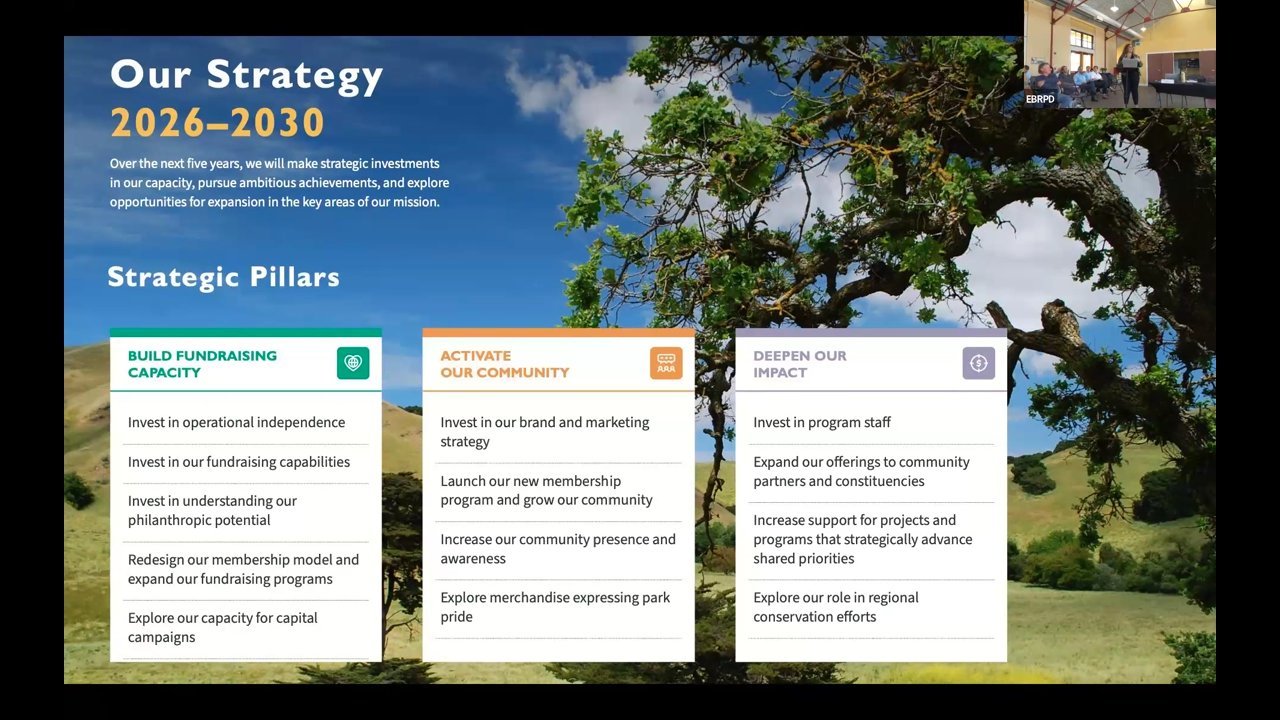
Where things stand: Holly Potter, President of the Regional Parks Foundation Board, Bruce Kern, Foundation Treasurer, and Lauren Bernstein, Foundation Executive Director, presented a two-year strategic plan built on three pillars: building fundraising capacity through dedicated staff and redesigned membership, activating the community beyond the current 12,500 members to reach 3 million East Bay residents, and deepening impact through investments in programs and capital projects.
Kern described financial modeling showing a path to $10 million in annual contributions by 2030, calling this the most consequential project in his 16 years with the district. The plan includes transitioning the membership program from a transactional model — where members essentially buy parking passes — to a philanthropic engagement model, with the district taking over the transactional elements.
"By 2030, we will have built an institution capable of ensuring that East Bay Regional parks thrive for all forever," said Lauren Bernstein, Foundation Executive Director.
General Manager Cortney described how the new partnership would differ from the past, when the foundation would ask staff after budget adoption if there were things to fund. "We ended up funding some cool things, but they weren't always the highest priorities that we hold," he said.
The other side: Board members raised questions about the foundation's role in elections and ballot measures, estate planning programs, and geographic equity in fundraising priorities. President Sanwong asked how the foundation would balance major capital projects against smaller community projects. Director Waespi delivered extended remarks honoring Bruce Kern's 16 years of volunteer service, calling the foundation work "probably the most significant project that I've been engaged with" during his eight years on the board.
What's next: A draft memorandum of understanding between the district and the foundation will return to the executive committee in September and the full board in October.
Wildcat Canyon Flow Trail Draws Sharp Opposition
Three public commenters spoke forcefully against a proposed mountain bike flow trail planned for Wildcat Canyon Regional Park, raising environmental, safety and legal concerns.
John Taylor presented detailed testimony arguing that bike use on riparian trails would loosen soil that washes into creeks, forming silt that covers the gravel beds necessary for rainbow trout reproduction. He accused the district of deliberately narrowing its environmental review. "The park district staff could have had the biological resource assessment look at the entire loop, which would include the creeks, but instead they focus just on the part that's going to be constructed," Taylor said. "If you look at the 32 pages of the biological resource assessment, you won't see the word trout."
Judith Offers, a 46-year Oakland resident and hiker, drew on personal experience seeing trail damage from bikes in Joaquin Miller Park and warned that riders from across the Bay Area would not stay on the designated trail.
Jane Kelly, a 25-year park district volunteer, raised liability concerns, documenting that flow trail injuries include broken bones of all types. "A flow trail is more like what the legal profession calls an attractive nuisance, a dangerous feature on public or private property that is particularly enticing to children," she said, urging the board to openly discuss safety risks and liability costs before approving the project.
The board took no action; the comments were received during the general public comment period.
Oakport Project Says District's Golden Gate Fields Request Blocks State Funding
Benito Delgado Olson, Executive Director of supplybank.org and the Oakport Project, told the board that the district's $125 million state funding request for Golden Gate Fields is making it nearly impossible for community-based shoreline restoration projects to compete for state dollars. The Oakport Project proposes restoring a one-mile stretch of the Martin Luther King Jr. Regional Shoreline between Geese Creek Slough and Damon Slough — described as the largest voluntary shoreline restoration in Oakland's history.
"We have been told directly by members of the Senate and the Assembly the $125 million that the district is asking for for Golden Gate Fields is making that really far on a parallel timeline," Delgado Olson said. He added that 700 partner organizations share similar concerns but are afraid to speak publicly because their funders are part of the Golden Gate Fields transaction.
L.K. Monroe, Oakport Project Committee Chair and former Alameda County Superintendent of Schools, urged the board to think expansively about which communities benefit from investments and to prioritize underserved communities. The board did not respond during the public comment period.
Hayward Marsh Restoration Delayed, but $5M EPA Grant Brightens Outlook
During consent calendar discussion, staff explained that construction bids for the Hayward Marsh Restoration Project came in higher than the engineer's estimate due to market conditions and the complexity of working in bay mud. A $5 million EPA grant was awarded around the same time bids opened, but tight shoreline work windows meant construction could not start this season, pushing it to next year when additional budget will be available.
Director Waespi expressed disappointment at the delay but noted strong support from the Hayward Area Shoreline Planning Agency, calling it the district's "crown jewel" project.
Minor Items
Consent calendar (items G1–G7, G9, G10) approved 5-0; item G8 removed without discussion. Directors Echols and Mercurio were absent for the vote.
3% salary increase for unrepresented public safety management approved 5-0, aligning pay with the recently adopted Police Association MOU, effective Aug. 22, 2026.
$1.7M transfer of existing general funds between 2017 and 2023 winter storm FEMA projects approved 5-0 to cover ineligible costs and required match — no new money requested.
Del Valle self-serve fee machines: Staff reported 10 new machines are being installed following a successful 2024 pilot program that reduced entry kiosk wait times during peak summer months.
General Manager Cortney highlighted MLK Shoreline Center renovation completion, community grants, a Save the Redwoods League partnership, and prescribed fire learning initiatives.
Pat McCully, a Fremont resident, asked the board to direct staff to maintain the landscape easement and sidewalk along Isherwood Way adjacent to Quarry Lakes, citing years of neglect.
Dick Quigley and David Lund urged trail development progress in Murray Township, noting the De Anza Trail has seen no progress in four years despite its inclusion in the master plan.
Evan Branning, Livermore City Council member, thanked the board for holding its first meeting in Livermore and encouraged continued support for Murray Township trails.
Peter Rosenberg, HARD Board member, congratulated the new general manager and praised the collaborative relationship between the two park agencies.