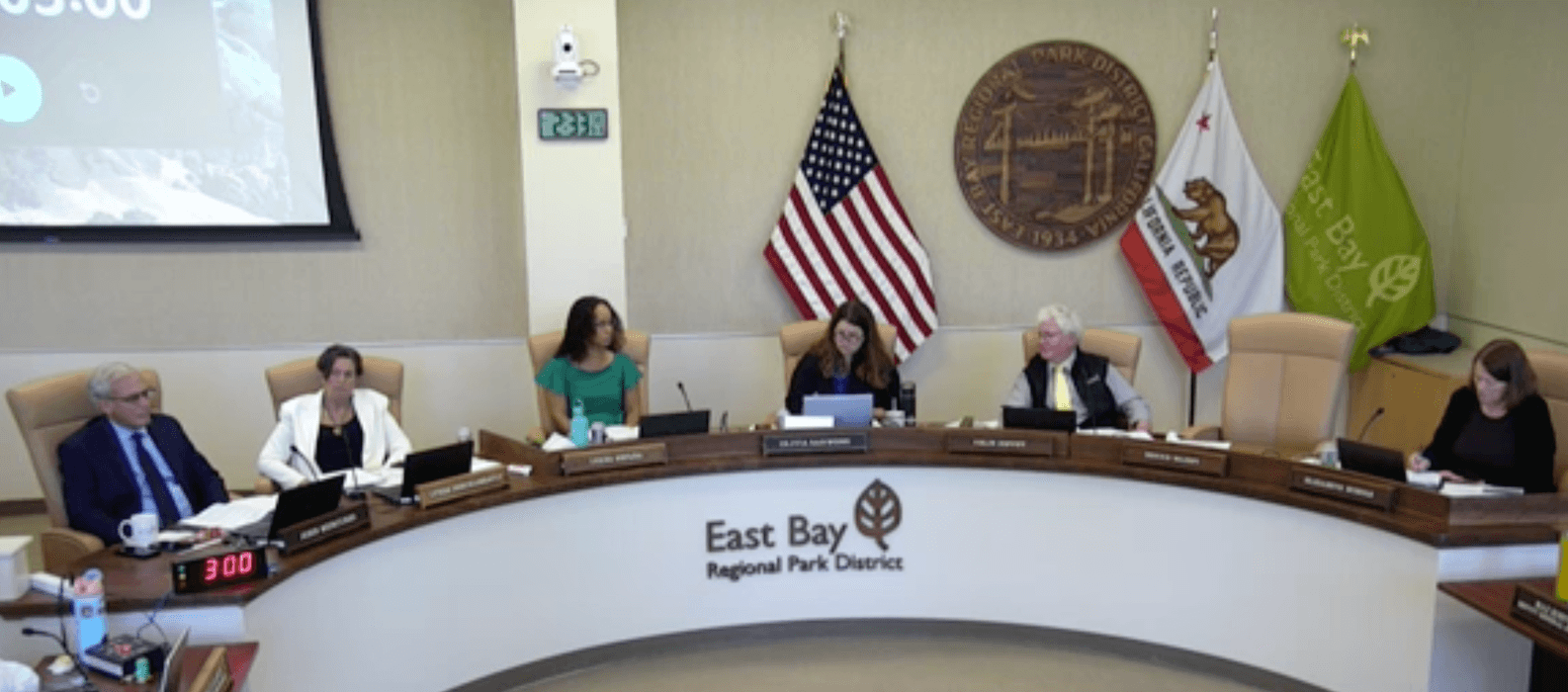
Board of Directors - Sep 15, 2026 - Meeting
Board of Directors • East Bay Regional Park DistrictSeptember 15, 2026
Locunity is a independent informational service and is not an official government page for this commission.We use AI-assisted analysis and human editorial review to publish information.
Board Pushes to Bring Back Swimming at Contra Loma as $53M Golden Gate Fields Grant Advances
The East Bay Regional Park District Board of Directors used its Sept. 15 meeting to send an unmistakable signal: the community planning process for the shuttered Contra Loma swim lagoon must center on rebuilding a place to swim, not explore open-ended alternatives. That directive, delivered by nearly every director at the table, came alongside a 10-item consent calendar that included a landmark $53 million grant agreement to acquire Golden Gate Fields and new volunteer principles adopted unanimously with union buy-in.
Board tells staff to stop being "agnostic" about a swim facility at Contra Loma, redirecting a planning process that directors said had drifted too far from what east county communities need
$53 million Wildlife Conservation Board grant for Golden Gate Fields acquisition clears consent calendar, with a purchase agreement expected at the Oct. 6 meeting
New volunteer principles adopted 6-0 after collaboration with AFSCME Local 2428, replacing a 1990 policy that called volunteers "unpaid staff"
Public commenters clash over proposed Wildcat Canyon Flow Trail, with opponents saying 85% of park users don't know about it and families describing how mountain biking transformed their children's lives
Tilden steam train operator warns the 75-year-old attraction may leave if an 8-year lease renewal impasse isn't resolved
Lifeguard training partnerships expand to four new school districts serving communities that lost access when the Contra Loma lagoon closed
Stop the Soul-Searching: Directors Want a Swim Facility at Contra Loma
The basics: The Contra Loma swim lagoon — a massive, over-acre facility built atop a Contra Costa Water District reservoir — closed in 2022 after structural failures. Hydrostatic pressure from the reservoir below destroyed joints and seams, and repair estimates reached $11–$14 million. The district hired consultant MIG and assembled a 14-member community advisory group to plan the site's future. But when staff presented the planning framework, directors pushed back hard on what they saw as a process agnostic about whether swimming would return at all.
Why it matters: Contra Loma served roughly 60,000 swimmers a year, predominantly from low-income, largely Hispanic east county communities facing increasingly extreme summer heat. With no comparable facility nearby, the closure removed a critical piece of public health infrastructure during the region's hottest seasons.
Where things stand: Director Colin Coffey, Vice Chair, delivered the most pointed critique, recounting a Labor Day phone call from the Mayor of Antioch.
"So this whole reimagining Contra Loma to include something possibly not a swim facility is dead on arrival," said Director Coffey. He added that the Antioch mayor "kind of chuckled and said, no, that's never going to happen. It's not going to be a splash pad."
Coffey also pressed staff on what he saw as an inconsistency in how the district approaches community outreach: "It's being presented and the community outreach is based on it being a bike trail. So why isn't this process presented and reviewed and studied and getting community input as a swim facility?" — referring to the Wildcat Canyon Flow Trail, which was framed around a specific project from the outset.
Director John Mercurio, Ward 6, reinforced the regional significance of the site, noting that "you could actually ride a bike from Clayton and Concord directly to Contra Loma without going on a street. The trail system connects." He added that "the American Discovery Trail, a coast to coast multi-use trail, passes right next to the lake, so it's on a national trail."
Board President Olivia Sanwong, Ward 5, connected the issue directly to climate: "I do believe that we have really hot temperatures sometimes during heat waves in the eastern parts of East Bay Regional Park District. And I always support swim facilities and heat relief in the areas that get hotter temperatures."
Director Elizabeth Echols, Ward 1, expressed support for a swim facility but urged the board to let the community process play out: "I certainly support having some type of swim facility out there," she said, while pointing to the North Basin community engagement process as a model that "brought in a whole lot of voices as well as long standing community activists to really talk about what they wanted and hear each other."
Director Lynda Deschambault, Ward 2, asked detailed questions about the lagoon's structural challenges and pressed staff on whether a project website was sufficiently visible.
The other side: General Manager Max Courtin acknowledged the feedback candidly: "If we're misaligned with the board on this process, that's my fault. To be honest, I wasn't aware of some of those conversations that you had with the previous GM." He agreed the process had started broader than necessary.
Brian Holt, the district's planning lead, explained that CEQA doctrine around pre-commitment — formally defining a project before environmental review — was the reason staff had kept the process open-ended. But directors' consensus was clear: centering a swim facility in outreach materials is different from pre-committing to a specific design.
Among public commenters, Scott Bartlebach of the Bicycle Trails Council of the East Bay, a former 30-year Antioch resident, validated the community value of swimming at Contra Loma but also advocated for mountain biking trails and disc golf, calling east county a "single track desert." Paula Sanghoi raised conservation and biodiversity concerns, asking how environmental protection would be ensured during the planning process.
What's next: Staff will update outreach materials, the project website, and the community survey before a public meeting on Sept. 22 to reflect the board's direction that a swim facility should be the organizing concept — not one option among many.
$53 Million Grant Puts Golden Gate Fields Acquisition Within Reach
The consent calendar included a grant agreement with the Wildlife Conservation Board and Trust for Public Land for up to $53 million toward acquiring Golden Gate Fields, the storied horse racing site in Albany.
Why it matters: The district earmarked $20 million from 2008's Measure WW for this acquisition. The grant would bring a decades-long community vision for wetlands restoration dramatically closer to reality.
Board President Sanwong shared that she had a positive conversation with Albany's mayor at the Alameda County Mayor's conference: "When we think about wetlands restoration at Golden Gate Fields, it will likely be very similar to the experience at Coyote Hills and Dawn Edwards. And that's really exciting."
General Manager Courtin noted the item was "for a grant to receive potentially up to $53 million from the Wildlife Conservation Board towards the acquisition of Golden Gate Fields."
What's next: The actual purchase agreement with the Trust for Public Land is expected to come before the board at its Oct. 6 meeting.
New Volunteer Principles Replace "Unpaid Staff" Policy After Union Collaboration
The basics: The board unanimously adopted nine volunteer principles developed through a cross-divisional working group and the Article 19 labor-management committee with AFSCME Local 2428, the union representing district workers. The new framework replaces a 1990 resolution that had referred to volunteers as "unpaid staff" and referenced departments and forms that no longer exist, as well as a 1976 predecessor.
Why it matters: The district has more than 2,000 active volunteers across specialized programs — trail safety patrols, docents, farm volunteers, botanic garden stewards, wildlife monitors, ambassadors, and archive specialists — who contributed over 40,000 hours across more than 550 events in the prior year. The new principles explicitly state that volunteers do not replace paid staff, a critical distinction for the union while enabling the district to sustainably grow volunteer capacity.
Where things stand: Staff members Sandy Funke and Jessica Sloan from Interpretive and Recreation Services presented the nine principles, covering role clarity, sustainability, training, risk management, community connections, stewardship, inclusivity, safety, and engagement. The principles were developed collaboratively with the union through the Article 19 committee.
Director Deschambault successfully moved to amend the stewardship principle, adding the word "educates" so it reads as "connecting volunteers to the parks in a way that adds — educates and inspires caring and responsibility for the land and the park district resources."
Director Coffey highlighted an existing but underused resource: "There is this thing called the Ivan Dixon Fund, which was donated in a will by a very avid hiker, one of our hikers from years ago. Hundreds of thousands of dollars in a fund dedicated to support volunteers working on trails." He also questioned whether the Ambassador program, currently housed in Public Affairs, should be moved under the volunteer program.
The other side: Multiple public commenters pushed for the principles to translate quickly into expanded opportunities. Jim Hansen of the California Native Plant Society Conservation Committee noted the urgency of having a workable policy before spring growing season so skilled retired professionals could help with invasive species removal. Scott Bartlebach of the Bicycle Trails Council of the East Bay asked for easier volunteer trail stewardship at more parks, pointing to vegetation management as a gap where trails are overgrown for weeks during peak season.
Whitney Grover, Director of Conservation for the Golden Gate Bird Alliance, requested that the new policy include a pathway for organizational partnerships to support bird habitat stewardship and invasive plant control. Cora Cooper, head coach of the Wildcat Composite Middle School Mountain Biking Team, noted 600 NICA riders and 30,000 Sierra Club members as untapped volunteer pools, adding that her team has required trail work days for a decade but found limited local opportunities — often volunteering at China Camp or Joaquin Miller instead.
Long-time volunteer Amelia Marshall, who has served for 27 years in trail safety and 14 years in archives, noted that volunteer programs are siloed across departments and cited an instance at Lake Temescal where ad hoc volunteers cleaning up fishing nets were reprimanded rather than thanked.
Decisions: The resolution passed 6-0 (For: Sanwong, Coffey, Echols, Deschambault, Espana, Mercurio; Absent: Waespi), with the amendment adding "educates" to the stewardship principle.
What's next: Staff will develop a detailed administrative policy based on the adopted principles, working with AFSCME through the Article 19 committee, with a target of late fall 2026.
Wildcat Flow Trail Debate Heats Up Ahead of EIR Release
Public commenters split sharply during the open comment period over the proposed Wildcat Canyon Flow Trail, a planned mountain biking trail whose environmental impact report is nearing release.
Janet Flint of Friends of Wildcat Canyon Park cited conversations with more than 600 park users showing that 85% were unaware of the project. She called for direct mailings to 150,000 surrounding households and urged the district not to release the EIR response period over the holidays.
Three supporters countered with intensely personal testimony. Hannah Odiniec, a parent and teacher, described how mountain biking transformed her four children's confidence and character, arguing the trail would provide safe, dedicated riding and reduce conflicts on shared paths. Rachel Gorham, a child psychologist, described her son's recovery from back surgery through mountain biking and offered an analogy: "When you make an accommodation for one child, it often ends up benefiting everyone."
The exchange previews what could be a contentious public process once the EIR is formally released.
Tilden Steam Train's Future in Doubt After 8-Year Lease Stalemate
Ellen Thompson, owner of the Redwood Valley Railway Company, told the board that the beloved 75-year-old steam train at Tilden Regional Park could be forced to leave if a lease renewal that has been stalled for eight years is not resolved.
Thompson said the operation receives no district funding and privately maintains drainage, landscaping, fire abatement, and rare species protection. She cited 15 staff turnovers during the renewal process, accused staff of attempting to reverse previously settled decisions, and alleged that staff were ratifying agreement text they would not show her. She thanked General Manager Courtin and the legal team for recent efforts but warned that without legal protections, the railway would have to remove everything and leave.
No board action was taken, but the comments underscore the risk of losing a privately funded community amenity to bureaucratic friction.
Minor Items
Lifeguard program expansion: Board approved five-year MOUs with Forestry and Fire (renewal) plus four new partners — Brentwood Union, Sunol, Knightsen, and Eden ROP school districts — to train student lifeguard instructors. Director Coffey praised the expansion as serving communities impacted by the Contra Loma closure.
CCTA trail funding: Staff applied for up to $12 million from the Contra Costa Transportation Authority's Coordinated Call for Projects for the Martinez Bay Trail Gap and Point Wilson to Point Pinole Trail Gap.
Oyster Bay Bike Skills Area: Scott Bartlebach of the Bicycle Trails Council spoke in support of a grant application for the project, calling it a valued opportunity active for more than 13 years.
New hire: GM Courtin welcomed Kirsten Holder as the district's new assistant general manager for acquisition, stewardship, and planning, noting she comes from 15 years with the National Park Service.
Public safety assists: The district's helicopter team rescued an injured hiker on Mount Diablo, and its armored vehicle aided Richmond police, highlighting the district's regional mutual-aid role.
Louis Andrade of the Hayward Area Recreation and Park District suggested adding lookout points, pullouts, interpretive signage, and driftwood benches along the new Shoreline Trail.
Mission Peak trailhead hours: A public commenter named Misha, representing a group of evening hikers, requested that the Ohlone College trailhead exit hours be extended from 10 p.m. to midnight after an encounter with park police.
AFSCME representative Matt McDonnell spoke during end-of-meeting public comment; details of his remarks were limited in the record.
The consent calendar passed 6-0 (Sanwong, Coffey, Echols, Deschambault, Espana, Mercurio; Waespi absent). The volunteer principles resolution passed 6-0 with the same lineup. The Golden Gate Fields purchase agreement is expected at the Oct. 6 board meeting, and the Contra Loma community meeting is scheduled for Sept. 22.