
Board of Directors - Sep 01, 2026 - Meeting

Board of Directors - Sep 01, 2026 - Meeting

Board of DirectorsEast Bay Regional Park DistrictSeptember 1, 2026

Sources:

Locunity is a independent informational service and is not an official government page for this commission.We use AI-assisted analysis and human editorial review to publish information.

Board Debates Strategic Plan Pivot as Lake Temescal Gets $670K Fix

The East Bay Regional Park District Board of Directors wrestled with the future shape of its long-range planning — and whether to abandon a 90-year tradition — while also advancing a scientific solution to decades of algae closures at one of Oakland's most popular swimming spots. The Sept. 1 meeting also featured an emotional helicopter rescue recognition and a first look at a project that could transform the East Bay's most-used trail.

  • Board approves $670,000 engineering contract to tackle Lake Temescal's 60-year water quality crisis through dredging and sediment analysis
  • GM proposes replacing master plan rewrite with a streamlined 10-year strategic plan; multiple directors push back
  • Contra Costa County supervisor presents $2M pilot to separate bikes and pedestrians on the Iron Horse Trail
  • Parents and coaches rally for Wildcat Flow Trail; lone opponent says relocate it to protect natural grasslands
  • Officers honored for helicopter rescue of 7-year-old suffering heat stroke on Mission Peak

Master Plan or Strategic Plan? Board and GM at Odds Over District's Future Roadmap

The longest and most contentious discussion of the evening centered on how the East Bay Regional Park District should plan its next decade — and whether a leaner document can replace the comprehensive master plan framework that has guided the district since the 1930s.

The basics: The district launched a major planning effort in 2023, originally conceived as an update to its 2013 master plan. Roughly $750,000 of an approved $1.3 million has already been spent, including extensive community engagement: 31 stakeholder meetings, 25 public events, and contracts with 14 community-based organizations.

Why it matters: The outcome will determine how the district prioritizes land acquisitions, capital projects, and trail expansions — and could serve as the foundation for a potential 2028 parcel tax ballot measure. A streamlined plan might move faster; a full master plan rewrite might carry more institutional weight with voters and staff.

Where things stand: General Manager Max Courten recommended redefining the effort as a strategic plan with a small number of clear goals and implementation strategies, rather than a traditional comprehensive rewrite. "The recommendation today is to redefine this effort as a strategic plan. That's something that people generally know what a strategic plan is. Usually they're less than 10 years, sometimes more like five years," he said. Courten cited similar agencies — Midpeninsula Regional Open Space District and Santa Clara Valley Open Space Authority — that use strategic plans, and said community feedback showed residents love the district's existing work but want a specific roadmap.

Planning Division Lead Brian Holt reported that engagement efforts have been extensive, with survey results completed and a framework ready for board input.

The other side: Several directors expressed real discomfort. Board Member Lynda Deschambault was the most pointed, invoking the district's institutional identity: "We have a 90-year history of district plans that have guided us so clearly. And I think you heard earlier we were worried. Are you trying to rewrite the mission? Are land use plans going away?" She requested an outline and Gantt chart before proceeding.

Board Member Elizabeth Echols raised a practical concern about timing: "I'm a little worried. I mean, this is a good timeline. It's fairly quick as things go, but it may not be quick enough for a 2028 bond measure."

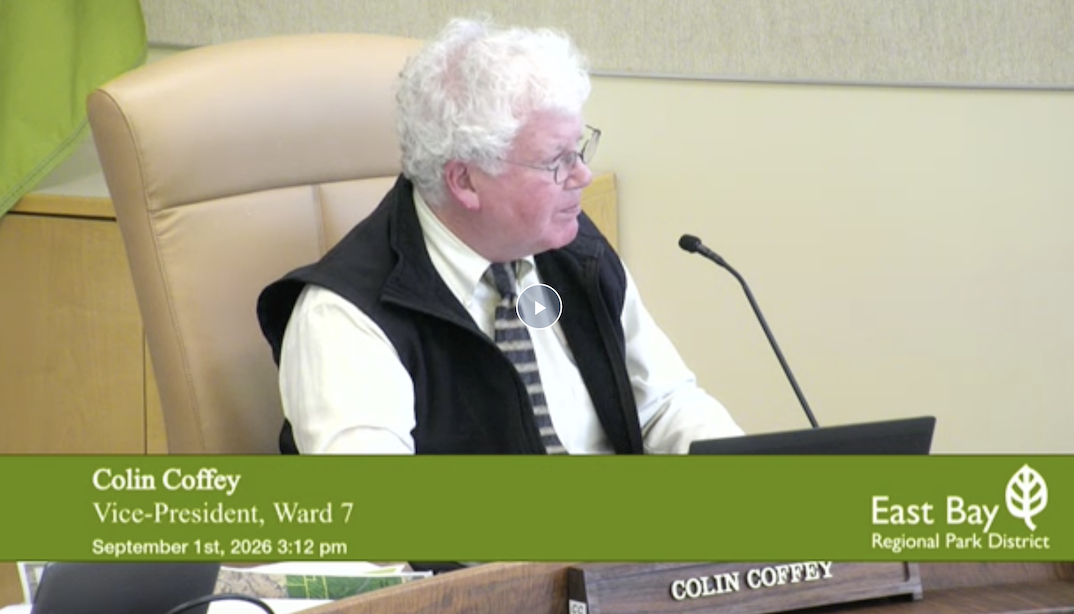
Vice President Colin Coffey pressed on how specific park visions would fit into the new framework. "I have a vision for a future park called Rancho Pinole. It is in the 2013 plan, but needs updating. So what is my vehicle for that?" he asked, also listing Rodeo Shoreline, Dutch Slough, and John Marsh State Historic Park as projects needing a planning home.

Board Member John Mercurio offered a constructive middle path, asking staff to produce a mock-up: "Maybe you can bite off a little piece of the proposed strategic plan and show us the structure of it and what's covered in it, as if it was an outline, and you would choose one section and then just lay it all out how it relates to the master plan."

President Olivia Sanwong questioned the budget and flagged a separate governance concern — a De Anza Trail map had been updated on the district's website without board notification. "I wasn't made aware that we were updating the De Anza Expedition of 1776 brochure, nor was I aware that our vision had changed to be a different route," she said. Courten agreed to remove the updated map.

Decisions: No formal action was taken. Courten committed to sharing strategic plan examples from peer agencies and working with the board chair to schedule workshops.

What's next: Workshops will need to reconcile the board's split reaction — general support for clearer goal-setting, but deep institutional attachment to the master plan framework — before any adoption vote can proceed.


Lake Temescal's 60-Year Algae Battle Gets a $670K Engineering Push

The board unanimously authorized a contract that could finally address chronic harmful algae blooms at one of the East Bay's most visited urban swimming spots.

The basics: Lake Temescal, California's oldest engineered man-made reservoir at 160 years old, has suffered persistent water quality problems since the 1960s. The lake sits downstream from Oakland neighborhoods and an adjacent freeway, collecting sediment and urban pollutants. A three-firm Stage 1 feasibility study identified the core problem: roughly 90% of nutrient loading comes not from upstream runoff but from chemical reactions in the lake's own bottom sediment.

Why it matters: The reservoir generates about $47,000 annually from swimming, fishing, and parking but has faced chronic closures from harmful algae blooms. An oxygen saturation technology installed in 2025 has prevented beach closures since deployment, but staff described it as a management tool, not a permanent fix.

Where things stand: Civil Engineer Mack Olson delivered the key scientific finding: dredging the lake to 30–35 feet could create a permanent thermal barrier. "The 30 to 35 feet creates a thermocline in the lake, so that means there's pretty much this layer that stays cold in the bottom. And that layer prevents the sediment in the bottom of the lake from undergoing this redox reduction oxidation reaction that releases nutrients into the lake water," he explained. The Stage 1 analysis also concluded there is no single silver bullet, that current sediment basins are not providing adequate removal, and that active management currently offers the best cost-benefit ratio.

General Manager Max Courten emphasized a dual approach: "We both wanted deep in the lake so that we can take advantage of that process. And then we want to invest in mechanisms that help so that it doesn't just fill back in again."

Board Member Deschambault asked about accelerating sediment basin cleaning but learned that hardened material and narrow regulatory permit windows — Aug. 1 through Oct. 31 — limit capacity. President Sanwong discussed upstream pollution sources and suggested partnering with Alameda County's Clean Water Program for upstream education. She also raised the possibility of a sediment bypass around the dam.

Decisions: The board voted 6-0 (For: President Sanwong, Board Members Echols, Espana, Coffey, Mercurio, Deschambault; Absent: Board Member Waespi) to authorize a $670,000 Stage 2 contract with Moffett & Nickel for targeted data collection, sediment toxicity sampling, technical analysis, and preliminary design. Staff committed to presenting preliminary design findings to the board's executive committee before proceeding further.

What's next: Moffett & Nickel will conduct sediment toxicity sampling and develop preliminary dredging designs. Staff will return to the executive committee with findings before advancing to final design.


Contra Costa Pitches $2M Pilot to Turn Iron Horse Trail Into a Bicycle Expressway

Contra Costa County Supervisor Candace Anderson presented an ambitious vision to separate cyclists from pedestrians on the region's most popular multi-use trail — a project she hopes to build next year.

Why it matters: The 33-mile Iron Horse Trail, built on a former railroad corridor closed in 1978, has become increasingly congested as e-bike speeds rise and ridership grows. Nine schools sit along the corridor, and thousands of new housing units are under construction at Bishop Ranch in San Ramon.

Where things stand: The 1.3-mile Phase 1 pilot between Bollinger Canyon and Crow Canyon Road would create parallel paths for bikes and pedestrians, estimated at roughly $2 million. Anderson traced the project's legislative lineage through a bill by Assemblymember Tim Grayson that freed the corridor from a transit-only mandate, clearing the way for trail improvements.

Funding sources include a $1.5 million direct spending request from Congressman Mark DeSaulnier, CCTA-administered OBAG grants, and potential state recreational trails funding. The pilot was designed to avoid C3 stormwater permit requirements and utility relocations, keeping costs down. "My goal really is to get the first pilot phase built. Really my goal is next year. Whether or not we can pull that off or not, I'm not sure. But I think it's important for the public to see what we can do," Anderson said.

Board Member Mercurio discussed the trail's history and recent multi-agency police enforcement efforts. Board Member Deschambault praised the bike-pedestrian separation concept and the PCA funding classification. President Sanwong highlighted multi-jurisdictional complexities on the Dublin and Alameda County side: "I think we're in a really unique position where we can bring both sides, both county, Alameda and Contra Costa County sides of the trail together, since we work with City of Dublin on the Dublin side and then City of Pleasanton manages the Pleasanton side."

Anderson framed the project as both a greenhouse gas reduction tool and a potential signature item for a CCTA sales tax renewal or an EBRPD parcel tax measure.

What's next: No formal action was required. Anderson indicated she is pursuing funding to begin construction next year.


Parents Rally for Wildcat Flow Trail; Opponent Says Preserve the Grasslands

Four speakers during public comment turned the proposed Wildcat Flow Trail into the evening's most emotional community debate, highlighting a growing tension in East Bay parks between expanding mountain biking access and protecting natural landscapes.

Why it matters: The proposed trail in Wildcat Canyon Regional Park has become a flashpoint for competing visions of how regional parkland should be used — as active recreation space for youth or as preserved ecological habitat.

Three speakers — all parents of youth mountain bikers — urged the board to build the trail. Jenny McGregor, an Albany mountain bike coach, argued flow trails provide a sanctioned alternative to unsanctioned trail building and reduce conflict between mountain bikers, hikers, and equestrians. Cecile Bastide, a Berkeley parent and Wildcat Composite team coach, described how mountain biking transformed her three sons' engagement with nature and exercise, noting the team runs out of trail options for weekly rides. Karen Leung, an El Cerrito parent, said the sport got her children off screens and built new friendships, emphasizing limited local options and safety benefits of biker-specific trails.

The other side: Sally Tobin of Richmond argued that the natural grasslands of Wildcat Canyon serve ecological purposes through cattle grazing that mirrors historic tule elk activity and reduces fire danger. She called for the flow trail to be relocated rather than built in the canyon.

Decisions: The board took no action; this was general public comment.


Officers Honored for Airlifting Unconscious Child From Mission Peak

The board opened with an emotional presentation honoring the helicopter crew and paramedic who rescued 7-year-old Samaira Shetty, who collapsed from heat stroke near Mission Peak's summit on Aug. 9.

Captain Terrence Kocher of the EBRPD Police Department recounted how Officer Pilot Kiefer and Tactical Flight Officer Saunders aboard Eagle 8 developed an expedited rescue plan with Fremont Fire, airlifting paramedic Ryan Eisfeld to the summit and extracting the child to a waiting ambulance. The child's temperature was still 105 degrees at the hospital. A pediatric physician later said the additional time required for a ground rescue could have resulted in death or lifelong impacts.

The Shetty family attended the meeting to express gratitude. Samaira's father described the terror of the moment and credited the crew's speed. The board surprised Samaira with a birthday gift. AGM Roberto Felice thanked the board for supporting the air support unit, calling the outcome proof of the program's value.


Minor Items

  • Consent calendar approved 6-0 (Items 1–4, 6–8). Item 5, a Wildlife Conservation Board grant, was pulled and deferred to the next meeting due to a state budget dollar-amount change requiring revision.
  • Board Member Deschambault highlighted the Save the Redwoods League agreement (consent Item 3), which will guide redwood forest management combining fuels reduction and native habitat restoration. She emphasized that public messaging should lead with restoration: "Our number one is to restore and enhance them and help them grow."
  • Friends of the Regional Parks Botanic Garden celebrated their 30th anniversary. David Scheretz, the organization's chair, reported growth to more than 500 members and achievement of a $30,000 fundraising goal for the Westgate Rock Garden project.
  • New Deputy General Manager introduced: GM Courten welcomed Deputy GM Amy, who brings 22 years of experience including 19 years as a recreation and parks director and most recently as assistant city manager in Alameda.
  • Tilden vegetation management near Jewel Lake is revealing native coast live oak, bay laurel, and toyon trees previously suppressed under eucalyptus canopy, combining wildfire fuels reduction with habitat restoration.
  • Summer day camps served 368 campers with 28 scholarships. A major 72-inch culvert installation was completed in Leona Canyon.
  • Director Coffey requested a Sept. 15 action item on the Contra Loma Lagoon replacement, warning that consultants plan to approach community outreach in Antioch without a directive to replace the swimming facility: "I think we need to give direction to our consultants who are about to start an outreach program in Antioch, that we are intending to replace that swim facility with another swim facility, and their plan is to be agnostic on that."