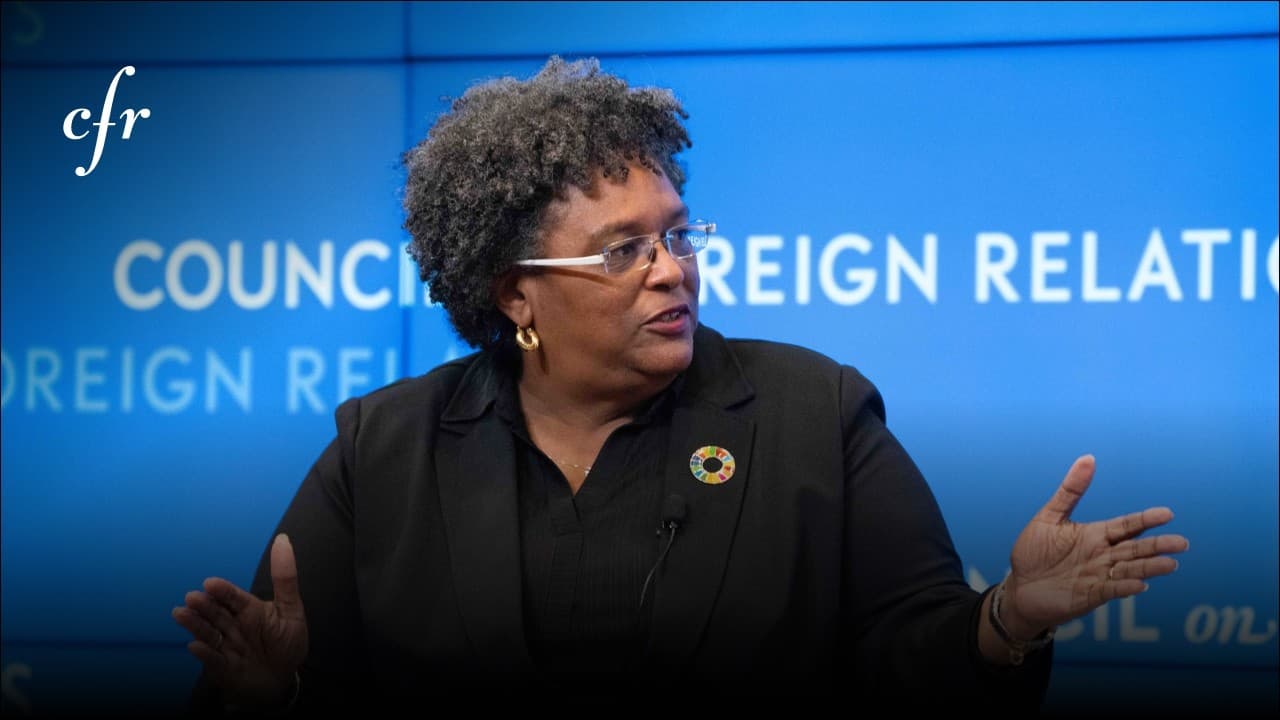
Mottley Presses for Climate Finance Overhaul, Reparatory Justice at CFR
Council on Foreign Relations • United NationsSeptember 23, 2026
Locunity is an independent informational service and is not an official government page for this commission. All information is sourced from public footage and an analysis of official agendas with the aid of responsible, fact-checked AI. to report an error or omission.
Barbados Prime Minister Mia Mottley delivered a sweeping case for restructuring how the world finances climate adaptation, trades with small states, and reckons with the legacy of slavery — in a wide-ranging Council on Foreign Relations session moderated by former U.S. Ambassador to the United Nations Linda Thomas-Greenfield. From a landmark compact with 16 financial institutions to a new global commission on reparations, Mottley laid out a policy agenda that positions small island developing states at the center of multilateral reform.
- Barbados-led V2V Compact commits 16 financial institutions to 30–50 year concessional loans and debt swaps for climate-vulnerable nations
- Mottley announces three debt swap innovations — for nature, climate and social needs — repurchasing over $1.1 billion in Barbados debt
- Social partnership model caps private-sector markups on 47 basic commodities at 15% amid global supply chain disruptions
- Global commission on reparations launches under Ghana's President Mahama, expanding scope to include indentured laborers from India and China
- Mottley backs "Carolyn from Guyana" for UN Secretary-General, calls for charter reform on climate, inequality and AI
- PM declines immediate Secretary-General bid, citing domestic mandate after third consecutive sweep of all parliamentary seats
Climate Finance and the V2V Compact
Why it matters: Climate-vulnerable countries face a $490 billion annual financing gap and pay, on average, 1.2 percentage points more in interest than non-vulnerable nations — a structural disadvantage that compounds with every hurricane season and rising sea level.
Where things stand: Prime Minister Mia Mottley detailed the Vulnerability-to-Viability (V2V) Compact signed in Vienna in June with 16 financial institutions, including the World Bank, the Inter-American Development Bank, the Caribbean Development Bank, CAF, the African Development Bank, and the Asian Development Bank.
"The ability for us to have signed a compact in Vienna in June with 16 financial institutions … was a major, major step," said Prime Minister Mottley.
The compact rests on four pillars: expanding concessional finance with 30–50 year terms, mobilizing private capital, ensuring country ownership of development plans, and deploying innovative instruments such as natural disaster clauses and debt swaps.
Barbados itself has pioneered three types of swaps. A debt-for-nature swap with IDB and the Nature Conservancy. A debt-for-climate swap involving IDB, the Green Climate Fund, and the European Investment Bank — repurchasing $500 million in debt to unlock $125 million for a sewage treatment plant. And a forthcoming debt-for-social swap combining the World Bank, IDB, CDB, and CAF to repurchase $600 million in debt for healthcare financing.
Domestically, Barbados created a resilience and regeneration fund requiring contributions from all employees, employers, and self-employed persons, with government contributing 0.35% of GDP annually. "Every employee in Barbados is now required to put quarter of one percent of their salary in that fund, and every employer must match it," Prime Minister Mottley said.
She cited a World Bank finding to underscore the economics: "For every dollar we spend in building resilience, we avoid $6 to $7 in damage, and God knows that money can't replace life."
Former U.S. Ambassador Linda Thomas-Greenfield pressed on why progress remains so elusive despite the clarity of the vision. "You are very clear about what the vision is, and my question is — why is it so hard?" Ambassador Thomas-Greenfield asked.
Prime Minister Mottley pointed to institutional resistance: "When they leave that conversation, I don't know whether to blame the bureaucrats or whether to blame the same people who allow gatekeepers to block them from making meaningful change."
Global Economic Shocks and Barbados's Social Partnership Model
The basics: Small island states with no overland trade routes are acutely exposed to disruptions in global shipping lanes — and multiple choke points are under pressure simultaneously.
Why it matters: Mottley described a "trifecta" of disruptions: the Straits of Hormuz, the Red Sea (from Houthi actions), and Panama Canal vessel restrictions. For import-dependent Caribbean economies, these translate directly into higher food, fuel, and consumer costs.
Where things stand: In July 2022, after the Ukraine war disrupted supply chains, Barbados convened its social partnership — government, trade unions, and the private sector — to address the affordability crisis. The partners identified 47 basic commodities: government removed all duties, and the private sector agreed to limit markups.
"Government took off all the duties. Private sector agreed to cap their markups at 15% instead of the 25-30% that a number of them were using," Prime Minister Mottley said.
About 50% of those products remain cheaper than pre-compact prices. Barbados also absorbed 50% of electricity rate increases, implemented fuel oil hedging, provided cost-of-living allowances for pensioners and welfare recipients, reduced VAT on electricity bills, and shifted its customs valuation basis from CIF to FOB capped at December 2019 container prices.
Despite being in an IMF Extended Fund program, Barbados has reduced its debt from 178% of GDP to 93%, though Mottley warned that rising global interest rates create fresh uncertainty.
Africa-Caribbean Alliance and the Fight Against Antimicrobial Resistance
Why it matters: The COVID-19 pandemic exposed how middle-income countries were shut out of equitable access to vaccines and medical supplies — prompting a geopolitical realignment that is reshaping South-South cooperation.
Where things stand: When the United States imposed export restrictions on medical equipment during COVID and PAHO/WHO excluded middle-income countries from equitable access programs, Barbados turned east and south. India's Prime Minister Modi sent 100,000 vaccines to Barbados, half of which Mottley shared with Caribbean neighbors. Through Dr. Tedros Adhanom Ghebreyesus and Strive Masiyiwa, Caribbean countries joined the Africa Medical Supplies Platform, enabling even St. Kitts and Nevis — population 38,000 — to procure supplies at the same prices as Nigeria.
Afreximbank subsequently opened its first regional office outside Africa in Barbados, with CARICOM countries joining a $4 billion investment portfolio.
On health policy, Mottley chaired the WHO One Health Global Initiative on antimicrobial resistance for five years. She described AMR as a "silent slow-motion pandemic" that could reverse a century of medical progress and become the world's largest killer by 2050. She convened WHO, FAO, UNEP, and OIE in a quadripartite agreement, and the resulting Accra Reset on Health addressed the exploding cost of healthcare that puts precision medicine out of reach for Global South citizens.
Reparations for Transatlantic Slavery
The basics: In March, Ghana — backed by CARICOM nations — pushed a symbolic resolution through the UN General Assembly that overwhelmingly denounced the transatlantic slave trade as the gravest crime against humanity. The United States and two other countries voted against it.
Why it matters: A new global commission on reparations, chaired by Ghana's President Mahama with a CARICOM deputy chair, signals that reparatory justice is moving from symbolic declarations to institutional momentum — with the scope expanding to include indentured laborers from India and China.
Where things stand: Ishaan Tharoor, Edward Morrow Fellow, Council on Foreign Relations, and columnist, The New Yorker, asked Mottley about the U.S. vote and the prospects for reparations. "Ghana, backed by the nations of CARICOM, pushed — had a symbolic resolution at the GA pass overwhelmingly that denounced the transatlantic slave trade as the gravest crime against humanity. The US and 2 other countries voted against it," Tharoor noted.
Prime Minister Mottley drew parallels to the U.S. position at the 2001 Durban conference and rejected the framework of pure legal liability. "This notion that countries determine the justice and the morality of an issue purely on the basis of legal liability is what is killing us," she said.
Mottley noted that Germany compensated the Jewish community with $95 billion over 50 years, while the transatlantic slave trade — the first institution to describe Black people as chattel property — has never received an apology. Barbados passed the first slave code in 1661, and Mottley emphasized the reparations movement does not seek to bankrupt any country but envisions an intergenerational solution.
She also detailed Barbados's own self-repair: land reform legislation in 1980 allowed tenants to buy land at 5 cents U.S. per square foot, enabling homeownership and economic agency — connecting historical inequity to present-day systemic disadvantages in credit ratings and international financial access.
UN Reform and the Secretary-General Question
Why it matters: With 65 active global conflicts and emerging AI governance needs, the next Secretary-General selection and institutional reform could reshape multilateral cooperation for decades.
Where things stand: Mottley declared Barbados's position plainly: "We're supporting Carolyn from Guyana, so that's clear."
She affirmed the UN as essential for small states, arguing that growing predatory behavior globally proves exactly why the institution is needed. "At the very time people call into question the necessity for the UN, we are seeing exactly why the UN is needed, because countries have been the victim of that kind of predatory behavior that really denies their inherent sovereignty," Prime Minister Mottley said.
But she identified critical gaps in the UN Charter, which does not address the climate crisis, global inequality, or artificial intelligence. She noted that AI companies were addressing the Security Council that same afternoon — companies that reject national regulation but seek international legitimacy. She called for reform to reduce duplication and bureaucracy and argued that countries unwilling to maintain financial contributions should not wield the same power and influence.
Mottley proposed reframing the World Bank's mission from post-World War II reconstruction to protecting the "global commons" across five areas: climate, pollution, and biodiversity; food and water security; conflict victim protection; pandemic preparedness; and the digital divide and AI governance. She argued multinational corporations with balance sheets larger than many states should contribute to the global commons and that philanthropies should leave "5 cents on every dollar on the table" for global needs.
Mottley's Legacy and Domestic Focus
Former Legal Advisor Mark Simonoff of the U.S. Mission to the United Nations asked directly why Mottley chose not to run for Secretary-General. Tidjane Thiam, Leader of the Opposition, Ivory Coast, asked about her legacy.
"I have a country to run and a region to take care of, and I mean that with all sincerity," Prime Minister Mottley responded. She noted that Barbados's share of global goods trade is 0.000% and services trade 0.001%, meaning it has no capacity to distort markets — yet it faces one-size-fits-all WTO prescriptions that harm small developing states. She described the challenge as being denied the right to swim any proper stroke and forced to "dog paddle."
Mottley warned against the concentration of power and the silencing of advocates for ordinary people. On the Secretary-General question, she said she "never say never" but does not see it as immediate, having just won all parliamentary seats for the third consecutive election in February 2026 and facing unprecedented regional complexity.
Minor Items
- Former U.S. Ambassador Linda Thomas-Greenfield introduced Prime Minister Mottley by highlighting her multiple firsts: first female Attorney General, first female leader of the Barbados Labour Party, and first female Prime Minister of Barbados.
- Mottley referenced a Bangkok white paper and COP28 commitments in the context of climate finance timelines and the $490 billion annual financing gap through 2035.
- Hurricane Beryl and damage to Grenada were cited as recent examples of the devastating costs facing climate-vulnerable Caribbean states.