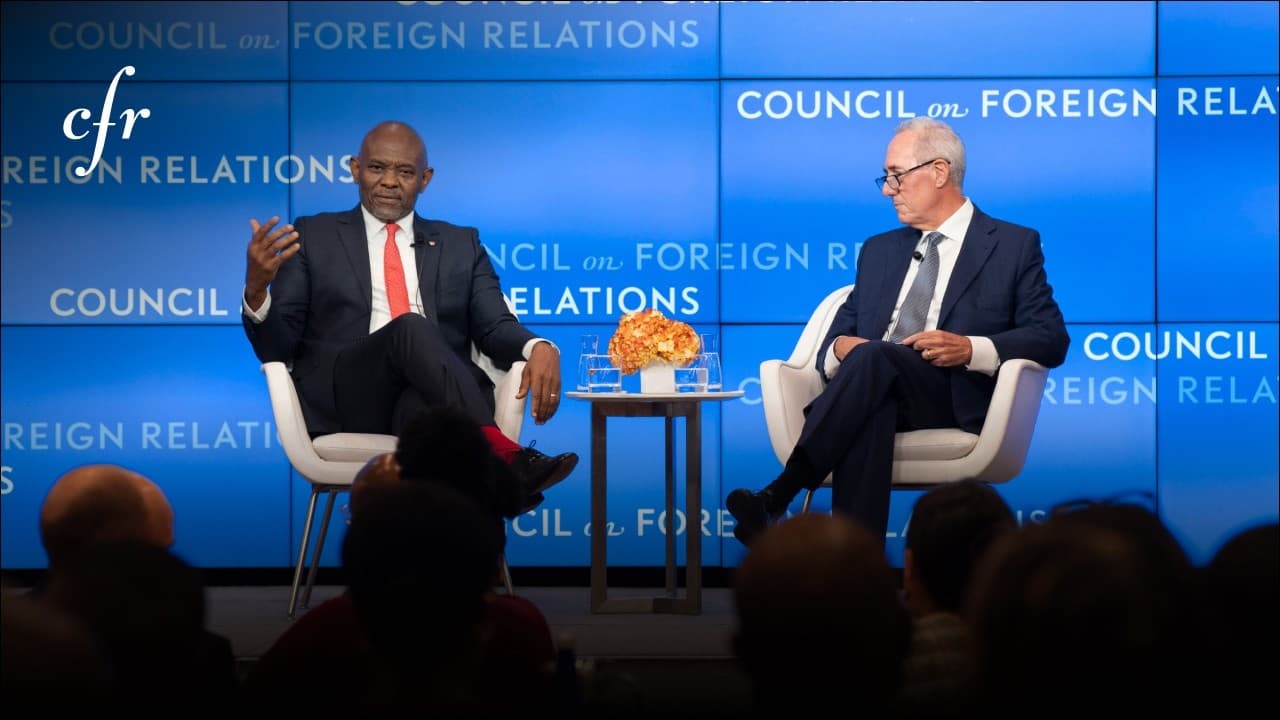
Council on Foreign Relations - Sep 22, 2026 - Meeting
Council on Foreign Relations • United NationsSeptember 22, 2026
Locunity is an independent informational service and is not an official government page for this commission. All information is sourced from public footage and an analysis of official agendas with the aid of responsible, fact-checked AI. to report an error or omission.
Elumelu Makes the Case for an Energy-Led Marshall Plan for Africa
At the Council on Foreign Relations' Darryl G. Berman Lecture on Africa Policy, Nigerian billionaire Tony Elumelu delivered a sweeping argument that Africa's transformation depends on one thing above all else: electricity. In a wide-ranging conversation with CFR President Michael Froman during United Nations General Assembly week, Elumelu pressed global policymakers and investors to rethink how they engage with a continent he says has "come of age" — and is done waiting for aid.
- Elumelu calls electricity Africa's single biggest barrier to industrialization, AI adoption, and security — and demands a Marshall Plan for energy
- Trade not aid gets a real-world test as Trump-era foreign assistance cuts force African leaders toward self-reliance
- Africa will choose partners based on economics, not geopolitics, Elumelu says, pushing back on the China-vs.-West framing
- Development finance institutions face sharp criticism for prioritizing AAA ratings over deploying trillions for African infrastructure
- Nigerian fintech unicorns and Dangote's refinery cited as proof that Africa's private sector is outpacing the development establishment
Electricity: The One Thing That Changes Everything
Tony Elumelu, Chairman of Heirs Holdings and Founder of the Tony Elumelu Foundation, returned to a single theme throughout the hour-long conversation with a persistence that bordered on a campaign speech: without reliable electricity, nothing else works.
Why it matters: Nigeria alone needs roughly 100,000 megawatts of power but consumes only about 4,700. That deficit constrains hospitals, factories, data centers, and schools — and makes it impossible for the continent to participate in the AI revolution or attract the kind of investment that could lift hundreds of millions out of poverty.
Where things stand: Elumelu's own conglomerate is part of the answer and part of the illustration. Transcorp, one of his companies, holds 2,000 megawatts of generating capacity — making it Nigeria's largest private power producer. He noted that Strive Masiyiwa, working with NVIDIA, had approached him about supplying power for data centers, underscoring that the AI opportunity is real but physically impossible without energy infrastructure.
"One single factor we need to fix to set Africa free is electricity," said Elumelu.
He called for a renewal of President Obama's Power Africa initiative and referenced his own prior testimony before the U.S. Senate on the Electrify Africa Act. But his ask was bigger: a Marshall Plan for African industrialization, with energy at the center, combining hydro, renewable, and thermal sources.
"It is one of the ones I talked about, a Marshall Plan for African industrialization, and I said key part of it is energy," Elumelu said.
What's next: Elumelu used the CFR platform — packed during UNGA week with diplomats, investors, and development officials — as a megaphone. Whether his call gains traction will depend on whether policymakers and multilateral institutions shift capital toward energy infrastructure at the scale he envisions.
Trade Not Aid: How Africa Is Adapting to the Trump Era
Froman opened the conversation by noting that Elumelu has long championed the idea of trade over aid — and asked, pointedly, whether the Trump administration's deep cuts to foreign assistance were what he wanted.
Why it matters: The reduction in U.S. foreign aid — including USAID programs — has forced African governments and business leaders to confront a question they've debated for decades: can the private sector fill the gap left by departing development dollars?
Where things stand: Elumelu acknowledged the disruption but reframed it as validation. "It's not what we bargained for per se, but it's the reality of the times and we need to adjust to it," he said.
His foundation has put the philosophy into practice. The Tony Elumelu Foundation has supported more than 26,000 young entrepreneurs across all 54 African countries, giving each $5,000 in non-refundable seed capital along with 12 weeks of training and mentorship.
"Instead of the traditional grant aid, we give them non-refundable seed capital, $5,000 each, and we train them for 12 weeks," Elumelu explained.
He argued that African leaders and private sector actors are already adjusting — building trade relationships globally, not just with the United States. The Dangote Refinery, he noted, now supplies over 35% of jet fuel consumed in Europe. OPay, a Nigerian fintech company, is potentially pursuing a $4–5 billion IPO. These are not aid-dependent enterprises.
Decisions: No formal policy action was taken — this was a lecture — but Elumelu endorsed renewal of the African Growth and Opportunity Act (AGOA) by year's end, while cautioning that trade access means nothing without production capacity, which circles back to electricity and transportation infrastructure. Froman noted that African exports to the U.S. under AGOA remain modest at roughly $4.5–5 billion, mostly from South Africa.
Africapitalism: Profit Meets Purpose
Elumelu outlined a framework he's been building for years — Africapitalism — arguing it predates and transcends the Western ESG movement.
The basics: Africapitalism is defined as the intersection of doing well (profit) and doing good (social impact). It holds that private sector investments should generate returns while also powering hospitals, schools, and communities.
"I champion the philosophy of Africapitalism, which is the intersection of doing well and doing good," Elumelu said.
Why it matters: Froman pressed him on the distinction between economic prosperity and social wealth. Elumelu argued that businesses focused solely on profit leave too much behind, while investments that also serve communities create sustainable transformation. Healthy and educated populations, he said, are the precondition for lasting prosperity — and private sector leaders are increasingly recognizing that responsibility.
Africa Will Choose Partners on Terms, Not Geopolitics
When Froman asked how Africa navigates between China and the West — on everything from telecom technology to AI infrastructure — Elumelu gave a bluntly pragmatic answer.
Why it matters: The U.S. and China are competing aggressively for influence across Africa, offering competing infrastructure deals, technology platforms, and financing packages. Elumelu's response suggests African business leaders will not align based on ideology.
Where things stand: Elumelu said Africa will partner with whoever offers the best terms — export credit guarantees, affordable technology, and willingness to transfer technology. He cited the Dangote Refinery as an example of African-led investment that sources technology from the most favorable provider regardless of origin. His own group's plans to roll out floating liquefied natural gas (FLNG) will be driven by competitive terms, not geopolitical loyalty.
"So it's not an issue of whether it's West or East. What is my interest? What's my medium to long-term interest? Who is meeting that interest?" Elumelu said.
Development Banks Get a Failing Grade
The sharpest exchange of the afternoon came when Moushmi Khan, former U.S. Alternative Executive Director at the Asian Development Bank, asked what role development finance institutions should play in mobilizing private capital.
Why it matters: DFIs and multilateral development banks hold trillions in capital that is, in theory, meant to catalyze investment in developing countries. Elumelu argued the system is broken.
Where things stand: Elumelu contended that DFIs are so focused on maintaining AAA credit ratings that their capital flows back into U.S. Treasuries rather than funding African infrastructure. He cited the Dangote Group as a cautionary tale: the company once needed significant institutional support to scale but now holds over $7 billion in free cash and would easily earn top ratings. DFIs, he argued, missed their chance to catalyze that growth.
"Most development financial institutions are more rating-minded," Elumelu said, calling for institutions to accept AA or AA+ credits given their developmental mission.
He argued that private capital has stepped into the void precisely because development finance has failed to deploy effectively — a damning indictment from someone who operates across both worlds.
Africa's Risk Story Is About Returns, Not Just Risk
Froman raised the familiar cycle — "Africa Rising" followed by pessimism — and asked whether the market misprices African risk.
Where things stand: Elumelu pushed back hard. He framed Africa as a story of "risk and returns," citing his own Transcorp power sector investment, which paid significant dividends within 24 months.
"It doesn't happen elsewhere in the world. There's nowhere you get the kind of returns on investment as what you see in Africa," Elumelu said.
He acknowledged challenges but rejected sweeping negative characterizations, arguing that 1,000 bad actors in a country of 220 million don't define the whole. He pointed to Dangote's IPO drawing massive interest, Seplat listed on the London Stock Exchange with diversified global investors, and UBA operating in the United States as evidence of a changing reality.
Audience Q&A: Minerals, Brain Drain, and a Youth Bulge
The audience session brought pointed questions from institutional heavyweights:
Critical minerals and the Lobito Corridor: Cassia Janicek of Bechtel asked about the U.S.-backed corridor connecting copper and cobalt regions to Atlantic ports. Elumelu reframed the question: the real issue is that extraction without local processing is exploitative. With reliable electricity and a conducive business environment, he argued, companies would refine locally and sell globally rather than shipping raw minerals overseas.
Brain drain: Reynold Verrette of Xavier University of Louisiana asked about creating conditions for African scientific talent to return. Elumelu shared a personal anecdote — his daughter, studying medicine abroad, says she'll return "eventually" but wants the right hospital infrastructure. He cited recruiting Professor Chika Modi from Johns Hopkins to help establish Nigeria's National Competitiveness Council, which his foundation sponsored. The answer, he said, is the same: electricity, rule of law, security, connectivity, and intellectual property protections.
Youth opportunity: Felicia Penting, President and CEO of the Africa-America Institute, asked about Africa's youth bulge. Elumelu pointed to the tech sector's emerging unicorns — including OPay's potential $4–5 billion IPO — as evidence that young Africans are innovating despite enormous infrastructure barriers. He asked the audience to imagine what would happen if those barriers were removed.
AI talent: Eddie Mandry of Columbia University's School of Engineering asked about cultivating African AI talent. Elumelu connected the question directly to electricity: without power for data centers, Africa cannot participate in the AI revolution regardless of its human capital.
Minor Items
- AGOA renewal: Elumelu endorsed extending the African Growth and Opportunity Act by year-end but stressed it is only useful if African countries can produce goods to trade.
- Nigeria's foreign exchange policy: Elumelu cited Nigeria's shift to a market-driven FX policy as a governance improvement attracting new investor interest, including from a Gulf investor he met that morning.
- Intra-Africa transportation: Identified as a major barrier to trade alongside electricity, though received less detailed treatment.