South Africa's Top Diplomat Calls White Genocide Claims 'Fake News,' Offers U.S. a Minerals Deal
Council on Foreign Relations • United NationsSeptember 23, 2026
Locunity is an independent informational service and is not an official government page for this commission. All information is sourced from public footage and an analysis of official agendas with the aid of responsible, fact-checked AI. to report an error or omission.
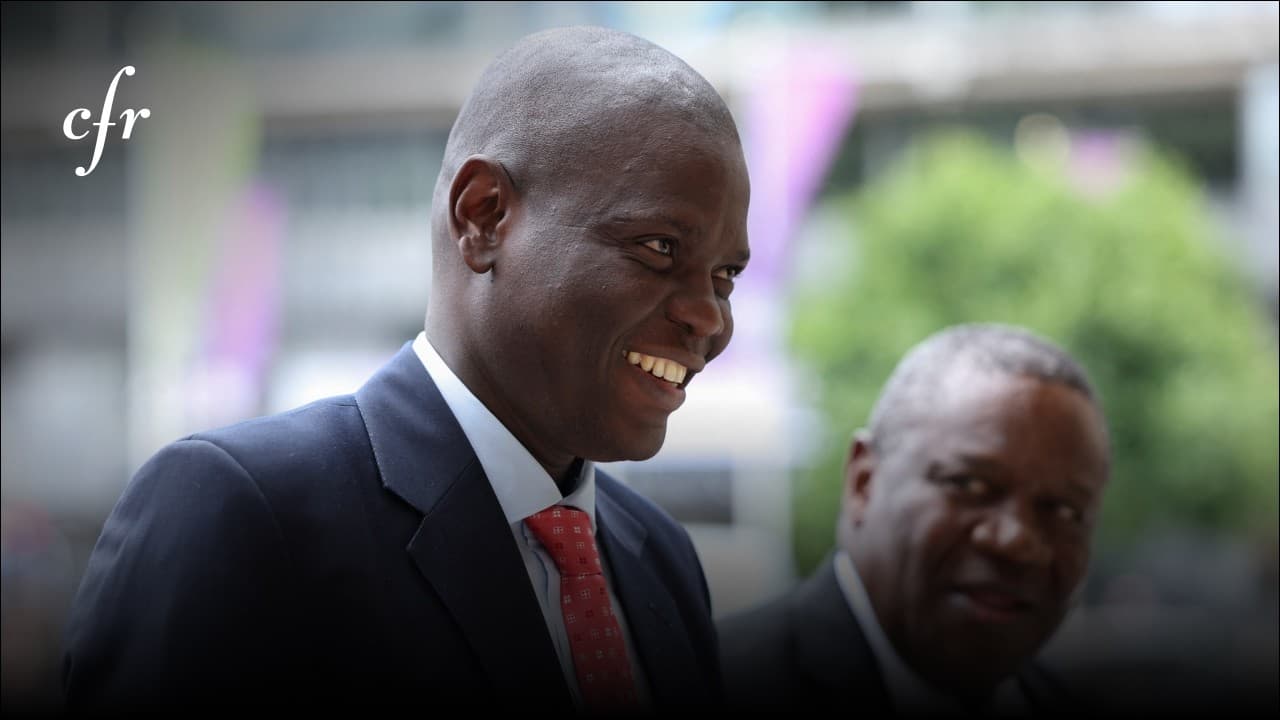
South Africa's foreign minister used a high-profile Council on Foreign Relations forum to deliver a sweeping defense of his country's domestic policies and global positioning — rejecting U.S. allegations of Afrikaner genocide, warning that AGOA trade preferences hang by a thread, and calling the situation in Gaza "one of the most painful genocides" of our time. The exchange, moderated by Jendayi Frazer, Distinguished Visiting Fellow at Stanford's Hoover Institution, laid bare a bilateral relationship at its lowest point in decades, even as Minister Ronald Lamola extended an olive branch built on critical minerals.
South Africa's foreign minister rejects white genocide claims as "fake news," says even the new U.S. ambassador can't confirm them
Lamola offers the U.S. a trade deal anchored by critical minerals found almost nowhere else — platinum, rhodium, vanadium among them
AGOA reauthorization passed Congress, but Lamola warns Trump has yet to sign it in "an unpredictable environment"
South Africa will not attend the Miami G20 uninvited, challenges legitimacy of excluding a founding member
Minister calls Gaza genocide unfolding "on our fingertips," urges Israel to stop bombing and negotiate
China has overtaken the U.S. as South Africa's top trading partner; Lamola tells Washington to examine what it's not doing
Lamola condemns xenophobic violence — 300+ arrested — but pushes back on conflating all attacks on immigrants with xenophobia
Genocide, BEE, and Afrikaner Refugees: Lamola Takes On Washington's Case
The basics: The Trump administration has leveled three core charges against South Africa: that a genocide is underway against white Afrikaners, that Black Economic Empowerment (BEE) laws constitute race-based exclusion of white citizens, and that an Afrikaner refugee resettlement program is justified. Secretary Rubio has announced visa restrictions; South Africa faces tariffs of 30% (later reduced to 12.5%, plus 25% on automobiles).
Why it matters: The dispute has triggered concrete trade penalties and diplomatic isolation for Africa's largest U.S. trading partner, threatening the operations of more than 600 American companies on the ground.
Where things stand: Minister Lamola dismantled the allegations point by point. On genocide: "The story of white genocide does not exist. It's fake news. It's not there. There is no evidence to back it either through any form of technology." He noted the new U.S. ambassador, after actually living in South Africa, can no longer affirm the claim: "Now he knows there is no genocide, and that's why he can't confirm it even himself on record. He can just speak with ambiguity because he still has to report to Washington."
On BEE, Minister Lamola argued that American companies have adapted and thrived under the framework, pointing to Microsoft, Amazon, and Coca-Cola operating profitably through BEE-equivalent programs. On the Afrikaner resettlement program, he called it race-based and inconsistent with international standards: "It's the only program — it does not fit the UN definition of a refugee. Even the UN Refugee Committee says this is not a refugee program where only the refugees can be processed from the country of origin."
Presider Frazer framed the stakes bluntly, noting that "South Africa is the United States' largest trading partner in Africa. There's over 600 American companies there. There's over 30,000 U.S. citizens there" — and yet relations are at a historic low.
What's next: With tariffs in place, visa restrictions active, and AGOA reauthorization unsigned, the bilateral relationship hinges on whether the Trump administration accepts Pretoria's rebuttals — or escalates further.
A Critical Minerals Deal — if Trump Will Take It
Why it matters: South Africa hosts roughly six critical minerals found almost nowhere else on Earth — platinum, rhodium, and vanadium among them — giving it rare leverage at a moment when the U.S. is scrambling to secure supply chains independent of China.
Where things stand: Minister Lamola confirmed South Africa has offered the U.S. a trade package centered on critical minerals beneficiation, the country's university system, its youthful workforce, and its status as one of Africa's most industrialized economies. "Indeed, those critical minerals, most of them you can only find in South Africa. So that's the leverage. It's about six of them," he said.
But the offer comes with an asterisk: AGOA reauthorization, the backbone of U.S.-Africa trade preferences, passed Congress — yet President Trump has not signed it. "Yes, we are concerned because President Trump still has to sign the reauthorization. So we don't know what will happen. As we are aware, it's an unpredictable environment," Minister Lamola said.
The other side: Fraser pressed on whether South Africa has sufficient leverage given the asymmetry of power between Washington and individual African nations. "I do feel that the administration is able to pick off countries one by one because of the asymmetry of power," she said. Minister Lamola countered that African countries should engage collectively through the African Union's critical mineral strategy rather than be isolated in bilateral negotiations.
What's next: Whether Trump signs AGOA — and whether the minerals deal gains traction — will likely determine whether the economic relationship stabilizes or deteriorates further.
South Africa Won't Crash the G20, but Questions Its Legitimacy
Why it matters: The Trump administration excluded South Africa from the upcoming G20 summit in Miami — an extraordinary step against a founding member of the group. Few countries have publicly objected; Frazer noted possibly only Brazil has pushed back.
Where things stand: Minister Lamola confirmed South Africa's disappointment but said it would neither attend uninvited nor encourage a boycott. He instead challenged the summit's legitimacy: "What kind of G20 will this be when South Africa is not there? Can the declaration still be called a declaration of the G20 when one of the founding members is not there?"
He contrasted this with South Africa's own G20 presidency, which he described as "an Africa G20" that brought Nigeria, Algeria, Egypt, Ethiopia, and Angola to the table to project a collective continental voice. That summit produced declarations on critical minerals, AI, and climate finance that have since been adopted by the African Union.
Frazer questioned why other G20 members have not rallied to South Africa's defense: "Aren't you disappointed that other countries that are G20 countries are not standing up and saying no, you cannot exclude a member of the G20? If you exclude them, you exclude us."
Minister Lamola acknowledged the silence but maintained that the exclusion undermines the institution itself, not just South Africa.
The Broken Security Council: Africa Wants a Seat at a Table It May Need to Rebuild
Why it matters: Africa has no permanent representation on the UN Security Council, even though 60% of the Council's agenda concerns African conflicts — a legacy of colonialism, since most African nations didn't exist as independent states when the body was formed.
Where things stand: Frazer pressed on whether BRICS expansion — which brought in Egypt, Ethiopia, and Nigeria — has diluted South Africa's influence, noting those same countries refused to back South Africa's bid for a permanent Security Council seat. Minister Lamola reframed the issue, saying South Africa itself championed their entry into BRICS without preconditions, and that Africa's common position — the Ezulwini Consensus — calls for two African permanent seats without naming specific countries. Egypt and Ethiopia's objections were aligned with that consensus, he argued, not hostile to Pretoria.
Frazer pushed further, questioning the relevance of the Security Council itself: "Why are African countries fighting to have a permanent seat on the Security Council that's broken?"
Minister Lamola turned that argument on its head: "Maybe it's irrelevant because the African continent is not there, because 60% of the conflict that the UN Security Council deals with are in the African continent, and the African continent doesn't have that permanent representation." He argued African presence would provide both legitimacy and solutions, pointing to a recent UN resolution to fund African peacekeeping missions previously financed from national budgets.
Gaza: 'One of the Most Painful Genocides' Happening on Our Fingertips
Why it matters: South Africa's ICJ genocide case against Israel has galvanized Global South solidarity on Palestine and tested whether international legal institutions can constrain state conduct during active conflict. The case draws a direct line from South Africa's anti-apartheid identity to its current foreign policy.
Where things stand: Fielding questions from Miriam Safi, former Foreign Service officer at the U.S. State Department, and Jamie Garden, CFR term member, Minister Lamola described the Gaza situation in unflinching terms: "It's one of the most painful genocides to be happening because it's happening in full view of the whole world, on our fingertips. We can see it through modern technology."
He noted Israel has not respected the ICJ's three provisional measures but that a growing number of countries have joined South Africa's case. Asked by Garden what he would advise Israel to do, Lamola was direct: "If I was the State of Israel or the foreign minister, I will advocate for our government to stop the genocide, firstly, and go to the negotiation table and find a solution with all the partners." He warned that continued bombardment is "fast extinguishing" the prospect of a viable Palestinian state.
The other side: Minister Lamola emphasized South Africa has condemned Hamas, has no relations with Hamas, and condemned the Oct. 7 attacks — but maintained that killing civilians in the search for Hamas "does not in any way justify the actions of an occupier."
China's Gaining Ground and the U.S. Isn't Keeping Up
Why it matters: South Africa is a pivotal swing state in the U.S.-China tech competition across the African continent. China has already overtaken the United States as South Africa's top trading partner, and Chinese AI models are making inroads on the continent.
Where things stand: Nelson Cunningham, former U.S. State Department official, asked about South Africa's relations with Russia and China. Jean-Yves Monnier, Partner Emeritus at McKinsey, raised China's AI push into Africa via DeepSeek: "Those of us who go now in Africa, especially in South Africa, see a lot of the DeepSeek model, see a lot of the China push to get their AI model into the continent."
Minister Lamola maintained South Africa's non-aligned posture, saying it will work with "whoever brings us the solution." But he delivered a pointed challenge to Washington: "There are things that you may want to examine that you are not doing, for you to end up being overtaken in the South African economy, particularly with a long history of American companies in our economy."
He noted that most data centers in South Africa have been built by American companies — Amazon and Microsoft — suggesting the regulatory environment is welcoming. But the larger trade trajectory favors Beijing, and Lamola implied the U.S. has itself to blame.
Xenophobic Violence: 300 Arrested, but Lamola Says Not All Attacks Are Xenophobia
Why it matters: Waves of violence against foreign nationals undermine South Africa's moral authority as the continent's diplomatic champion and complicate relations with key partners like Nigeria.
Where things stand: Michelle Gavin of the Council on Foreign Relations asked directly about "how South Africa's vision of itself as a champion for African states has been affected by the xenophobic violence that's swept through the country."
Minister Lamola condemned the attacks "in the strongest terms," citing more than 300 arrests. But he pushed back against the dominant narrative, arguing that many killings attributed to xenophobia are actually criminal violence that affects all South Africans, predominantly Black citizens, in high-crime communities. He noted no Nigerians were killed in the recent wave despite widespread reports to the contrary, and that those most affected were Malawians. He cited a case of five Ethiopian nationals murdered in Johannesburg where investigations revealed intra-trade disputes rather than xenophobic motives.
Lamola acknowledged South Africa's responsibility to make everyone feel safe but maintained the distinction between targeted xenophobia and broader violent crime matters — both for accurate policy responses and for the country's international credibility.
Minor Items
Economic statecraft and regional integration: Minister Lamola outlined South Africa's strategy anchored in the African Continental Free Trade Area (AfCFTA), emphasizing local beneficiation, manufacturing, and growing intra-SADC trade from roughly 20% to double that level. Six one-stop border posts are being built on borders with Zimbabwe, Mozambique, Botswana, and Lesotho to modernize cross-border commerce.