Trump–Xi Summit Heavy on Pageantry, Light on Deliverables, CFR Experts Say
Council on Foreign Relations • United NationsSeptember 25, 2026
Locunity is an independent informational service and is not an official government page for this commission. All information is sourced from public footage and an analysis of official agendas with the aid of responsible, fact-checked AI. to report an error or omission.
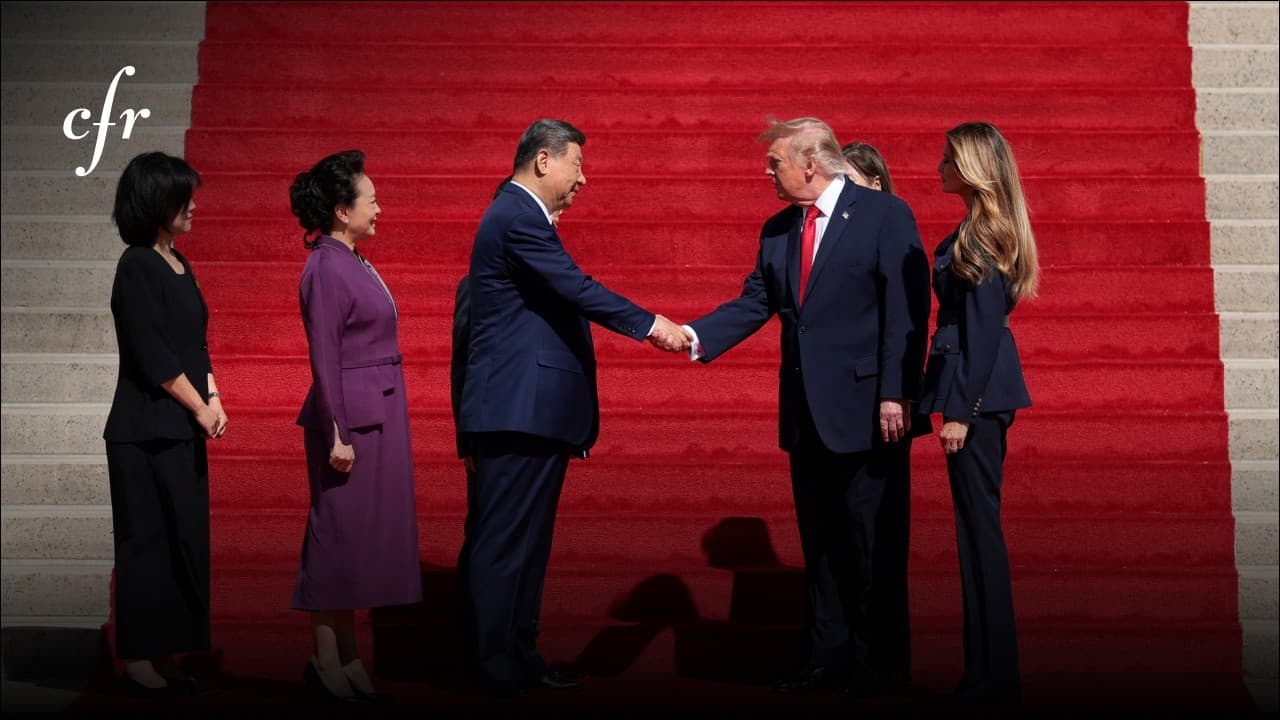
The first Chinese state visit to Washington in 11 years produced two pandas, a short trade truce extension and an unfinished list of purchase commitments, according to Council on Foreign Relations experts at an on-the-record briefing Sept. 25, 2026. No votes were taken. Across trade, artificial intelligence and Taiwan, panelists argued that Beijing left believing it holds the stronger hand.
- Summit falls below already low expectations. Purchase deals were still being negotiated after the leaders parted.
- Trade truce extended from Nov. 10 to January. China is behind on $15B in farm purchases.
- AI outcome limited to a risk dialogue and an informal hotline. Doshi called it weaker than the 2023 commitments.
- Beijing aims to delay $14B in Taiwan arms sales. Sachs predicts the sales slip into early 2027.
- Gray-zone risk to Taiwan is "high and increasing." Analysts flagged 2028 as especially dangerous.
- China won't back U.S. sanctions on Iran. Its 1.4 billion-barrel oil stockpile has become leverage.
Pomp, Pandas and an Unfinished Shopping List
The basics: Ehsan Thoroor, Edward R. Murrow Press Fellow at CFR and columnist for The New Yorker, moderated the briefing. It was an expert assessment, not a decision-making meeting. Xi is the first Chinese president to receive two state visits.
Why it matters: Trade purchase commitments were still being negotiated after the summit ended. That leaves businesses and farm exporters facing continued uncertainty.
Where things stand: "This is a summit that had a lot of history and symbolism to it, but unfortunately, a lot less substance," said Rush Doshi, CFR senior fellow for Asia studies and director of the China Strategy Initiative. He said the working meeting was shorter than expected. The trade truce, the purchase agreements and the AI dialogue all came in thinner than expected, and the pageantry favored Xi.
Doshi called it highly unusual that the summit ended before economic deliverables were settled. He cited Jamieson Greer telling CNBC that purchase talks would continue after the visit. "That's a bit like turning in your test a week after it was due," Doshi said.
Zoe Liu, CFR Maurice Greenberg senior fellow for China studies, said China has fallen behind on $15 billion in agricultural purchases. Chris Maguire, CFR senior fellow for China and emerging technologies, said the U.S. remains frustrated with Chinese compliance with the Busan deal.
The rare earths hangover: Doshi argued President Trump has never been truly hawkish on China. He pointed to first-term offers on Huawei and ZTE export controls, Xinjiang and Hong Kong, and to a trade deal whose purchase commitments never materialized. Trump greeted Xi on the tarmac, which Doshi called a break with decades of precedent. He said Trump likely meant it as warmth, but "I think that the Chinese probably saw it as a signal of deference."
Doshi traced the imbalance to 2025. Trump raised tariffs to 145%, and Xi retaliated with rare earths controls; about 90% of rare earths production is centered in China. Trump then cut tariffs by nearly 100 percentage points. "I believe that President Xi believes he has temporarily tamed the United States and he wants to extend that as far as he can," Doshi said.
Both sides are still quietly restricting each other. The U.S. has targeted Chinese drones, routers and robotics. According to Doshi, China has throttled rare earth supply to between half and two-thirds of U.S. expectations. He said State Council Directives 834 and 835 nearly criminalize U.S. companies leaving China.
The other side: Liu said summits cannot resolve structural problems. Still, she said the visit "keeps negotiation open so that working-level technocrats can continue to iron out some of the details." She called the truce extension "a huge win from domestic politics perspective, but not necessarily for US-China relationship point of view."
Decisions and stakeholder impacts: David Sachs, CFR fellow, joked that the Atlanta Zoo's two new pandas were the main deliverable. "So panda diplomacy is alive and well," he said. On a more serious note, he said there was no progress on a detained American citizen or on the jailing of Jimmy Lai. He added that the flattery of Xi exceeded expectations, while the leaders spent little substantive time together.
AI Talks: Realistic Ceiling or Missed Chance?
Why it matters: The summit's only AI outcomes were a risk dialogue and an informal hotline between Treasury Secretary Scott Bessent and Vice Premier He Lifeng. Panelists warned the two countries lack institutional crisis tools for fast-moving AI risks.
Where things stand: Maguire defended the modest result. "I think that a realistic deliverable, given the structural conditions that exist between the countries, is actually more or less exactly what we got," he said.
His reasoning: "The U.S. is ahead, but it is not way ahead. China is behind, but it thinks it can win." Maguire said arms control has no precedent for that situation. In his view, negotiated caps come only at parity or with a decisive lead. He urged the administration to widen the U.S. lead through export controls and to adopt safety measures on its own.
The other side: Doshi said he was disappointed. "We worked ahead of the 2023 Woodside Summit to launch an AI dialogue and to launch a commitment that neither side would connect AI to nuclear command and controls," he said. He noted that China has not fully confirmed today's dialogue. He described the crisis line as essentially two people on cell phones. "Why is it that the crisis communications line isn't a real crisis comms line?" he asked. His answer was that the U.S. did not expend the political capital.
Kat Duffy, CFR senior fellow for digital and cyberspace policy, disputed the size of the U.S. lead. She agreed the U.S. leads on benchmarked frontier capabilities. "If you were to think about domestic governance capability of AI as a part of winning an AI race, China is lapping us," she said.
She cited OpenRouter data: "In June, for the first time, token consumption for Chinese models outpaced that of US models." Duffy said the figure is likely underreported because many users run those models locally. She also pointed to three trends:
- Enterprise costs are rising as U.S. models shift to token-based pricing.
- Hugging Face brought in a Chinese open-weight model for cybersecurity defense because U.S. models were too guardrailed.
- At the UN General Assembly, 22 governments called for AI safety collaboration, including nine Pax Silica signatories. The U.S. pushed back.
Maguire countered that enterprise usage is largely missing from OpenRouter data. He said cloud inference remains dominated by U.S. models. He agreed that Chinese models are good and cost-competitive.
Decisions and stakeholder impacts: Maguire described the president's stance bluntly: "His approach is full steam ahead, no regulations. We have to beat China." He also noted there was no talk this time of loosening U.S. export controls. Duffy warned that without trusted U.S. standards, it is unclear why the world would rely on American models. "I wish I was seeing a greater discussion domestically, at least around an AI safety speed-up," she said.
Beijing Plays the Long Game on Taiwan
Why it matters: Sachs warned that if the $14 billion arms package is not sent to Congress early in 2027, the delays will compound. Taiwan would slide down delivery queues for defense capabilities such as air defense.
Where things stand: Sachs compared China's summit readout with its November 2024 statement to President Biden in Lima. The readout said China hoped the U.S. would "adhere to the correct position of opposing Taiwan independence." Sachs said the key term is better translated as "persist." "In other words, the Chinese already believe that they have moved President Trump on Taiwan," he said. The readout also explicitly linked Taiwan to "constructive strategic stability."
"I think that the first aim, of course, for the Chinese is to indefinitely delay the $14 billion in pending arms sales to Taiwan," Sachs said. The package was not sent to Congress before the May summit in Beijing, and Trump called it a bargaining chip. Beijing has signaled that notifying Congress before APEC in Shenzhen or the G20 in Florida would hinder another leaders' meeting. Sachs added that no Taiwan president has transited through the U.S. during Trump's second term; President Lai's planned transit did not happen.
Doshi said Trump's May remarks on Air Force One pleased Chinese officials. In those remarks, Trump called arms sales a negotiating instrument and Taiwan indefensible.
The other side: Sachs said he is confident day-to-day U.S.–Taiwan security cooperation will continue. He was responding to audience member Jill Gentry, who asked what U.S. military units can say to Asian counterparts. Sachs said the administration may still need more visible reassurance. He cited a photo, published by the American Institute in Taiwan, of the U.S. and Taiwan coast guards operating together.
Decisions and stakeholder impacts: "I would argue that we have not seen any alleviation of pressure on Taiwan from Beijing," Sachs said. He cited three developments:
- China Coast Guard exercises off Taiwan's east coast.
- Chinese hailing of commercial vessels there, after Japan and the Philippines announced talks on exclusive economic zones.
- A joint exercise between China and Indonesia.
Sachs said Xi is also working to lock Taiwan's KMT party and its chair, Zheng Liwen, into a pro-China position over the long term.
Timothy Young of the Pacific Defense Fund asked how the visit affects the risk of conflict or a blockade. "My own view is that 2028 will be a very difficult year for Taiwan and for the United States," Sachs said. He warned that if Lai is reelected, Beijing could impose a qualitatively different cost, possibly exploiting an end-of-term vacuum in Washington.
Doshi said the risk of a full-scale conflict is low. "The probability of a low-end or gray zone contingency is high and increasing," he said. He attributed the rising risk more to the May summit than to this one. A gray-zone move could include seizing an island or surging vessels near Taiwan's territorial waters.
China's Oil Cushion Becomes Leverage
Why it matters: Doshi said rising Chinese oil imports since June will add gradual upward pressure on global oil prices.
Where things stand: Haik Gugorats of Argus asked about Iran. "China is not going to in any way materially support American sanctions," Liu said. She noted that major Chinese banks and state-owned energy firms already avoid Iran. Smaller regional banks and thousands of Iranian front companies are harder for the U.S. Treasury to see. Her advice for Washington was to press Beijing on its own rules: "You guys have your anti-sanctions, anti-money laundering system. Just enforce that, and it actually can achieve the same kind of effect."
Chase Winter asked about China losing discounted oil amid the Iran war and U.S. intervention in Venezuela. Liu said Beijing banned exports of refined fuel and capped price increases. That leaves refiners to absorb the shock, especially independents that rely on discounted Russian and Iranian crude. "We are fairly confident to say that import from Iran has been going through Indonesia and Malaysia because the increase is just dramatic," she said.
Decisions and stakeholder impacts: Doshi said China's 1.4 billion-barrel stockpile helped it weather the loss of roughly 5 million barrels a day that previously flowed through the Strait of Hormuz. "China's been able to convert that enormous stockpile into a political tool," he said. That includes fuel export bans with exceptions for certain countries. He added that electric vehicles could cut China's oil imports by about 1.5 million barrels a day over time.
Minor Items
- Chinese CEOs absent: No major Chinese CEOs attended the state dinner. Liu said China is overhauling its financial system to fund tech self-sufficiency, so its firms no longer need U.S. funding.
- Press access: Thoroor noted some of the press corps was barred from the White House, and boycotts followed.
- Missed soft power: Liu said the visit wasted soft-power opportunities involving the first ladies.
Looking Ahead
Watch several windows. The trade truce now runs to January. APEC in Shenzhen and the G20 in Florida are potential flashpoints for sending the Taiwan arms package to Congress. Sachs identified early 2027 as the arms-sale deadline that matters, and both Taiwan analysts pointed to 2028 as the year of highest risk.