Somaliland's President Presses Washington for Diplomatic Recognition at CFR
Council on Foreign Relations • United NationsSeptember 24, 2026
Locunity is an independent informational service and is not an official government page for this commission. All information is sourced from public footage and an analysis of official agendas with the aid of responsible, fact-checked AI. to report an error or omission.
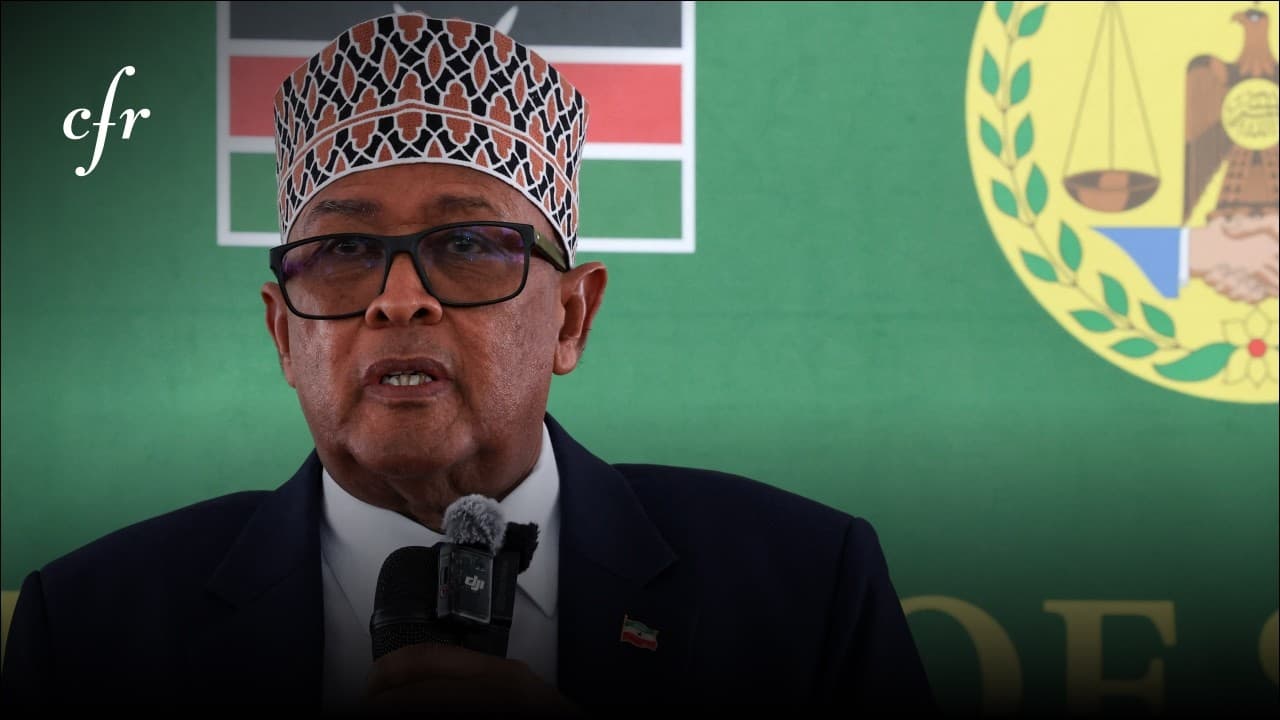
Somaliland's president brought his most comprehensive case yet for U.S. recognition to the Council on Foreign Relations, reporting "eye to eye" alignment with the State Department, Congress, and Treasury after two weeks of meetings across Washington. President Abdirahman Mohamed Abdullahi argued that 35 years of democratic self-governance, an 850-kilometer strategic coastline, and billions in untapped economic potential are all locked behind a single barrier: the world's refusal to acknowledge Somaliland as a sovereign state.
Somaliland president reports productive meetings with State Department, Congress, Senate, Treasury, and Department of Energy during two-week Washington visit
Abdullahi argues Somaliland meets all four Montevideo Convention statehood criteria but remains shut out of international banking and the UN
Ministry of Finance projects GDP could triple from $3.6 billion to $10 billion by 2035 — if recognition unlocks access to global finance
Somaliland offers itself as "indispensable" maritime security partner against Houthi threats along the Bab-el-Mandeb strait
President defends Taiwan partnership despite Chinese pressure, declaring "we are independent country, and we decide our own decisions"
Policy experts from Georgetown, the Atlantic Council, International Crisis Group, and CFR press Abdullahi on critical minerals, military presence, and bipartisanship
The Case for Statehood: Four Criteria, Zero Recognition
The basics: The 1933 Montevideo Convention establishes four criteria for statehood: a defined territory, a permanent population, an effective government, and the capacity to conduct international relations. Somaliland, a former British protectorate that declared independence from Somalia in 1991, has governed itself continuously ever since — holding elections, maintaining security forces, and running its own judicial system — but has not been formally recognized by any major Western power or the United Nations.
Why it matters: Without recognition, Somaliland cannot join the UN, access development finance institutions, or participate in the international banking system — constraints that touch every aspect of economic and civic life for its roughly 6 million residents.
Where things stand: President Abdirahman Mohamed Abdullahi opened his CFR address by laying out the legal case directly: "We have a defined territory, a permanent population, an effective government, and a capacity to conduct international relations. We meet all four criteria for a state to be established by the Montevideo Convention and is still accepted today."
He reported that his two-week Washington visit included meetings with Assistant Secretary Frank Garcia at the State Department, nearly a dozen members of Congress and the Senate, the Treasury Department, and the Department of Energy. He described the discussions as closely aligned: "We have no differences of what we have discussed: security, trade, counterterrorism, investment. Almost we have been eye to eye, I can say."
President Abdullahi drew historical parallels to bolster his argument. He cited the dissolution of the Soviet Union into 15 republics and Yugoslavia into five states — transitions he witnessed firsthand while posted in Moscow from 1988 to 1996. He noted that Somaliland was independently sovereign from June 26, 1960, when it gained independence from Britain, before voluntarily entering a union with Italian Somalia — a union he argued "failed" because its original goal of uniting all Somali-speaking territories never materialized.
The other side: Senior Fellow Ebenezer Obadare, the CFR moderator, pressed the president on African resistance: "There are 54 countries in Africa. It seems as if so far none of them is on board." President Abdullahi pointed to Israel's recognition of Somaliland in December 2024, noting that roughly half of African and Islamic countries stayed silent rather than denouncing it — which he interpreted as tacit acceptance. He identified Turkey, Egypt, and other governments as actively campaigning against recognition, and referenced a 2005 African Union fact-finding mission that affirmed Somaliland's "uniqueness" and right to self-determination but stopped short of formal recommendation.
What's next: President Abdullahi framed U.S. recognition as the potential catalyst that could trigger a cascade of international acknowledgment: "Any signal from the United States will make a difference, and maybe many countries are waiting for the signal of the United States." No timeline for a U.S. decision has been announced.
An "Indispensable" Security Partner on the World's Most Dangerous Strait
Why it matters: The Bab-el-Mandeb strait, connecting the Red Sea to the Gulf of Aden, carries an estimated 10% of global trade. Houthi attacks on commercial shipping have turned it into one of the world's most dangerous maritime chokepoints, and Somaliland's 850-kilometer coastline sits directly along the route.
Where things stand: President Abdullahi positioned Somaliland as a ready-made security partner: "Somaliland is ready to support American and international efforts to preserve freedom of navigation through Bab-el-Mandeb. We can contribute through intelligence sharing, maritime patrols, and participation in regional security operations." He noted that Somaliland has kept its waters safe for 35 years "for free to the whole world" and is now ready to formalize partnerships. He also disclosed meetings with the Department of Defense about training Somaliland troops.
Atlantic Council Senior Fellow Ariel Cohen underscored the strategic stakes: "The Horn of Africa today, with the Houthi aggression and international support of the Houthis, became a chokepoint just as the Strait of Hormuz. It's a threat to international security and international energy security and the well-being and economic survival of the world." President Abdullahi responded that "if the world trade is to be secured, it is indispensable."
The other side: Alexandra Starr of the International Crisis Group asked whether recognition would bring a U.S. security umbrella or military deployment to Somaliland. CFR Edward Murrow Fellow and New Yorker Columnist Ishaan Daroor pressed further on whether Israeli or Emirati military forces are currently on Somaliland soil. President Abdullahi denied any significant foreign military presence and explained that Somaliland's security rests on a community-driven model: "In Somaliland, everything is homemade. And most of the people, the ownership of peace is owned by the people. And every citizen of Somaliland wants that Somaliland to be safe." He credited this "homemade peace process" with preventing al-Shabaab from gaining a foothold — a sharp contrast with southern Somalia, where the militant group has operated for nearly two decades.
The $10 Billion Question: What Non-Recognition Costs
Why it matters: Somaliland's exclusion from the international banking system creates cascading economic consequences — exporters cannot receive payments directly, importers cannot open letters of credit, and the country cannot access development finance from institutions like the World Bank or IMF.
Where things stand: President Abdullahi cited Ministry of Finance projections that with recognition, Somaliland's GDP could grow from $3.6 billion to $10 billion by 2035, with annual growth reaching 8% and per capita income rising above $1,500. Regional exports could jump from under $300 million to over $4 billion, driven by the Berbera port as a trade gateway. Current resources include minerals, oil and gas reserves, marine resources, livestock — five million head of sheep and goats exported annually — and tourism potential.
But the current reality is far grimmer. The national budget has grown from $18 million to approximately $500 million, yet remains insufficient. President Abdullahi described the workaround Somalilanders have improvised: "If we export, we cannot get the money directly. If we are importing, we don't have bankers who can open letter of credit. But our people are naturally traders. They don't get tired. They take cash to Djibouti or to Dubai and send there to India or to China or to United States."
Financier Mahesh Kotaycha urged the president to make the human case, asking him to speak to "the cost of not being recognized for the people of Somaliland." President Abdullahi responded by emphasizing that recognition would open access to international humanitarian agencies like WHO and WFP that currently cannot operate at full capacity, along with unlocking investment across all economic sectors. He described Somaliland as a free market economy welcoming investment and emphasized meetings with the Treasury Department about banking barriers.
TIRIN Institute's Abdushkur Mohammed asked about critical minerals. President Abdullahi confirmed discussions with Washington about Somaliland's mineral resources and the potential for supply chain partnerships with the United States — a topic of growing strategic importance as the U.S. seeks to diversify sourcing away from Chinese-controlled supply chains.
Taiwan, Trump, and the Geopolitics of Recognition
Why it matters: Somaliland is one of only a handful of polities worldwide with formal diplomatic ties to Taiwan, making its geopolitical positioning a factor in U.S.-China competition — and potentially complicating its recognition campaign.
Where things stand: World Politics Review Editor-in-Chief Elliot Waldman asked whether the Taiwan relationship could get caught up in great-power rivalry. President Abdullahi confirmed that Somaliland and Taiwan signed a cooperation agreement and exchanged embassies in 2020 — when he himself, as speaker of parliament, served as the foreign minister who signed the deal. He described ongoing cooperation in health, education, training, and technology, noting his minister of interior was currently in Taipei meeting with Taiwan's president.
His response to Chinese pressure was unequivocal: "China is not happy with our relations with Taiwan. But we are independent country, and we decide our own decisions."
On bipartisan outreach in Washington, Ishaan Daroor challenged whether naming Berbera Airport after President Trump and encouraging a Trump Tower in Hargeisa was a sufficiently bipartisan strategy. President Abdullahi confirmed both gestures and claimed to be the first African leader to nominate President Trump for a Nobel Peace Prize. He did not directly address the bipartisanship concern but emphasized his government's engagement with both the administration and members of Congress.
Higher Education and Soft-Power Partnerships
Vassar College President Elizabeth Bradley asked about Somaliland's aspirations for higher education and potential partnerships with Western universities. President Abdullahi expressed strong interest in collaborations across education, noting that expanding higher education is critical for the country's long-term development and that partnerships represent a "win-win" for both sides.
This edition covers a Council on Foreign Relations event held Sept. 24, 2026, featuring Somaliland President Abdurrahman Mohamed Abdullahi. The session was moderated by CFR Senior Fellow for Africa Studies Ebenezer Obadare.