Board of Trustees - April 15, 2026 - Regular Meeting

Board of Trustees - April 15, 2026 - Regular Meeting

Board of TrusteesContra Costa Community College DistrictApril 15, 2026

Sources:

Locunity is a independent informational service and is not an official government page for this commission.We use AI-assisted analysis and human editorial review to publish information.

District Faces Structural Deficits as Costs Outpace $229M Revenue Ceiling

The Contra Costa Community College District Board of Trustees met for a marathon session that laid bare the financial math threatening the district's stability: salary and benefits now exceed total state revenue, and the tools to close the gap are shrinking. Against that backdrop, the board celebrated 18 newly tenured faculty, heard students describe lobbying Congress on immigration and campus safety, and learned that a once-daunting retiree healthcare liability has nearly been cut in half.

  • District salary and benefits hit $231M against $229M in state revenue, with $2.1M in position cuts already made and more expected

  • Retiree healthcare trust gap drops from $63.7M to $29.8M, raising the question of when the board will tap the fund

  • Fifteen students lobby Congress on immigration protections, campus sexual assault accountability, and STEM funding

  • Union president warns classified morale is "in the tank" as layoff notices ripple across campuses

  • Faculty and staff push for district AI policy after national conference reveals curriculum being uploaded without consent

  • CCC's Finish Line Fund clears debt for 181 students, drawing national media attention


Widening Gap: How $231M in Costs Broke Through a $229M Revenue Ceiling

Why it matters: The district is stuck on "hold-harmless" funding — a state safety net that guarantees $229M in annual revenue but doesn't grow with inflation. Every year, costs rise and the gap widens, forcing cuts that have already reached classrooms and custodial staff.

Where things stand: CFO Dr. Tony Wold walked the board through a 2026-27 budget picture shaped by forces largely outside the district's control. The governor's January proposal effectively cuts the statewide community college budget by 3% — shifting $7 billion in one-time funds and restoring $3 billion to the state's rainy day reserve. The Legislative Analyst's Office found the governor would underfund Proposition 98 by $11 billion, shortchanging community colleges by nearly $1 billion below what the formula requires.

For 4CD specifically, the Student Centered Funding Formula calculates the district's revenue at roughly $215M–$226M depending on performance metrics — still below the $229M hold-harmless floor. That means the district receives no cost-of-living adjustment, because COLA doesn't apply to hold-harmless funding. Meanwhile, salary and benefits alone consume $231M — more than 93% of college budgets — and continue climbing.

"There's our salary and benefits, $231 million. I'll remind you our total SCFF revenue is $229 million," said Dr. Tony Wold, Associate Vice Chancellor and CFO.

The district has already made $2.1M in position reductions for next year, $1.8M of it ongoing. "We began making reductions, very painful reductions, and we did reduce some positions for next year," Dr. Wold said. Colleges are now going line by line through budgets to identify further savings before the tentative budget comes to the board in June.

Key cost drivers include rising STRS and PERS pension contributions — up $3.2M annually since 2022-23 with no new employee benefit — and technology subscription costs that grow each renewal cycle. Health and welfare benefits saw a favorable 0.76% increase this year, but that reprieve is temporary.

Federal volatility compounds the pressure. TRIO programs face expiration, the "One Big Beautiful Bill Act" could trigger sequestration that forces the district to accelerate solar projects, and rising interest rates affect capital planning. One bright spot: a $2.1M student support block grant and $2.6M deferred maintenance allocation provide one-time relief.

Dr. Wold identified a potential $2M in ongoing revenue if the state fully funded faculty office hour reimbursement. "Currently it is only funded at $23 million at the state level. To fund the 90% that's in law that we're supposed to be reimbursed would require $75 million. So there's a $50 million shortfall," he said. "That alone would bring $2 million in ongoing revenue back to 4CD."

The other side: Trustee Rebecca Barrett flagged that Proposition 30 and Proposition 55 temporary taxes are nearing expiration — an additional revenue cliff the district hasn't fully accounted for. "Prop 30 and Prop 55 were temporary measures, and we are getting dangerously close to the end of its life, and I just want to always flag," she said during the Prop 30 spending plan vote.

Trustee Andy Li asked about the district's $55M in reserves and whether drawing from the OPEB trust could provide relief. Dr. Wold noted that $42M of reserves are committed to the required two-month operating cushion. Chancellor Mojdeh Mehdizadeh said the OPEB question is ahead of the board: "That's a future conversation for the governing board to assess. At what point do you feel comfortable for us to start drawing and not continuing to self-pay?"

Trustee Li also suggested the district lobby the state to use regional living-wage data — rather than statewide averages — when measuring student family income for supplemental SCFF metrics, which could unlock more formula funding.

What's next: Colleges will continue developing savings proposals for the tentative budget presentation in June. The board will need to weigh whether to begin drawing from the OPEB trust and how to prepare for the Prop 30/55 tax expiration.


OPEB Trust Gap Nearly Halves as $90M in Returns Reshape Retiree Liability

Why it matters: For years, the district's unfunded retiree healthcare obligation loomed as a long-term fiscal threat. Strong investment returns have dramatically narrowed the gap, potentially freeing millions in future general fund dollars — but only if the board decides when to stop self-paying and start drawing from the trust.

Where things stand: Rosalind Washington of Kenan Financial Services and actuary Will Kane of Foster and Foster presented the biennial performance report for the Retirement Board of Authority. The irrevocable trust, established in 2009, now holds $203.2M. Total deposits since inception: $108M. Net investment gains: $90M. The total actuarial accrued liability stands at $233M under GASB 75, putting the net OPEB liability at $29.8M — down from $63.7M just two years ago.

"The net OPEB liability, which is your funded status or your unfunded amount, shrank from $50 million to $30 million, which is what you want ultimately," said Will Kane, actuary with Foster and Foster.

Kane emphasized the trust's structural importance: without it, the district would use a lower discount rate, inflating the liability to $300M–$350M. "Instead of a $230 million liability like you have right now, that might be more in the range of $300 to $350 million if you didn't have this trust backing it," he said.

The benefit structure has two tiers. Employees hired before July 2020 receive lifetime medical coverage including Medicare Part B reimbursement. Those hired after only receive coverage until age 65. Kane cautioned that "fully funded" doesn't mean contributions can stop — active employees continue earning benefits each year, adding to the liability.

What's next: The 2026 valuation will use a less expensive roll-forward method. The board will eventually face the question flagged by the chancellor: whether to begin drawing from the trust rather than continuing to pay retiree health costs from the general fund, currently running at more than $10M annually.


Students Take Immigration, Campus Safety, and STEM Funding to Congress

Why it matters: Fifteen students from Diablo Valley College and Los Medanos College traveled to Washington, D.C., for the American Student Association of Community Colleges conference and met with five members of Congress — building direct advocacy experience on issues that affect undocumented classmates, campus safety, and program funding.

Where things stand: DVC student body president Luis Mario Fernandez Hernandez introduced delegates who each advocated on specific legislation. Monique spoke about ICE enforcement at DVC. A student named Anijita advocated for the Campus Safety and Accountability Act of 2025 addressing sexual assault. Proud, an international student, described how the experience deepened her civic engagement. Mars Ohio shared insights about challenges facing community colleges nationally.

LMC student body president Salvador Velasquez advocated for immigration protections including California SB 98, which would require schools to notify communities of immigration enforcement activity, and urged national replication. Vice President Natalia Marroquin pushed for sustainable STEM funding through HR 4048 and co-presented on imposter syndrome. Guadalupe Marroquin, a 20-year non-traditional student, led a workshop on barriers facing returning students. Shanna Armano's testimony on mental health resource gaps was read by proxy.

Trustee Andy Li shared his own first-generation immigrant experience and encouraged continued advocacy. He reported that AANHPI federal funding — $6.2M across 51 colleges — appears secure for the next few years, with 4CD receiving roughly $350,000 annually.


Union President: Classified Morale "In the Tank"

Why it matters: The position cuts described in the budget presentation are not abstractions — they are landing on classified employees who maintain campuses, support students, and keep operations running.

Where things stand: Local 1 President Jeannie Smith delivered a pointed report on the human cost of the district's financial squeeze. "Morale is pretty much in the tank right now with classified employees. The layoff notices have been hard, not just logistically, but emotionally. Our members are worried about their jobs, their families, and their futures," she said.

Smith credited Vice Chancellor Jeffrey Michaels and HR Director Dan Cueva for keeping members informed and rescinding notices as quickly as possible. She also thanked college presidents and vice presidents who held off filling certain positions to reduce the number of employees affected. She expressed hope that no final layoff notices will be issued.

During public comment, Hope Dixon, a Contra Costa College staff member, described receiving pressuring emails from HR on April 1 asking her to choose which position to "bump into," calling the pressure "unconscionable."


Faculty and Staff Push for AI Policy Before It's Too Late

Why it matters: Faculty at institutions across the country report that curriculum and scholarly work are being uploaded into AI systems without their knowledge or consent — a risk the district has no written policy to address.

Where things stand: Local 1 President Jeanie Smith attended a panel at the 53rd Annual National Conference in New York focused on AI in higher education. She shared a copy of Suffolk County Community College's AI Acceptable Use Policy with union leadership, describing it as comprehensive: it covers data privacy, FERPA compliance, protection from discriminatory AI use, prohibits uploading institutional content without senior leadership approval, and requires human oversight of all AI outputs.

"AI cannot replace human judgment. These are exactly the kinds of protections our district needs to have in writing," Smith said. "I want to strongly encourage this board to make developing an AI policy a priority and to do it collaboratively with employee and faculty input."

United Faculty President Marina Kraus also attended the conference and noted panels on academic freedom, AI equity, and contingent labor. The DVC Academic Senate separately reported continuing campus discussions about AI, including agentic tools, with consensus that faculty need time and space to plan as the technology evolves rapidly.


CCC Clears Debt for 181 Students, Draws National Spotlight

CCC President Dr. Kimberly Rogers announced that the college's Finish Line Fund surprised 181 in-state students by paying off all of their outstanding debt to the college. "I had the pleasure of surprising 181 students of our in-state residents by letting them know we had paid off all of their outstanding debt to the college," Dr. Rogers said. The initiative generated national media coverage.


Minor Items

  • Consent agenda (items 13B–19A) approved unanimously with no items pulled. (For: 3, Against: 0, Absent: 2 — Trustee Diana Honig and Trustee John Marquez)

  • Prop 30 spending plan (22A) approved unanimously. (For: 3, Against: 0, Absent: 2)

  • Director of Risk Management classification (23A) revised to include workplace violence prevention administrator duties. The position has been vacant since 2024. Approved unanimously. (For: 3, Against: 0, Absent: 2)

  • Board Policy 3012 on student behavior (24A) approved on second reading. (For: 3, Against: 0, Absent: 2)

  • DVC mission statement (25A) approved unanimously after more than 70 participants contributed at a college-wide event. DVC is the third college to complete the district-wide mission update cycle. (For: 3, Against: 0, Absent: 2)

  • Financial aid policy (21B) first reading presented; revisions prevent Cal Grant awards from displacing other scholarships, aligning with education code.

  • Board self-evaluation (21A): Dr. Frank Chong will facilitate the governing board's self-evaluation in June.

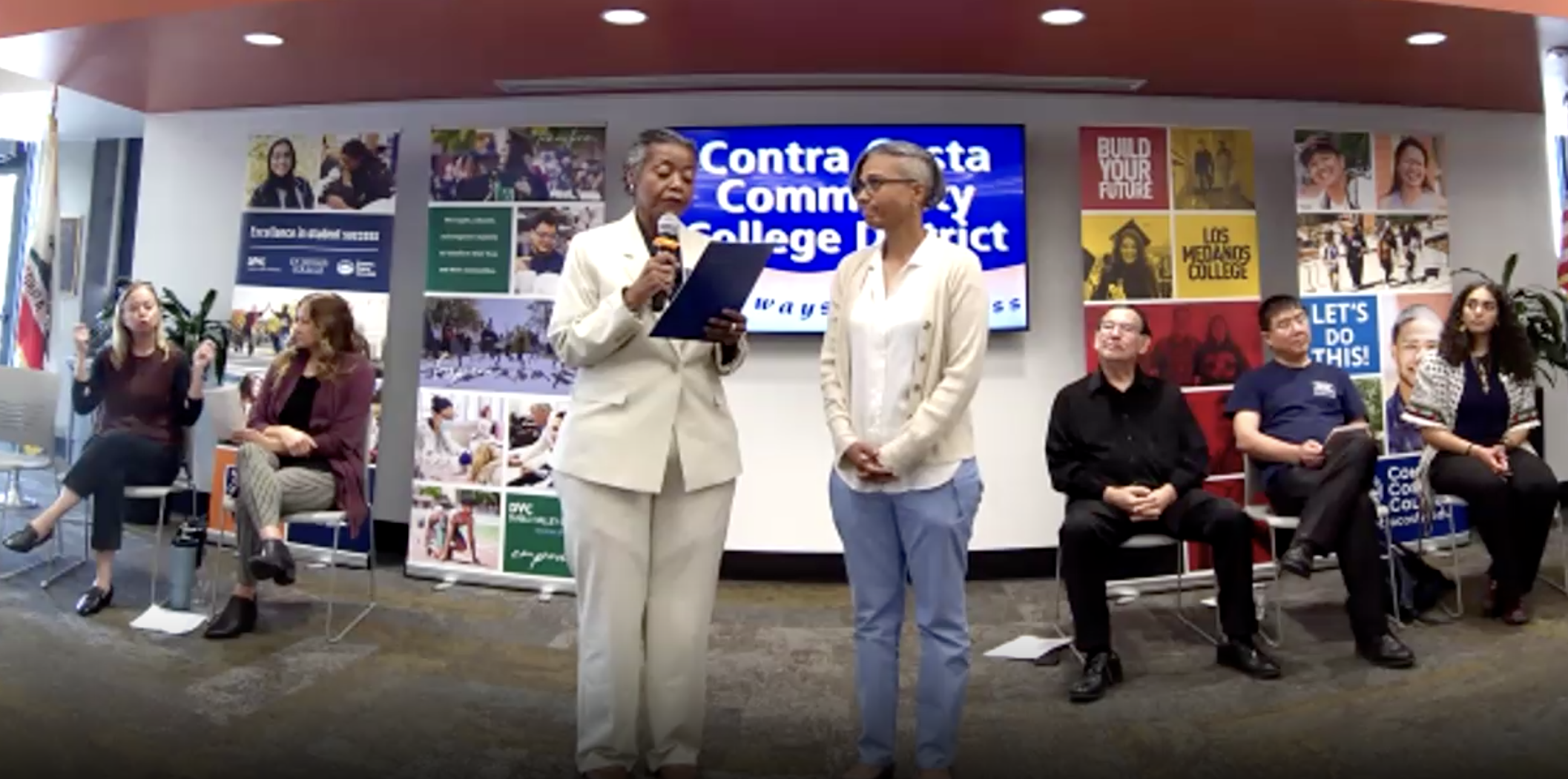
  • District honored 18 newly tenured faculty across DVC (12), CCC (4), and LMC (5) and named Arturo Torres of DVC as Classified Professional of the Year for outstanding custodial work — marking the program's 20th year.

  • Tracy Martial, the district's sustainability and energy manager, received the California Community College Board of Governors 2025 Sustainability Champion Award for leading the district to LEED Gold buildings, zero net energy facilities, and electrification ahead of state building codes.

  • Student Trustee Sophie Curry reported that three of five SSCCC regional officer positions are now held by 4CD students and advocated for recognizing SWANA (Southwest Asian, North African) terminology during Arab American Heritage Month.

  • Trustee Barrett requested a future agenda item to review the board's policy on allowing Zoom participation for public comment.

  • Trustee Barrett announced her appointment to the state Chancellor's Office Baccalaureate Degree Alliance ad hoc committee.

  • Hope Dixon flagged a nearly $36M community health and resilience grant available for Richmond, San Pablo, North Richmond, and unincorporated areas, noting limited eligible applicants and urging the district to attend RISE listening sessions. She also raised April 1 CalFresh eligibility changes that remove food assistance for asylees, refugees, parolees, trafficking survivors, and other non-citizen categories — directly affecting students at CCC.