
CPUC Cuts Liberty Water Rates, Debates Path Forward for San Joaquin Valley Communities
California Public Utility Commission • CPUCMay 14, 2026
Locunity is an independent informational service and is not an official government page for this commission. All information is sourced from public footage and an analysis of official agendas with the aid of responsible, fact-checked AI. to report an error or omission.
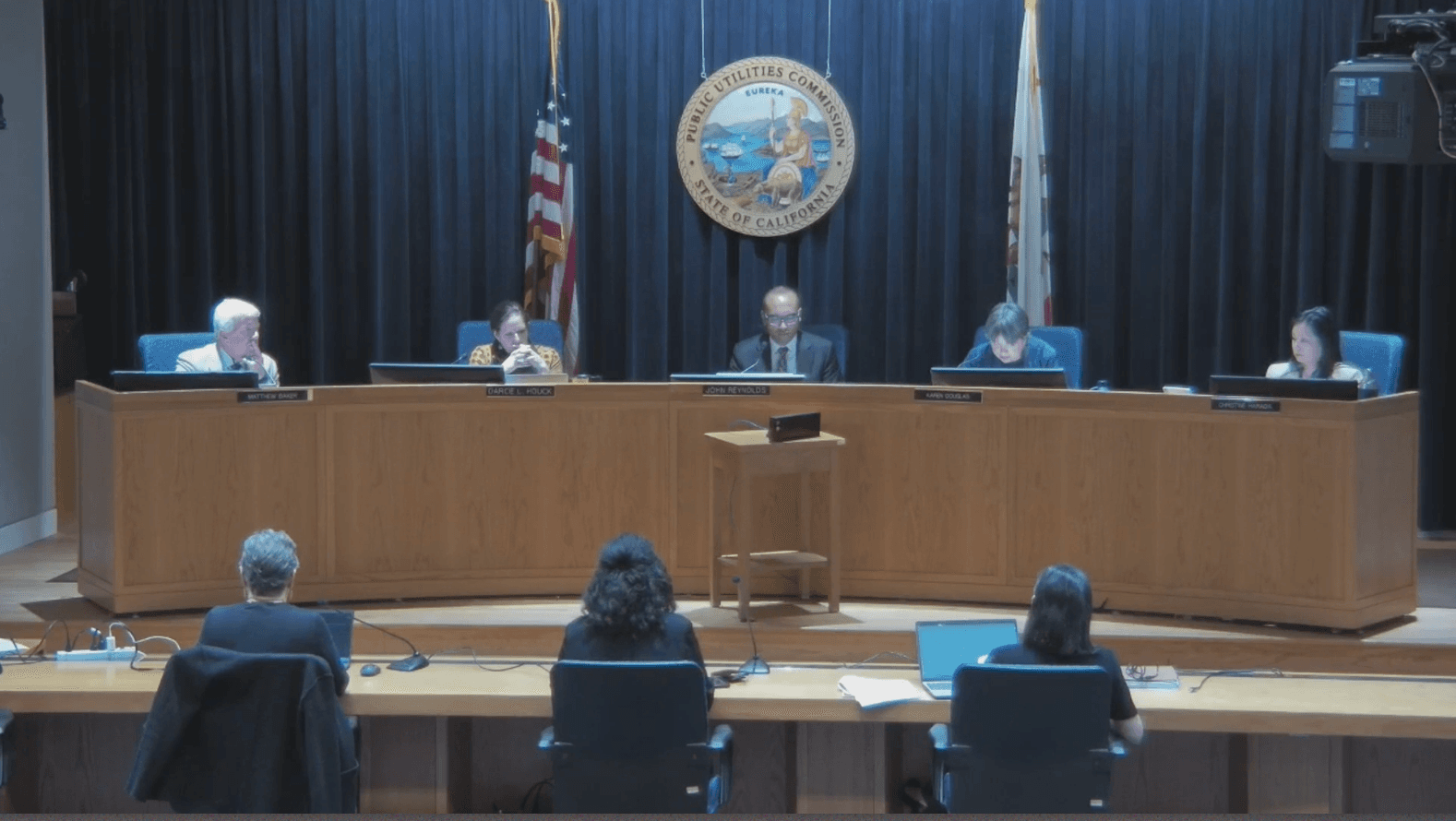
The California Public Utilities Commission used its May 14 voting meeting to protect ratepayers in some of Southern California's most disadvantaged communities — unanimously adopting an alternative rate decision that lowers Liberty Water bills and blocks the utility from collecting money for infrastructure it hasn't built. Meanwhile, commissioners clashed over how urgently to act for roughly 170 San Joaquin Valley communities still heating homes with propane, and more than a dozen public commenters mounted a passionate defense of copper landline phone service.
- Liberty Water rates cut instead of raised — alternative decision reduces Apple Valley Ranchos revenue by 7.7% and blocks ratepayer recovery for unfinished capital projects
- San Joaquin Valley petition denied 5-0, but Commissioner Houck presses colleagues to find a formal home for a six-year-delayed clean energy study
- Dozens of callers urge CPUC to save copper landlines, citing wildfire safety, disability access, and AT&T infrastructure neglect
- Central Valley families report Edison bills topping $1,600/month — Power California organizers also demand the utility cut ties with surveillance contractor Palantir
- Rural counties challenge BioMAT decision, alleging the Commission approved a consent item that falsely claimed no public comments were filed
Ratepayers Win: Liberty Water Must Build Before It Bills
The Commission's most consequential action was adopting an alternative proposed decision in the Liberty Water general rate case, covering Park Water Corporation and Apple Valley Ranchos water systems in Southern California.
The basics: Liberty Water had sought rate increases of 6.19% for Apple Valley Ranchos (AVR) and 14.3% for Park Water. An administrative law judge's proposed decision would have granted those increases. Commissioner Darcie L. Houck, the assigned commissioner, presented an alternative that flips the outcome — cutting AVR's revenue requirement by 7.7% and Park Water's by 0.7%.
Why it matters: The service areas include disadvantaged communities in historically redlined neighborhoods. The alternative decision establishes that utilities cannot collect ratepayer money for capital projects that were authorized in prior rate cases but never completed — a principle commissioners signaled should apply broadly.
Where things stand: The alternative proposed decision departs from the ALJ's version in two major ways.
First, on deferred capital projects: Liberty had previously been authorized to build infrastructure but left projects incomplete. The ALJ would have allowed those costs into rate base immediately. The alternative requires Liberty to demonstrate projects are "used and useful" before recovering costs through Tier 2 or Tier 3 advice letters.
"The APD states that these projects again remain approved, but that Liberty must complete them before it can recover the cost associated with the projects. This treatment aligns ratepayer and utility incentives," said Commissioner Houck.
Second, on revenue decoupling: The alternative rejects full decoupling — a mechanism that guarantees a utility's revenue regardless of how much water customers actually use — finding it does not promote conservation and shifts risk to ratepayers. Instead, it grants limited decoupling (MRAM) and adjusts the fixed-to-volumetric revenue split from 40/60 to 45/55.
"Instead of adopting full decoupling, the APD adopts a more targeted decoupling approach focused primarily on conservation-related usage impacts," explained President John Reynolds.
Commissioner Matthew Baker supported the approach, noting that full decoupling has a role but should be reserved for situations where utilities face genuine revenue erosion. "I think we've been very successful with conservation without it," he said.
Commissioner Christine Harada grounded the decision in the communities it affects: "Many of the communities that are in these water service areas are certainly disadvantaged communities and have been considered federal redline communities for decades, and it is just not right that the communities should continue to receive low quality service today because of a really bad history of neglect."
The alternative also adopted Cal Advocates' water sales forecasting methodology, denied Liberty's request to purchase new land for AVR wells, rejected merit and short-term incentive compensation tied to shareholder value, and adopted lower labor escalation factors (3.2%/2.4%/2.5% vs. Liberty's proposed 4%). Semi-annual reporting on deferred project status adds a new accountability layer.
Commissioner Houck also flagged a systemic problem: water utility rate cases are chronically delayed against the 14-to-20-month timeline in the rate case plan, which she said hasn't been updated since 2007. "I'm hopeful that the Commission will soon revisit the rate case plan for our water GRCs," she said.
Decisions: The alternative proposed decision passed 5-0. The original proposed decision (Item 47) and related Items 32 and 40 were withdrawn.
San Joaquin Valley: Petition Denied, but Pressure Mounts
Commissioners unanimously denied a petition asking the CPUC to reopen or launch a successor to its San Joaquin Valley disadvantaged communities proceeding — but not before a pointed debate about whether the Commission is moving fast enough for residents still cooking and heating with propane and wood.
The basics: The original proceeding was opened in 2015 under AB 2672, which directed the CPUC to study barriers to clean energy in the San Joaquin Valley. Phase 1 identified roughly 170 disadvantaged communities. Phase 2 launched pilot programs. The proceeding closed in August 2020 without advancing to Phase 3, an economic feasibility study. A petitioner argued the CPUC has a legal obligation under PUC Code Section 783.5 to reopen the matter.
Why it matters: These communities — many rural, low-income, and non-English-speaking — remain dependent on propane tanks and wood burning for basic heating and cooking. The economic feasibility study that could unlock cleaner alternatives has been delayed six years.
Where things stand: Commissioner Karen Douglas, the assigned commissioner, explained that while statutory obligations exist, the law sets no specific deadline. She noted that pilot project evaluations and bill protection analyses have continued. "The Commission has the discretion as to when and how to consider the matters set forth in the statute, including whether to do so through an existing proceeding, through a new rulemaking, or as we are right now, through ongoing studies and analysis," she said.
The other side: Commissioner Houck, who served as ALJ for Phase 2, offered the meeting's most forceful pushback. She argued that the economic feasibility study — originally supposed to be solicited in April 2019 — would not produce meaningful results without formal community engagement through an open proceeding.
Houck described visiting communities where residents showed commissioners propane tanks in their yards: "One lady described how it got so hot one summer, the cap popped off and there was propane leaking everywhere. And there's small children in this area."
She argued that these communities, many now fearful of engaging with government due to federal immigration enforcement, would not participate absent a formal proceeding with community-based organization partnerships and intervenor compensation. Rather than reopening the old proceeding, she proposed housing the study inside an existing docket — such as energy efficiency, CARE/ESA, or long-term gas proceedings.
Commissioner Douglas acknowledged the ideas had merit but maintained the petition itself should be denied on legal grounds. Commissioner Baker supported denial and emphasized leveraging existing programs like the Energy Savings Assistance Program. Commissioner Harada noted the tension between affordability concerns and infrastructure investment for disadvantaged communities.
Decisions: The petition was denied 5-0. President Reynolds committed to working with Director Tesfai and Energy Division to identify a procedural home for the economic feasibility study.
What's next: Staff will explore existing proceedings that could house the study and provide a framework for community engagement — though no specific timeline was announced.
Save Our Landlines: Callers Flood CPUC With Opposition
At least 15 public commenters turned the meeting's open comment period into a sustained protest against what they characterized as an AT&T-backed effort to retire copper landline phone service in California.
Why it matters: AT&T's push to eliminate Carrier of Last Resort (COLR) obligations and replace copper lines with wireless and VoIP alternatives would affect rural residents, seniors, and people with disabilities who depend on landlines — particularly during wildfires, earthquakes, and multi-day power outages when cell towers and internet-dependent services fail.
Where things stand: Commenters hit four consistent themes:
Emergency reliability. Multiple speakers from rural Sonoma and Plumas counties described week-long power outages during which only copper landlines functioned. Cheryl, a disabled senior in a wildfire-prone area, described being evacuated during the 2017 Lobo Fire via landline after cell towers were knocked out. David Sharp argued that VoIP and cell towers are fragile in earthquake country and that AT&T has neglected copper infrastructure because maintaining it isn't profitable.
Disability access. Several commenters cited electromagnetic hypersensitivity, which the California Supreme Court recognized as a physical disability in a March 2021 ruling. Karen Hudson cited a figure of 3.2% of Californians — roughly 1.26 million people — affected by the condition. Nina Beatty argued that the staff proposal to allow technology-neutral alternatives discriminates against disabled Californians for whom wireless and VoIP are unusable.
Rural service gaps. Callers reported poor cell coverage and restrictions imposed by AT&T. Kimiko Richmond, a disabled senior on SSI in HUD housing, described deteriorating AT&T landline service and an inability to use modern technology.
Federal preemption. Naveen Albert urged the CPUC to take legal action against the FCC's March 27 report and order (dockets 25-209 and 25-208), which aims to preempt state COLR protections.
No commissioners responded substantively to the landline comments, consistent with standard practice during open public comment.
Edison Bills Hit $1,600: Central Valley Organizers Sound Alarm
Three speakers from Power California, a community organizing group, called on the Commission to investigate Southern California Edison's rates in Tulare County and the broader Central Valley.
Why it matters: Speakers described an affordability crisis in a region already strained by rising costs for rent, gas, and healthcare, with utility bills consuming an outsized share of household income.
Where things stand: Joe Delgado, Power California's organizing director, reported that one in five SoCal Edison households are in debt at approximately $800. Rodolfo Morales, from Pixley, said community members are paying $1,200 a month. Audrey Whitaker described a family in Tulare County facing $1,600 monthly bills and called it a matter of life and death due to heat exhaustion risk.
All three speakers also demanded that Edison divest from contracts with Palantir, which they described as a surveillance company providing tools to ICE for deportations and detentions — a pointed concern in a region with large immigrant populations.
The speakers called on the CPUC to visit the Central Valley and hear directly from affected communities.
Rural Counties Challenge BioMAT Decision
John Kennedy of the Rural County Representatives of California objected to consent agenda Item 17, which addresses the BioMAT renewable energy program. Kennedy said the proposed decision inaccurately states that "there are no relevant comments on the docket card pertaining to the subject matter," asserting his organization filed timely comments in six parts and sent a letter to commissioners on April 30.
The procedural challenge raises due process questions about whether the CPUC's comment system adequately captures stakeholder input before decisions are finalized. Item 17 was approved on consent (4-0, Commissioner Baker recused).
Minor Items
- Item 13 held for one meeting by 5-0 vote; no discussion of subject matter.
- Consent Agenda 1 approved 5-0, covering approximately 30 items including Items 1, 3, 5–7, 9–10, 12, 16, 18–31, 33–34, 36–39, and 43.
- Consent Agenda 3 (Item 44) approved 3-0 with Commissioners Baker and Harada recused.
- Consent Agenda 4 (Item 45) approved 4-0 with Commissioner Harada recused due to a potential conflict from previous employment.
- Items 4, 8, 13, 14, and 15 were held to the June 11, 2026 meeting.
- Commissioner reports covered the CEC Summer Reliability Workshop, an Altadena rebuilding visit, a Stanford sustainable data center symposium, tribal energy partnerships, and new staff introductions. Commissioner Harada shared a personal reflection during AANHPI Heritage Month, noting her father grew up working on California farms during the era of alien land laws that prohibited Japanese Americans from owning property.