
Coastal Commission Certifies Pismo Beach Plan Overhaul, With Strings Attached
California Coastal Commission • California Coastal CommissionOctober 9, 2026
Locunity is an independent informational service and is not an official government page for this commission. All information is sourced from public footage and an analysis of official agendas with the aid of responsible, fact-checked AI. to report an error or omission.
Pismo Beach has a modernized coastal rulebook after nearly a decade of planning. On Oct. 9, 2026, the California Coastal Commission rejected the city's Land Use Plan as submitted, 0-9, then certified it without objection once staff's changes were added. Those changes cover beachfront parcels, shoreline access and short-term rentals. Elsewhere, commissioners waved off a Moss Beach neighbor's view appeal, cleared Marin's decade-long wildfire vegetation plan, and heard environmental groups say Sable Offshore is still defying Commission orders.
- Pismo Beach Land Use Plan certified with modifications after the as-submitted version failed 0-9.
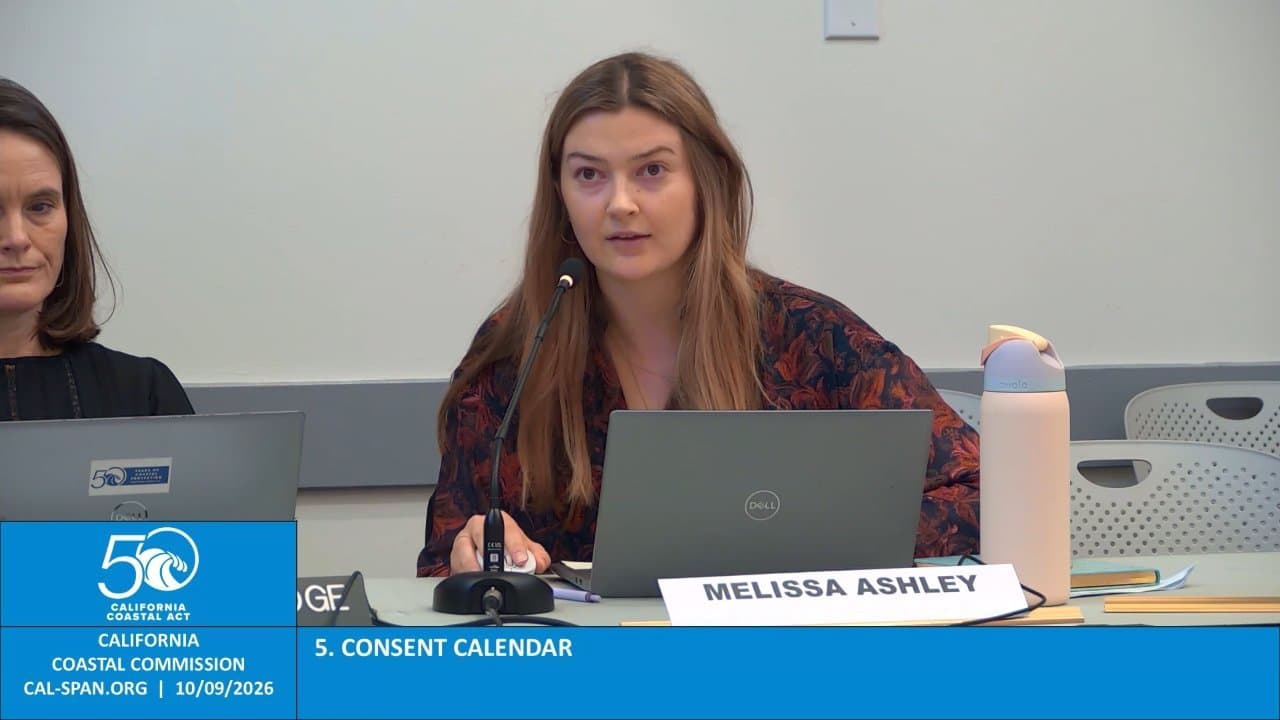
- Seal Cove home cleared: the Commission found no substantial issue in a private-view appeal.
- Marin wildfire plan and three Santa Cruz code updates passed on consent.
- Environmental coalition says Sable owes an $18M penalty and is digging without authorization.
- Commissioner Ariel Kelley criticized Newport Beach's 6 p.m. youth curfew messaging.
1 Big Thing: Pismo Beach's Coastal Blueprint Gets Rewritten
The basics: A Land Use Plan (LUP) is the policy core of a city's Local Coastal Program (LCP), which governs development in the coastal zone. The Commission first voted down the plan as submitted, which cleared the way to certify it with staff's suggested modifications.
Why it matters: The plan governs roughly six miles of shoreline. It adds requirements for lower-cost overnight lodging and encourages affordable housing above ground-floor commercial space. It defers sea-level-rise rules to a second phase.
Where things stand: Staff lead Sarah McGregor, Coastal Commission staff, said the update was partly funded by Commission grants and grew out of a community process that began in 2017. The plan keeps policies that steer development into already-built areas. It also:
- Updates protections for sensitive habitat, wetlands, and tribal and archaeological resources.
- Adds environmental justice and multimodal transportation policies.
- Consolidates 18 neighborhood planning areas into 10.
Staff's modifications remove a mixed-use designation from two beach parcels at the end of Addie Street. Those parcels sit next to Pismo Creek, where the Commission keeps its own permit authority. Other changes balance any habitat-related access limits against public access and require new vertical beach accessways to be evaluated for habitat, stability and safety.
The short-term rental change "would ensure that short-term rentals are provided in a manner that balances overnight visitor-serving accommodations with protecting neighborhood character and affordable housing stock," said McGregor.
The other side: Surfrider Foundation backed the update but wanted stronger hazard language. McGregor said the group asked "to require new development to waive any rights for future shoreline armoring and include a removal and site restoration requirement in lieu of such armoring." Staff agreed with the substance. They said those requirements already apply under the Coastal Act and the LCP, and that the city's upcoming hazards update is the right place for them.
Decisions and stakeholder impacts: Commissioner Ariel Kelley made both motions, and Commissioner Linda Escalante seconded them. The motion to certify as submitted failed on a roll call (For: 0, Against: 9: Escalante, Friend, Jackson, Kelley, Lee, Kalmick, Preciado, Wilson and Chair Megan Harmon). Certification with modifications then passed by unanimous consent. Commissioner Smith answered the opening roll call but was not called on this vote.
City officials accepted the changes. "We are in concurrence with the proposed modifications," said Scott Graham, Community Development Director, City of Pismo Beach.
The outcome affects several groups:
- Visitors gain a mandate for lower-cost lodging.
- Renters and long-term residents gain a short-term rental policy that weighs housing stock.
- Addie Street property owners lose mixed-use potential.
- Environmental advocates must wait for hazard rules.
Kelley praised staff for "really working in partnership with city staff to get out in front of some of those things," referring to parcels likely to draw development fights.
What's next: Graham said the project stalled in 2023 and was split into two phases with help from Commission staff. Phase 2 will update the city's safety element and hazard policies, and a vulnerability assessment is already complete. "We'll be looking to bring it before you probably towards the end of next year," said Graham. The staff report details all modifications.
Seal Cove Home Survives Neighbors' View Appeal
Why it matters: The decision reaffirms that Local Coastal Programs protect public views, not private ones. It came as residents warned that the Moss Beach neighborhood itself is unstable.
Where things stand: San Mateo County approved a single-family home of about 2,700 square feet, with a two-car garage, on a vacant lot of about 5,000 square feet inland of Seal Cove. Neighbors Dominic Dorn and Uma Parameswaran appealed. They argued that the county required no story poles, did no alternatives analysis and made conclusory view findings.
Dorn said a view analysis first shown Aug. 12 found "approximately 2/3 or greater of our dining room window would be obstructed," said Dorn, appellant. He added, "We are not asking that our neighbor be prevented from building."
Staff disagreed with the appeal. "While the LCP's design review standards encourage efforts to minimize impacts on neighboring views, the LCP does not actually protect private views, only public views," said Commission staff. Staff said the house was sited as far back on the lot as feasible. They called public view impacts insignificant, given the distance and intervening development.
The other side: Earlier, during general public comment, Sabrina Brennan, public commenter, described active landslides, sinkholes, sewer failures and red-tagged seniors. She said a local water and sanitary district will no longer serve more than 30 homes. "Our neighborhood is sliding towards the Fitzgerald Marine Reserve and the Pacific Ocean," said Brennan. She urged the Commission to oppose new Seal Cove development and supported a voluntary buyout.
Decisions and stakeholder impacts: Commissioner Jose Preciado moved to find no substantial issue, and Kelley seconded. The motion passed by unanimous consent, so the county permit stands. The applicant did not appear. The geologic hazards neighbors raised were not addressed in this action.
Marin Wildfire Plan Clears on Consent
Why it matters: The Marin Wildfire Prevention Authority's Forest Health and Fire Resilience Public Works Plan authorizes a decade of fire-related vegetation work in coastal dunes and wetlands. It won approval without a full hearing.
Where things stand: Four items were moved to consent:
- The Marin plan.
- A Santa Cruz County LCP cleanup.
- A deadline extension for Santa Cruz County's disaster-replacement rules.
- A City of Santa Cruz code cleanup that includes accessory dwelling unit standards.
One letter writer urged prioritizing home hardening over vegetation management. "While commission staff agree that home hardening efforts are also an important part of the overall strategy to reduce the risk of wildfire statewide, this PWP is only concerned with vegetation management work," said Commission staff.
The other side: Lillian Prince, a Scripps Institution of Oceanography graduate student speaking for herself, supported the plan. She said it overlooks marine species and ecosystems across Marin's 14 major watersheds. She also urged continued consultation with the Federated Indians of Graton Rancheria and stewardship roles for the tribe.
Decisions and stakeholder impacts: Anne Krelok, planning and program manager, Marin Wildfire Prevention Authority, backed certification, as did consultant Panorama Environmental. Kelley moved the consent items and Commissioner Friend, attending his first meeting, seconded. The items passed by unanimous consent.
Coalition Says Sable Is Still Defying Orders
Why it matters: Speakers said Sable Offshore restarted its Santa Barbara County pipeline and began excavating without Coastal Act authorization. They framed it as a direct test of the Commission's enforcement power.
Where things stand: Matt Kohler, Surfrider Foundation, said Sable restarted pipeline operations in early 2026. He said repair digs that followed violate the Commission's cease-and-desist order and a court judgment upholding it. "Sable continues to violate the commission's April 2025 orders by not paying the required penalty and failing to complete the required restoration," said Kohler.
Linda Krop, Environmental Defense Center, also spoke for Get Oil Out, Sierra Club, Santa Barbara Channelkeeper and Santa Barbara County Action Network. "Just 2 months later, testing on the pipeline revealed several anomalies, including 7 in the coastal zone," said Krop. Her other points:
- Sable sought county zoning clearance instead of Commission approval.
- Sable ignored a staff letter requiring Coastal Act authorization.
- Work occurred near the Gaviota Tarplant Reserve and the Arroyo Hondo Preserve.
- "Sable also has not paid the $18 million administrative penalty or completed all necessary restoration," said Krop.
What's next: The Commission took no action. The groups asked enforcement staff to hold Sable accountable.
Public Comment: Curfews, Rentals and Waterfront Views
About 18 speakers used general public comment to preview fights expected to return to the Commission.
Newport Beach curfew: Wade Womack, a Newport Beach resident, criticized the city's "Not in Newport" campaign. "The 6 PM unaccompanied minor curfew is unreasonable and unfair to law-abiding teenagers and children," said Womack. Kelley agreed and said city handouts suggested the beach was for residents only. "The beach belongs to everyone. And this is California's beach," said Kelley. She noted Commission staff are in talks with the city.
Short-term rentals: Noah Suarez Sykes, lead organizer, Better Neighbors LA, cited state housing law. "The commission cannot continue to defy the state legislature to prevent cities from doing so," said Suarez Sykes. Curtis Raynor, officer, Santa Monica Quaker Meeting, urged approval of Santa Monica's hosted-only ordinance, which he said will likely come before the Commission within the next month or so.
San Diego waterfront: Janet Rogers, Embarcadero Coalition, said the Port of San Diego's Master Plan update maps view corridors that don't exist. "Public access needs to be real, not fake lines on a map," said Rogers. One commissioner, describing a waterfront walk with Commissioner Raymond Jackson, said fencing near luxury yachts was "like razor wire."
San Onofre waste: Alice McNally, public commenter, said "SONGS has no El Niño emergency plan in place" for 1,800 tons of waste stored 100 feet from the surf. She urged the Commission to use its administrative order authority. Daryl Gale, public commenter, angrily blamed past commissions for the storage approval.
Minor Items
- Waddell Creek dune: The Commission concurred with a staff waiver for a State Parks log-and-dune project protecting Highway 1, built without armoring.
- Pacifica: Staff reported one LCP certification and one emergency permit; neither required Commission concurrence.
- Sand loss: Speakers warned of severe beach loss near Doheny and Capo Beach. Jackson cited firsthand El Niño erosion damage.
- Wildlife: Speakers flagged seabird entanglements at Point La Jolla, opposed San Diego's BioCap spray proposal and described a dried-out Ballona marsh.
- Venice and Palisades: Speakers sought an enforcement probe of the Venice Beach Business Improvement District and opposed artificial turf at the Pacific Palisades Recreation Center.
Looking ahead: Watch for Santa Monica's short-term rental ordinance and the Port of San Diego's Master Plan amendment, both expected before the Commission soon. Pismo Beach's coastal hazards update is targeted for late next year.