
Local Leaders Press Coastal Commission to Fund Sea Level Rise Response
California Coastal Commission • California Coastal CommissionNovember 6, 2026
Locunity is an independent informational service and is not an official government page for this commission. All information is sourced from public footage and an analysis of official agendas with the aid of responsible, fact-checked AI. to report an error or omission.
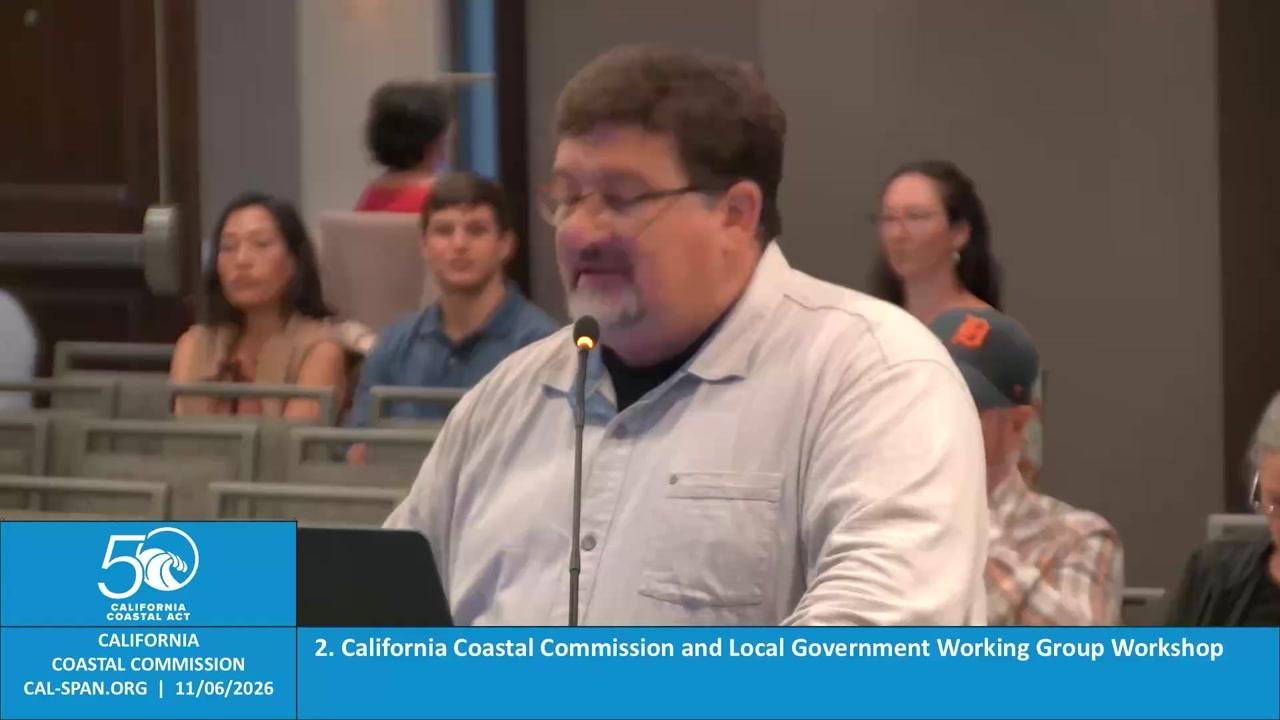
Record El Niño tides are giving California's coastal leaders a preview of conditions to come, and local governments told the California Coastal Commission on Nov. 6, 2026, that they cannot pay for what's coming alone. In a nearly two-hour workshop, the Local Government Working Group asked the Commission to back a call to action for state adaptation funding, faster approvals and earlier community conversations. A revised version returns for Commission support in December.
- Sea level rise call to action heads to December after a nearly two-hour workshop with no vote
- Surfrider and allies back funding but warn scaled plans could pre-justify seawalls
- Caltrans' Gaviota wildlife undercrossing approved despite objections over its location and calls for a master plan
- Seven San Pedro ADUs approved over tenant objections on parking, sewers and air quality
- Advocates urge denial of Beach Chalet artificial turf permit, citing microplastics and toxic runoff
Cities Say Adaptation Costs Exceed Local Budgets
Why it matters: Speakers described the El Niño tides as a preview of future baseline conditions. Cities and counties are signaling they will plan for sea level rise, but not without state frameworks and money.
Where things stand: This was the eighth joint workshop since 2019. The working group pitched a "scaled" approach, formerly called the neighborhood approach, that tailors adaptation to areas with shared characteristics.
Mayor Ed Wagy of Pismo Beach presented the call to action. It asks for:
- Expanded funding, including buyout, leaseback and transfer of development rights options
- More flexible disaster recovery funds
- Faster approval of nature-based projects
- Better coordination among agencies
- Earlier hard conversations, including with people who are often excluded
"Delay is not neutral," said Mayor Wagy.
Melissa Sparks-Kranz of the League of California Cities, who also spoke for the California State Association of Counties, said 61 coastal cities need pathways, tools and funding. Shawn Charpentier, City Manager of Pacifica, asked that strategic relocation, armoring trade-offs and funding be treated as one package.
The other side: Environmental groups backed the funding requests but warned about seawalls. Jennifer Savage, California Policy Associate Director at Surfrider Foundation, argued that phased adaptation is credible only if it is binding. She called for:
- Triggers and deadlines written into local coastal programs
- Hard end dates for temporary armoring
- No presumption that armoring wins when Coastal Act Section 30200 policies conflict
Lauren Witt of the Environmental Action Committee of West Marin urged dune restoration and living shorelines over neighborhood seawalls. Public commenter Mike Guth said dollar-at-risk figures are misleading when most homes are already unprotectable under their permit conditions.
Decisions and stakeholder impacts: No vote was taken. Commissioners pushed to widen the document's scope and urgency.
"We need legislation and we need funding to really address this," said Commissioner Mike Wilson.
Commissioner Christopher Lopez said, "we're specifically calling out tribal inclusion as well as labor," and asked that communities of color also be named.
Commissioner Linda Escalante called for a media and education campaign against pro-armoring narratives. "We cannot allow this narrative to continue running rampant without us countering it," she said.
Commissioners also raised the money question from several angles:
- Commissioner Smith said local governments should match new state grants, while noting that the ability to tax varies by community.
- Commissioner Williams described Caltrans' budget strain: "25% of our SHOP is going to emergency response, which is over $1 billion."
- Commissioner Raymond Jackson proposed county-by-county community meetings.
What's next: Facilitator Kalen McGee said the group will revise the document, including its sections on justice and inclusion, and "present it back to you in December for your support." Commissioner Wilson asked that it appear on next month's agenda.
Separately, staff's Kelsey Ducklow said draft policy and technical guidance on scaled adaptation, funded by a NOAA Project of Special Merit, will open for public review in December. Review runs into February, with adoption proposed in spring.
Gaviota Wildlife Crossing Wins Approval
Why it matters: The crossing relies on time-limited federal grant money tied to an existing Highway 101 project. Opponents say a regional plan would serve wildlife and steelhead better.
Where things stand: Permit 4-26-0650 covers 17 miles of Highway 101 rehabilitation in Santa Barbara County. It also replaces a 1952 culvert with an undercrossing roughly 25 feet wide, 15 feet high and 110 feet long. The project adds:
- Wildlife fencing
- Escape ramps
- Geofoam stabilization, under Special Condition 6
The permit carries 11 special conditions in total. Caltrans said the site scored 20 of 20 in its evaluation and is tied to an $8M federal grant.
The other side: Public commenter Doug Campbell said the site was chosen before the study was done, called the stakeholder meetings a charade, and said the area north of the Gaviota Tunnel needs action. Candace Minagan of the Coastal Ranches Conservancy said fish and wildlife passage needs have long been known. She asked that a master plan be made a condition of approval. Public commenter Susan Kirks worried a larger culvert could endanger smaller prey species.
Marlene Alvarado, Senior Coastal Planner, said other crossing locations fall outside this project's footprint. She argued that calls for a broader plan should not stop this project while the opportunity exists.
Decisions and stakeholder impacts: The permit passed by unanimous consent. No numerical tally was recorded, and the mover and seconder were not identified. Public commenter Colin Tolbert-Smith backed the crossing as a way to reduce danger to drivers and mountain lion deaths.
"This one is a fantastic one, and I'm so excited and so grateful that it's happening," said Chair Megan Harmon.
Larger species gain a passage now. Conservationists' push for a regional master plan and fish passage projects remains unresolved.
San Pedro Carport Becomes Seven ADUs
Why it matters: The case shows how state law on accessory dwelling units (ADUs), or backyard and add-on units, limits the Commission's tools to protect coastal parking.
Where things stand: Permit 5-26-0356, filed by Danny Monempour, converts a carport into seven 245-square-foot ADUs. The project adds four replacement parking spaces and 12 bike spaces, for a net loss of five parking spaces. Special Condition 1 requires 31 parking spaces and the bike stalls to remain for the life of the development. Staff also updated findings on parking along West 25th Street.
"State ADU law does not require replacement parking for a carport-to-ADU conversion," said Seth Villanueva, Coastal Program Analyst.
The other side: Tenant Cynthia Quintero cited sewer backups, density and unrealistic overnight street parking rules. Resident Bridget Kood cited:
- Loss of a laundry facility
- A new wall close to residents' windows
- Construction air quality for vulnerable residents
- Her concerns about the landlord's motives
Decisions and stakeholder impacts: Commissioner Susan Lowenberg said many of the complaints "should have been addressed to the building department" rather than to the Commission. Vice Chair Caryl Hart moved approval and Commissioner Lopez seconded. The permit passed by unanimous consent. The property owner gains seven units, while existing tenants absorb the parking loss.
Turf Opponents Target Beach Chalet Permit
Why it matters: Commissioners agreed to follow up with San Francisco Recreation and Parks and with staff on the complaints.
Where things stand: Several speakers asked the Commission to deny a permit for replacement artificial turf at Beach Chalet in San Francisco:
- Susan Mulaney cited lead, DEHP, PFAS and microplastics in runoff.
- Bob Hall asked for sampling across multiple storms, including for microplastics, and for the permit to be denied.
- Diane Wolke, a board member of Safe Healthy Playing Fields, urged the Commission to apply its policies to all petrochemical plastic surfacing. She cited installations in Chula Vista and Carlsbad.
- Sarah Minnell said an 11-mile slurry seal project in Mill Valley is shedding aggregate into salmonid creeks.
Decisions and stakeholder impacts: Commissioner Lowenberg asked whether contractors could be cited and offered to help set up a conversation with Rec and Park. Vice Chair Hart supported the concern.
"If it's a permit that the commission issues, we include BMPs and a whole host of other protective measures," said Kate Huckelbridge, Executive Director. BMPs are best management practices, the standard pollution controls attached to permits.
Minor Items
- Manhattan Beach housing LCP amendment approved on consent. Modifications protect affordable units for the life of the development rather than 55 years and keep ground-floor commercial space in mixed-use zones. The city must submit objective coastal protection standards within three years. City Planning Manager Adam Finestone supported the changes.
- Long Beach Vista Del Golfo seawall repair (5-25-0598) approved on consent. Mike Barmiller, representing the owners, said they do not oppose the project but oppose waiving their legal rights in the required acknowledgment agreement.
- El Niño emergency actions in Los Angeles County. These include a Dockweiler State Beach sand berm extended by 1,300 linear feet, repairs to broken piles in Long Beach, and repairs for two Peninsula homeowners.
- Four items postponed: an LA County San Pedro playground, the SCE Malibu staging yard appeal, the Cicileo trail gate and the Tahiti Marina reconstruction.
- General public comment raised four other issues. SEIU Local 1000 site steward Julian Honey urged support for striking state workers. Embarcadero Coalition Co-chair Janet Rogers said the San Diego Port Master Plan update drops committed parks. Other speakers raised Newport Harbor mooring fees and hosted-only short-term rental rules.
Looking Ahead
The revised call to action returns in December, the same month draft adaptation guidance opens for public review. A Commission vote on the San Diego Port Master Plan update is expected in the next few months. Staff will report a separate Long Beach boardwalk emergency permit next month.