
California Coastal Commission - Aug 13, 2026 - Meeting
California Coastal Commission • California Coastal CommissionAugust 13, 2026
Locunity is a independent informational service and is not an official government page for this commission.We use AI-assisted analysis and human editorial review to publish information.
Commission Blocks Offshore Fracking at Aging Platform in Unanimous Vote
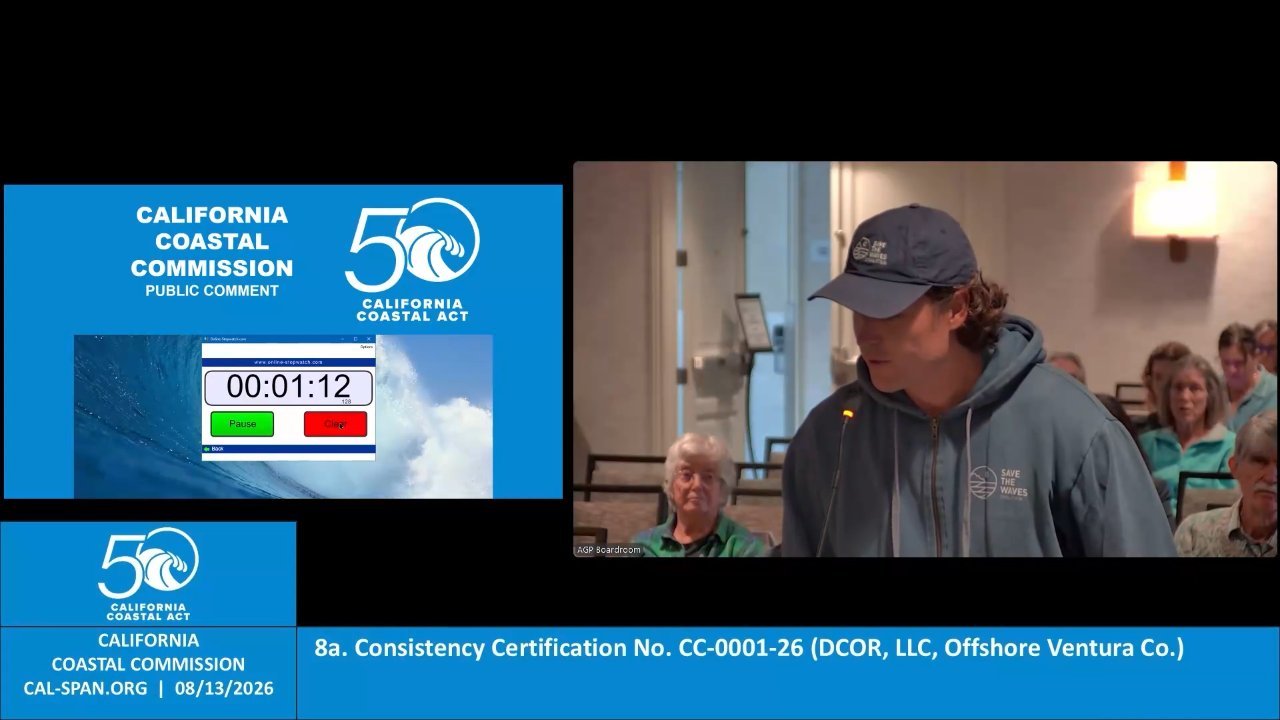
The California Coastal Commission sent an unambiguous signal Thursday: aging offshore oil infrastructure in the Santa Barbara Channel will not get a second life through hydraulic fracturing. In a 10-0 vote — with one recusal — commissioners objected to DCOR, LLC's proposal to frack 16 wells at the 45-year-old Platform Gilda, finding the project inconsistent with California's coastal management policies on everything from spill containment to seismic safety. More than 30 speakers testified against the project; not one spoke in its favor.
Commission votes 10-0 to block offshore fracking at Platform Gilda, citing inadequate spill response and aging infrastructure risks in the Santa Barbara Channel
Environmental groups, tribal representatives and a county supervisor line up against DCOR's plan to quadruple oil production through a platform twice past its design life
Organizations rally behind the Commission's coastal authority as NOAA reviews California's management program under federal pressure
Carpinteria Salt Marsh dredging approved with first-of-its-kind satellite turbidity monitoring that could set a statewide standard
Santa Monica wins a five-year trial for restricted parking near the coast, with annual monitoring and a sunset clause
Commissioner Wilson casts lone no vote on Redondo Beach electronic signs over dark-sky compliance concerns
No Fracking in the Channel: Commission Rejects DCOR 10-0
The most consequential action of the day consumed nearly two hours of testimony and deliberation. DCOR, LLC sought a federal consistency certification to hydraulically fracture 16 existing production wells at Platform Gilda, an offshore facility roughly nine miles off Ventura County that has been operating since 1981 — more than double its originally anticipated 18-year lifespan.
Why it matters: The project would have quadrupled daily oil production from approximately 1,100 barrels to 4,000 barrels per day and extended operations for roughly 20 additional years, yielding an estimated 14 million barrels of oil. Staff found the proposal inconsistent with multiple enforceable policies of the California Coastal Management Program (CCMP), most centrally Section 30232, which requires both hazardous material spill prevention and effective containment and cleanup.
Where things stand: Jonathan Bishop, staff presenter, delivered a detailed analysis explaining that while DCOR's prevention measures passed the first test of Section 30232, the company failed the second independent test — demonstrating effective containment and cleanup under realistic ocean conditions. Staff's spill trajectory modeling showed sobering numbers: "Floating oil affects approximately 895 square miles of ocean surface and approximately 134 miles of coastline, with shoreline contact occurring within 73 hours of the spill."
Staff cited historical spills — the 2015 Refugio pipeline disaster, the 2021 Amplify/Huntington Beach pipeline spill, and DCOR's own 2021 Pipeline 0919 incident — to demonstrate that mechanical recovery typically captures only 10–20% of spilled oil in real-world conditions. Beyond spill risk, staff found the platform's seismic design does not meet current USGS earthquake projections for the area, and the project was inconsistent with CCMP policies protecting marine resources, commercial fishing, public access, and air quality.
DCOR's case: Mark Chaconis, DCOR representative, argued the project was consistent with both the CCMP and the Coastal Zone Management Act, necessary for national security, and backed by federal certifications of structural integrity and a California Department of Fish and Wildlife-approved spill response plan.
A Flood of Opposition, Zero Support
The public comment period was one-sided. More than 30 speakers testified against the project — representing organizations including the Environmental Defense Center, Center for Biological Diversity, Oceana, Surfrider Foundation, Save Our Shores, Azul, the Sacred Places Institute for Indigenous Peoples, the California Coastal Protection Network, and the Santa Barbara Channel People Conservation Organization.
Salvador Tumamite Ambriz, tribal secretary of the Barbareno Venturino Band of Mission Indians, testified that all 200 tribal members oppose oil extraction from waters near their cultural hub. Jennifer Savage, policy director for the Surfrider Foundation, challenged DCOR's safety claims: "DCOR claims no record of any spillage from prior fracking treatments at this platform. Your staff report is explicit. That claim has not been independently verified, but is an unverified assertion in an application from an operator involved in two of the three most significant offshore spills in California in the past five years."
Supervisor Justin Cummings of Santa Cruz County, co-chair of the Save My Coast Coalition, urged commissioners to stand firm: "I know that you all today may be under pressure given that BOEM is trying to decertify our coastal management program here in California. But I'm just asking that you all stay strong and not be intimidated by that and that you uphold the staff's recommendation."
Commissioners Leave No Doubt
Every participating commissioner spoke to the record. Commissioner Mike Wilson walked through the policy inconsistencies in detail: "We know that hydraulic fracturing works by injecting fluid at high pressure into rock and hold it open. And that physical process adds mechanical stress to whatever infrastructure runs through it, wells, wellhead, flow lines, regardless of who operates it or how carefully."
Commissioner Ann Notthoff put the risk in historical context: "I want to say that sadly the technology to contain and clean up an open ocean spill has really not progressed much since" the 1990 California Oil Spill Prevention and Response Act was adopted.
Vice Chair Dr. Caryl Hart flagged the legal dimension: "There is currently an injunction that covers the sort of program, and now they're proposing one project within the program. However, the injunction still applies."
Commissioner Raymond Jackson offered the most quotable summation: "Just because we can do something doesn't mean that we should. And this is just simply one of those cases where the juice isn't worth the squeeze."
Commissioner Kalmick recused himself due to receiving a settlement from a class action lawsuit against DCOR related to a 2021 oil spill.
Decisions: The motion to concur with DCOR's consistency certification failed 0-10 (For: 0, Against: 10, Recused: Kalmick). Under the Coastal Zone Management Act, the failure of the concurrence motion constitutes a formal objection to the project. The companion item — a BOEM consistency determination for the same project — had already been withdrawn after staff determined the proper review pathway was through DCOR's certification.
What's next: DCOR may appeal to the Secretary of Commerce under the CZMA override provision. The unanimous vote underscores the Commission's stance that aging offshore infrastructure cannot meet Coastal Act spill containment standards — a signal that carries weight as NOAA simultaneously reviews California's coastal management program.
Satellite Eyes on the Shore: Carpinteria Dredging Sets New Monitoring Standard
Why it matters: The Commission unanimously approved a five-year routine maintenance permit for the Santa Barbara County Flood Control District to dredge flood control channels at Carpinteria Salt Marsh, but the real news is the condition attached to it. Special Condition 9 requires the District to help fund a scientific study by the Southern California Coastal Water Research Project (SCCWRP) using satellite data to characterize nearshore turbidity patterns from surf-zone sediment placement — a pilot that staff said could become a new statewide standard for evaluating environmental impacts of beach dredging.
Where things stand: The permit authorizes periodic dredging using both dragline and hydraulic methods, mechanical opening of the marsh mouth, and maintenance of pilot drainage channels. The permit carries 17 special conditions total.
Commissioner O'Malley praised the SCCWRP partnership, citing 15 years of experience working with the research organization: "I'm really glad to see us partnering with SCCWRP on this."
Decisions: Approved unanimously (For: 10, Against: 0).
What's next: The SCCWRP satellite monitoring study could reshape how the Commission evaluates sediment placement projects statewide, establishing data-driven regulatory guidance where subjective assessments currently govern.
Parking Near the Beach: Santa Monica Gets a Five-Year Trial
The basics: The Commission approved a coastal development permit for the City of Santa Monica to establish a residential preferential parking district on five blocks in the Ocean Park neighborhood near Lincoln Boulevard. The zone would restrict public parking to two hours between 7 a.m. and 6 p.m. without a permit, affecting 131 on-street spaces roughly a mile from the beach.
Why it matters: Staff recommended approval with four conditions — filed plans, a five-year term limit, a parking monitoring plan, and Commission review of future changes. Only Pier Avenue has completed the required two-thirds household petition, so restrictions would be implemented there immediately; the remaining blocks need to meet the petition threshold before any restrictions take effect.
Where things stand: Commissioner Raymond Jackson raised an unusual observation — residents pushing back against their own parking restrictions: "I've never heard community pushback against the opportunity to limit parking. So that's really where I'm trying to figure out the connection or the disconnect here." He questioned whether the parking shortage stems from residents using garages for non-parking purposes. Commissioner Ariel Kelley requested the city engage specific residents who had submitted opposition letters. Commissioner Ann Notthoff noted the area has older craftsman homes with limited off-street parking and clarified the Commission's action was permissive rather than directive.
One public commenter, Susan Allen Sangin, a neighboring Ashland Avenue resident, supported the program, noting her street faces similar issues with LAX parking spillover and Lincoln Boulevard business parking.
Decisions: Approved unanimously (For: 10, Against: 0).
What's next: Monitoring data collected under the five-year sunset will inform the Commission's approach to future coastal parking restrictions statewide.
Wilson's Lone No: Dark-Sky Standards for Coastal Signs
During the consent calendar vote on items moved from the regular agenda, Commissioner Mike Wilson cast the only no vote — specifically targeting Redondo Beach's LCP amendment (Item 14A) allowing electronic signs in the harbor area.
Wilson noted the amendment lacks shielding requirements, lumen caps, and color temperature limits and does not comply with dark-sky standards. Staff explained they did not require dark-sky compliance given the urban setting and the limited scope of five signs. Wilson requested — and staff agreed — that a letter be sent to Redondo Beach's design review committee encouraging dark-sky considerations.
Decisions: Items moved from regular to consent approved 9-1 (For: 9, Against: 1 — Wilson).
Coastal Authority Under Pressure
Threaded throughout the meeting — during general public comment and the DCOR item — was a clear subtext: the Commission's federal consistency authority faces an active challenge. NOAA is reviewing California's Coastal Management Program, and multiple speakers from Oceana, Save Our Shores, Indivisible Santa Cruz County, and other organizations framed their testimony as both opposing fracking and defending the Commission's review power.
Executive Director Kate Huckelbridge acknowledged the review but reminded commissioners that their task was to evaluate the specific consistency certification before them. The unanimous DCOR objection, rendered under that very authority, served as its own answer to the federal pressure.
Minor Items
Original consent calendar (items 5A, 5B, 5C): Three coastal permits — a Venice single-family home remodel, a Hermosa Beach retail space remodel, and a Hermosa Beach four-unit apartment remodel — approved unanimously.
BOEM consistency determination withdrawn (Item 8B): BOEM pulled its parallel review of the DCOR Platform Gilda fracking project after staff determined the proper pathway was through DCOR's certification.
NPS Stinson Beach restoration (Item 8C): National Park Service habitat restoration plan for Stinson Beach approved on consent, restoring native dune and riparian habitats despite a 10% parking reduction.
NMFS fisheries research (Item 8D): National Marine Fisheries Service research consistency determination approved on consent. Commissioner Notthoff flagged underwater acoustic impacts on marine life as a concern: "I do appreciate put a pin in making sure that we're taking a close look at acoustic impacts to marine life."
Venice dispute resolution (Item 16A): SonnyBoy Hospitality restaurant dispute withdrawn after parties resolved the filing issue.
East Beach mooring controversy: During general public comment, four speakers — Steve Worthington, Nathan Starkey, Ian Pollock, and Graham Martin Sotaro — formally objected to an executive director immaterial determination that would convert Santa Barbara's East Beach Area C from a free seasonal public anchorage to 17 fee-based rental moorings. They requested a public hearing and an independent materiality determination.
Deputy Director reports for Energy/Federal Consistency, South Central Coast, and Los Angeles County all concurred without objection. Notable items included Ventura County's sea level rise LCP amendment certification and emergency permits for Malibu debris removal.