
California Coastal Commission - Aug 14, 2026 - Meeting

California Coastal Commission - Aug 14, 2026 - Meeting

California Coastal CommissionCalifornia Coastal CommissionAugust 14, 2026

Sources:

Locunity is a independent informational service and is not an official government page for this commission.We use AI-assisted analysis and human editorial review to publish information.

Commission Certifies Landmark Mission Bay Wetland Restoration After Marathon Hearing

The California Coastal Commission advanced one of Southern California's largest coastal habitat restoration plans, heard blistering testimony about the City of San Diego's failure to protect sea lions at La Jolla Cove, and reinforced its precedent on beachfront setbacks — all during a packed Friday session that stretched across seven action items and more than 30 public speakers.

  • Commission certifies De Anza Natural plan to restore 140+ acres of Mission Bay wetlands, converting mandatory policy language the city resisted

  • Commissioners demand San Diego fix sea lion protections after volunteers document 43% pup mortality and lifeguards undermining ranger enforcement at La Jolla Cove

  • Newport Beach accused of secretly freezing liveaboard permits and pricing out middle-class boaters with fees 474% above the state average

  • Beachfront development in Sunset Beach approved 8-1, with the Commission requiring five-foot setbacks at all floors to preserve public beach as sea levels rise

  • Laguna Beach paid parking pilot upheld after Commission finds no substantial issue with metered spaces along Coast Highway

  • Dana Point reconciles 18 uncertified zoning ordinances, but disputed garage-vs.-carport rule for flood-prone Beach Road deferred


De Anza Natural: A Generational Bet on Wetland Restoration

Why it matters: The De Anza Natural plan covers 505 acres of northeastern Mission Bay — converting the aging Campland on the Bay lease area into more than 100 acres of restored salt marsh, expanding overnight RV camping from 30 to 50 acres, and establishing an interpretive nature center. It is one of the largest coastal wetland restoration proposals in San Diego's history, backed by the 101-organization Rewild Mission Bay coalition.

Where things stand: Staff Analyst Alex Urandi presented the plan and recommended denial as submitted, followed by approval with modifications. The core dispute was straightforward but consequential: the city's draft used advisory language — "should" — throughout its environmental policies, while Commission staff insisted on enforceable "shall" language. Staff argued that under the Coastal Act, land use plans must contain mandatory protections, not suggestions.

The city pushed back. Kelly Stanko of the San Diego Planning Department argued that mandatory language is inappropriate for a long-range planning document and that existing city regulations already provide enforcement mechanisms. Deputy Director Carl Schwing countered that the Coastal Act requires LUP policies to be self-executing — if the plan says "should," there is no legal hook to enforce habitat protections when individual projects come forward.

Staff modifications also addressed water quality monitoring, cultural resource protections for Kumeyaay heritage sites, clear limits on habitat conversion, and sea level rise adaptation — including a requirement that new structures be designed for disassembly as conditions change. At the San Diego Bird Alliance's request, staff added a prohibition on artificial turf within the plan area.

Stakeholder alignment: San Diego City Council President Joe LaCava called the plan one of the city's most significant achievements. Andrew Meyer of the San Diego Bird Alliance and Rewild Mission Bay supported the staff modifications. Ali Linton, representing the Kumeyaay community, spoke at length about the cultural significance of the site, emphasizing that restoration must include meaningful protections for Indigenous heritage.

Commissioner Nothoff noted the city and staff ultimately agree on the desired outcome — the fight was over enforceability. Commissioner O'Malley moved the procedural votes.

Decisions: The Commission first voted unanimously (9-0, one absent) to reject the plan as submitted, then voted unanimously (9-0) to certify it with staff modifications. The result: every advisory "should" in the plan's habitat, water quality, and cultural resource policies becomes a mandatory "shall."

What's next: The city must accept the modifications and begin the long implementation process, including negotiating the end of the Campland lease and phased wetland construction. Individual development proposals within the plan area will return to the Commission for coastal development permits.


Sea Lions, Lifeguards, and a City at War With Itself

Why it matters: Despite a joint protection plan presented to the Commission in June, volunteers documented that the City of San Diego has failed to implement basic measures at La Jolla Cove — and that city lifeguards are actively undermining the rangers tasked with enforcing them.

Where things stand: A coordinated group of speakers from the Sierra Club Seal Society, Wildlife Jewels, and the San Diego Bird Alliance laid out a damning case. Sunny Cha of the Sierra Club Seal Society reported 43% pup mortality this season — 21 births, six verified deaths, five rescues of pups deemed abandoned — compared to just 6% at nearby Point La Jolla, where protections are stronger.

Nathan Brenner, also of the Sierra Club Seal Society, documented that rangers rarely station on the beach, cones and tape barriers are seldom deployed, and city lifeguards tell visitors the beach is entirely open — directly contradicting ranger instructions. Dr. Aziz Sharif of Wildlife Jewels described tourists feeding, crowding, and kicking sea lions, with evidence of potential gaff injuries.

"I'm beyond angry and quite honestly just embarrassed to be a City of San Diego resident right now," said Commissioner O'Malley. "I'm at the point where I believe a partial closure is really the only way to deal with the issue until the city gets their program implementation figured out."

Commissioner Nothoff offered a blunt comparison: "The city of Monterey at San Carlos Beach, when the sea lions are present there, the city closes the beach to people and the sea lions are there and they do their pupping and then they leave."

The other side: Emily Piatanesi from the Mayor's Office acknowledged the internal conflict between lifeguards and Parks and Recreation and said the city would work to unify messaging. Executive Director Kate Huckelbridge said staff would meet with the city to explore citation authority beyond the federal Marine Mammal Protection Act.

What's next: No formal vote was taken — this arose during general public comment — but the Commission's frustration was unmistakable. Staff will meet with city officials, and the issue is likely to return with potential enforcement action or a push for partial beach closure.


Newport Beach Mooring Crisis: Permit Freeze, Fee Hikes, and an "Economic Wall"

Why it matters: Eight speakers told the Commission that Newport Beach has quietly stopped issuing liveaboard permits — eliminating some of the last affordable housing on the coast — while simultaneously proposing mooring fee increases that would price out middle-class boaters.

Where things stand: Adam Leverins revealed the city has not issued a liveaboard permit since September 2024, displacing at least nine households without public notice or coastal development permit review. Ann Stenton of the Newport Mooring Association described a statewide trend: rate increases have forced 800 boaters from Dana Point Harbor, and Newport mooring fees jumped 34% this year alone.

Christopher Bliss presented data showing Newport's mooring fees are already 69% higher than any other California harbor. Proposed increases would push them to 474% above the state average — what he called "an economic wall around Newport Harbor."

The other side: Commissioner Preciado raised an important counterpoint about whether generational mooring use truly constitutes public access: "I'm trying to understand how we reach points where a public asset can become a personal family asset."

Vice Chair Hart framed it differently: "I really do think it's an environmental justice and an access issue."

Executive Director Huckelbridge noted the city and State Lands Commission are working toward a comprehensive solution, with public hearings expected before next summer.


Sunset Beach Setback: The "Shy Zone" Precedent Holds

Why it matters: A seemingly routine beachfront development permit became a test of whether the Commission would maintain its 2018 precedent requiring setbacks at every floor — not just the ground level — to protect public beach access as sea levels rise.

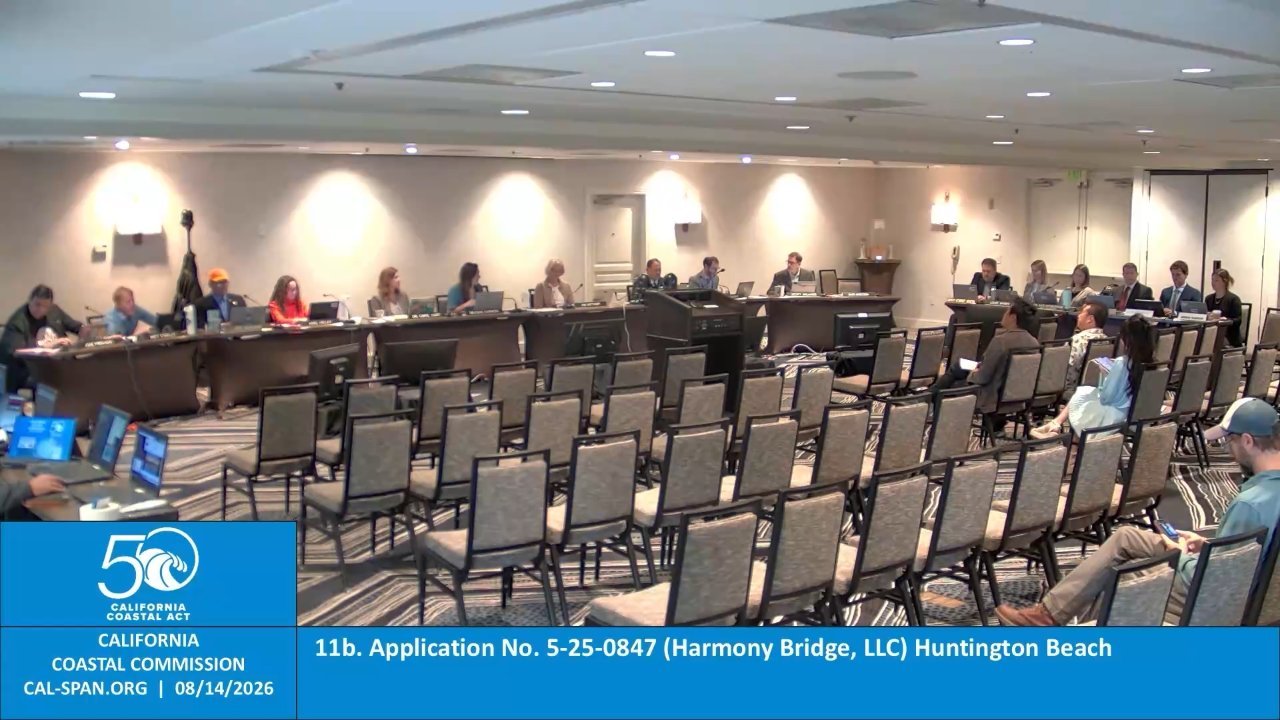
Where things stand: Staff Analyst Willie Runagi presented the application from Harmony Bridge LLC to demolish an existing 18-foot quadplex at 16733 S. Pacific Ave. in Sunset Beach and build two single-family homes with accessory dwelling units. The applicant proposed a five-foot setback at the ground floor but zero setback on upper floors. Staff recommended the five-foot setback at all levels.

Commissioner Wilson introduced the key concept: "People are shy to walk up against a building or an overhang, and the overhang, if it's coming to the property line, it will affect whether or not people feel comfortable in approaching that space." As the beach narrows with sea level rise, upper-floor balconies at the property line create a "shy zone" that effectively shrinks the usable public beach.

Commissioner Kalmick noted Sunset Beach lacks a certified local coastal program, making Commission precedent especially important. Commissioner Preciado questioned the loss of buildable area but ultimately voted no.

Decisions: Approved 8-1 (For: 8; Against: 1 — Commissioner Preciado; Absent: 1). The five-foot seaward setback applies at all levels.


Laguna Beach Parking Pilot Survives Appeal

Why it matters: Appellants argued that installing 237 metered parking spaces at $3.95 per hour along roughly 3 miles of Coast Highway violates a 2011 LCP amendment prohibiting preferential parking districts and would restrict coastal access.

Where things stand: Staff Analyst Jeffrey Palm presented the one-year pilot program, which would establish 501 delineated spaces — 264 free and 237 metered — with five-hour time limits from 8 a.m. to 7 p.m. Revenue funds the city's free trolley service. Appellants Brian Menney and Paul Merritt contended the program reduces available parking and disadvantages visitors.

Staff found the program does not constitute a preferential parking district and maintains free overnight parking plus a majority of free daytime spaces.

Commissioner Preciado cut through the debate: "Parking in your neighborhood is not your parking. It is public parking."

Decisions: The Commission unanimously found no substantial issue (9-0, one absent). The pilot proceeds.


Dana Point Reconciles 18 Uncertified Ordinances

The basics: Dana Point had accumulated 18 city ordinances that were never formally certified into its local coastal program. Staff Analyst Vince Lee presented a comprehensive cleanup amendment to bring them into compliance.

Where things stand: Most changes were non-controversial. The key dispute involved whether Beach Road properties in the floodplain should be allowed to use enclosed garages instead of the currently required carports. Staff argued that enclosed garages in the floodplain create marine debris hazards during storm events and high tides — breakaway wall panels become projectiles. The city proposed a footnote compromise distinguishing flood hazard from non-flood hazard areas, but staff recommended maintaining the status quo.

Mayor John Gabbard and Jonathan Lightfoot of the City of Dana Point spoke in support. Commissioner Nothoff noted both sides agree on the practical outcome and moved approval with staff modifications.

Decisions: Rejected as submitted (unanimous), then certified with modifications (unanimous). The garage-vs.-carport question for Beach Road is deferred to a future amendment focused on sea level rise.


Minor Items

  • Consent calendar (Items 11A, 12A, 14A, 15A): Four items approved unanimously, including conditions for San Diego Bayfair racing requiring wildlife monitoring and a public benefits plan.

  • Mission Beach and Pacific Beach jurisdiction maps (F16a): Adopted unanimously. The first official digital boundary maps — built with modern GIS — for Commission permit and appeal jurisdiction in two of San Diego's most visited beach communities. Jeffrey Rosen of Defend Coastal Access raised concerns but the Commission found no issue.

  • Orange County deputy director's report: Included waivers, time extensions, and an emergency coastal development permit for unpermitted excavation in San Clemente.

  • San Diego deputy director's report: Noted an emergency sewer repair in Carlsbad and the completion of Oceanside's LCP adoption.

  • Point Lobos overcrowding: Betty Maruto, president of the Point Lobos Foundation, described the reserve as being "loved to death" and urged support for a reservation and shuttle system. Sherry Hasty of Community Partnership for Youth argued that unmanaged access actually excludes families with elderly or mobility-impaired members.

  • Artificial turf pollution: Robert Hall warned about microplastic and PFAS contamination from Beach Chalet soccer fields in San Francisco's coastal zone, scheduled for plastic turf replacement in 2028. Diane Wolke of Safe Healthy Playing Fields raised similar concerns about a proposed Topgolf facility at East Harbor Island in San Diego.

  • Embarcadero Hotel violation: Janet Rogers of the Embarcadero Coalition reported that the Intercontinental Hotel's private rooftop Reading Club violates its CDP-required public access, with $3.8 million in potential ill-gotten gains and no fines assessed.

  • Dana Point Harbor boat hoist: Michelle Kraus of the Dana Point Harbor Youth Foundation urged preservation of the harbor's last remaining boat hoist until an equivalent facility is operational.

  • Herbicide concerns: Melinda McNaughton opposed glyphosate use in wildfire fuel management in coastal zones, citing EPA findings that glyphosate harms 93% of listed endangered species.

Commission Certifies Landmark Mission Bay Wetland Restoration After Marathon Hearing | California Coastal Commission | Locunity