
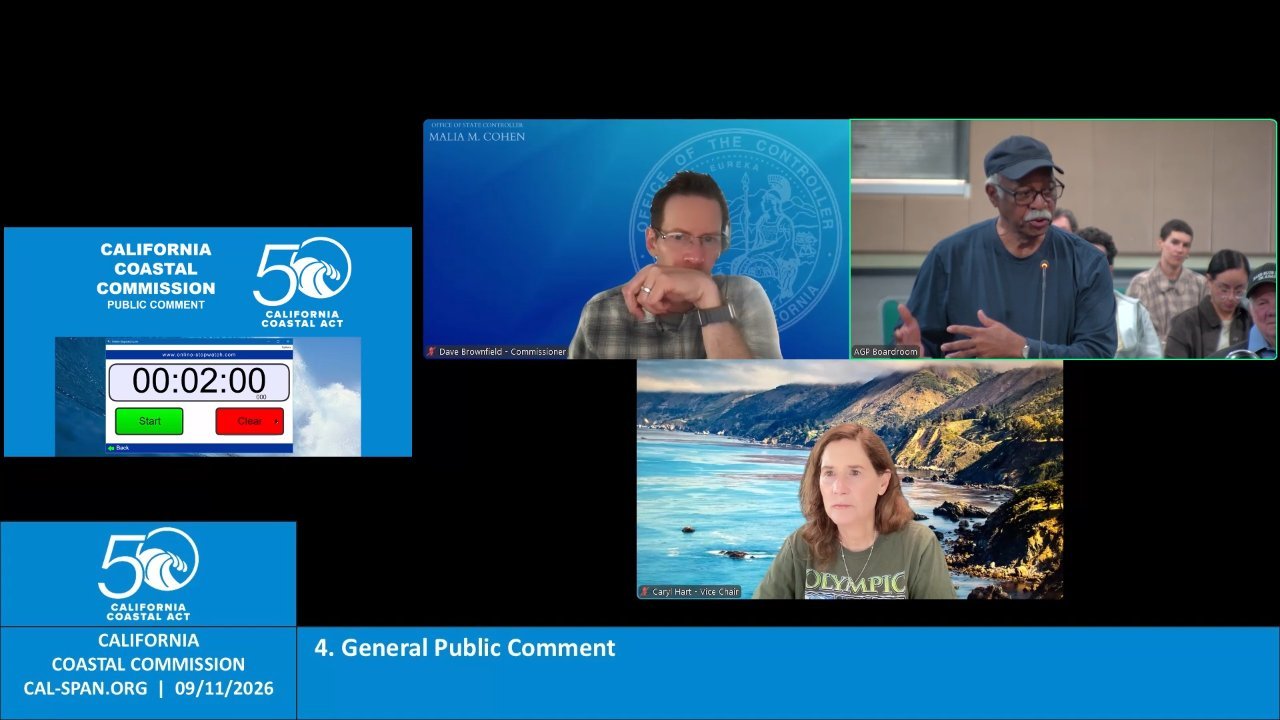
California Coastal Commission - Sep 11, 2026 - Meeting
California Coastal Commission • California Coastal CommissionSeptember 11, 2026
Locunity is a independent informational service and is not an official government page for this commission.We use AI-assisted analysis and human editorial review to publish information.
(Day 2): Malibu Beachfront Home Approved as Climate-Resilient Coastal Template
The California Coastal Commission's Friday session turned into a masterclass in climate adaptation — unanimously approving a redesigned Broad Beach residence with 13 special conditions that forced the home landward and off its seaward pilings, while hearing a parade of public testimony on coastal destruction, offshore wind equity, and the housing squeeze from short-term rentals. The meeting fell on the anniversary of September 11, and Commissioner Mike Wilson closed public comment with a tribute to a Humboldt Bay wildlife refuge manager killed aboard Flight 93.
Redesigned Malibu Broad Beach home approved unanimously with conditions requiring landward shift, removable deck, and protected public access path
Environmental justice coalition urges Commission to partner with frontline communities before offshore wind terminal permitting in Humboldt Bay and Long Beach
Coastal storm damage documented from Carlsbad to Malibu — 19 homes red-tagged in Dana Point, 31 evacuated in Malibu after Hurricane Marie swells
Residents from three cities call for stronger short-term rental rules, with Commissioner Wilson urging the legislature to act
Newport Beach liveaboards warn of 700% mooring fee hikes that could displace retired seniors from affordable waterfront housing
Long Beach inclusionary housing ordinance certified for the coastal zone, requiring affordable units in new development
Climate-Resilient Blueprint: Broad Beach Home Gets Green Light
The basics: The Commission unanimously approved a de novo coastal development permit for a residence at 31340 Broad Beach Road in Malibu — a case four years in the making after two commissioners appealed the City of Malibu's original approval in 2022. The original design extended seaward of required stringlines (the alignment connecting adjacent structures that limits how far toward the ocean new development can go), included a pile-supported deck encroaching into a required 10-foot public access path, and featured a solid concrete privacy wall that also violated access requirements.
Where things stand: After replacing architects and working extensively with Commission staff, the applicant delivered a fundamentally different project. Staff analyst Gabriella Goff explained that the revised design moved the residence 3.5 feet landward, relocated the deck approximately 33 feet landward to eliminate any encroachment into the public access path, swapped pile supports for a cantilevered deck design that is readily removable, and replaced the seaward concrete wall with a 6-foot wood fence to reduce visual impacts. The permit carries 13 special conditions.
Commissioner Ann Notthoff called it a model for the Commission's work: "This seems like such a textbook example of the good working relationship interaction between applicants, local governments and Coastal Commission on how do we get climate resistant — the best climate resistant development approved."
The other side: Vice Chair Dr. Caryl Hart pressed the applicant on proximity to the unfolding disaster just a third of a mile away on Sea Level Drive, where sinkholes have opened and homes have been red-tagged. "This is very near to the disaster that's unfolding in Malibu, right?" she asked. Applicant's counsel Ken Ehrlich confirmed Broad Beach Road remained open but acknowledged the area's hazards, noting his dual role as counsel for the Broad Beach Geologic Hazard Abatement District. Architect Doug Burge walked through the four key design changes: stringline compliance, removal of pile-supported deck development, a revised privacy fence for public access, and the cantilevered deck design.
Decisions: The permit passed unanimously via roll call (For: 12, Against: 0, Absent: 0). Motion by Commissioner Notthoff, seconded by Commissioner Wilson.
What's next: The 13 special conditions — including requirements that the deck be readily removable as sea levels rise — set a template the Commission is likely to apply to future beachfront applications in hazard zones along Broad Beach and beyond.
Offshore Wind Equity: Environmental Justice Coalition Demands a Seat at the Table
Why it matters: Heavy-lift marine terminals proposed near residential communities in Samoa (Humboldt County) and the Ports of Long Beach and Los Angeles could repeat the environmental injustice patterns that have given port-adjacent neighborhoods some of the nation's worst air quality — unless the Commission builds community partnership into the permitting process before decisions are made.
Where things stand: A coordinated delegation from the IMPACT Project coalition — spanning Earth Justice, the Central Coast Alliance United for Sustainable Economy (CAUSE), East Yard Communities for Environmental Justice, and the Samoa residential community — delivered back-to-back testimony urging the Commission to proactively engage frontline communities.
Vanessa Rivas Villanueva of Earth Justice highlighted the South Coast air quality crisis, warning of potential Clean Air Act sanctions including loss of federal highway funding. Dr. Alex Montanoya of CAUSE presented survey data showing 70% public support for offshore wind after education about pros and cons, stressing the need for community-centered development. Marcos Lopez of East Yard Communities for Environmental Justice described how industrial operations at the ports impact neighboring communities and urged the Commission to scrutinize industrial zoning near the Samoa residential community.
Rod Gonzalez, a Samoa homeowner and 40-year construction tradesman who lives 80 feet from the proposed heavy-lift terminal site, made the most personal appeal. He described ongoing violations by developer Danco and asked the Commission to require alternative site studies, with relocation as the top recommendation for his community.
Darrell Golden of West Long Beach put the human cost in stark terms, describing port pollution deaths in his neighborhood and asking the Commission for relief. Kent Sawatsky warned that a heavy-lift terminal could be repurposed by the federal government as a strategic port for oil derricks, citing offshore oil and gas reserves.
Commissioner Notthoff responded with cautious optimism: "I just hope we have a chance to do it right this time. There's so many impediments to doing clean energy right now with the federal administration." Commissioner Wilson thanked speakers for building cross-jurisdictional solidarity between Humboldt and Long Beach communities.
Hurricane Marie's Wakeup Call: Damage From Carlsbad to Malibu
Why it matters: The LA Times called recent coastal destruction "just a glimpse of what is coming this winter" — and a Surf Fighter Foundation presentation laid out the evidence beach by beach, underscoring the urgency of the Commission's managed retreat and climate adaptation policies.
Where things stand: Mitch Silverstein of the Surf Fighter Foundation presented slides documenting damage from Hurricane Marie swells, high tides, and a marine heat wave across Southern California: a destroyed boardwalk on the Long Beach peninsula, 19 homes red-tagged on Beach Road in Dana Point (one crumbled into the ocean), a destroyed parking lot at Aliso Beach in Laguna Beach, and a sinkhole on Malibu's Sea Level Drive where 31 homes were evacuated.
Separately, Ann Cantrell called on the Commission to reconsider all beach development and begin managed retreat, criticizing the past approval of a $100 million pool on Long Beach's Belmont Shore beach in what she described as a liquefaction zone with expected sea level rise.
Short-Term Rental Showdown: Three Cities, One Message
Why it matters: The Commission reviews more short-term rental ordinances than perhaps any agency in the world, and multiple speakers warned that unhosted STRs are displacing residents, raising rents, and undermining community character along the coast.
Where things stand: Speakers from Pacifica, Long Beach, and Santa Monica called on the Commission to support hosted-only STR models — where the owner must live on the property — and respect local regulations that limit unhosted rentals.
Cindy Abbott of Pacifica cited housing expert David Wachsmith's finding that unhosted STRs generate far more costs than benefits. Melissa Reiki of Long Beach described living next to an unhosted STR that rented for $600 a night and attracted disruptive guests until she successfully petitioned to restrict STRs in her census tract. Lila Raniero of Pacifica stressed the importance of local control, noting that coastal communities differ widely in housing supply and infrastructure. Curtis Raynor of the Santa Monica Quaker Meeting urged the Commission to resist corporate platform interests seeking to weaken local rules.
Commissioner Wilson put the issue in perspective: "This commission probably reviews more short-term rental ordinances than any agency on the planet." He urged the state legislature to develop comprehensive legislation addressing housing impacts from the STR industry.
Newport Beach Liveaboards: 700% Fee Hikes Threaten Affordable Coastal Living
Why it matters: With only 51 liveaboard permits among 700 moorings in Newport Beach, the proposed fee structure could eliminate one of the last affordable paths to coastal living in the harbor.
Where things stand: Captain Patricia Cummins, a retired Coast Guard captain and Newport Beach liveaboard, told the Commission her annual mooring fee would skyrocket from $2,089 to $14,308 — a 700% increase — under the city's proposal to tie fees to commercial marina rates. She described liveaboards as "24/7 eyes and ears on the water" and said most are retired seniors on fixed incomes. Samantha McDonald, also a Newport Beach liveaboard, argued that moorings are the only way the public can affordably access tidelands for boating recreation. She invited commissioners to visit the mooring field at the Commission's December meeting.
Minor Items
Long Beach inclusionary housing LCP amendment certified. Deputy Director Steve Hudson reported that the amendment, approved by the Commission in February, is now certified after the city accepted suggested modifications. New coastal residential development in Long Beach must now include a percentage of affordable units.
Pacific Palisades permit extensions upheld. Nine objections to time extensions for two residential projects (WSBO LLC) were rejected. Objectors argued the January 2025 Palisades fire constituted changed circumstances; Hudson said the objections "do not provide information demonstrating that post-fire, traffic and evacuation conditions have changed in a manner that would affect the approved development's consistency with the applicable Chapter 3 policies of the Coastal Act."
Closed session: Los Osos permit denial vacated. The Commission voted to vacate its July 2020 denial of a CDP for three single-family homes in Los Osos and dismissed related appeals for lack of jurisdiction — reopening the door for residential development on the site.
Santa Barbara County agricultural enterprise LCP amendment and UCSB Coal Oil Point prescribed burns moved to consent and approved unanimously (For: 12, Against: 0).
Catalina Island emergency road repair permit reported as part of the South Central Coast deputy director's report; no objections.
Long Beach marina dock replacement (Item 12A) postponed. Venice Breitenbach dispute resolution (Item 13A) withdrawn.
Newport Beach minor curfew. Adam Leverens asked the Commission to intervene on a proposed 6 p.m.-to-6 a.m. curfew for minors on summer holidays, arguing it conflicts with the LCP's mandated 6 a.m.-to-10 p.m. beach hours. Commissioner Notthoff asked staff whether beach curfews require a permit; staff confirmed they generally do and committed to follow up with the city.
September 11 tribute. Commissioner Wilson honored Richard Gugno, manager of the Humboldt Bay National Wildlife Refuge, who was aboard Flight 93 and is believed to have been among the passengers who stormed the cockpit. The refuge's visitor center bears his name, and scholarships at Cal Poly Humboldt and College of the Redwoods honor his legacy.