School Board - Aug 20, 2026 - Meeting
School Board • Cabrillo Unified School DistrictAugust 20, 2026
Locunity is a independent informational service and is not an official government page for this commission.We use AI-assisted analysis and human editorial review to publish information.
District Overhauls Ed Services, Addresses Criminal Probe at First Meeting of Year
Cabrillo Unified School District's board opened its 2026-27 year with a sweeping reorganization of its Educational Services Department — a direct response to state flags on chronic absenteeism and achievement gaps — and closed with a rare public statement acknowledging a criminal investigation involving a district employee.
Educational Services split into three divisions with two new grant-funded positions to tackle state-flagged absenteeism and achievement deficiencies
$19.4M El Granada modernization nears completion; lease-leaseback contractor for high school pool and classroom rebuild heads to board at next meeting
Coastside Pickleball Club members turn out in force, reporting $70,000 in private court improvements and seeking a formal MOU with the district
Teachers union rallies for Proposition 3 (The California Children’s Education and Health Care Protection Act of 2026), warning San Mateo County stands to lose $36 million if the existing education tax renewal fails
District publicly addresses criminal investigation involving an employee, with superintendent declaring an end to any culture of inaction on safety
New Structure, New Staff: District Tackles State Warnings Head-On
Why it matters: Cabrillo USD is under both Differentiated Assistance and Differentiated Technical Assistance from the state — designations triggered by California School Dashboard results showing deficiencies in chronic absenteeism, pupil achievement, and school climate among English learners, students with disabilities, and socioeconomically disadvantaged students. The reorganization is the district's most concrete structural response.
Where things stand: Chief Academic Officer Israel Castillo presented a three-division restructuring of the Educational Services Department: curriculum and instruction, special education, and student services. Two new positions anchor the plan — a Director of Student Services, filled by Andy Boysen, and a Math Teacher on Special Assignment, known internally as a Math TOSA, filled by a staffer named Molly.
Castillo emphasized that the workload had outgrown the previous structure. "Mr. Barnes, who did a great job last year, I was in his shoes before, but without the role as the Director of Student Services. Let me tell you, the amount of time that we spent just reading one IEP can take you about three to four hours," said Chief Academic Officer Israel Castillo.
He described the Math TOSA as already making an impact in schools: "She's visiting classrooms since day one. She's not stuck at the district office. She's basically collaborating. Today she went to Hatch and I before the meeting I saw three of our immersion teachers and they said Molly's great."
Special Education Director James Barnes framed his focused role as a financial safeguard, noting that IEP non-compliance can force the district into costly private placements. "The cost, for instance, of a student to attend a private or non-public school, because they've been found that we can't serve them — that costs hundreds of thousands of dollars altogether, millions that could otherwise be serving our students here," he said.
Director of Student Services Andy Boysen outlined his approach to chronic absenteeism: "I hope to leverage our attendance clerks, community liaisons, our school resource officer, school and mental health counselors to target intervention while also continuing to build our teachers' capacity for providing daily tier one relationship building."
The other side: Board Member Peter Cerneka pressed on the tension between adding district office positions and classroom conditions, noting that averages can mask real problems. "If I'm the parent of a kid who's in a classroom of 33 kids, I'm not interested in what the average is. I'm interested in the fact that my kid is in a classroom with 33 kids and it's chaos," he said.
Superintendent Dr. Ramon Miramontes responded that only two classrooms at Hatch Elementary exceed 30 students and that all others are below that threshold.
Board Member Brianna asked for measurable outcomes by year's end: "I would love to see at the end of the year, like some of the things that were mentioned. So chronic absenteeism. We went into the school year with X amount of students falling under chronic absenteeism. What is the number at the end of the year once these protocols, this intervention, the services have been put in place."
Funding: Castillo confirmed the two new positions are funded through a combination of CTE funding, LCAP, the Student Support Professional Development Discretionary Block Grant ($2.1 million), and summer school funds — not the general fund. He also clarified that the state's Differentiated Technical Assistance designation comes with oversight but no additional money: "Unfortunately there's no funding. Basically what it is is if you're not implementing specific — like for example, we just adopted the math curriculum. If we're not using it with fidelity, that's one of the first things that they focus on."
What's next: The board requested measurable outcome data on chronic absenteeism and achievement metrics by the end of the school year.
High School Rebuild Enters Critical Phase as Bond Projects Advance
Why it matters: The district is in the midst of a once-in-a-generation rebuild of Half Moon Bay High School, funded by voter-approved bonds, and the contractor selection method will determine how taxpayer dollars are protected on a project with a 14-month construction timeline for the pool alone.
Where things stand: Bond Construction Manager Andrew Gamet and Roger Anchartechahar of Vanir Construction Management presented summer progress across five school sites.
At El Granada Elementary, the $19.4 million Phase 2 modernization has Buildings A (administration and classrooms) and K (TK/K) completed and occupied. Building D — housing the library and additional classrooms — continues through November 2026. New parking lot lights, playground features, basketball courts, and landscaping are finished.
At Half Moon Bay High School, a new digital sign was installed and discussions with Cal Fire resulted in a requirement to widen fire lanes to 20 feet on the east and north sides of the academic campus. The district is using a lease-leaseback procurement model for three major high school projects. An RFPQ process yielded contractor interviews on Aug. 7, and board approval is anticipated at the next meeting.
Gamet explained the model's value: "The purpose of doing that is that allows us to lock the contractor into a guaranteed maximum price for the project. Once we have established what that guaranteed maximum price is, then the advantage is, if they are going over that price and the fault is in their court for having gone over it, then they're on the hook for paying that money."
On classroom design philosophy, Gamet described an educator-centered approach: "Needs to be a rectangle, needs to have good classrooms. They need to be well ventilated, they need to have fire life safety, they need to be good right-sized classrooms to support student learning. And they need to be done in such a way that teachers feel that they can be the most effective that they can when they walk into a classroom."
Other site updates included a new play structure at Farallon View delayed by equipment held at the Canadian border, full asphalt replacement at Kings Mountain with PE curriculum-aligned game stencils planned, and a shade structure at Hatch Elementary running two to three weeks behind due to late steel delivery.
Board Member Pete Cerneka urged the public to get involved: "We are getting to the nitty gritty of the high school rebuild. So please express your opinion, send us emails. This is a once in a multi-generation opportunity to rebuild the high school."
What's next: The board will vote on a lease-leaseback contractor at its next meeting.
Pickleball Community Rallies: $70K Invested, MOU on the Way
Six public speakers from the Coastside Pickleball Club and Coastside Tennis Association addressed the board to celebrate the tennis and pickleball court renovation at Cunha Middle School — a partnership years in the making.
Rick Southern, president of the Coastside Pickleball Club, described the club's more than 100 members and their investment: "In that short period of time we spent $70,000 improving the courts. We really have a destination place now for people to come to. That's where we are today. Where we want to go is we want to finish an MOU with the district and we want to be responsible, just like CTA, for maintaining the courts."
The community partnership mirrors a decades-long arrangement with the Coastside Tennis Association, which maintains the high school courts. Ron Weiss, a retired teacher and member of both organizations, noted that Half Moon Bay's courts are considered among the best public courts on the Peninsula.
Kate Livingston, a retired teacher who helped create the original pickleball courts in 2016, described how access was lost after COVID and celebrated their reopening. Dave Powell, 88, announced a weekend celebration including a Saturday ribbon cutting and a Sunday tournament with more than 55 players registered. Mark Newton of the Boys and Girls Club praised the collaboration and noted PE teachers and Cunha athletics are eager for student use.
What's next: The district and Coastside Pickleball Club plan to finalize a maintenance MOU.
District Addresses Criminal Investigation, Signals Cultural Shift
In the superintendent's report, the board confronted what Board President Lizet Cortes called "the elephant in the room."
Senior HR Director Leah Fro read a formal statement: "The district is aware of a serious personnel matter related to a criminal investigation involving a district employee. Because this involves both confidential matters and an active criminal investigation, we cannot comment on the specific allegations or details."
Superintendent Dr. Ramon Miramontes preceded the statement by framing the moment as a turning point: "What I'm going to say is if there was a culture of 'we knew it,' that's gone moving forward. Just like this past week. We hear something, we say something, we do something, we will take action."
The district is reinforcing mandated reporter requirements and established complaint procedures with all staff.
Teachers Union Sounds Alarm on Prop 3
The CUTA representative reported that the teachers union is actively campaigning for Proposition 3, a renewal of an existing education tax. Failure to renew, the representative warned, could cost San Mateo County $36 million and potentially result in one in six teachers statewide losing their jobs.
CUTA also voiced support for the new Math TOSA position, the district's special education recruitment efforts, and a proposed student teacher agreement with San Francisco State University.
Minor Items
Enrollment on target: Superintendent Miramontes reported enrollment across all seven schools closely matched projections. The largest gap was at Half Moon Bay High School — 781 actual vs. 795 projected, a difference of 14 students.
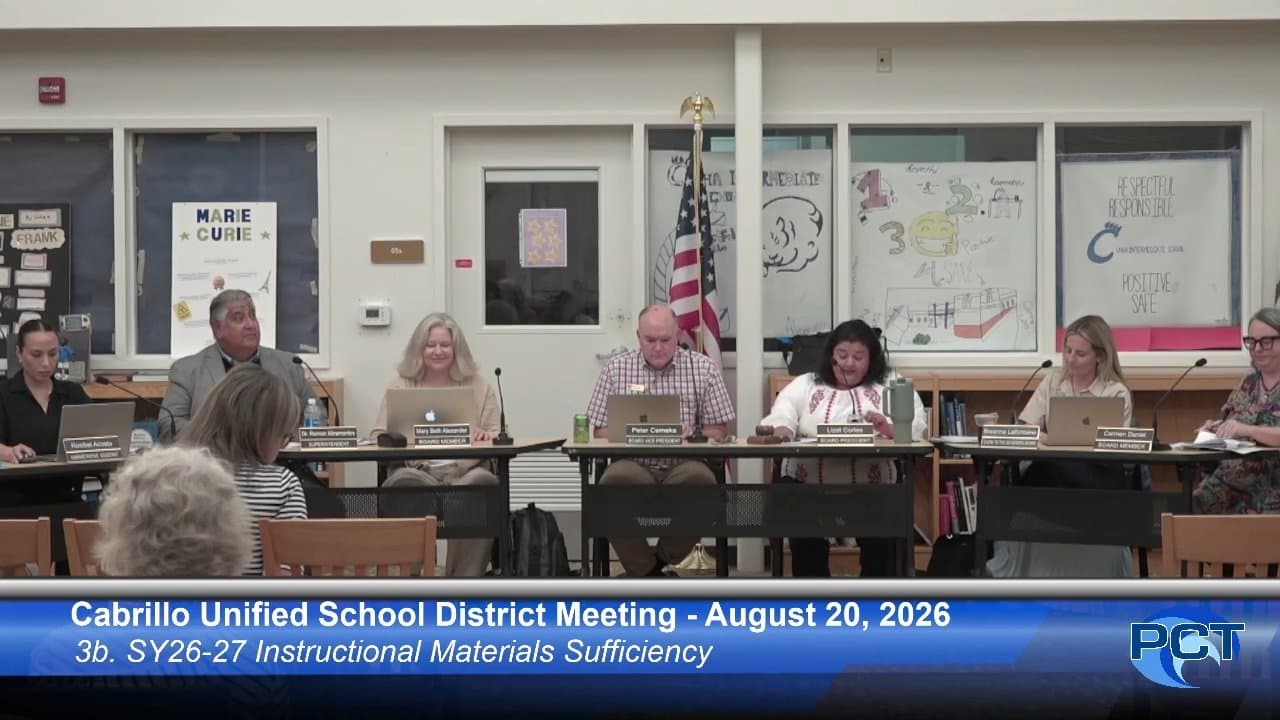
Resolution 10-2026 adopted 5-0: The board certified that all students, including English learners, have sufficient standards-aligned instructional materials for 2026-27, as required by Education Code Section 60119. A limited number of materials remain on backorder.
Consent agenda approved 5-0.
Student board member report: Student Board Member Jamie Mao, a junior at Half Moon Bay High School, gave her first report, noting freshmen are adjusting well, fall sports are underway, and homecoming is scheduled for Oct. 10. She also flagged that red status lights on water fountains have been concerning to new students, even when filters are clean.
SPED recruiting gains: The district recruited three of five speech-language pathologists through outreach to Cal State East Bay and CSU Monterey, reducing reliance on contractors who cost approximately $180,000 to $200,000 each. Two of four special education teacher vacancies were also filled with employees.
Board member Cerneka shared an emotional anecdote from a visit to Hatch Elementary, where a teacher told him a student "just this week spoke his first sentence in English."