
Cabrillo Board Keeps Pool on Track, Sends 16-Lane Option to New Trustees
School Board • Cabrillo Unified School DistrictNovember 12, 2026
Locunity is an independent informational service and is not an official government page for this commission. All information is sourced from public footage and an analysis of official agendas with the aid of responsible, fact-checked AI. to report an error or omission.
The Cabrillo Unified School District's aquatic center stays on its current 14-lane design for now. Superintendent Dr. Ramon Miramontes will ask the architects to sketch a 16-lane version for the incoming board to discuss in January. At its Nov. 12, 2026, meeting, the outgoing board also approved about $880,000 in contracts and purchases, heard teachers and students press for smaller classes and arts funding, and split openly on whether trustees should speak with one voice.
- Aquatic center design holds at 14 lanes; a 16-lane study heads to the new board in January
- $119,680 agency contract approved for a Hatch special education teacher, drawing union criticism
- Teachers and students push for smaller classes, a drama director and arts funding
- Trustees split on board unity as outgoing members say goodbye
- Half Moon Bay High posts Dashboard gains and weighs changes to graduation requirements
The Pool Debate Moves to the Next Board
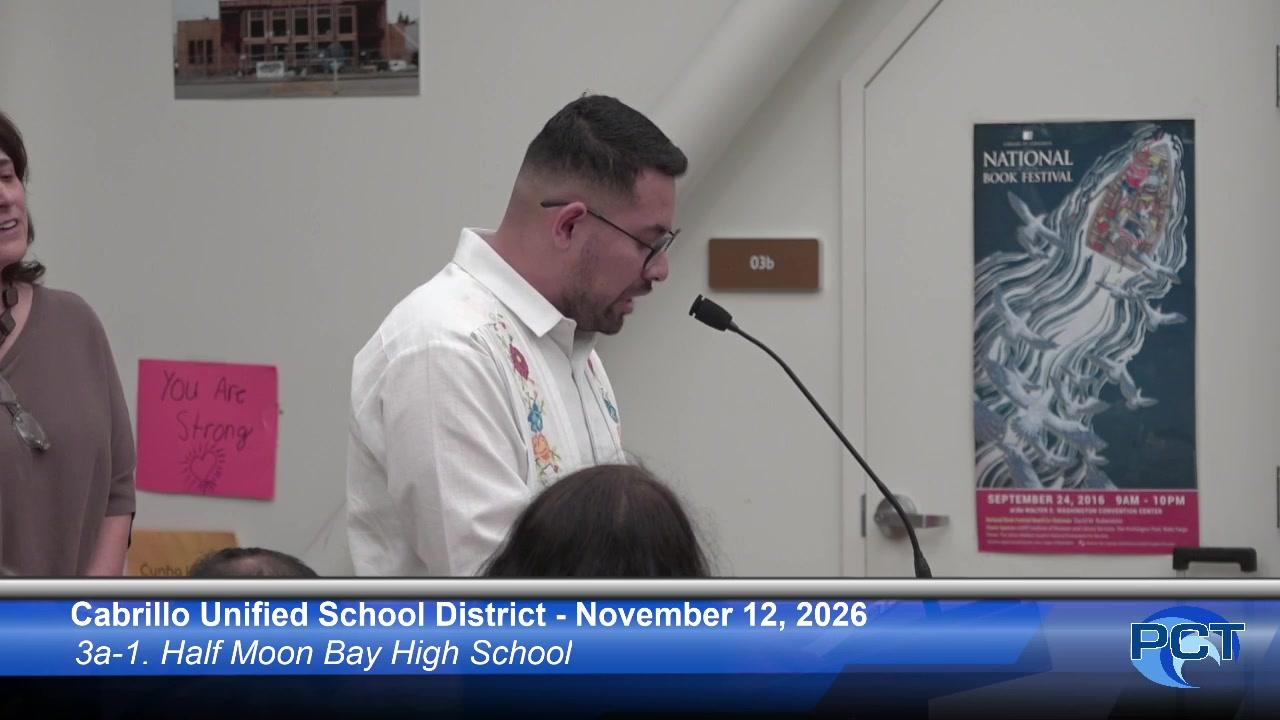
The basics: Derivi Castellanos Architects (DCA) presented Measure K plans for Half Moon Bay High School (HMBHS). The plans include a 14-lane competitive pool, a shallow community pool and a pool building made of concrete masonry units. They also include a two-story replacement for Building G and eight temporary classrooms. The item was information only, so the board took no vote.
Why it matters: The pool is a commitment of $18 million or more in Measure K bond funds. How the lane question is settled affects how much money is left for classrooms at the high school.
Where things stand: Principal Architect Ramon Gomez of DCA said stakeholders backed the current design. "There was consensus around the fact that the current design met the needs of every group that was represented at that meeting," said Gomez.
Miramontes said he could ask DCA for a 16-lane schematic for a January discussion, ahead of a facilities master plan study session. He described that step as "not necessarily a vote, but a discussion first with the new board."
Kurt Reamer, president of Friends of Half Moon Bay Parks and Rec, urged the board to keep moving. His group funded the feasibility study. "We know if it stalls, honestly, it could be another 50 years before we can even talk about this again," said Reamer. He also asked the district to price heat-pump water heating.
The other side: Board Vice President Peter Cerneka said he supports a pool but criticized the process. He pointed to missing documentation on a 16-lane option and to unanswered questions about maintenance costs, grants and county funding. "My frustrations with this has been that the board is not getting the information that it needs to make good decisions about this project," said Cerneka.
Board Member Mary Beth Alexander said the design follows the feasibility study, and she warned that delays add cost. "I appreciate that this board has made a commitment, and I feel like we're being fiscally responsible with the commitment we made," said Alexander. Later in the meeting she added: "Let's get this pool done so we can move on to the classrooms."
Building G and the fire lane: Eight portables would go between the library and the stadium: two for special day classes (SDC) and six for general education. Completion is targeted for summer. "CAL FIRE has approved this project, and it's currently being reviewed by the Division of State Architect for approval for construction," said Gomez.
The new Building G would stay on its current footprint with an open atrium. It would hold eight general education rooms, a career technical education room, SDC and resource specialist (RSP) rooms, and restrooms. Trustees asked about breakout rooms, supervision, parking and a new SDC drop-off lane. On the fire lane, Gomez conceded the concern: "On paper it is a fire road, but you're correct, it is inadequate." Staff said the lane is being widened.
What's next: The 16-lane schematic and discussion are expected in January with the new board. Teachers can comment on the designs using QR codes posted on boards in the staff lounge.
Special Ed Vacancies Drive Agency Spending
Why it matters: Students with disabilities are legally owed their services, whether a district employee or an outside agency provides them. Every vacancy pushes the district toward pricier contractors.
Where things stand: The board approved a contract with AYA Healthcare for a resource specialist at Hatch Elementary, not to exceed $119,680. The voice vote was announced as "4 plus 1," meaning four trustees plus the student advisory vote.
Megan Castro, a special education teacher, described the shortage. "This year alone, we started the year with four unfilled special education positions," said Castro. She urged stipends or reduced caseloads to keep staff.
The other side: John, the Cabrillo Unified Teachers Association (CUTA) representative, argued the contract wastes money. "If we had hired a first-year teacher with a master's degree for that position, the district would have saved $45,000," he said.
He also said the district gave late notice of its second bargaining opener, which led CUTA to ask for a postponement. He called for mentor-teacher stipends at every school.
Alexander countered with the district's record: 29.5% in raises over eight years, a three-year contract and a 5% raise next year.
Decisions and stakeholder impacts: Miramontes said agency contracts are a bridge, not a habit. "We find somebody, we cut that contract off in 30 days and hire that person on," he said. He added that three of five speech pathologists are now district employees and that the district is recruiting interns.
The board also approved, 4 plus 1, a no-cost agreement with Azusa Pacific University Global for student teaching and intern placements. The item had been pulled from consent. Senior HR Administrator Leah Ferraro said the agreement supports a teacher working on a waiver.
Paul Harrison, incoming president of the California School Employees Association (CSEA), praised paraeducators for covering an SDC preschool gap. "Glad to say that we are now in excess of 150 members," said Harrison. New CSEA officers take over in January.
Teachers and Students Press for Smaller Classes, Arts
Why it matters: Speakers waited more than two hours to talk, so the board agreed to exceed its 20-minute public comment cap. What they described amounts to a to-do list for the incoming board.
Where things stand: Dr. Tracy Yerby, an HMBHS teacher, disputed the idea that classes are small. She said most still run 20 to 35 students and that the board can lower section minimums. "A smaller class size like 20 to 25 students would go a long way to serve our students better," said Yerby.
English teacher Claudia Lundström opposed larger and combined sections. She contrasted growth at the district office with fewer teachers. Teacher Kenan Damon cited one class of 11 students and another of 70.
Two seniors described a shrinking drama and band program, with directors quitting and no money for sets. "We're broke. Sucks to say it, we're flat-out broke," said one senior student. Sola Palanczyk, drama club secretary, urged a fast search for a drama director: "We only have known what it's like to have a committed director once in my whole career here at Half Moon Bay."
The other side: Meta Townsley, a parent and substitute teacher, backed the superintendent and asked for timely grading. She also questioned the 90-minute block schedule: "It's challenging for students to stay focused for 90 minutes."
The student board representative, Jamie, reported that students want block scheduling kept. Jamie also raised a lack of open bathrooms, the need for a track coach before December preseason, and limits on what the athletic trainer can treat.
What's next: Cerneka said class size and arts support should be studied next year. Lundström and CUTA both asked the new board to move public comment back toward the start of meetings.
Trustees Split Over Speaking as One
Why it matters: Three new members are joining the board. This exchange previews how the reshaped board may handle dissent and public messaging.
Where things stand: In her farewell, Alexander urged members to talk with the superintendent before making public statements and to back majority decisions. Once a decision is made, she said, "it is our responsibility as board members to move forward together, support the outcome, and work collaboratively to see that decision through." She listed accomplishments from her eight years, including expanded early childhood programs, a three-year labor contract and workforce housing plans.
Board Member Carmen Daniel also said goodbye. "I came in four years ago not knowing very much of what was going on, and now I know more, and it's been incredible," said Daniel.
The other side: Cerneka respectfully disagreed. "I don't think the board should be unified," he said. He noted that trustees can speak to each other only at public meetings.
Transparency test: Several speakers questioned a vague closed session listing about El Granada property near Clipper Ridge. Damon said the notice's negotiator field read N/A and raised whether it complied with the Brown Act, California's open meeting law.
Board Clerk Breanna Lafontaine agreed with the concern: "The naming of the closed session item is terrifying." She said the timing of a county rezoning was coincidental. She added that she visited the site after receiving emails about monarch butterflies and tree cutting.
Miramontes thanked the departing members and called for a high-functioning governance team.
Half Moon Bay High Shows Gains, Eyes Graduation Rules
Where things stand: Principal Dr. Christian Aguilar reported 794 students and a 1.4% suspension rate. He also reported growth in English and science on the California Dashboard, the state's school accountability report. Trustees credited improved testing participation.
The school's priorities are math and science proficiency, professional development for teaching English learners, and a 5% cut in chronic absenteeism. Aguilar thanked ALAS, an immigrant-serving group, saying it "has always really stepped up to making sure that our students and our families, as well as our community members, feel safe."
Why it matters: With enrollment falling, Cerneka asked how the school can "continue to provide solid college prep." Aguilar floated rotating Advanced Placement (AP) courses so students still have access to them.
Miramontes said comparison districts require 217 to 220 credits to graduate, compared with 230 in Cabrillo. Financial literacy will be added for incoming freshmen. Alexander pointed to the district's dual-enrollment agreement with the community college, known as CCAP.
What's next: A committee with the chief academic officer will review alignment with A-G, the course sequence required for University of California and California State University admission. A board item is expected in January or spring.
- Generator hookup: $274,441 Rodan Builders amendment adds a generator quick-connect at El Granada Elementary (Measure M); work finishes summer 2027.
- Modulars bought: Two leased El Granada Elementary classrooms purchased for $278,550 (Measure K), ending monthly lease payments.
- Elevator upgrade: Updated TK Elevator pricing of $207,956 approved for HMBHS modernization (Measure K).
- Consent agenda: Passed by roll call (For: 4 — Cerneka, Lafontaine, Daniel, Alexander; Absent: 1 — Board President Lizet Cortes).
- Closed session: Board reported two 4-0 votes, one to start litigation and one to open an investigation; neither matter was described.
Looking ahead: In January, the new board takes up the 16-lane pool study, and CSEA's new officers take over. A graduation-requirements item is expected in January or spring.