School Board - Mar 12, 2026 - Meeting
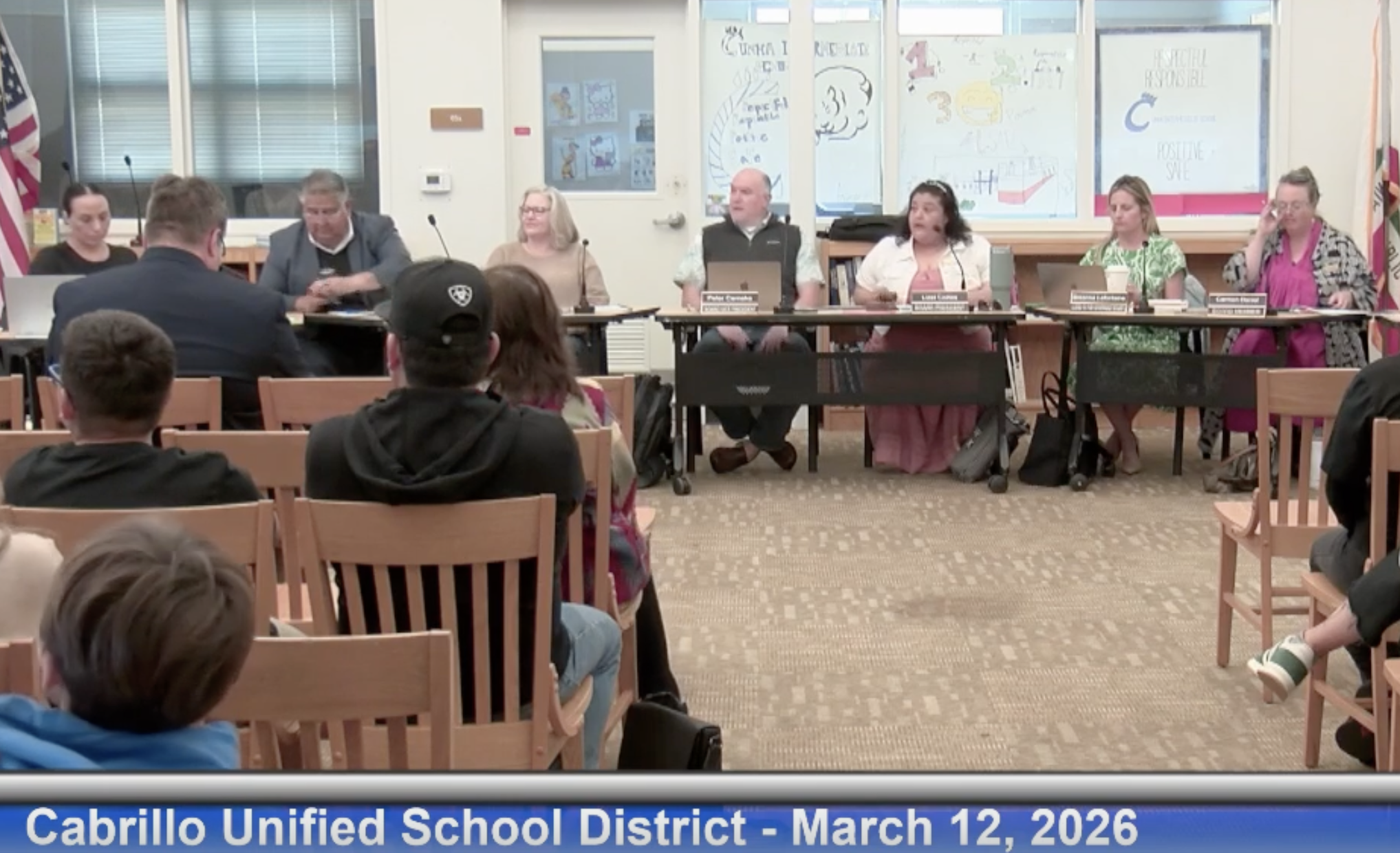
School Board • Cabrillo Unified School DistrictMarch 12, 2026
Locunity is a independent informational service and is not an official government page for this commission.We use AI-assisted analysis and human editorial review to publish information.
Cabrillo Unified Approves Historic Three-Year Labor Deals, Issues $45M in Bonds
The Cabrillo Unified School Board moved decisively to stabilize its finances and workforce, unanimously approving the first three-year labor agreements in district memory with both its teachers and classified staff — a milestone for a district that was on the brink of a strike just a few years ago. The board also authorized $45 million in new bonds for school facilities and refinanced older debt to save taxpayers millions, even as a depleted settlement fund and projected deficit spending cloud the fiscal outlook.
Historic three-year contracts with teachers and classified staff approved unanimously, ending years of adversarial labor relations
$45M in new Measure K bonds issued for school facility improvements, with $31M refinancing projected to save taxpayers $2.5–5M
District's $12M legal settlement fund is fully spent; CBO warns of $600,000 annual deficit spending ahead
Board splits 3-2 on pay raise from $240 to up to $1,200/month, with two members demanding self-evaluation first
Hatch Elementary test scores remain flat as superintendent acknowledges years of leadership instability and a dual immersion program that "lacked rigor"
Three parents push for digital citizenship curriculum after finding students watching YouTube on school Chromebooks
A New Chapter for Labor Relations
For the first time anyone can recall, Cabrillo Unified has locked in three-year contracts with both its unions — a development that marks just how far the district has come from the near-strike conditions that defined recent years.
Why it matters: The agreements with the Cabrillo Unified Teachers Association (CUTA) and California School Employees Association (CSEA) Chapter 485 each include a 2.5% salary increase plus step-and-column adjustments, covering fiscal years 2025-26 through 2027-28. Three years of cost certainty is a significant budgeting advantage for a district projecting deficit spending, and the deals signal a fundamentally different labor climate under Superintendent Dr. Ramon Miramontes.
Where things stand: The CSEA ratification was overwhelming — 115 in favor out of 122 votes cast from a membership of 142, a dramatic jump from prior agreements that drew only about 30 voters.
A CUTA representative called the three-year deal the first anyone could recall and predicted it would increase staff stability and improve outcomes. Superintendent Miramontes reflected on the shift:
"I just want to thank both bargaining units and our staff, Jen, Israel, and the rest of the team to get a three-year contract moving forward. Especially after, you know, when I first got here watching some of the videos."
Board Member Pete Cerneka highlighted how far the district has traveled from its near-strike past. Board President Lizet Cortes expressed gratitude that the board could now focus on students rather than labor disputes.
Decisions: Both agreements passed 5-0 by voice vote. The board also unanimously approved the required AB 1200 public disclosure, which was reviewed by the San Mateo County Office of Education, confirming the district can manage projected costs while recommending close budget monitoring.
Bonds, Refunding, and the Parcel Tax Playbook
Municipal advisor Dale Scott of Dale Scott and Company laid out the district's debt management strategy in a wide-ranging presentation that touched every corner of Cabrillo's tax and bond portfolio.
The basics: Voters approved Measure K in November 2024 — a $153.4 million bond measure that passed at 62%. The board authorized issuing $45 million in Series B bonds, the second tranche from that measure, to fund school construction and facility upgrades. Separately, the board authorized up to $31 million in refunding bonds to refinance the 2018 Series A bonds at lower interest rates.
Why it matters: The refinancing alone could save taxpayers between $2.5 million (spread proportionally) and up to $5 million (if backloaded to shorten repayment by 1.5 years).
"These bonds have interest rates that are higher than the market. So somebody's being paid more than they'd be paid today. So we're going to take it away from them and we're going to give that extra money back to the taxpayers," Scott explained.
Where things stand: On the parcel tax front, voters passed Measure N in November 2024, replacing the prior Measure I at $150 per parcel. Scott noted that parcel tax replacements have a 100% passage rate in San Mateo and Santa Clara counties since 2014. He recommended the district begin voter survey research now to explore a replacement that could include a higher amount, cost-of-living adjustments, or an extended duration — with a decision needed by June for a potential November 2026 ballot.
Board Member Pete Cerneka pressed on the community's comparative tax burden.
"In terms of tax rates, you're low. I mean, you're low for districts, similar districts. And I say similar districts, I mean suburban or metropolitan districts in Northern California," Scott responded.
Board President Lizet Cortes confirmed that additional bond issuances extend payment duration rather than significantly increasing annual tax bills. The district has seen remarkably consistent 5% annual assessed valuation growth over 15 years.
Decisions: Resolution 03-2026 ($45M Series B bonds) and Resolution 04-2026 ($31M refunding bonds) both passed 5-0 by roll call.
What's next: The district must begin voter survey research soon if it intends to pursue a parcel tax replacement on the November 2026 ballot.
Fund 40 Is Gone. Deficit Spending Is Here.
Chief Business Officer Jennifer Marsh delivered the second interim financial report with a clear message: the safety net is gone, and the district must find new ways to hold the line.
Why it matters: Fund 40 — established from a $12 million legal settlement in October 2022 — is now fully depleted after final transfers of $3.388 million to the general fund and $500,000 to reserves. Over its lifetime, the fund was used 54% for salaries and fiscal stability and 31% for building reserves. Without that cushion, the district projects approximately $600,000 in deficit spending in each of the next two years.
Where things stand: The district holds a 12.54% combined reserve (5.35% in the general fund plus 7.19% in Fund 17 special reserves), tracking toward the board's 16% policy target.
On the revenue side, a Genentech property tax dispute with the San Mateo County Assessor covering tax years 2000–2005 has already reduced revenues by $185,000, with additional unsettled lawsuits covering 2006–2024 posing further risk. A bright spot: Marsh discovered $149,000 in ongoing home-to-school transportation reimbursements that had not been properly claimed.
"I realized that the special ed non-public school transportation was not being coded with that code. So I made sure that happened in the 24-25 closing of the books," she said.
Marsh noted that 74.8% of expenditures are salary and benefits, and the three-year labor agreements provide cost certainty — a factor the county office weighed in concurring with the district's fiscal outlook. Budget assumptions use a conservative 3% property tax growth rate compared to the district's historical 7%.
Decisions: The second interim report was approved 5-0 with a positive certification.
Hatch Elementary: Flat Scores, New Leadership, Long Road Ahead
Principal Jeff Clinton delivered a candid assessment of Hatch Elementary, a dual immersion school with 549 students where 55% are enrolled in the immersion program, 31% are English learners, and 54% are Latino. Test scores have stagnated in English language arts and math, with science declining.
Why it matters: Only 9% of English learners at Hatch were reclassified last year, compared to 20–25% at Cunha middle school. The challenge is partly structural: English learners take state assessments in English while actively learning in Spanish.
"English learners, if I put their performance up there, it's like 0 to 5% in math and ELA because the test is in English. They're English learners, so they don't know English," Clinton said.
Where things stand: The most successful initiative has been a "reading switch" intervention — 35-minute sessions grouping students by reading level across first, second, and fourth grades. Clinton called it super effective and plans to expand it to all grades next year. The addition of a school counselor has dramatically improved school culture.
Superintendent Dr. Ramon Miramontes was blunt about the school's past.
"It's the oldest immersion program in the county, and I love it. It's fantastic. But it lacked rigor and it lacked relevance. I mean, I want to give everybody a lot of credit, but it was shortchanging our English learners," he said.
He described a strategic plan to stabilize the school with three administrators, bring in Kaveh experts for the immersion program, adopt new state-approved curriculum, and pilot a math curriculum for board review in May.
The other side: Board Member Pete Cerneka pressed on whether higher-achieving students were being challenged, noting "if you're a parent of a child who is not being challenged, it's tricky."
Board President Lizet Cortes raised concerns about pull-out interventions disconnecting students from their classrooms:
"It just broke my heart to see that a student was not even part of the whole class operation because unfortunately, she's been pulled out."
Board Splits 3-2 on Pay Raise
Superintendent Dr. Ramon Miramontes proposed restructuring board compensation under AB 1390, which updated Education Code 35120 and raised the authorized cap from $240 to $1,200 per month for districts of Cabrillo's size. The proposed eight-year progression starts at $500/month and increases $100 annually.
Why it matters: The vote exposed a governance gap — the board has never formally conducted a self-evaluation, and two members refused to support a raise without first establishing accountability benchmarks.
Where things stand: Board President Lizet Cortes initially expressed support, saying as the only Latina on the board the increased compensation was meaningful for her ability to continue serving. But she insisted the board should complete a self-evaluation before approving any increase, and ultimately voted no. Board Member Pete Cerneka also voted no, raising the total annual cost: "If it was $1,200 for a year, that's over $70,000 impact to the district. And I know that this upcoming year we're going to be thinking about in terms of teaching assignments, split classes." He preferred a smaller immediate bump with revisitation later.
Miramontes said the structure mirrors employee step-and-column increases and noted that a CSBA-facilitated board goals workshop is scheduled for March 28, which he recommended as a precursor to eventual self-evaluation on a three-year cycle. Research into other San Mateo County districts showed varied approaches: Redwood Shores adopted the full $1,200, while Pacifica and Jefferson have not yet addressed the issue.
Decisions: Passed 3-2 by show of hands. Daniel, Alexander, and Lafontaine voted yes. Cerneka and Cortes voted no.
Parents Sound Alarm on Screen Time at Hatch
Three Hatch Elementary parents used public comment to make a coordinated case for a digital citizenship curriculum and stricter management of classroom technology.
Marissa urged the board to implement digital literacy education starting in kindergarten, covering skills like evaluating online sources and understanding algorithms. Rachel, a parent of two immersion students, described finding fifth graders watching YouTube on school Chromebooks while younger children gathered around them. After the parents flagged the issue to Principal Jeff Clinton, he enacted a "computers in classroom only" policy and stopped sending Chromebooks home with students — a practice unique to Hatch among the district's elementary schools. Martin questioned whether students learn fundamental computer skills before being introduced to AI programs.
Josie cited research showing screen-based learning is less effective than pencil-and-paper instruction and pointed to San Mateo-Foster City's efforts to reduce screen time. Board Member Pete Cerneka endorsed the effort during his board report, framing it as a six-month learning and policy development process. He highlighted one parent's perspective:
"One of the women I talked to said that it's not just that they want to ban cell phones in the high school or the middle school, that they want the students to have an understanding of why schools should be phone free."
Minor Items
TRAN borrowing authorized: Resolution 02-2026 authorizes up to $14 million in short-term borrowing (Tax and Revenue Anticipation Notes) to cover cash flow shortfalls in fall 2026. Passed 5-0.
Classified position eliminated: Resolution 05-2026 approved the reduction in force of one part-time position after federal migrant education program funds were frozen. Passed 5-0.
FFA field trip adjusted: Half Moon Bay High School's FFA trip to the state conference was approved with revised dates (March 19–24) to accommodate a student running for state office. Passed 5-0.
AB 1204 flagged: President Cortes highlighted AB 1204 as a bill to watch for potential LCFF formula reform including regional cost-of-living adjustments, though she noted she has no idea whether it will pass.
Board goals workshop: A CSBA-facilitated board goals session is scheduled for March 28.