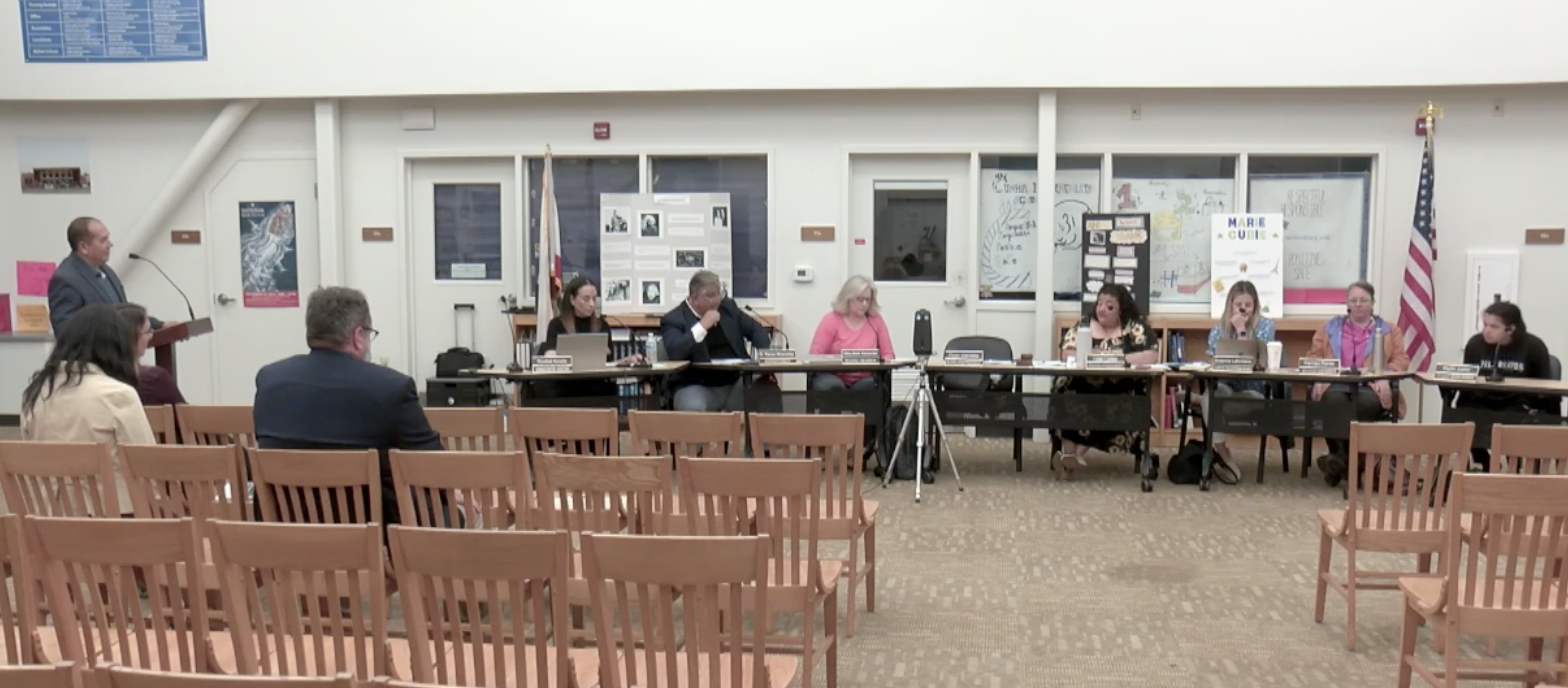
School Board - Jun 11, 2026 - Meeting
School Board • Cabrillo Unified School DistrictJune 11, 2026
Locunity is a independent informational service and is not an official government page for this commission.We use AI-assisted analysis and human editorial review to publish information.
Cabrillo Enters State Monitoring as Equity Gaps Persist, Board Eyes Parcel Tax and Deficit Budget
The Cabrillo Unified School District Board of Trustees confronted a web of interconnected challenges at its June 11 meeting: alarming achievement gaps that have triggered the highest level of state intervention, a proposed budget projecting deficit spending, and survey data suggesting a replacement parcel tax — potentially essential to the district's long-term solvency — faces a narrow path to the two-thirds supermajority it needs. Across nearly four hours, the board also approved a superintendent contract amendment with a debated longevity bonus and seven other action items.
- District enters state-level monitoring for the first time over persistent achievement gaps for English learners, low-income students, and students with disabilities
- Parcel tax survey shows support at 63-64%, climbing above 70% after voter education — but still tight for the required two-thirds threshold ahead of a potential November 2026 ballot
- Proposed $51.9 million budget projects deficit spending while maintaining combined reserves near 11%; potential $978,000 annual boost from historic state special education funding increase
- Board approves superintendent's 5% longevity bonus after debate about setting a precedent, with research showing the three-year trigger is aggressive compared to most California districts
- Board members sound alarm over elementary math, questioning a staff reduction at Cunha Intermediate when over 60% of incoming sixth graders aren't meeting standards
State Steps In: LCAP Reveals Deepening Equity Crisis
The basics: The Local Control and Accountability Plan is the district's primary roadmap for spending state equity dollars and closing achievement gaps. This year's data triggered a new level of outside scrutiny.
Why it matters: Cabrillo has entered Designated Technical Support — a Level 3, state-led tier of intervention — for the first time, in addition to county-level Differentiated Assistance. Both designations stem from persistent red and orange ratings on the California Dashboard for English learners, long-term English learners, socioeconomically disadvantaged students, Hispanic/Latino students, and students with disabilities in ELA, math, and chronic absenteeism.
Where things stand: Chief Academic Officer Israel Castillo presented data showing green performance in graduation and suspension rates but stark gaps elsewhere. The college and career readiness gap between English-only students (61%) and English learners (7%) stands at 54 percentage points.
"Here we have the English-only college and career readiness 61%, which we can continue to improve. But the gap between English-only and English learner — it's a 54% gap. That's alarming," said Chief Academic Officer Israel Castillo.
DIBELS early literacy data offered a bright spot: K-2 students showed 14- to 22-percentage-point gains. But those gains declined in grades 3-5, and Castillo noted this is the first year the district has reached Level 3 state monitoring.
Board President Lizet Cortes delivered a pointed assessment of what she had observed in classrooms: "I was blown away to see that kids are not even adding and subtracting and they are fourth and fifth graders where there was an adult in a room for a whole year who saw something. Why isn't this targeted? Why are we not intervening?"
Board Clerk Breanna Lafontaine zeroed in on a staffing decision that she said contradicted the district's own data: "We reduced the Cunha math department by one FTE. And I'm really having a hard time aligning those two things." She also requested that all board members receive access to master schedules for the middle and high schools to verify that course alignment matches what is being presented to the board.
Superintendent Dr. Ramon Miramontes acknowledged the tension but pointed to systemic instructional issues, arguing that the district needs to enforce fidelity to adopted curriculum before adding staff. "Too many people are using their own things and they think their own things are better than what the science of reading has provided. We've got to tighten that up," he said. He noted that pilot teachers have requested a math teacher on special assignment (TOSA) to support the new curriculum rollout.
Board Member Mary Beth Alexander urged a more focused approach, referencing research on effective governance: "The high-functioning boards are the ones that are able to focus in and get something done. The example they gave in the study was they just decided they're going to fix third grade reading."
LCAP supplemental and concentrated funding for 2025-26 totals $1,917,380. One written public comment was submitted and acknowledged by the board. The LCAP remains under county review, with adoption expected at the next board meeting. Summer programs including Big Lift and STEM enrichment launched the same day.
What's next: State and county monitors will closely track whether the district's improvement strategies move the needle for its most vulnerable student groups. The board will vote on LCAP adoption at its next meeting.
Parcel Tax Replacement: Close but Not Yet Over the Threshold
Why it matters: The district's current parcel tax is set to expire, and any replacement requires a two-thirds supermajority — 66.67% — to pass. A survey of 202 likely voters shows initial support just below that line, making voter education strategy the decisive variable for a potential November 2026 ballot measure.
Where things stand: Consultant Dale Scott of Dale Scott & Co. presented results of a survey testing a replacement measure at $239 per parcel for eight years, generating approximately $2.6 million annually. Uninformed initial support stood at 63-64% — roughly three points short. After voters received information about programs the tax supports and protections built into the measure, support rose above 70% for a version without specific school names in the ballot language.
Top motivators for voters included hiring and retaining teachers (above 70% support), career training and college readiness (approximately 70%), and the guarantee that funds cannot be taken by state or federal government. Testing at $257 per parcel showed no significant difference from $239. However, an eight-year term generated more resistance than five- or seven-year options.
Scott noted that the survey's 6.9% margin of error is standard for this sample size, and that historical data favors the district: "The average passage rate for parcel tax is about 55% statewide. That climbs up to closer to 80% when it's an extension or a replacement."
The other side: Board Vice Chair Peter Cerneka pushed back on the survey's utility: "I appreciate your work. I do have major concerns about this, plus or minus seven. I don't really know how valuable this is to us, and I'm not sure what to do with this." Cerneka questioned whether the timing was right given broader concerns about district reputation.
Scott responded that there is no downside to running a measure beyond the campaign cost, and Superintendent Miramontes noted the survey confirmed that keeping the parcel tax on the ballot makes continuation easier than letting it lapse and starting over. Two key contextual data points: 51% of voters have no current or past connection to district schools, and 49% get information about the district directly from district channels, with Coastside News reaching 32%.
What's next: The board took no action but will use the survey data to determine whether to place the measure on the November 2026 ballot. If it proceeds, the campaign will need to close a gap among voters who lack direct ties to the schools — more than half of the electorate.
Deficit Budget Heads to Adoption With Eyes on Special Ed Windfall
Why it matters: The proposed $51.9 million FY 2026-27 budget projects deficit spending — total revenues of $51.1 million fall short of expenditures — but a potential historic increase in state special education funding and reserves above 10% provide a cushion as labor contracts expire in 2028.
Where things stand: Chief Business Officer Jennifer Marsh presented a budget that allocates 82 cents of every dollar to employee salaries and benefits. Cabrillo is a "community-funded" district, meaning 80% of revenue comes from LCFF and local property taxes rather than state apportionment. Property tax growth is projected conservatively at 3% annually, below the historical average of over 4%.
The biggest potential upside: the Governor's May Revision proposes a 40% increase in statewide special education funding. "The May Revision proposes approximately a historic 40% increase to statewide special education funding, which is estimated to increase Cabrillo's revenue by approximately $978,000 annually," said CBO Jennifer Marsh. That money would reduce General Fund pressure. A separate one-time Student Support Professional Development Block Grant of $2.15 million is not included in the proposed budget pending legislative approval.
Combined Fund 01 and Fund 17 reserves sit at 10.97% of annual expenditures — well above the 3% state minimum. Multi-year projections show near break-even in 2027-28 but an increasing deficit in 2028-29, when labor contracts expire.
Board Clerk Lafontaine noted the current $880,000 deficit and the looming contract expirations. Board Vice Chair Cerneka connected the budget picture to the parcel tax conversation, advocating for long-term ambition: "Eventually we are going to have to embrace that parcel tax and I think we're going to have to embrace a really healthy parcel tax. A $500 parcel tax has to be part of our ongoing thought process in terms of how we support our schools."
Board Members Alexander and Lafontaine were recognized for advocating in Washington, D.C., for the special education funding increase.
Decisions: The public hearing was opened and closed with no public comment. Budget adoption is scheduled for June 18, 2026.
Superintendent Contract: Longevity Bonus Sparks Precedent Debate
Why it matters: The board approved an amendment to Superintendent Dr. Ramon Miramontes' employment agreement that consolidates allowances into a $303,232 base salary and adds a one-time 5% longevity adjustment — but not before a detailed debate about whether the three-year trigger sets a problematic standard for future negotiations.
Where things stand: Amendment No. 2 folds the existing auto allowance and community engagement stipend into the base salary, updates health insurance to the Kaiser HMO full-family rate, and establishes the longevity bonus upon completion of three years of service measured from July 1, 2026 — effectively four and a half years of total tenure.
Board Clerk Lafontaine flagged the provision using original research: "The longevity, it seems high. What we were given — the information that Rosie was able to receive from other superintendent or other executive assistants — they usually start between four and six years, and this is for three years, and then the range being 2% to 6.5%." The survey covered 33 California districts, of which only 10 provide longevity compensation at all.
Board Vice Chair Cerneka agreed the concept was reasonable but wanted a hard date specified rather than a rolling trigger. Board President Cortes said she was comfortable after reviewing the range data. Board Member Alexander argued that each contract creates its own precedent and that the amendment history provides context.
Superintendent Miramontes framed the provision as a retention tool in a volatile market: "The average superintendent in California is 2.89 years."
Decisions: The amendment passed 5-0. The provision is within the range found across California but sits at the aggressive end — a benchmark future boards and candidates will likely reference.
Dual Immersion Concerns
Board Vice Chair Cerneka raised questions during board comments about whether the district's dual immersion program is effectively serving its English learner students. "I just feel like we're asking a lot of those English learner students in those classes, given the current state of the immersion program, which is sort of not where we need it to be, and it's not serving those students," he said. No formal action was taken, but the comments add pressure to a program already under scrutiny as part of the district's equity gaps.
Minor Items
- Declaration of Need for Fully Qualified Educators for 2026-27 approved 5-0, allowing the district to request emergency or intern teaching permits for staffing shortages.
- Resolution 06-2026 adopted 4-0, granting CBO authority for routine year-end budgetary increases and transfers.
- Resolution 08-2026 adopted 4-0, authorizing a temporary $350,000 interfund transfer from the general fund to the cafeteria fund.
- Half Moon Bay High School elevator modernization approved 4-0, funded by Measure K bond funds.
- Farallone View Elementary play structure construction contract ratified 4-0 at $307,000, awarded to Andrini Brothers Inc. with completion targeted by July 31, 2026.
- CBO Jennifer Marsh's contract extended through 2029 at $215,082 base salary with a 4% adjustment in 2027 and 1% in January 2028, approved 4-0.
- Resolution 07-2026 adopted 5-0 for November 2026 school board election specifications and candidate forms.
- Consent agenda approved 5-0.
- Youth Cinema Project recognition: Students from Half Moon Bay High School and Cunha Intermediate were celebrated for winning Best Actor (Jeremy Becerra Montoya) and Best Film awards at the LA Latino International Film Festival. The winning short film, "Who Needs Sleep," was a PSA about screen time before bed, screened at a Hollywood theater through a partnership with the Latino Film Institute.