
School Board - May 14, 2026 - Meeting

School Board - May 14, 2026 - Meeting

School BoardCabrillo Unified School DistrictMay 14, 2026

Sources:

Locunity is a independent informational service and is not an official government page for this commission.We use AI-assisted analysis and human editorial review to publish information.

Teachers, Parents Rally Against $200K Coding Contract as Pool Costs Balloon

The Cabrillo Unified School Board's May 14 meeting surfaced simmering frustrations over spending priorities, as teachers and parents demanded the district drop a coding contract they called wasteful while administrators sought community and government partnerships to close a $6.1 million gap on the high school pool project. The board unanimously approved four action items and heard a major academic update from El Granada Elementary.

  • Teachers and a parent urge the board to cancel the ~$200K-per-year Code to the Future contract, saying Scratch is free and the money should fund core academic staff

  • HMBHS pool's preferred design exceeds budget by $6.16 million, sending the district scrambling for federal, county, and community funds

  • El Granada Elementary posts strong academic results, with 86% of students improving ELA scores and a 23-point jump on state indicators

  • Board approves $1.4M in Measure K spending for temporary high school classrooms and design services to keep construction on track

  • Board members lobby Congress for special-education and career-tech funding during Washington D.C. trip


Teachers Sound the Alarm on Code to the Future

Three speakers — two teachers and a parent — used public comment to deliver a coordinated case against the district's contract with Code to the Future, a coding instruction program that costs approximately $200,000 per year.

Why it matters: The speakers argued the program duplicates freely available tools and diverts scarce dollars from positions the district urgently needs — a math interventionist, a reading specialist, a science teacher, or an additional classroom teacher.

Where things stand: Avis Calhoun, a teacher at El Granada Elementary, read a statement on behalf of the fourth- and fifth-grade team. "The program's expensive and not worth the money. We're really glad that you've identified computer literacy is something valuable to our students. However, Scratch — the coding program that Code to the Future uses — is free and it's easily accessible on the Internet," she said. Calhoun added that fourth- and fifth-grade teachers were never surveyed about the program and that none support it.

A parent of a fourth grader, reinforced the point by comparing Cabrillo to peer districts. She noted that well-funded systems like Albany and Pleasanton do not pay for elementary coding programs. She zeroed in on a stark resource gap: "El Granada has a beautiful new science room, but the fourth graders don't have a science teacher."

A third-grade teacher at El Granada used her time to raise a separate curriculum concern, calling the Studies Weekly social studies material "very dry and difficult" for students and not culturally responsive. She said even her RSP push-in teacher struggled with the material. Melanie pointed to the Red Bud Resource Group curriculum — designed by indigenous Americans from the North Bay and approved under California standards — as a more engaging alternative.

What's next: The Code to the Future contract includes a yearly reconsideration option. Speakers urged the board to exercise it. No board action was taken during public comment, but the volume and coordination of the opposition signal this issue is likely to return.


Pool Ambitions Test District's Partnership Strategy

$6M Over Budget

The board's bimonthly bond facilities update was dominated by discussion of the Half Moon Bay High School pool project, where the most future-proof design option exceeds the facilities master plan budget by $6.166 million.

The basics: Facilities staff presented four pool options. Option 3, the base plan, includes a competition pool (7+ feet deep) with bleachers for lap swimming and water polo, plus a separate teaching pool (3.5–4.5 feet) and a mechanical/locker room building. Option 4 widens the teaching pool and adds office and storage space — but blows past the budget.

Why it matters: The pool would be the only public competition aquatic facility on the coast side of San Mateo County and could provide mandatory swim lessons to every third grader, addressing what district leaders describe as a life-safety need in a coastal community.

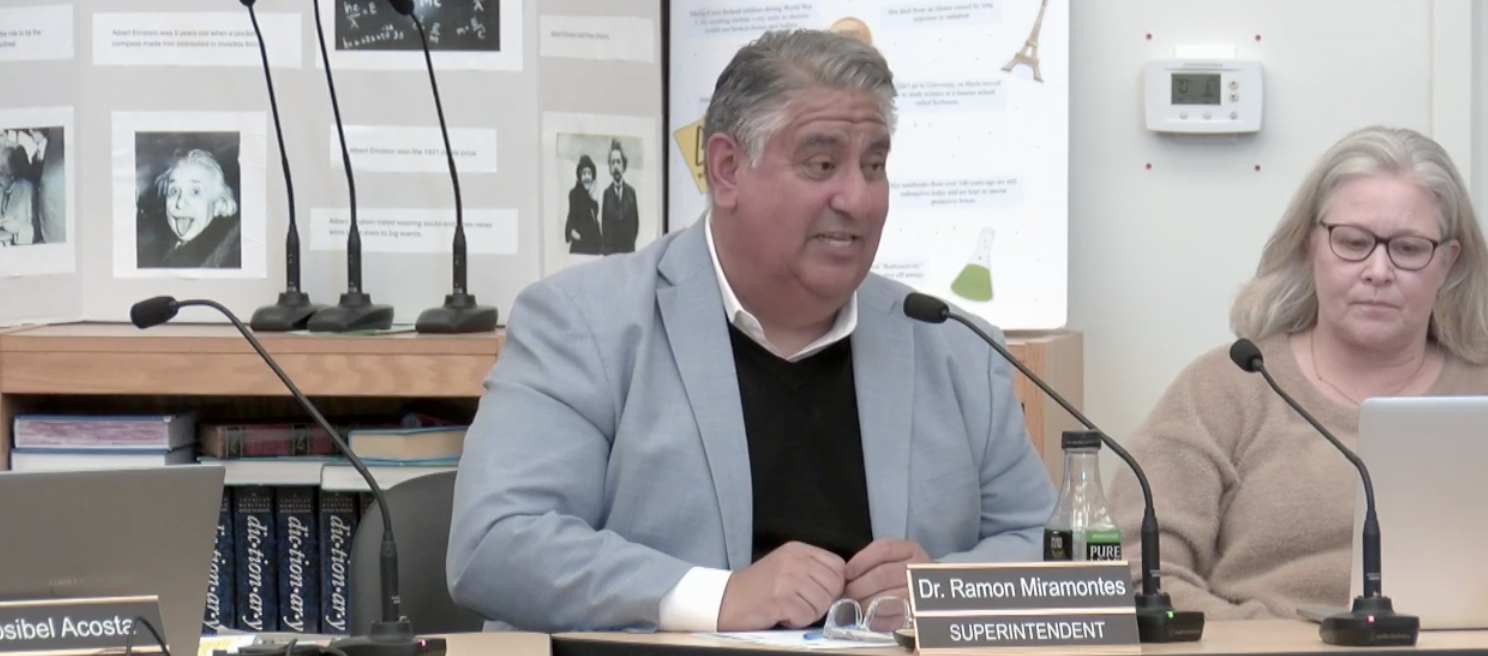
Where things stand: Superintendent Dr. Ramon Miramontes outlined an aggressive fundraising strategy. He reported verbal support from U.S. Representative Sam Licardo for federal grants in the $500,000 to $2 million range and said County Supervisor Mueller has committed to seek $1 million from county colleagues. "I do want to build a pool for the future. We just got plans. The board hasn't seen them. I just got them today," he said, referencing a new 14-lane configuration received the day of the meeting.

Miramontes was emphatic about the educational mission: "I really would want to commit from the board saying we also expect that every third grader is going to have swim lessons."

Vice President Peter Cerneka pushed the board not to settle too quickly. "I would hate to be five years down the line and we look at the pool and we think, ah, it's not what we want. But we're stuck with it for the next 50 years," he said, advocating for exploring a 16-lane configuration before committing to a smaller design. He noted community advocates from Mavericks and other aquatic programs had been consulted.

Cerneka also framed the project as a community obligation: "This is an opportunity for the community to step up. That has to happen. So the school district has done what we said we were going to do. We put ourselves in position to build this pool and then invited the community in."

Board Member Carmen Daniel raised concerns about standardization across school construction, noting the visual differences between Farallon View and El Granada projects built at the same time. "When we have four elementary schools and every single one has a different plan for construction … it's hard to see the two different things," she said.

Moving the pool to the lower parking lot was priced at $26 million — not including required locker rooms — effectively ruling out that alternative.

What's next: The new 14-lane plan had not yet been reviewed by the board. Staff will continue pre-design work on Building G (RSP, SDC, and CTE classrooms), and the pool design will likely return for further discussion as external funding commitments materialize.


El Granada Posts Strong Academics as Inclusion Hub

Principal Erin O'Connor-Brown presented a comprehensive update on El Granada Elementary, which serves 333 students and doubles as the district's special education and inclusion hub with 51 students on IEPs.

Why it matters: The school's results demonstrate that strong academic outcomes and inclusive service delivery can coexist — a question many districts struggle with.

Where things stand: El Granada earned a Green Performance Indicator in English language arts, posting a 23-point increase on state assessments. "86.2% of our students are improving their scores in English language arts. That's huge," O'Connor Brown said, noting the school also achieved a 13.45% proficiency increase. Math results were more mixed: a 6.2% year-over-year gain, but only 41% of students meeting or exceeding standard. "We're still showing only 41% of our students meeting or exceeding standard in mathematics. We want more for and from our students, and we're excited for our new math framework and curriculum to help us with that," she said.

The school earned a Green indicator for English Learner progress, with 50% of its 59 English learners making gains on the ELPAC. Chronic absenteeism continues to decline.

Vice President Cerneka asked about the school's approach to English Language Development instruction. O'Connor Brown explained the school uses a traditional English-only program with mandatory 30-minute designated ELD blocks daily, supplemented by integrated language development in content areas.

Board Member Carmen Daniel praised El Granada's community but called for more consistent parent volunteerism district-wide. "If everyone could just volunteer a little bit, it would make such a lasting impact," she said.

Phase 1 construction of Building C is complete; Building A is expected for the 2026-27 school year.


Board Approves $1.4M for HMBHS Temporary Classrooms

The board approved two items totaling nearly $1.2 million to prepare temporary classroom space at Half Moon Bay High School, clearing the way for Building G construction to begin without displacing students.

Decisions:
**- **Architectural design services: $417,776 plus $5,000 in reimbursable expenses, awarded to Derive Castellano Architects from Measure K bond proceeds. Approved 5-0.

  • Lease agreement: $760,000 for a 72-month lease of eight modular classrooms. Approved 5-0.

Vice President Cerneka asked about the scope and timeline. Facilities staff member Drew confirmed the portables are essential to relocate students during the Building G construction phase.


Board Members Take IDEA Fight to Congress

Coast to Coast in D.C.

Board Member Carmen Daniel and Board Member Mary Beth Alexander reported on the California School Boards Association Coast to Coast trip to Washington, D.C., where they met with Representative Sam Licardo and advocated in four areas: increased IDEA special-education funding, CTE Perkins V funding, student online safety, and responsible AI in education.

Why it matters: Federal IDEA funding currently covers only about 12% of costs, far below the original 40% mandate. Daniel said the delegation's ask was to move the needle: "Can you increase it to 16%? Let's get the needle moving toward the original bill of 40%."

Alexander described the CTE pitch, noting the district's construction CTE students collaborated with the robotics team. "Sam Licardo was like, wow, this is really cool," she said.

Locally, Vice President Cerneka reported on a growing digital citizenship initiative, including a gathering at San Benito. "This is not just how can we get students not to have their phones in the classroom, but it's more of how can we be intentional about how we use technology in healthy ways that are productive," he said. Cerneka announced regular community office hours at Cafe Society and Ocean View park.


Minor Items

  • E-Rate network upgrade approved 5-0: $248,000 contract with IT Management Corporation to replace aging Meraki (Cisco) networking equipment across the district; E-Rate covers approximately 60%, reducing the district's cost to about $99,000. IT staff explained expiring Meraki licenses would render equipment inoperable.

  • Farallone View playground: Board delegated authority to award the construction contract ahead of the May 20 bid deadline; ratification expected June 11. Approved 5-0.

  • Farallone View modernization completed over spring break, including a new fire hydrant and fire truck access gate.

  • El Granada Phase 2 update: Building K received occupancy in March; Building A is approximately 90–95% complete with exterior stucco done. Two of five parking lot lights installed during spring break.

  • Consent agenda approved 5-0 by roll call.

  • CUTA report: A union representative highlighted productive collaboration on elementary scheduling and strong teacher retention, noting "we had two teachers that have been here for 30 years and four teachers that have been here for 25, seven teachers that have been here for 20."

  • Pilarcitos High School student representative Mark Martin reported 12 graduates and an administrative assistant opening.

  • Coastside Gives fundraiser raised over $2 million; the inaugural "Honoring Our Own" staff appreciation event organized by Leah Ferreira was praised by multiple board members.

  • Superintendent Dr. Miramontes noted the governor's May Revise was due the following day, which could significantly impact the district's LCAP and budget development.

  • Board adjourned to closed session on litigation, superintendent employment, and labor negotiations.