
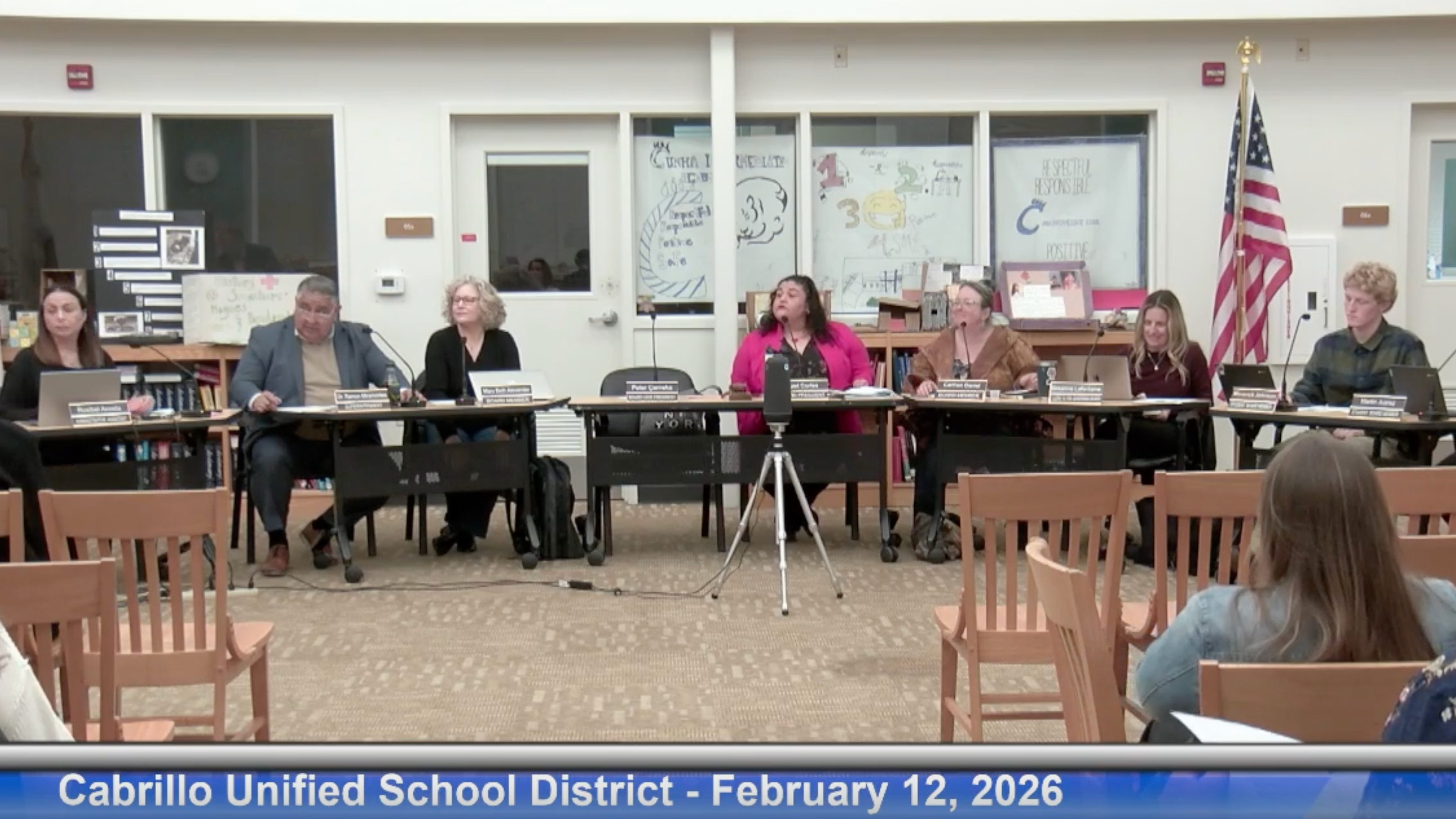
School Board - Feb 12, 2026 - Meeting

School Board - Feb 12, 2026 - Meeting

School BoardCabrillo Unified School DistrictFebruary 12, 2026

Sources:

Locunity is a independent informational service and is not an official government page for this commission.We use AI-assisted analysis and human editorial review to publish information.

Board Adopts Immigration Protections, Confronts Achievement Gaps in Marathon Session

Cabrillo Unified's school board moved swiftly to codify immigration protections for students and families ahead of a state deadline, then spent the bulk of a three-and-a-half-hour meeting wrestling with two intertwined questions: whether the district's dual immersion program is set up to succeed, and why English learners continue to post some of the lowest achievement numbers in the county.

  • Immigration policies adopted unanimously on first and final reading to meet a March 1 state deadline, with staff detailing campus enforcement protocols and family resources

  • Dual immersion master plan reveals years of inconsistency — parents praise elementary fixes but flag serious concerns about the secondary pathway

  • Zero percent math proficiency for English learners in grades 7 and 11 draws alarm as district enters final year of its LCAP cycle under state-mandated differentiated assistance

  • $8.7M architect contract approved for a $91M+ Measure K modernization of Half Moon Bay High School, launching a three-phase build through 2030

  • Labor peace signals: Both CUTA and CSEA announce tentative three-year agreements, with classified staff describing a transformation from formerly contentious negotiations


Protecting Families: Immigration Policies Clear Board Ahead of State Deadline

The board voted 5-0 to approve mandatory immigration-related policy updates on first and final reading, meeting a March 1, 2026, California Department of Education submission deadline. The policies align the district with California Attorney General guidance and California School Boards Association model language, establishing formal protocols for how staff should respond if immigration enforcement agents arrive on campus.

Why it matters: With immigration enforcement activity escalating across California, the vote puts Cabrillo Unified's legal obligations and practical response plans into writing — covering FERPA compliance, staff conduct, and family notification procedures. The policies also reflect new state legislation granting students excused absences for political activity, including walkouts.

Where things stand: James Barnes, Director of Educational Support Services, walked the board through enforcement scenarios in detailed terms: if agents arrive without a judicial warrant, staff should deny access — but if agents proceed anyway, the staff cannot physically impede them, lawfully. The staff will document everything.

Barnes also described accompanying roughly 100 Half Moon Bay High School students during a recent walkout, framing it as a protected civic exercise:

"This is a really important thing for students to be able to do, to engage in democratic civic action, to go out there and have their voices heard. It's a learning experience, a hugely important learning experience."

The other side: The board's debate centered not on the policies themselves but on how loudly the district should publicize its stance. Board Vice President Peter Cerneka voiced the tension directly:

"I am really torn on this. As a board member, I have my personal feelings about what's happening and I feel those feelings strongly. But I also don't want to do anything that draws undue attention."

He cited concerns he'd heard from Latino community members who worry that high-profile statements could invite enforcement activity.

Superintendent Dr. Ramon Miramontes described a calibrated approach — a "soft letter" to families linking the full presentation in English and Spanish, distributed through community liaisons rather than splashy public announcements. He recounted a prior incident where an alert about enforcement activity in the area triggered a dip in school attendance.

Public commenter Christine Walker pushed in the opposite direction, urging the district to form a mutual aid committee modeled on networks in Minnesota — coordinating food distribution, safe schooling locations, and staff guidance on protest participation — anticipating that enforcement would spread to the coastside.

Board President Lizet Cortes pressed staff on accessibility, asking how they are sharing the family guide and how families who lack internet or smartphones can access the website that hosts the guide.

Decisions: The policies passed 5-0 (with one student advisory vote). The district plans to distribute resources through Parents Square, community partners including ALAS San Mateo County, and direct outreach to families at Moonridge and Pillar Point.


Dual Immersion Overhaul: Elementary Gains, Secondary Doubts

Chief Academic Officer Israel Castillo presented a new master plan for the district's dual immersion program at Hatch Elementary, developed in partnership with the California Association for Bilingual Education. The plan replaces what Castillo and Miramontes acknowledged had been years of inconsistency.

The basics: The dual immersion program serves students in a combined Spanish-English instructional model. The new plan establishes a 60/40 Spanish-to-English ratio in grades K-2, transitioning to 50/50 in grades 3-5, with defined language allocations by subject area.

Why it matters: Until now, language time was unevenly distributed across classrooms. Miramontes was blunt about the state of affairs:

"When we first started to have this conversation with our staff and we wrote down how much time it was, it was all over the place... There was no continuity, no vertical alignment, no consistency."

Where things stand: The elementary-level changes drew broad support from parents and board members alike. But the plan's proposal to add Spanish social studies at Cunha Middle School starting with sixth grade in 2026-27 drew pointed concern.

Catrine Brown, president of the Spanish Immersion Parent Association (SIPA) and mother of four children in the program, identified three persistent problems: unstable administration at Hatch, teacher shortages hitting immersion classrooms harder than other programs, and insufficient English development for English learners. She supported the 50/50 model with team teaching and a phased approach but urged the district to strengthen bilingualism pathways at Cunha and the high school, not just at the elementary level.

Kendra Holland, a former SIPA leader, was more pointed about the secondary proposal. She warned that no qualified teacher currently exists for a Spanish social studies role at Cunha, questioned why that school would be forced to adopt changes next year without the same phased timeline Hatch is receiving, and asked whether three years of Spanish social studies would adequately prepare students for AP Spanish as sophomores — a key step toward the Seal of Biliteracy.

The other side: Board Member Breanna Lafontaine raised a different equity concern — the cost of private tutoring. She noted that families who can afford supplemental instruction are pulling further ahead of those who cannot, creating a two-tier dynamic inside the program. She pressed staff on whether core subject mastery is being maintained regardless of language of instruction.

Castillo acknowledged the challenge of attracting and retaining Spanish-speaking families:

"A lot of conversation comes from parents who compare their students to other students that are not in the dual immersion. And sometimes the English language development is not as proficient as their neighbors or their cousins."

Cortes closed with a call for more intentional bicultural community building:

What's next: The master plan was presented as an informational item; no vote was required. Implementation at Hatch begins in the current school year, with the Cunha expansion proposed for 2026-27.


Zero Percent: LCAP Data Reveals Deep Achievement Gaps

Castillo also delivered the district's mid-year review of its Local Control and Accountability Plan (LCAP), painting a picture of a system that has made scattered progress but remains far from closing persistent gaps for its most vulnerable students.

The basics: The LCAP is a state-required plan that ties district spending priorities to student outcomes. Cabrillo Unified is in Year 1 of "differentiated assistance" — a designation triggered when the same student groups underperform across multiple state indicators. This is the final year of the current three-year LCAP cycle, meaning the district must develop a new plan for 2026-27.

Why it matters: The numbers are stark. Only 7% of English learners are completing the A-G course sequence required for University of California and California State University admission, compared with 61% of English-only students. In math, Board Member Breanna Lafontaine highlighted the most alarming data point:

"Grade 7 and grade 11 — this says that zero percent of our English learners are proficient in math. Zero."

Where things stand: Bright spots exist: 49% A-G completion for Hispanic students overall, and improving reclassification rates — 40 students (11.8%) reclassified out of English learner status at mid-year. The district has expanded its English Language Development staffing from 0.6 to 1.0 FTE, added elementary counseling, and is piloting new math curricula including Inova Mat and Imagine Learning. Financial reserves have climbed from 5.6% to over 10%.

Public commenter Stacy McCarthy amplified concerns she heard at a recent Spanish-language LCAP community meeting: families discovering only in their children's senior year that A-G requirements had not been completed, with no earlier warning from the district. She asked what guardrails exist to flag ninth graders falling off the college-readiness path and raised concerns about social promotion — advancing students without foundational literacy mastery.

Board Member Mary Beth Alexander and Superintendent Miramontes both engaged at length on the data, with Miramontes describing ongoing work with county-level partners on root cause analysis.

What's next: The district must develop its new three-year LCAP for adoption before the 2026-27 school year. The differentiated assistance designation means state and county oversight will continue.


$91M High School Overhaul Moves Forward With Architect Contract

The board approved an $8.7 million not-to-exceed architect services agreement with Derivi Castellanos Architects for the Measure K modernization of Half Moon Bay High School — the district's largest capital project in a generation.

Why it matters: The three-phase project, spanning 2026-2030, carries an estimated construction value exceeding $91 million. It includes a new aquatic center, replacement of aging Buildings G and A with new classroom construction, career and technical education facility improvements, and underground utility upgrades.

Where things stand: Ramon Gomez, Senior Principal Architect with Derivi Castellanos Architects, presented the phased timeline. Drew Gamet, Bond Program Fiscal Project Director with CUSD, walked the board through the contract structure: the $8.7M fee represents approximately 9.5% of estimated construction costs, a figure board members questioned. The architect confirmed fees are scope-based, not inflation-indexed — if material costs rise, the fee does not automatically increase. The contract includes a built-in protection: if bids exceed design estimates by more than 10%, DCA must revise drawings at no additional cost.

A separate but related concern surfaced during the El Granada fee adjustment item. Nicole Robinson, a reading intervention teacher at El Granada Elementary, reported that fixed TV screens centered on large magnetic whiteboard walls in the school's newly constructed C building are obstructing structured literacy instruction. She surveyed 16 of 18 teachers; all 15 respondents agreed screens are in the way. Robinson requested that future buildings have movable or relocated screens, citing state laws requiring evidence-based phonics curriculum. Superintendent Miramontes committed to investigating the issue before final construction phases.

Decisions: The DCA contract passed 5-0. The board also approved El Granada Phase 1's final fee adjustment of $117,169 (5-0) and the Farallone View Elementary fee reconciliation of $251,812 (5-0), both reflecting final guaranteed maximum price settlements with their respective architects.

What's next: DCA will begin design work on Phase 1, with construction targeted to start in 2026. The project will use a lease-leaseback delivery method.


Minor Items

  • Security cabling at El Granada Elementary: $113,666 contract with Keep It Simple for Verkada security system installation, funded from bond proceeds. Approved 5-0.

  • Resolution 01-2026 adopted 5-0, designating the superintendent and CBO Jennifer Marsh as authorized representatives for State Allocation Board–administered programs.

  • Independent audit for fiscal year ending June 30, 2025: Auditor Angela Lee of Chavon and Associates reported an unmodified (clean) opinion with no findings across financial statements, federal compliance, and state compliance. Total revenue was $65.9M against $66.8M in program expenses. Net position edged from $26M to $25M. Approved 5-0.

  • Bond oversight report: Kendra Holland, chair of the Citizens Bond and Parcel Tax Oversight Committee, confirmed Measures S ($81M, 2012), M ($99M, 2018), and K ($153.4M, 2024) are all in compliance with voter intent. Approved 5-0.

  • CSBA delegates for Sub-Region 5B: Chelsea Bonini, Terry Chavez (incumbents), and Mary Beth Alexander (write-in) selected 5-0.

  • Out-of-state travel to Coast to Coast federal advocacy conference in Washington, D.C., April 13-15, approved for Board Members Mary Beth Alexander and Breanna Lafontaine at approximately $3,000-$3,500 per member. Approved 5-0.

  • Labor updates: CUTA representative Mr. Carey reported attending a solidarity rally with 6,000 striking San Francisco educators, framing it as part of a broader movement. CSEA Vice President Paul Harrison announced a tentative three-year agreement, describing a transformation in labor relations. Both unions plan member ratification votes in March.

  • Coastside Community Orchestra: Jerry Fong announced March music education assemblies at El Granada and Farallone View elementary schools and an upcoming concert April 11 at IDES Hall.

  • Farallone View Elementary school presentation highlighted student achievements and campus culture; the school's principal briefed the board on programs and student engagement.