Budget & Appropriations Committee - Mar 18, 2026 - Regular Meeting
Budget & Appropriations Committee • San FranciscoMarch 18, 2026
Locunity is a independent informational service and is not an official government page for this commission.We use AI-assisted analysis and human editorial review to publish information.
Budget Committee Draws Line on Layoffs, Targets Senior Management in $900M Deficit Fight
San Francisco's Budget and Appropriations Committee laid down its markers for the coming budget battle Wednesday, unanimously adopting a framework that demands cuts start at the top of city government — not with frontline workers serving vulnerable communities. With a $900 million deficit looming and an estimated $737 million in federal funding losses over four years, the committee's priorities will shape how the Board of Supervisors evaluates Mayor Daniel Lurie's proposed budget starting in May.
Committee adopts "chop from the top" budget priorities, directing cuts at senior management before frontline staff, and sends framework to full Board on 3-0 vote
$737 million in projected federal losses compounded by a chilling effect on philanthropy, leaving the city as the last line of defense for immigrant, trans, and BIPOC communities
Chair Connie Chan announces she will step down as Budget Committee chair in August 2026 after shepherding the two-year budget through passage
Payroll data shows the city added 815 senior managers at $211.9 million in cost over 14 years, bolstering the case for management-level reductions
Nonprofit service providers push for stabilization funding, warning that rising costs and delayed city payments are straining the safety net
Chop From the Top: Committee Sets the Terms for Budget Season
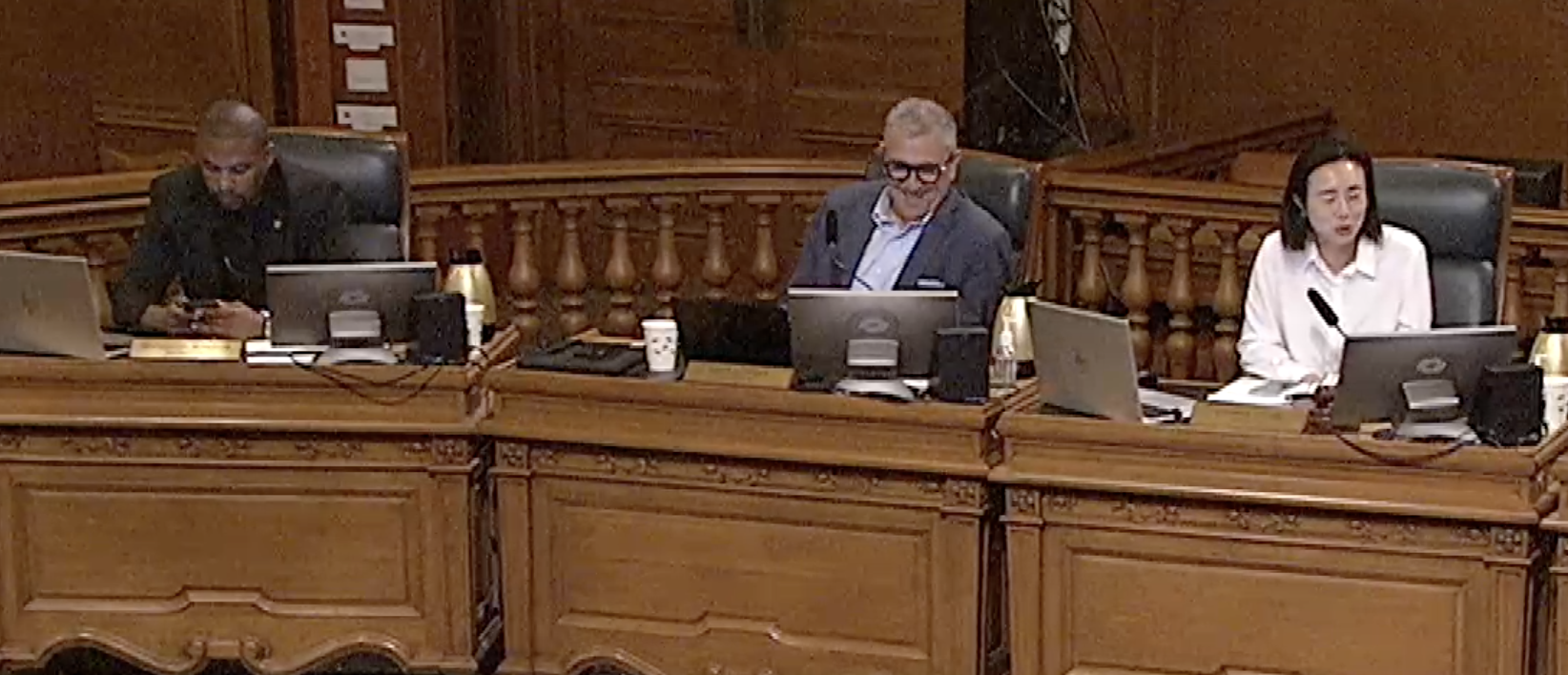
Supervisor Connie Chan, chair of the Budget and Appropriations Committee, introduced a motion establishing the Board's priorities for the fiscal year 2026–2028 budget cycle — a two-year spending plan that will be negotiated against one of the worst fiscal outlooks San Francisco has faced in recent memory.
Why it matters: The city is staring down a projected $900 million deficit, and the committee's framework will serve as the Board's official negotiating position when Mayor Lurie presents his proposed budget. The priorities signal that supervisors intend to push back against across-the-board layoffs by demanding management-level reductions first.
Where things stand: Chan outlined six core priorities: (1) "chop from the top" by reducing senior management positions rather than relying on frontline layoffs; (2) maximize federal and state grant reimbursement rates; (3) review contracts of $1 million or less and consolidate procurement processes; (4) reduce administrative costs across all departments; (5) invest in oversight to root out wasteful and corrupt spending; and (6) require enterprise agencies to streamline capital improvement projects.
"Chop from the top in the face of Mayor Lurie's conversation around layoffs, leverage federal and state grant and funding. We need to maximize our reimbursement rate," said Chair Chan.
The motion also established guiding principles requiring the budget protect services for immigrants, the LGBTQ community, seniors, people with disabilities, children and youth, tenants, unhoused people, and working families. Chan called for evaluating the fiscal impacts of fee waivers and tax revenue suspensions on housing production and business revitalization, and for scrutinizing the city's use of debt instruments including bonds, enhanced infrastructure finance districts, and certificates of participation.
"I really want all of us to evaluate the utilization of debt and financing policies, including but not limited to bonds, enhanced infrastructure finance districts and certification of participation in coalition with the projection of economic growth for the city," Chair Chan said, framing the budget as both a fiscal and moral document. "It is time that we hold true to our value that we deliver for working people and not the wealthy few in the city."
The other side: Supervisor Matt Dorsey, vice chair, didn't push back on the priorities — he pushed them further. Dorsey elevated a dimension of the crisis that goes beyond the headline deficit number: the Trump administration's projected $737 million in federal cutbacks over four years, compounded by what he described as an unprecedented retreat by philanthropic organizations afraid of political retaliation.
"There is real fear even in the philanthropic world, that good philanthropies don't want a target on their back because of how politicized things are from the Trump administration," Vice Chair Dorsey said. "For many of the communities that we're going to be endeavoring to support, it's important that we be mindful that there's no cavalry coming for them unless we are."
Dorsey called this downturn fundamentally different from past budget crises and asked to be added as a co-sponsor of the motion.
Supervisor Shamann Walton, the committee's third member, drove the equity point home, warning that proposed cuts would not fall evenly across the city.
"These budget cuts, from what we're seeing and what possibilities may exist, are not necessarily neutral. And these are going to be very real and have some very inequitable impacts across the city," Supervisor Walton said, calling for the Board to maintain critical services, address affordability, decrease inequities, and continue serving unhoused and immigrant populations.
Decisions: The motion was amended with a minor clerical correction and referred to the full Board of Supervisors with a positive recommendation on a 3-0 vote (For: Chan, Dorsey, Walton; Absent: Sauter, Mandelman). It is expected on the Board agenda March 24, 2026.
A Leadership Shift
In the middle of laying out her budget framework, Chair Chan dropped a significant piece of news: she plans to step down as Budget Committee chair in August 2026, as her congressional campaign approaches election day, after completing this year's budget process.
Why it matters: The Budget Committee chair wields enormous power over San Francisco's $14+ billion budget. Chan's departure will force the Board of Supervisors to install a new chair heading into whatever fiscal crises follow — at a time when sustained deficits and federal uncertainty make the role more consequential than ever.
"This is why I have every intention to guide the city through another challenging year as the Budget Committee chair. But also why I plan to step down as committee chair in August of 2026 after we complete this year's budget process," Chair Chan said, calling on colleagues to step into new leadership roles and learn to make the difficult choices that shape future budgets.
What's next: The transition won't happen until after the FY2026-28 budget is adopted, but the announcement puts Board leadership on notice that a successor will need to be identified.
Public Comment: The Data and the Human Cost
Two public commenters provided the committee with both granular data and a ground-level view of how the city's fiscal decisions ripple outward.
Patrick Monette-Shaw, a public commenter, arrived with 14 years of Controller payroll data showing the city added 8,704 employees since FY2010-11, including 815 senior managers at a combined cost of $211.9 million. He highlighted that the Mayor's Office alone grew by 88 employees to 188 total, and that 334 city employees earned total pay exceeding the Mayor's $383,760 salary — at a combined cost of $147.3 million. Monette-Shaw urged the Board to oppose Mayor Lurie's charter change proposal to eliminate the mayoral staff salary cap, and to cut both vacant and filled senior manager positions. His data provided an empirical foundation for the committee's "chop from the top" framework.
Rosio Molina of the San Francisco Human Services Network, representing more than 60 nonprofit organizations, advocated for a "cost of doing business" investment to stabilize the nonprofit service providers the city depends on to deliver health and human services. She described organizations facing rising health insurance costs, increased administrative and reporting burdens, and delayed contract payments from the city — a combination that is redirecting program staff away from direct services and toward compliance paperwork before organizations are even paid. The Human Services Network's ask is a stabilization investment, not a new program — a signal that the city's own contracting delays are compounding the fiscal pressure on its safety net partners.
What's next: The full Board of Supervisors is expected to take up the budget priorities motion on March 24. Mayor Lurie's proposed budget is anticipated in May, at which point these priorities become the lens through which supervisors will evaluate every line item — from senior management headcount to the city's obligations to its most vulnerable residents.