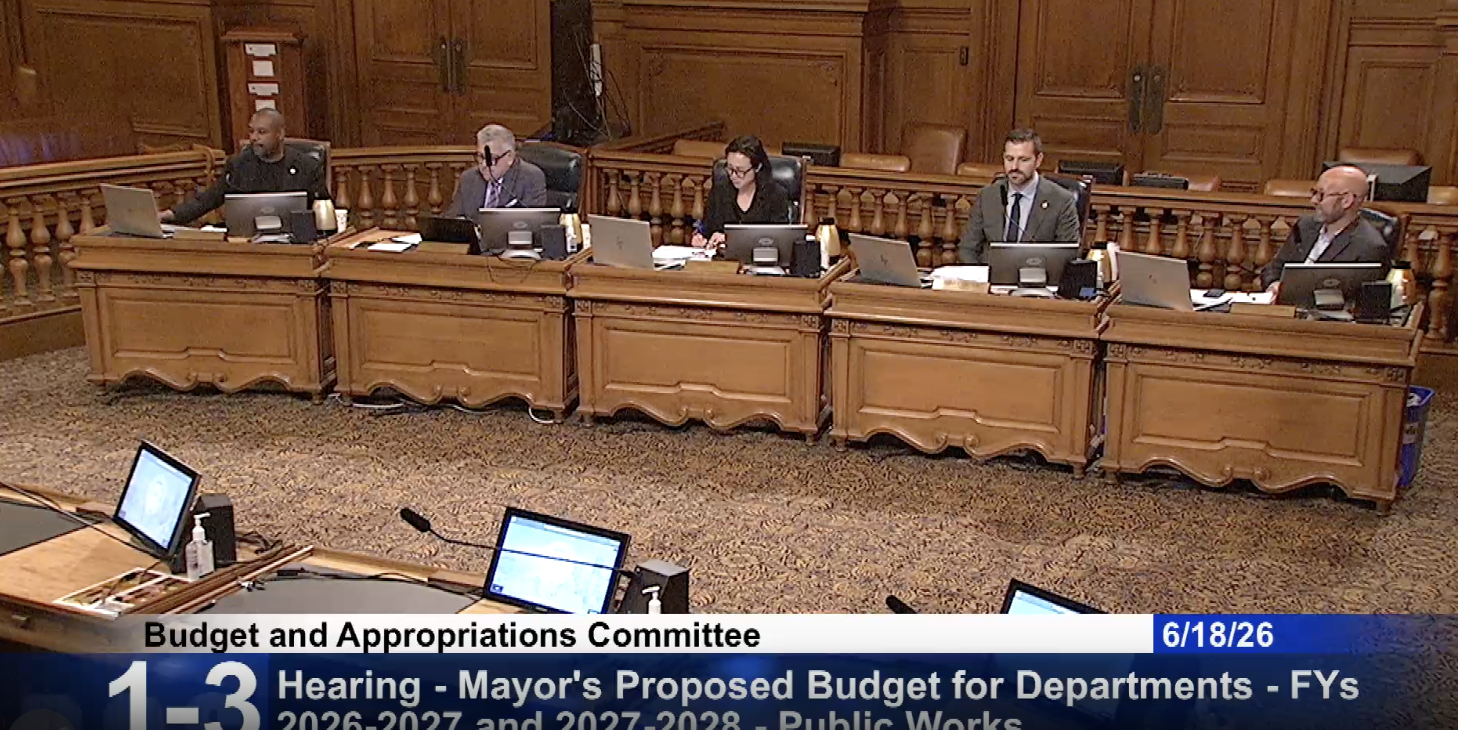
Budget & Appropriations Committee - Jun 18, 2026 - Special Meeting

Budget & Appropriations Committee - Jun 18, 2026 - Special Meeting

Budget & Appropriations CommitteeSan FranciscoJune 18, 2026

Sources:

Locunity is a independent informational service and is not an official government page for this commission.We use AI-assisted analysis and human editorial review to publish information.

City Administrator, Public Works Fight to Preserve Key Staff as SF Tackles $643M Deficit

San Francisco's Budget & Appropriations Committee spent more than three hours hearing impassioned defenses from two department heads who pushed back on millions in proposed budget reductions — setting up a pivotal Monday showdown as supervisors try to close a $643 million structural deficit without gutting the city's capacity to manage its buildings, clean its streets, and fix its roads.

  • City Administrator opposes 8 of 11 proposed cuts, defending a citywide data platform, Moscone Center capital reserves, and real estate positions managing the Hall of Justice exit
  • Public Works director warns $2M paving cut could cost 10x more later, noting it costs $50,000 to maintain a road in good condition vs. $600,000 to rebuild one that deteriorates
  • Fourteen departments accept all analyst-recommended reductions without objection, establishing the committee's savings baseline
  • All contested decisions deferred to June 22 as Chair Chan urges colleagues to see the full picture before committing
  • Mayor's Budget Office adds $2M in net costs through technical adjustments, including accelerated fire equipment purchases and backfilling shrinking state revenue

City Administrator Draws Line on Data, Real Estate and Moscone

The Budget & Legislative Analyst recommended $2.2 million in fiscal reductions and $366,000 in policy reductions to the City Administrator's nearly $600 million budget. City Administrator Carmen Chu accepted three of 11 recommendations but opposed the rest, arguing the cuts would hollow out citywide functions just as the office is being asked to do more.

Why it matters: The City Administrator's Office oversees functions that cut across every department — from a unified data platform serving 70-plus agencies to management of 77 city buildings. Proposed charter reform could expand that coordinating role further.

Where things stand: Chu framed the budget as lean by design, telling the committee: "With the exception of a small increase in investment in the technology sector component, where we are investing in the city's data platform, not the city administrator's data platform, we're simply asking to keep our existing core operating resources." The office's six-person data team, led by Chief Data Officer Somya Kalra, supports more than 70 departments through DataSF's unified platform. The BLA recommended eliminating a senior engineer position and reducing funding for the platform expansion.

Chu also fought to preserve a project manager for complex real estate transactions, warning that major efforts — exiting the Hall of Justice, disposing of Log Cabin Ranch, vacating 1 South Van Ness — would have no dedicated staff to push them forward. On the campus manager position overseeing 40 buildings, she noted the office is already stretched thin.

Supervisor Dorsey was the most vocal defender of the administrator's requests, calling the 1455 Market Street transaction "the kind of investment with the city's real estate assets that can be a game changer for the neighborhood." He also highlighted the scale of the Treasure Island development: "Treasure Island is one of the most ambitious housing development projects in our city's history. Right now we're working on 8,000 new homes, 27% affordable."

The other side: Supervisor Walton offered a pointed counterweight, reminding colleagues that every department makes the same case for its own needs. "I also know that we are in a budget crisis and everyone has been asked to step up and put some skin in the game. And it is not easy for all of our city departments," he said. On the argument that cross-departmental coordination requires city administrator staffing, Walton was blunt: the "lack of coordination among city departments, issues and concerns that cause disagreement between city departments fall in the mayor's lap," he said, adding that departmental coordination is "the problem of the person who is in charge of this city."

Board President Mandelman sided more with the administrator, noting the city has "17 Salesforce contracts" across siloed departments and arguing the office should be resourced to reduce that fragmentation — whether or not charter reform passes. He also cautioned that years of accumulated cuts are making each new round harder: "One would expect the cutting is going to get harder and harder and that the impacts of moving forward with additional cuts beyond what are recommended by the mayor are going to be more and more serious."

Decisions: No votes were taken. All items were deferred to the June 22 continuation.


Moscone's $7.5M Reserve at Stake

The most dollar-significant single recommendation was ADM9: transferring $7.5 million from Moscone Center's special revenue fund balance to the general fund. The BLA noted revenues had exceeded projections.

Why it matters: Moscone receives no public bond money for capital improvements — its fund balance is the only source for maintenance of the aging convention complex.

Where things stand: City Administrator Chu laid out more than $30 million in identified capital needs: a freight elevator replacement, end-of-life generators at $3 million, corrosion repairs at the 23-year-old Moscone West, $3 million in roofing work, an $8 million escalator replacement, and IT infrastructure upgrades. She warned that 13 competitor convention centers nationally are investing a combined $14 billion in upgrades. "We're still at 60% occupancy of our hotels compared to where we were before pandemic at over 80%. So still a lot of room to move," Chu told the committee.

The BLA noted that approximately $17 million would remain in the fund after the proposed transfer. Chair Chan highlighted that Moscone's self-funded model means the general fund does not backstop its capital needs — a key distinction from other city facilities.

What's next: The committee deferred the decision to June 22 alongside all other contested items.


Public Works Director Pushes Back on Street, Paving and Permitting Cuts

The BLA recommended $4.3 million in fiscal reductions and $1.2 million in policy reductions to the Department of Public Works. Director Carla Short accepted $4.7 million in reductions over two years but opposed cuts she said would directly affect streets, roads, and the city's permitting overhaul.

Why it matters: The proposed reductions touch services residents interact with daily — street cleaning, road quality, and the speed of building permits — while the city faces both a cleanliness crisis and ambitious housing production goals.

Street Cleaning: Every Dollar Spent

Short pushed back hardest on the BLA's recommendation to cut three street cleaning positions — a general laborer, a supervisor, and a superintendent — arguing the department uses every cent of its cleaning budget. "While we have had vacancies in our general laborer positions, we have spent every single dollar of street cleaning funding," she said, explaining that when civil service hiring lists are exhausted, the department fills gaps with temporary 9916 positions.

On the superintendent vacancy, Short challenged the BLA's characterization that the position had been empty since November 2021: "I want to strongly emphasize that in fact it had been filled with an exempt position for three years and then that individual retired and we have someone acting in this position currently."

Paving Math: $50K Now or $600K Later

The BLA proposed cutting $2 million from street resurfacing. Short made a direct economic argument: "To repair a road that is in good condition, it costs about $50,000 per block. To rebuild a road that is in poor condition, it costs upwards of $600,000 per block." She noted the proposed budget merely backfills lost state and federal funding, not new spending.

Management Already Cut to the Bone

Short pre-empted concerns about overhead by noting the department has already trimmed management significantly. "Today, managers represent only 3.5% of our workforce. This is down from 5.4% of our workforce," she said, adding that 96% of DPW employees directly support frontline service delivery.

She also defended contested positions including a permit project director tied to the city's Permit SF modernization effort, and the urban forester who manages 125,000 street trees and oversees a $12 million federal Inflation Reduction Act forestry grant.

Limited General Fund Savings

Short delivered a pointed fiscal argument: most of the positions the BLA recommended cutting are funded by overhead charges, not the general fund. "With the exception of the paving program and the three street cleaning positions, none of these other recommendations are general fund funded. So from our perspective, it does not allow you to reallocate any resources for other programs," she told the committee.

The other side: Supervisor Sauter proposed reopening one already-agreed-upon vehicle reduction to redirect roughly $260,000 toward a power-washing truck. He noted that a California Air Resources Board exemption for such vehicles had recently come to light, making the purchase feasible: "In the last couple weeks, it's my understanding that there's been awareness that for the power washing vehicles, there's actually an exemption for those vehicles from the California CARB requirements."

DPW CFO Bruce Robertson provided detailed fiscal breakdowns on the overhead funding structure and confirmed the limited general fund impact of most contested positions.

Decisions: No votes taken. All items deferred to June 22.


Chair Chan's Budget Primer: Why Every Cut Decision Is a Trade-Off

Throughout the hearing, Chair Connie Chan used department presentations as tutorials on how the budget process works, repeatedly walking colleagues and the public through the mechanics of a process that will determine spending for the next two fiscal years.

Why it matters: The committee controls roughly $2 billion to $3 billion in truly discretionary general fund spending out of a $17 billion total budget. Every BLA recommendation the committee rejects affirms the mayor's proposed spending. Every recommendation it accepts generates savings the Board can redirect.

Chan explained why she chose to defer all line-by-line votes rather than act piecemeal: "We are having a $643 million of deficits that we have to tackle for the next two fiscal years. And it is no small feat." She wants supervisors to see the full savings picture across all departments before committing.

She also pushed back on the notion that the BLA exists to maximize Board spending power: "I do not view the budget — it's the responsibility of the Budget and Legislative Analyst to somehow hackle the city departments to give us as much money as we could so then the Board can spend however way we want." Her framing: the analyst provides impartial analysis, and the committee must make political choices about priorities.

What's next: The BLA's second-half report, covering the city's largest departments — Public Health, Police, Fire, Sheriff, Human Services, Homelessness, Rec and Park, and others — was expected later that day, setting up Monday's session as the most consequential of the budget cycle.


Minor Items

  • Fourteen departments accepted all BLA recommendations without objection, including the City Attorney's Office, Superior Court, Assessor-Recorder, Asian Art Museum, Fine Arts Museums, Arts Commission, War Memorial, Agency for Human Rights, General City Responsibility, Comptroller's Office, Department of Technology, Human Resources Department, Juvenile Probation, and the Board of Supervisors itself.
  • Treasurer & Tax Collector accepted all four fiscal recommendations but rejected all four policy recommendations; the committee noted a persuasive letter from the office.
  • Department of Elections accepted two of three recommendations; a vacant director position was placed on reserve, with the option to redirect approximately $330,000 toward voter information pamphlet costs.
  • Mayor's Budget Office presented a second round of technical adjustments with a net general fund cost of approximately $2 million over two years. Key changes included accelerating Fire Department turnout coat purchases into year one and backfilling $25 million to $30 million in reduced excess ERAF revenue from the state.
  • Self-Insurance Surety Bond Fund and two homelessness funding items (fund reallocation and the two-year expenditure plan) were carried to June 22 without discussion.
  • The committee voted 5-0 (Dorsey, Sauter, Walton, Mandelman, Chan) to carry all undecided items to the June 22 meeting and recess.
City Administrator, Public Works Fight to Preserve Key Staff as SF Tackles $643M Deficit | Budget & Appropriations Committee | Locunity