
San Francisco Braces for Federal Fallout With 154-Person Hiring Surge to Protect CalFresh Recipients
Budget & Appropriations Committee • San FranciscoJune 22, 2026
Locunity is an independent informational service and is not an official government page for this commission. All information is sourced from public footage and an analysis of official agendas with the aid of responsible, fact-checked AI. to report an error or omission.
The San Francisco Board of Supervisors' Budget & Appropriations Committee spent more than three hours on June 22 hearing from seven city departments fighting back against millions in proposed budget cuts — and largely siding with them. The most consequential debate centered on the Human Services Agency's plan to hire 154 new workers to shield 50,000 CalFresh recipients from sweeping new federal work requirements under HR1, a move officials say could protect up to $300 million in Medi-Cal reimbursements.
- HSA unveils innovative "14-hour" volunteer program to keep 50,000 CalFresh recipients enrolled under HR1 work mandates
- DPH director argues department has already cut managers at 8x the staff rate; remaining 23 positions tied to $176M in federal revenue
- Committee places California Academy of Sciences funding on reserve pending audit, citing 53 layoffs despite $200M endowment
- Vice Chair Dorsey brokers compromise on Sheriff's Reset Center, narrowing reserve to performance-based contract portion only
- Public Defender warns cutting filled attorney positions would push caseloads past 129 per lawyer — highest in the Bay Area
- Chair Chan proposes holding SFPD funds until department presents long-term fleet and facility strategies
154 New Workers, 14 Hours a Month: HSA's Plan to Blunt Federal Cuts
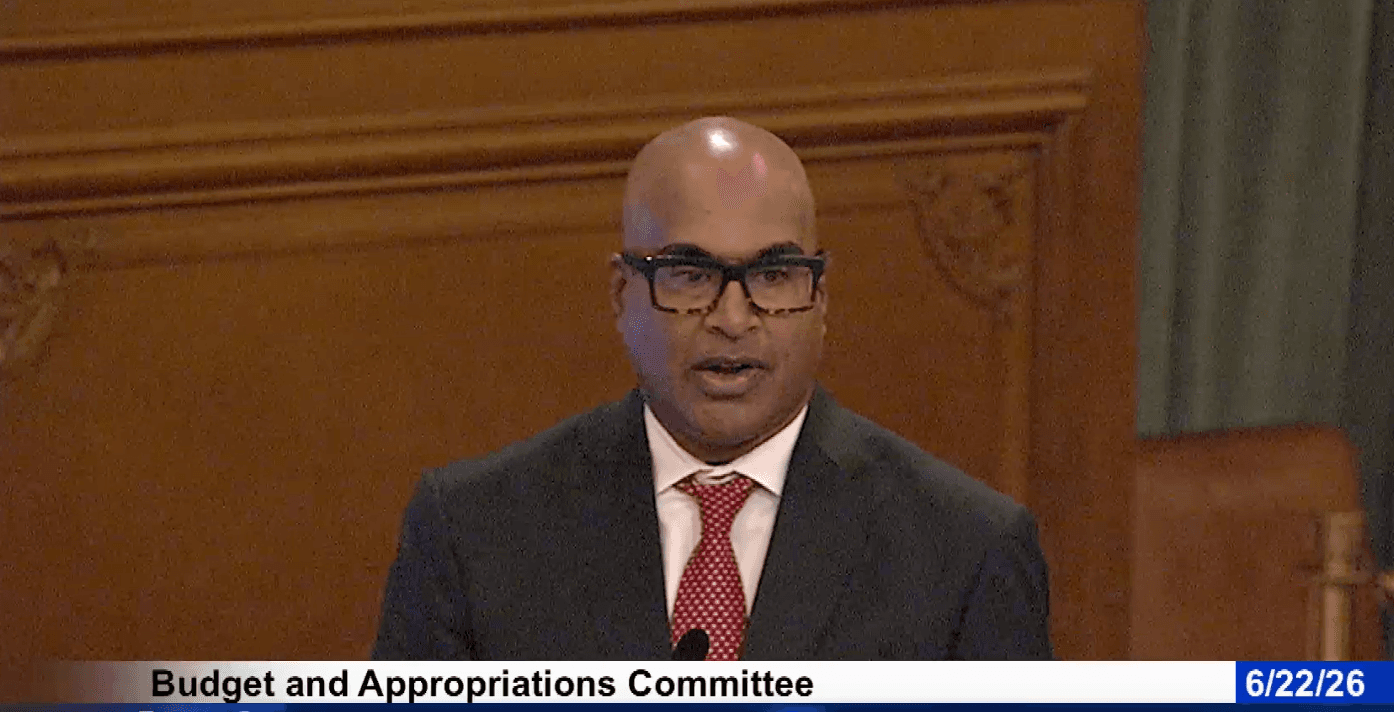
The sharpest policy debate of the afternoon belonged to Human Services Agency Director Trent Rohr, who laid out in granular detail how San Francisco plans to respond to HR1's elimination of California's decade-long waiver of CalFresh work requirements.
The basics: HR1 expands mandatory work requirements to CalFresh recipients who were previously exempt — including veterans, unhoused individuals, families with children 14 and older, adults ages 60–64, and former foster youth. Of roughly 112,000 CalFresh recipients in San Francisco, about 50,000 are newly affected. An estimated 30,000 will qualify for exemptions but still require individual eligibility assessments by trained staff.
Why it matters: CalFresh compliance automatically exempts recipients from upcoming Medi-Cal work requirements starting January 2027. If recipients lose CalFresh, they risk losing Medi-Cal too — a cascading failure that San Francisco estimates could cost $150 million to $300 million in lost federal reimbursements.
Where things stand: Rohr's team devised a workaround grounded in federal labor law. Because the Fair Labor Standards Act triggers minimum wage requirements for work settings, dividing the average $298/month CalFresh benefit by San Francisco's minimum wage yields roughly 14 hours per month of required volunteer service — far below the federal 80-hour standard.
"We're building a program that will say to the CalFresh recipient, all you need to do is volunteer in this workfare sort of setting — volunteer at a nonprofit or even a public sector placement for average of 14 hours a month," said Director Trent Rohr.
Rohr framed the stakes in historical terms: "This is the biggest shift in federal law governing our program since the Affordable Care Act in 2010 and before that 1996 with the federal welfare reform act. It's a drastic shift, and San Francisco has proven in 1996 and in 2010 and hopefully now that we step up to the plate to protect the people who are most vulnerable."
The other side: The Budget and Legislative Analyst recommended a $1.5 million reduction assuming hiring delays and proposed making 149 of the 154 positions limited-term rather than permanent. Rohr pushed back, arguing that temporary status would undermine recruiting and waste training investments. He noted that HSA already built vacancy attrition into its projections and has active eligibility lists with more than 602 candidates.
Chair Connie Chan expressed caution about committing to all 154 positions given fiscal uncertainty but praised Rohr's track record: "I would love to understand a little bit more. Again, you know, I think that with the 149 FTEs you mentioned, 80 FTEs that you will hire by October."
Decisions: The committee accepted fiscal recommendations 1–6 from the BLA. The disputed policy recommendations — including whether positions should be permanent or limited-term — were carried to the June 24 session.
What's next: Final decisions on the 154 positions will come at the June 24 reconvened meeting, where public comment will also be heard. The CalFresh Community Service program design will need to be operational before new federal requirements take effect.
DPH Says It's Already Done the Cutting — 23 Remaining Positions Protect Revenue
Why it matters: The Department of Public Health is the city's largest department by budget. The BLA recommended deleting 23 vacant manager positions for more than $7 million in savings. Director Dan Tsai arrived with data showing the department has already absorbed deep reductions — and that the remaining positions are tied directly to money coming in, not just money going out.
Where things stand: DPH has already eliminated 130 FTE positions, including 19 vacant managers — 40% of all manager vacancies — at eight times the rate of non-manager reductions. Tsai grouped the remaining 23 into five categories: positions needed to avoid layoffs of acting staff; positions with no general fund impact; revenue-generating roles critical to securing $176 million in new Medi-Cal and Medicare revenue; positions required by regulators (including a cybersecurity head and Laguna Honda director of nursing); and recent critical vacancies being actively recruited.
"We have been at the lowest rate of turnover in DPH in the past 10 years. We're at a 6.7% turnover rate," Director Tsai said, noting the department had already budgeted attrition at 10% — 50% above the actual turnover rate.
Dr. Susan Ehrlich, CEO of San Francisco General Hospital, explained that two of the contested positions handle the revenue cycle — coding on the front end, compliance and billing on the back end — essential infrastructure for maximizing reimbursements, especially given HR1 threats to federal health funding.
Vice Chair Matt Dorsey pressed specifically on credentialing positions, citing Laguna Honda's recent troubled history with federal regulators.
Board President Rafael Mandelman acknowledged the pain directly: "You are I think the largest chunk of our budget, and therefore when cuts come, they come hardest for you. And I think your work with the mayor's team to try to find the least — I mean, there's no cuts to public health that are not painful."
Decisions: The committee accepted fiscal recommendations 1–17. Policy recommendations on the 23 manager positions were deferred to June 24.
Academy of Sciences Faces Audit After Layoffs Despite $200M Endowment
Why it matters: The California Academy of Sciences laid off 53 employees while sitting on a $200 million endowment, raising pointed questions from supervisors about how the institution stewards more than $6 million in annual city funding for Steinhardt Aquarium operations.
Where things stand: The BLA recommended placing portions of the aquarium budget on reserve — 50% of five line items and 25% of a sixth in year one, 100% in year two — pending a performance and management audit. Interim Executive Director Amber Mace opposed the reserve, arguing the funds are tightly controlled by the city for charter-mandated obligations. The $932,000 increase reflects unavoidable costs including utilities, union salaries for Local 39 engineers, and capital projects. Mace warned that placing salaries on reserve could cause essential staff to seek other employment.
Chair Chan was unsparing: "I do have to say that I disagree about what would really make the members and the workers at Cal Academy think about changing their career or even leaving the institution. It's the fact that you started off with 53 layoffs already, and that does not provide confidence for the institution when you have $200 million of endowment available."
Chan compared the approach to the successful audit-and-reserve process recently applied to the San Francisco Zoo. BLA Director Dan Goncher confirmed the audit timeline: start in August, entrance conference within weeks, initial findings by October, and a report to the Budget & Finance Committee by November for fund release. First-year funds for the initial six months would be released immediately.
Supervisor Shamann Walton noted the city itself has had to tap reserves to protect programs from federal cuts, arguing that institutions with substantial endowments should also contribute.
Decisions: The committee moved forward with placing aquarium funds on reserve pending the audit. The Academy will need to cooperate with the BLA's review to unlock the funds.
What's next: The BLA expects to begin the audit in August, with findings presented by November.
Community Ambassadors Win Support as Good Neighbor Lifeline
Why it matters: The Department of Homelessness and Supportive Housing convinced supervisors that $4.4 million the BLA identified as savings from interim housing should instead fund community ambassador services in SOMA and the Tenderloin — the neighborhoods most directly affected by shelters and permanent supportive housing.
Where things stand: The BLA recommended taking the $4.4 million in current-year savings, noting HSH lacked a clear spending plan. The HSH Director countered that the funds would sustain and expand the Good Neighbor Policy, which stations ambassadors around shelter and PSH sites to manage neighborhood impacts and build community support.
Vice Chair Dorsey delivered an extended defense of the spending, calling prevention and housing placement cost-effective tools and arguing that ambassador programs are foundational to public willingness to accept homelessness services in their neighborhoods: "I am powerfully persuaded by the Department's position on the importance of the positions. In my view, we can't manage a growing homelessness response system with fewer people responsible for planning and coordination."
Supervisor Danny Sauter reinforced the point: "I've always had a feeling that our good neighbor policy has to be strengthened. It needs to be backed up. And I would like to see these services kind of built in from the beginning."
An unidentified supervisor specifically cited the intersection of Turk and Hyde as a success story for the ambassador model.
The BLA also recommended deleting four vacant manager positions. HSH argued these are essential to managing growing contracts and programs. The committee appeared inclined to support the department.
Decisions: Fiscal recommendations 1–4 were accepted. Policy recommendations on manager positions were deferred to June 24.
Dorsey Brokers Reset Center Compromise With Sheriff
The Sheriff's Office faced six BLA-recommended reductions totaling roughly $957,000 in fiscal savings, plus a proposal to place the entire Reset Center contract — $3.3 million in year one, $5.3 million in year two — on reserve.
The basics: The Reset Center connects intoxicated individuals to care services rather than booking them into jail. The program has processed 753 individuals with a 27% connection-to-care rate.
Where things stand: Sheriff Paul Miyamoto opposed all six recommendations. A key sticking point was the fingerprint technician unit, where the department has only three active technicians for 24-hour operations — with one on disability — forcing costly overtime using cadets.
Vice Chair Dorsey proposed a targeted compromise: place only the performance-based incentive portion of the contract on reserve — approximately $793,000 in year one and $625,000 in year two — while keeping operational funding intact.
"I think there is merit in the Sheriff's proposal to place only the performance-based portion of the contract on reserve," Vice Chair Dorsey said. The Sheriff agreed to the approach.
Chair Chan asked detailed questions about performance metrics and thresholds built into the contract. Supervisor Walton questioned hiring freeze timelines for fingerprint technicians.
What's next: Final action on the modified reserve will come at the June 24 session.
Public Defender: Cutting Filled Positions Would Break an Already Strained System
The BLA recommended denying conversion of eight temporary-to-permanent positions — four misdemeanor attorneys, three legal assistants, and one clerk — for $2.1 million in savings.
Public Defender Manu Raju made clear these are not vacant positions awaiting hire — they are filled and carrying active caseloads.
"These are four attorneys in our misdemeanor unit who currently each have a caseload, and I just checked this morning, of 129 cases each, which is way above national workload standards, California standards, and actually the highest in the Bay Area," Public Defender Raju said.
The Clean Slate program, which helps individuals clear criminal records, serves 1,500 new clients annually with a backlog of more than 400 and over 3,132 open files. Raju warned that the cuts would leave the program with zero paralegals and no dedicated clerk: "Eliminating these positions would leave our Clean Slate team with no paralegals whatsoever, no full-time dedicated clerk, meaning they'd be left without the dedicated support that they need to sustain their operations."
Raju also argued the office is more cost-effective than outside counsel, citing release motions that reduce jail costs, in-house immigration consultation, and faster case processing. Vice Chair Dorsey asked specifically about cost comparisons to contracted attorneys. No committee members expressed support for the BLA cuts.
Chan Pushes SFPD to Show Its Long-Term Plan Before Funds Flow
Rather than accept or reject $1.278 million in BLA-recommended reductions outright, Chair Chan proposed placing the funds on reserve until SFPD presents long-term strategies for fleet replacement and facility renovations.
SFPD CFO Kimmy Wu detailed how each targeted line item is already committed: hazmat abatement across 10 stations and 14 leased facilities, a $350,000 attrition adjustment that would worsen a projected $2.4 million deficit in temporary salaries, and a live-scan technology system launching July 1. Vehicle replacement has fallen far below the 66-per-year historical average, driving up maintenance costs by $2 million annually.
On the policy side, two of three targeted manager positions are in SFPD's Technology division, which already lost 16 FTEs this year.
Chan indicated she would reject the policy recommendations but wants SFPD to come back with fleet management and facility renovation plans — including how Proposition A bond funds would address the Taraval Station rebuild and the long-term future of the Arctic temporary facility.
Mayor's Office Keeps Its Positions — For Now
Supervisors appeared inclined to reject all BLA recommendations to delete six vacant positions in the Mayor's Office.
Sophia Kittler from the Mayor's Office explained that several positions are in active recruitment, others serve as flexible attrition placeholders, and some are grant-funded with no general fund impact. Dan Adams of the Housing Authority argued that the Deputy Director position is essential for Housing Authority operations and fully reimbursed by the authority.
Vice Chair Dorsey framed the debate in institutional terms: "I've always felt strongly that the Mayor's Office, if we're going to have an executive, a strong-mayor form of government, we should make sure that we're funding that adequately."
Minor Items
- Retirement System, Ethics Commission, and Sheriff's Inspector General reached pre-negotiated agreements with the BLA on their respective recommendations, allowing the committee to focus on contested items.
- A national Comcast/Xfinity outage disrupted the meeting broadcast, causing a brief recess.
- The committee voted 5-0 to recess and reconvene June 24 at 10 a.m. for public comment and final budget decisions on all outstanding policy recommendations (For: 5 — Chan, Dorsey, Sauter, Walton, Mandelman; Against: 0; Absent: 0).