Budget & Appropriations Committee - May 06, 2026 - Regular Meeting
Budget & Appropriations Committee • San FranciscoMay 6, 2026
Locunity is a independent informational service and is not an official government page for this commission.We use AI-assisted analysis and human editorial review to publish information.
SF Faces Hard Debt Ceiling by 2032 as Housing Fee Cuts Fail to Restart Building
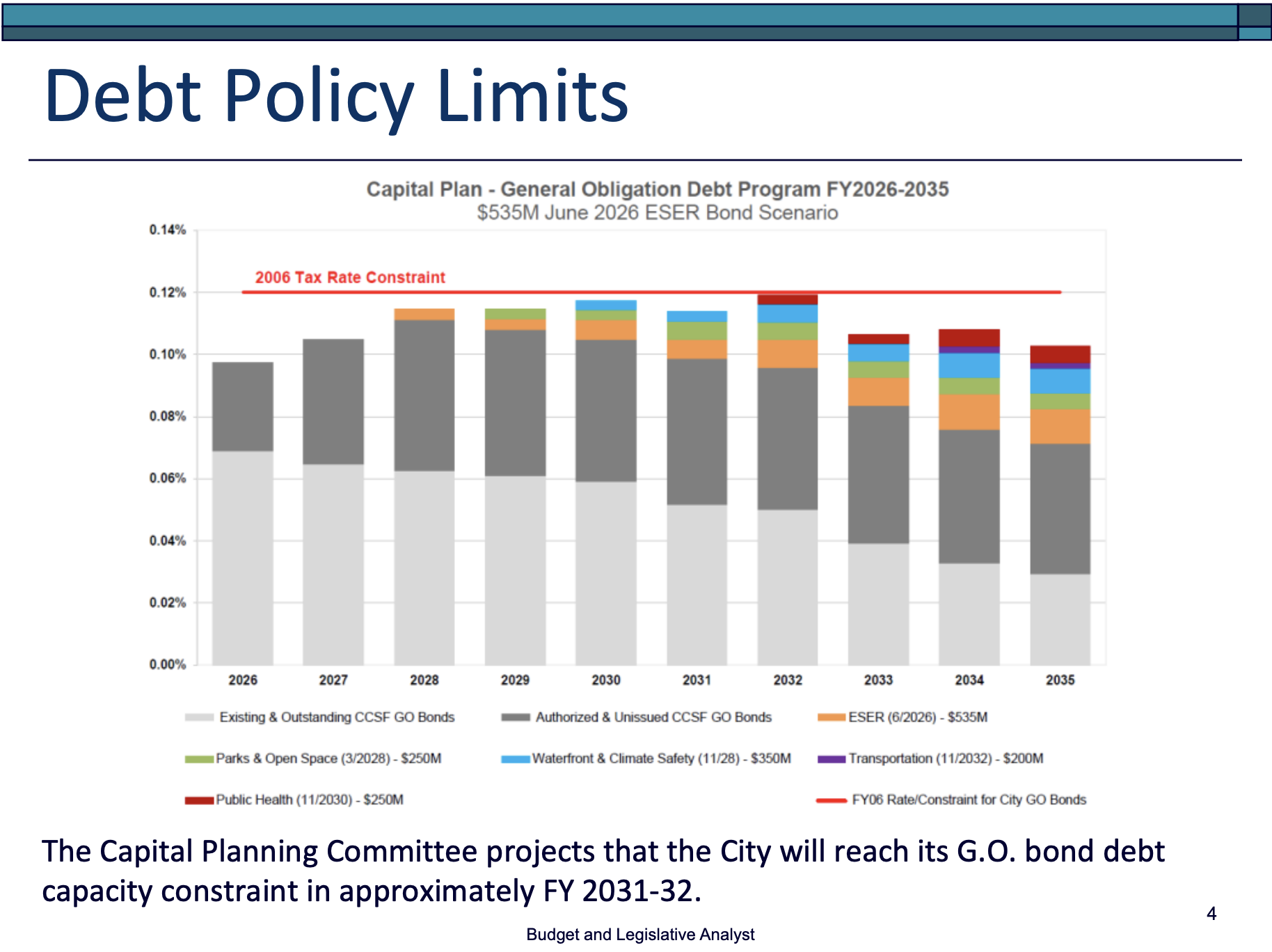
San Francisco's Budget & Appropriations Committee received two sobering reports this week that together define the fiscal and housing constraints heading into the June budget cycle. The city will exhaust its general obligation bond capacity by 2032, with $1.18 billion in voter-approved debt sitting unissued — while recent fee cuts designed to spur housing have failed to produce a single measurable uptick in building permits.
City hits GO bond debt ceiling by 2032; $1.18 billion in authorized bonds remain unissued, including $300M for projects that haven't broken ground
Emergency firefighter water system faces a $1.3B+ funding gap that would take 25 years to fill at current pace
Housing fee reductions since 2023 have not accelerated construction; SF issued the fewest building permits per capita among California's 10 largest cities in 2024
$308,000-per-unit feasibility gap driven by macroeconomic headwinds overwhelms city-level fee relief
Hall of Justice relocation faces December 2026 deadline as staff scramble to find new space for SFPD investigations
The Borrowing Wall: SF's Bond Capacity Running Out
The basics: San Francisco finances major capital projects through two instruments: general obligation (GO) bonds, repaid by property taxes and capped at a rate set in 2006 ($120 per $100,000 of assessed value), and certificates of participation (COPs), capped at 3.25% of general fund discretionary revenue. The Budget and Legislative Analyst's report found both instruments are approaching their limits.
Why it matters: Hitting the debt ceiling constrains every future bond measure — housing, seismic safety, infrastructure, climate resilience — forcing the city to either raise property taxes, reorder capital priorities, or accept decades-long timelines for critical projects.
Where things stand: Nick Menard, Budget and Legislative Analyst's Office, told the committee the city will exhaust its GO bond capacity by 2032 and its COP limit by fiscal year 2028-29. The math for expanding capacity is steep:
"Each 0.01% increase is $410 million dollars general obligation bond. In the case of COPs, each 0.25% increase is $128 million COP, which would require about $13 million a year in annual debt service," he said.
For GO bonds, even a tiny rate increase would add $75 per year to the median homeowner's property tax bill and could push San Francisco from the eighth- to the sixth-highest property tax rate in California. Menard also warned that any additional debt could cause a downgrade in the city's rating.
Meanwhile, $1.18 billion in voter-authorized GO bonds remains unissued, with roughly $300 million of that assigned to projects that have not begun construction. Supervisor Danny Sauter asked the natural follow-up:
"How much flexibility do we have to, if there is money that has been designated for something that isn't going forward, how much flexibility do we have to change versus back to voters?"
Menard indicated that reallocation is possible where voter-authorized scope permits, a lever the analyst recommended the Board explore.
Firefighter Water System: A 25-Year Funding Gap
The city's potable emergency firefighter water system — which currently serves only the west side — faces a $1.28 billion to $1.44 billion funding gap. At current capital plan capacity, full funding would take approximately 25 years. Brian Strong, City Administrator's Office, Office of Resilience and Capital Planning, explained why federal money has been elusive:
"FEMA requires that this be a system that's only used in an emergency. And the fact is that we use CFWS whenever we have a four-alarm fire or a significant fire."
Chair Connie Chan pressed on whether the city is doing enough to accelerate the timeline. Strong confirmed the city is strategically spending existing seawall bond dollars to position them as local match for a potential Army Corps package:
"We have this opportunity to leverage those funds to be able to hopefully get between $13 and $17 billion in federal funding."
Hall of Justice: The Clock Is Ticking
The Hall of Justice relocation — long acknowledged as necessary given the building's failing systems, closed jails, and repeated evacuations — carries a minimum cost that may exceed the currently budgeted COP allocation. Heather Green, Resilience and Capital Planning, was blunt:
"There is a need for us to get out of that building that we all know is substandard."
She cautioned that the analyst's per-square-foot cost estimate may be low, noting that industrial renovations for police use could be significantly more expensive:
"If that is more of an industrial, let's say even $700 a square foot, which I mean I am making that number up. It could be higher, like when we did Animal Care and Control."
Chan underscored the urgency, noting the December 2026 expiration of the Arctic investigations facility leaves staff with effectively six months to finalize relocation plans. She also flagged that the Hall of Justice COP allocation may be over-budgeted by roughly $400 million relative to actual needs — dollars that could potentially be redirected. Chan signaled interest in using COPs for fire apparatus purchases and the Chinatown Preservation Fund.
Decisions: Both hearings were filed on a 3-0 vote (For: Chan, Chen, Sauter; Absent: Dorsey, Mandelman, Walton).
What's next: These findings set the analytical framework for the June budget cycle. Supervisors now have quantified trade-offs for relaxing debt policy, reallocating unspent bond proceeds, and evaluating the Hall of Justice budget as project scope becomes clearer.
Fee Cuts Aren't Enough: SF Trails All Major California Cities in Housing Permits
The basics: Since 2023, the Board of Supervisors has approved a series of measures to jumpstart housing: inclusionary requirement reductions of 18% to 68%, development impact fee cuts of 33%, fee and tax waivers for downtown adaptive reuse, and approximately $3.8 billion in direct project funding through infrastructure financing districts at the Power Station, California Street, and Stonestown.
Why it matters: The independent analysis found none of it has produced a measurable increase in building permits — raising hard questions about whether further fee reductions, and the revenue they sacrifice for affordable housing, are justified without market recovery.
Where things stand: Construction costs have risen 53% and interest rates more than doubled since January 2019, while rents and condo prices have remained flat in nominal terms. The result is a $308,000-per-unit feasibility gap for typical market-rate projects. Nick Menard, Budget and Legislative Analyst's Office, told the committee:
"The fee reductions have not been sufficient to accelerate housing production since 2023 in the face of broader macroeconomic headwinds."
He noted these conditions account for a "substantial portion" of that gap — meaning city-controlled levers like impact fees and inclusionary requirements, while significant, cannot close the gap on their own.
San Francisco issued just 127 building permits in 2024, the lowest per-capita rate among California's 10 largest cities. While the housing pipeline grew 18%, the increase was concentrated in entitlement-seeking — essentially land banking — not construction starts. Of 113 stalled projects identified in late 2023, more than half were deleted from the pipeline entirely; only 17% moved forward. The controller's triennial review confirmed that development remains infeasible under current conditions.
The other side: Supervisor Cheyenne Chen probed the land-banking dynamic, asking whether the pipeline growth signals speculative positioning:
"You mentioned something about it's probably due to entitlement increase, that means land banking. So someone is doing land banking in a city."
Menard confirmed the pattern. Chen also asked about the effect of state density bonus changes on project cancellations.
Chair Connie Chan framed the findings as a direct challenge to pending legislation, including transfer tax waivers. She warned against open-ended fee reductions without sunset provisions, noting that long-term waivers restrict the city's ability to reimpose fees historically used to fund affordable housing and community facilities.
Decisions: Filed 3-0, alongside the debt capacity hearing.
What's next: The analyst recommended tying future fee reductions to macroeconomic improvement rather than making them permanent, requesting broader analysis of area-specific inclusionary requirements and impact fees, requiring planning and building departments to report on waiver impacts every three years, building a tracking system for project status over time, and considering backfilling lost fee revenue dedicated to affordable housing. These recommendations will directly inform upcoming debates on transfer tax waivers, inclusionary policy, and the June budget.
Minor Items
Three members excused: Vice Chair Matt Dorsey, Rafael Mandelman, and Shamann Walton were absent, leaving only Chair Chan, Supervisor Sauter, and Supervisor Chen present — the bare quorum of three.