
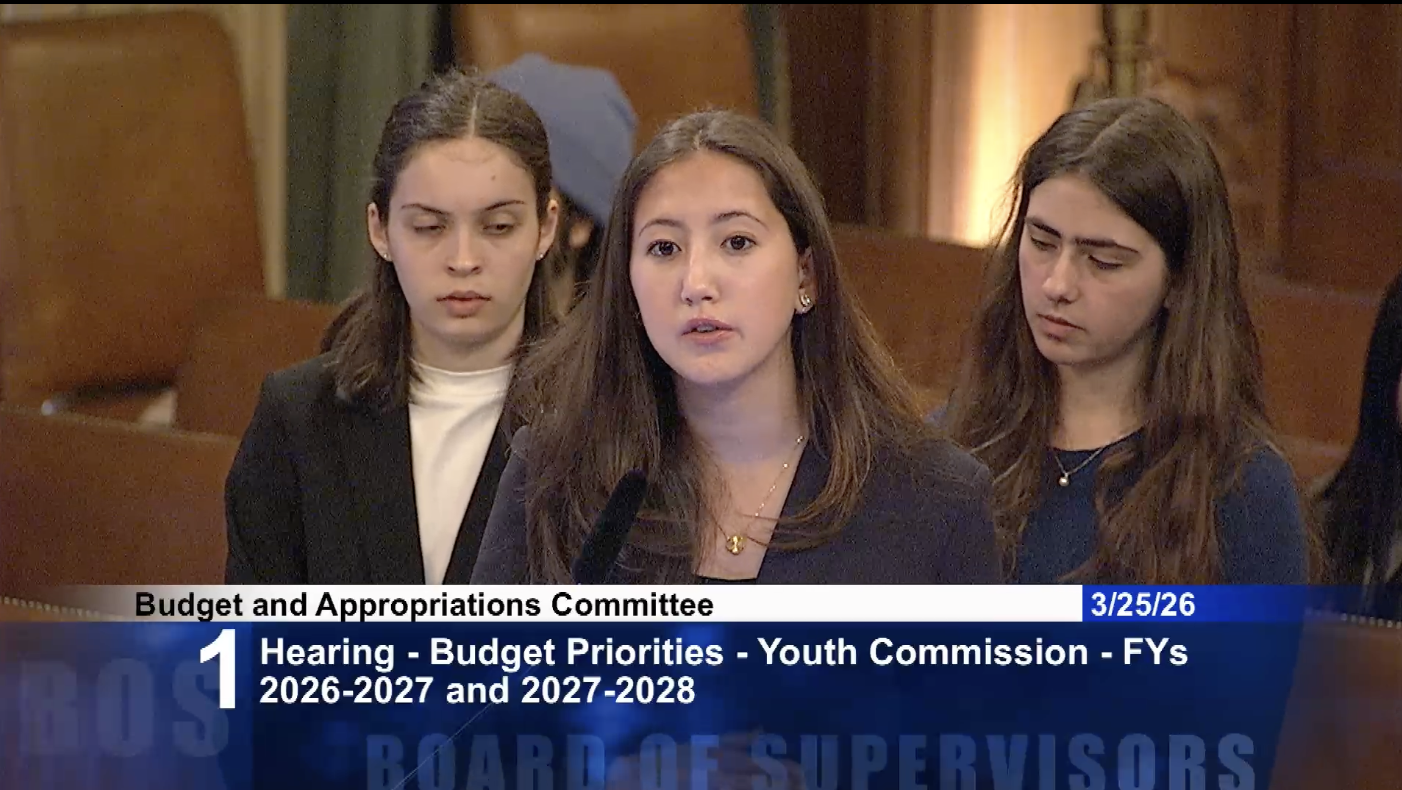
Budget & Appropriations Committee - Mar 25, 2026 - Meeting

Budget & Appropriations Committee - Mar 25, 2026 - Meeting

Budget & Appropriations CommitteeSan FranciscoMarch 25, 2026

Sources:

Locunity is a independent informational service and is not an official government page for this commission.We use AI-assisted analysis and human editorial review to publish information.

Youth Commissioners Sound Alarm on Gun Violence, Title IX Failures and Budget Threats

San Francisco's Youth Commission came to the Budget & Appropriations Committee on March 25 with 19 priorities and a blunt message: young people are being shot at rising rates, sexual harassment complaints are going uninvestigated, and the commission itself could lose the staffing and charter protections it needs to function. The hearing unfolded against a nearly $1 billion projected city deficit that will force painful choices on every line item the commissioners touched.

  • Youth shootings up 74% in five years; commissioners push gun buybacks, mental health funding and reject restoring school resource officers

  • Only 5 of 24 Title IX complaints investigated in SFUSD in 2022; dissolved student advisory group leaves students without a voice

  • $3.4 million ask for SF Environment to save eight at-risk staff positions working on climate equity and youth education

  • Family homelessness surged 82% between 2022 and 2024; commission calls for youth-specific housing assessments outside the Tenderloin

  • Youth Commission fights to stay in the city charter after Commission Streamlining Task Force recommends removal; Vice Chair Dorsey floats hybrid compromise

  • Chair Chan assigns homework: come back with recommended spending cuts, not just asks


Guns, Fear and Prevention: The Youth Violence Debate

Why it matters: Firearm violence has been the leading cause of death for youth ages 0–17 since 2020. The Youth Commission issued three statements on youth violence in just five months this term — an unprecedented pace that reflects how urgently young San Franciscans view the crisis.

Where things stand: Commissioner Leah Mordehai, Legislative Affairs Officer on the Youth Commission, delivered the sharpest statistical punch of the hearing: "In San Francisco, shootings have risen 74% in the last five years. And one in three homes with children have a gun in them."

The Transformative Justice Committee recommended partnering with gun buyback and weapon trade-in events, expanding youth mental health access by increasing counseling staff and reducing wait times, supporting SFUSD wellness centers, and funding community organizations including United Playas, Bayview Hunters Point Foundation, and Samoan Community Development Center.

Vice Chair Matt Dorsey, Supervisor, District 6, added national context: "Since 2020, firearm violence is the leading cause of death for youth ages 0 to 17. And that's been the case since 2020." He attributed the trend partly to Supreme Court decisions that have limited local gun regulation.

The other side: Supervisor Danny Sauter, Supervisor, District 3, pressed on a politically sensitive question — whether there is appetite to restore school resource officers, a partnership between SFPD and SFUSD that was canceled in 2020. "Since then there's been no school resource officers. So that partnership and relationship has eroded. Do you think there's appetite to bring that back?"

The commissioners pushed back firmly. Vice Chair Téa Lonné Amir, Youth Commission Vice Chair, warned that "many youth might feel threatened by their presence and that actually might even incentivize them to even bring a weapon just in case something happens to protect themselves."

Commissioner Mordehai reinforced the prevention-first stance: "I think really the key with youth is thinking about prevention before it happens. And I think sometimes having an SRO is kind of putting out the idea that implicitly youth puts out the assumption that youth might have guns."

Commissioner Evelyn Conboy, Legislative Affairs Officer, added a resource dimension: SFUSD schools sometimes have only one counselor for 2,000 students because "when counselors are leaving, those positions are no longer being filled," a consequence of the district's fiscal distress.

What's next: The committee took no action beyond hearing the item, but the exchange between Supervisor Sauter and the commissioners drew a clear line: the Youth Commission is firmly against SROs and will continue to advocate for mental health and community-based violence prevention as the budget takes shape.


Title IX Breakdown: 5 of 24 Complaints Investigated

Why it matters: If students who report sexual harassment see their complaints ignored, the reporting system loses credibility — and a pattern of institutional failure becomes self-reinforcing.

Where things stand: Commissioner Conboy presented data showing that in 2022, only 5 of 24 Title IX sexual harassment complaints within SFUSD were investigated. She called it "a pattern that I've heard from many students across SFUSD."

When Vice Chair Dorsey pressed on why so few complaints moved forward, Conboy explained a troubling mechanism: "Certain teachers or counselors were flagged to have problems. And rather than them being investigated, they were given a period to resign and they were able to leave the school without any punishment, retribution." The result: allegations dropped, and student voices sidelined.

The commission recommended renewing the Title IX Student Advisory Group — which has been dissolved — implementing SFUSD curriculum on sexual assault and sexual health, and providing non-competitive funding for domestic violence survivors. Conboy also connected the surge in tourism to increased youth susceptibility to human trafficking.

Chair Connie Chan, Supervisor, District 1, expressed alarm that the advisory group no longer exists, meaning students have no formal seat at the table. She pledged to work with the Youth Commission to restore it.

What's next: Commissioner Conboy committed to working with the authoring commissioner to develop a concrete proposal for the advisory group's renewal.


$3.4 Million to Save SF Environment's Climate Team

Why it matters: SF Environment has helped cut the city's carbon footprint 48% since 1990 and engaged over 20,000 youth. Losing eight positions would gut the Clean Transportation, Climate Equity Hub, Climate Action Plan, and Healthy Ecosystems teams.

Commissioner Harper Fort Gang, HRT Committee Chair on the Youth Commission, made the direct ask: "We recommend protecting SF Environment by allocating $3.4 million from the general fund to protect the eight at-risk positions."

The commission also called for SFUSD and SF Environment to dedicate a district-wide Day of Climate Action, expand the education program to cover biodiversity and environmental justice, and secure permanent funding for the SFUSD High School Climate Action Fellowship.

Public commenter Emily Yang, a Balboa High School senior and citywide Youth Commissioner, reinforced the urgency, citing a record March heat wave and Bay sea level rise projections of up to 7 feet by 2100. She described how SF Environment empowered her own climate leadership, including hosting a Green Careers Fair.


Family Homelessness Up 82%: A Call for Youth-Specific Solutions

The basics: The 2024 Point in Time count found 405 youth and 1,100 transitional age youth (TAY) experiencing homelessness nightly. Family homelessness grew 82% and TAY homelessness 11% between 2022 and 2024.

Why it matters: Commissioner Fort Gang framed the long-term stakes: "Over 50% of adults experiencing homelessness first became homeless when they were a young person, so early intervention is critical."

Recommendations were informed by focus groups held by Larkin Street Youth Services with different demographics including LGBTQ youth and newcomer youth. The commission urged diversifying TAY housing options in neighborhoods outside the Tenderloin — including the Mission, the Haight, and near colleges and transit — and creating a youth-specific housing assessment process. The current system disadvantages younger people with questions like "how long have you been homeless," effectively penalizing those who became homeless recently. The commission also called for strengthening the Rising Up initiative's goal of cutting youth homelessness by 50%.


Charter Fight: Youth Commission's Existential Question

Why it matters: Removing the Youth Commission from the city charter would let the Board of Supervisors or the Mayor restructure or eliminate it without voter approval — fundamentally changing youth representation in city governance.

Where things stand: In October 2025, the Commission Streamlining Task Force recommended moving the Youth Commission from the city charter to the administrative code, arguing it does not oversee a city department and lacks standard charter body powers. The Youth Commission counters that charter status ensures independence and reflects the will of voters who established it in 1995.

Vice Chair Amir defended the status quo: "The 17 members, the no pay, all of that has stood the same, I believe since almost its beginning in 1995. And that's almost 30 years. And there's almost been no need to go back to the voters."

The other side: Vice Chair Dorsey proposed a hybrid compromise modeled on the Arts Commission — keep the commission's existence in the charter but move prescriptive details to the administrative code. He noted that charter provisions are onerous to change, citing the example of the Department of Aging and Adult Services needing a ballot measure just to change its name. "I wanted to ask if the Youth Commission would be open to a compromise, that we would make sure that there is a youth commission enshrined in our charter, but take some of the prescriptive elements and move those to the administrative code."

Vice Chair Amir declined to commit on behalf of all 17 commissioners but agreed to bring the proposal to the next full commission meeting.

Chair Chan weighed in firmly: "I believe that San Francisco city government is better because of it. I believe that the San Francisco city government is better because we have Youth Commission, that we have many different bodies who volunteer their time and more than willing to dedicate their hours and resources to figure out ways to make city government better."


The Deficit Reality Check

Chair Chan closed the hearing with a directive that underscored the fiscal gravity facing every priority the commissioners had just presented: "Regrettably, there is almost a billion dollars budget deficit. While we appreciate your recommendation today, I think that we also would like for you to help us understand in the coming months in the events that truly that the city will be facing painful reduction of our budget."

The message was clear: in this budget cycle, advisory bodies will be expected to recommend cuts alongside asks. The Youth Commission's 19 priorities — from $3.4 million for SF Environment to three-person staffing to charter independence — now enter a negotiation where nearly every city service faces the knife.


  • Immigration funding: The Transformative Justice Committee urged continued multi-year grants for newcomer-serving community organizations, Know Your Rights campaigns, OCS Language and Access Community Grants, and hiring Vietnamese language specialists among bilingual city staff. Chair Chan has already advocated for $3.5 million in legal defense funding.

  • Youth employment at risk: Programs including SF Youth Works and Opportunities for All face potential budget cuts. The commission recommended strengthening partnerships with the Office of Workforce Development and mandating employer training on harassment prevention for young workers.

  • Transit safety: Commissioners thanked the Board for protecting free Muni and recommended investing in lighting, security cameras, and emergency call stations at high-traffic stops, plus a pilot youth transit safety audit discussed with Janice Lee.

  • AI regulation: The Transformative Justice Committee flagged AI regulation as a budget priority. Supervisor Sauter expressed strong interest; the authoring commissioner was absent, and full details will be sent to the supervisor separately.

  • Youth Commission staffing: After Director Alondra Scoville Garcia resigned in January, the commission dropped to two staff covering three roles. Vice Chair Amir warned that the mayor's hiring freeze could replicate a 2021–22 breakdown when the team shrank to a single staffer.

  • Former director testifies: Alondra Esquivel Garcia, former Youth Commission director, urged continued support and suggested the commission's budget priority report could serve as the framework for a formal youth agenda, similar to the recently released women's agenda from the Department on the Status of Women.

  • Procedural: Supervisors Shamann Walton and Rafael Mandelman were excused (3-0). The hearing was declared heard and filed (3-0: Chan, Dorsey, Sauter).