
Budget & Appropriations Committee - Feb 25, 2026 - Regular Meeting

Budget & Appropriations Committee - Feb 25, 2026 - Regular Meeting

Budget & Appropriations CommitteeSan FranciscoFebruary 25, 2026

Sources:

Locunity is a independent informational service and is not an official government page for this commission.We use AI-assisted analysis and human editorial review to publish information.

Budget Cuts Would Gut SF's Climate Team, Threatening $84M Grant Pipeline

The San Francisco Board of Supervisors' Budget & Appropriations Committee convened an urgent, pre-budget hearing on Feb. 25 to confront a stark prospect: the near-total elimination of the Environment Department's capacity to implement the city's Climate Action Plan. Over two hours of testimony from city staff, environmental justice organizations, and health advocates made one thing clear — the fight over $3.4 million in general fund dollars is really a fight over whether San Francisco keeps its climate promises.

  • Proposed budget would eliminate ~8 FTE positions from the Environment Department, wiping out the city's climate accountability, building electrification, and EV charging teams

  • $84 million in grants at stake — the department has returned $29 for every general fund dollar invested since 2022, a ratio that disappears without staff to pursue and manage awards

  • Climate Equity Hub faces shutdown after installing 55 free heat pump water heaters in low-income homes and training 200+ small contractors

  • City's entire EV charging coordination team would be eliminated, including oversight of a stalled $15 million federal grant

  • Over 20 public commenters unanimously called for restoring $3.4 million in general fund support, representing PODER, Sierra Club, Physicians for Social Responsibility, SOMCAN, the Climate Emergency Coalition, and others

  • Hearing continued to the call of the chair, 3-0, keeping pressure on Mayor Lurie's office before the June budget release


The $3.4 Million Question: Can SF Fund Its Own Climate Goals?

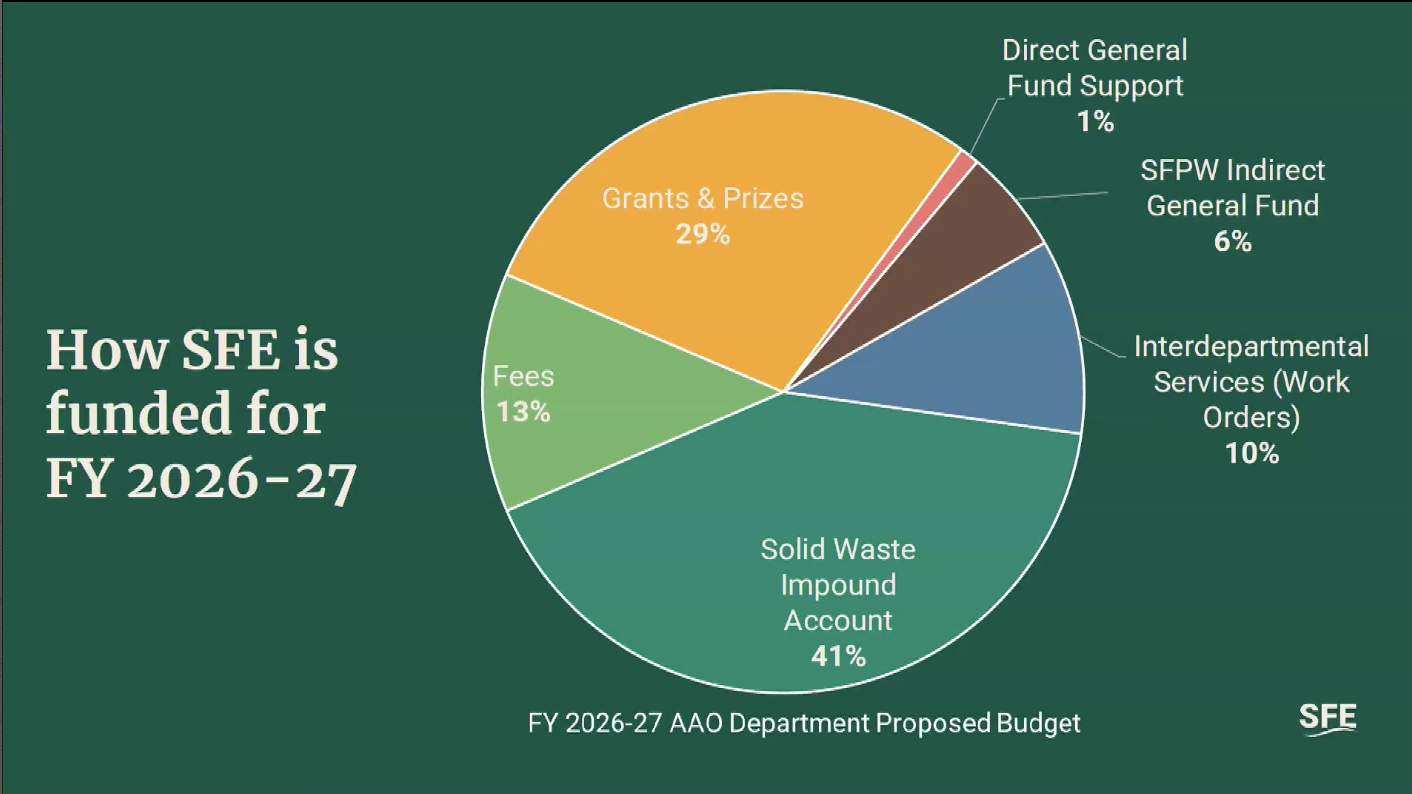
The basics: The San Francisco Environment Department operates almost entirely on restricted funding — 93% of its budget is tied to specific grant deliverables and work orders. The small slice of flexible general fund money is what pays for the staff who coordinate climate policy across 18 departments, write the grant applications that bring in tens of millions, and run programs that connect low-income residents to building electrification.

That slice is vanishing. General fund support has fallen from $2.6 million in fiscal year 2022-23 — the first-ever general fund allocation to the department, added by the Board of Supervisors — to a proposed $544,886 in FY 2026-27. At the same time, Public Works work orders have declined and a 20-year arrangement with the PUC for interdepartmental work orders is ending. The result: 7.81 full-time positions face elimination.

Why it matters: The positions at risk aren't back-office roles. They are the city's building electrification team, clean transportation team, and climate accountability coordinators — the people who track whether San Francisco is actually meeting its emissions targets. Buildings and transportation account for 89% of the city's emissions.

"Under the current fiscal year 26-27 base budget, we are at risk of losing 7.81 full-time equivalent positions," said Director Tyrone Ju, San Francisco Environment Department. "93% of the funds that we get are restricted and tied to specific scopes and deliverables." (Lightly edited for clarity.)

Where things stand: Board President Rafael Mandelman, who sponsored the hearing, framed it as a deliberate move to build political pressure before the mayor's budget is released in June — when the Board's ability to make changes narrows sharply.

"By the time the mayor's budget comes to us in June, we are very limited in our ability to make significant changes," President Mandelman said. "Without those people and without those resources, these ambitious goals are just numbers that won't mean anything in the real world."

Mandelman pressed the point further, noting the department has historically been forced to survive on grants alone. "This department has had to sort of eat what it kills and go out find things to do," he said, arguing the Board's FY 2022-23 allocation was the first time the city acknowledged climate work as a general fund responsibility.

Director Ju presented a peer city comparison that underscored the point: San Francisco trails Boston, Seattle, Washington, D.C., and Portland in climate staffing across every category — building decarbonization, transportation decarbonization, and climate action planning. Portland has a roughly $200 million dedicated climate fund; Seattle has tens of millions from voter-approved taxes. San Francisco's building decarbonization capacity exists only because of the Board's add-back funding, which expires this year.

The other side: Sophia Kittler, Mayor's Budget Office, acknowledged the department's strategic importance but stopped short of committing to restoration.

"I think that the mayor's office understands that without that general fund support, they are greatly inhibited in their ability to be strategic. And that is not something we take lightly," Kittler said. She added: "All of these conversations that we can have sooner really shed light on how to think about those priorities and shape the budget before it gets before you in June."

Supervisor Danny Sauter questioned the history of the department's chronic underfunding and whether a stable funding model has ever existed — a line of inquiry that reinforced the structural nature of the problem.

Decisions: The committee voted 3-0 to continue the hearing to the call of the chair (For: Mandelman, Sauter, Vice Chair Matt Dorsey; Absent: Supervisor Shamann Walton; Excused: Chair Connie Chan). By continuing rather than filing the hearing, supervisors preserved their ability to reconvene and maintain pressure on the administration.

What's next: The hearing will be reconvened at the chair's discretion. The Environment Commission has unanimously rejected the department's proposed budget and formally requested $3,391,566 in restoration. The mayor's budget is expected in June, but advocates — including the People's Budget Coalition — are pushing for commitments by April, before the traditional add-back process begins.


$29 for Every Dollar: The Grant Machine That Might Go Dark

Why it matters: Since the Board's $2.6 million general fund investment in FY 2022-23, the Environment Department has secured $84 million in grants — a $29-to-$1 return. But that pipeline depends on the staff who write grant applications, manage compliance, and implement awards.

"Since November 2022, when the Board allocated that $2.6 million, we've managed to go out and successfully get $84 million in grants for the city," Director Ju said. "Our return on investment has been $29 for every dollar that has been invested in our department."

The current federal environment adds urgency. Some grants have been terminated, others are paused or stalled, and implementation timelines are uncertain under the current administration. However, new state grant opportunities are emerging as California moves to fill the gap. Without the staff who wrote and would manage these awards, the department cannot pursue new state funding or comply with existing federal grants that may resume.

Multiple public commenters seized on the $29-to-$1 figure. Zachary Fria of the South of Market Community Action Network argued the department's work directly aligns with Mayor Lurie's stated budget priorities of efficient government and economic revitalization. Angelique Tompkins, Vice President of the Commission on the Environment, warned that stepping back now defers costs rather than saving money.


Climate Equity Hub: A National Model on the Chopping Block

The basics: The Climate Equity Hub is a community-led program that pairs trusted neighborhood organizations with the Environment Department's technical expertise to bring building electrification to low-income households. Since launching in June 2024, it has completed 55 heat pump water heater installations at no cost to residents, secured over $650,000 in independent grant funding including from the Bay Area Air Quality Management District, and trained more than 200 small contractors in electrification skills.

Why it matters: Bay Area Air District regulations will begin requiring building electrification starting in 2027. Without the Hub, low-income communities face being the last to decarbonize — or being forced to continue using polluting gas appliances because they can't afford alternatives.

Antonio Diaz of PODER described completing the first phase of a Mission District building decarbonization project — a four-unit residential building fully electrified with PG&E cutting gas service — that would not have been possible without the department's incentive expertise and engineering support. Teresa Dulalas of SOMCAN, a Hub participant living along a freeway corridor in SoMa Pilipinas, testified that her family experienced respiratory illness from gas appliances and that department staff coordinated inspections, appliance replacements, and follow-up.

Julie Lindo of the San Francisco Bay Physicians for Social Responsibility, representing hundreds of healthcare professionals, noted that her organization secured two grants that could go to waste without the Hub, which the Air District considers a national model.


EV Charging Team Faces Total Elimination

The department's clean transportation team — responsible for citywide EV charging coordination, the 2017 Electric Vehicle Roadmap that tripled charging access, and a $15 million federal grant application now stalled — would be entirely eliminated under the proposed budget.

"Our entire team goes away. So the city will not have any coordination on electric vehicle charging infrastructure going forward," Director Ju warned.

President Mandelman noted that MTA, which owns the charging infrastructure, has not been enthusiastic about private EV charging and that the Environment Department has driven most of the strategic thinking in this area. The team also coordinated the city's first curbside EV chargers near IBEW Local 6 in DeBose Triangle and leads implementation of the commercial garage EV charging ordinance.


A Community United — and Watching

The public comment period stretched through more than 20 speakers, every one calling for full funding restoration. The breadth of the coalition was notable: environmental justice organizations like PODER and SOMCAN alongside the Sierra Club, 350 San Francisco, the Climate Emergency Coalition, Physicians for Social Responsibility, All Things Bayview, the People's Budget Coalition, and DSA San Francisco.

Department staff also spoke in personal capacity. Nick Kestner, who leads the building decarbonization team, detailed the team's accomplishments and asked the committee to save the general fund allocation. Elizabeth Stamp, senior climate action coordinator, described coordinating the Climate Action Plan update across 18 departments with extensive public engagement and racial equity review, with publication planned for April.

Rachelle Holmes of All Things Bayview submitted testimony on behalf of Bayview Hunters Point residents facing elevated asthma, cancer, and pollution-related illness rates, calling for community-owned air monitoring as a core requirement of the Climate Action Plan.

Anya Worley-Ziegmann of the People's Budget Coalition urged supervisors not to wait until June, arguing San Francisco has enough money for climate and other priorities without forcing trade-offs, and pledged coalition support for supervisors in negotiations with the mayor.

President Mandelman closed with a direct appeal: "I think this is an opportunity for the mayor to show his commitment to the environment and to being a leader in this area. I think we need to find the resources to keep the work going that was cut from last year's budget."


  • Chair Connie Chan was excused from the meeting by a 3-0 vote (Dorsey, Sauter, Mandelman).