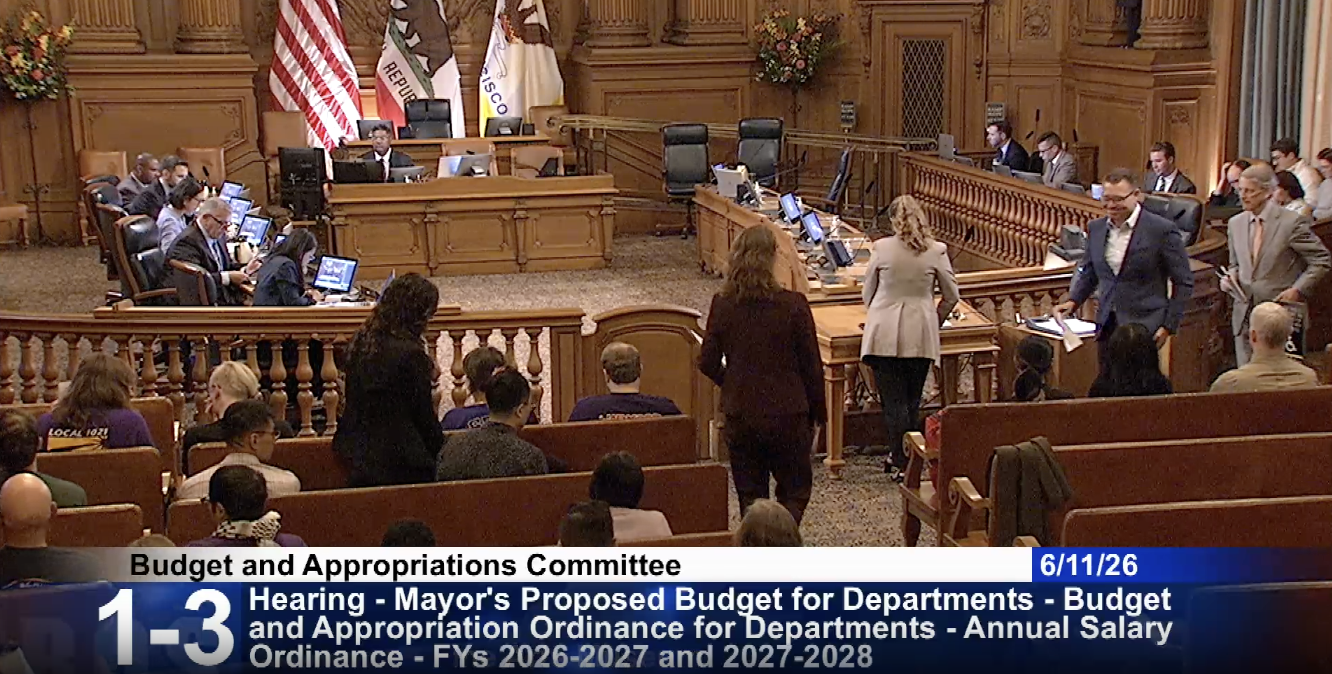
Budget & Appropriations Committee - Jun 11, 2026 - Special Meeting
Budget & Appropriations Committee • San FranciscoJune 11, 2026
Locunity is a independent informational service and is not an official government page for this commission.We use AI-assisted analysis and human editorial review to publish information.
San Francisco Commits $251M to Backstop Federal Health Cuts in Marathon Budget Hearing
The Board of Supervisors' Budget and Appropriations Committee spent nearly five hours hearing 14 department budgets that together tell a single story: San Francisco is pouring hundreds of millions in local dollars into a safety net fraying under federal pressure — while demanding sharper accountability from the cultural institutions it funds. The June 11 special meeting ended with all items continued to June 12 for further deliberation.
- DPH receives a historic $251M general fund increase — a 32% jump — to offset Medicaid losses from HR1 and cover immigrants losing state healthcare
- HSH proposes $835M budget with 800 new housing subsidies and a $98M reserve against potential federal funding cuts
- Chair Chan calls for audit of California Academy of Sciences after 53 layoffs tied to an $8M structural deficit, drawing parallels to the SF Zoo process
- Early Childhood Department raises educator wages 16% and secures three new childcare sites, including one at Zuckerberg SF General Hospital
- Arts community mobilizes against gallery staff cuts as more than 10 speakers protest the halving of the city's only public-facing gallery program
- OEWD eliminates 19 positions as new federal work requirements threaten vulnerable residents' benefits
- Latino and Indigenous organizations warn of service gaps as MOCD and OEWD cut millions in community grants
The Safety Net Gets a $251M Lifeline
Why it matters: No other U.S. city is committing this level of local money to replace collapsing federal and state healthcare funding — and Health Director Dan Stein made clear the alternative was unthinkable.
Where things stand: The Department of Public Health's budget grows from $3.3 billion to $3.7 billion, with general fund support jumping from $779 million to $1.03 billion. The driver is HR1's Medicaid cuts and state policy changes that will strip Medi-Cal coverage from immigrants — populations San Francisco has committed to covering through Healthy San Francisco.
"That is a $251 million increase, or a 32% increase. That is a really, really huge amount of support that San Francisco is putting into the safety net in public health, without which we would be tanking," said Health Director Dan Stein.
Despite the budget's growth, DPH eliminated 130 FTE positions: 103 vacancies, 23 reassignments, and just 4 layoffs from a staff of 8,000. Manager-class reductions ran at 8 times the rate of non-managers, with 40% of manager vacancies deleted.
The other side: Vice Chair Matt Dorsey pressed on drug treatment access, noting that as many as half of people in drug treatment may be on Medi-Cal. Director Stein assured the committee that the department would maintain treatment access even for those losing coverage.
Two youth clinics — Chipier Kids sites at Larkin Street and Columbia Street — will consolidate, with staff transitioning to other clinical settings. Southeast Mission Geriatrics is also folding into the broader DPH clinic network. On HIV services, general fund backfill has grown to $28 million (rising to $30 million) to offset a $23 million decline in Ryan White federal funding since 2020, keeping total HIV spending around $84 million. A specific 6.6% cut ($750,000) hits health access points in prevention.
On the community-based organization side, $20 million in reductions were made — but the overall CBO budget still grows by $80 million.
What's next: The committee will continue deliberations on June 12 with Budget and Legislative Analyst recommendations.
HSH Banks $98M Against Federal Uncertainty
Why it matters: With 800 new housing subsidies and a $98 million reserve hedging against potential federal cuts, the Department of Homelessness and Supportive Housing is making its largest investment in permanent housing exits while bracing for Washington's next move.
Where things stand: The HSH Director presented an $835.3 million FY27 budget ($781.8 million in FY28), largely driven by Our City Our Home (Prop C) investments. Key new spending includes $37.3 million for prevention programs covering families, young adults, workforce development, and eviction prevention; $54.7 million for interim housing, including 70 new emergency hotel vouchers for families and youth and an SFUSD family stayover program; and $140 million for supportive housing.
"There are no proposed layoffs and no direct service reductions tied to the general fund target," the HSH Director told the committee. The department met its $4 million general fund reduction by shifting shelter costs to non-general-fund sources. Eight vacant positions were deleted for $1.5 million in savings, and 11 positions plus two contracts transferred to DPH for outreach consolidation.
The Prop C-funded rapid rehousing program reported a 92% success rate, and 100% of shallow subsidy households remain housed. The 12% cap on short-term rental subsidies is proposed to be lifted for FY28 to support both ongoing subsidies and the 800 new units. Total staffing decreases nearly 29 FTE over two years — an 11% reduction — even as the budget grew 6.6%. Cost-of-doing-business increases for providers: 1.4% in year one, 3% in year two.
Supervisor Shamann Walton asked about the RV strategy; the department reported housing 120 households and sheltering 37 from the permitted RV program.
What's next: Continued to June 12. The $98 million reserve will be a focal point if federal housing funding decisions become clearer.
Academy of Sciences Faces Audit Call After 53 Layoffs
Why it matters: The California Academy of Sciences is the latest publicly funded cultural institution to draw Board scrutiny over financial management — and Chair Connie Chan is reaching for the same accountability tool that reshaped the SF Zoo.
Where things stand: Interim Executive Director Amber Mase presented a $9.04 million city budget — roughly 10% of the Academy's $80 million total — while disclosing 53 employee layoffs ($5.9 million in savings) driven by an $8 million structural deficit. She cited a 29% drop in daytime ticket sales compared to pre-pandemic levels, shifting audience behaviors, and federal funding cuts.
"These reductions were a last resort taken deliberately to address an immediate $8 million cash operating shortfall," said Interim Executive Director Mase.
Supervisor Danny Sauter zeroed in on two points. He questioned the Academy's ownership of a Pacific Heights mansion valued at roughly $8 million — a figure matching the deficit — and asked about plans for the asset. He also challenged the institution's withdrawal from the Museums for All program, which provides discounted admission to low-income families.
"I think it is short sighted and foolish to remove yourself from something like that which, you know, you speak about accessibility and getting people out to the museums," said Supervisor Sauter.
Chair Chan went further, questioning a $200 million endowment — $150 million restricted, $50 million unrestricted — and why draws weren't used to prevent layoffs. She proposed having the Budget and Legislative Analyst conduct a formal audit, potentially placing the Academy's city funding on reserve until the review is complete.
"We want to see an audit, potentially with our budget and legislative analysts. And you can ask San Francisco Zoo — they have found our audit to be very, very helpful," Chair Chan said.
The Academy has no capital or operating reserve aside from its endowment. SEIU members were among public commenters who supported workers and called for management accountability.
What's next: The committee may request a BLA audit and consider placing the Academy's $9 million in city funding on reserve. Continued to June 12.
Early Childhood Wins Wage Increases and Hospital Childcare Sites
Why it matters: Record kindergarten readiness, significant educator pay raises, and childcare at Zuckerberg SF General mark concrete progress on workforce and family policy that San Francisco has debated for years.
Where things stand: Director Ingrid Mesquita presented the Department of Early Childhood's $343.6 million FY27 budget, highlighting a fourth straight year of kindergarten readiness gains — now at a record 69% — with over 9,000 children enrolled in Early Learning for All.
The budget raises the base educator wage by 16% to align with a living wage standard and provides a 10% increase for educators already above the base. Teachers in high-vulnerability settings have seen nearly 50% wage increases. Family affordability expanded significantly: families earning under 200% AMI ($312,000 for a family of four) now qualify for at least 50% tuition credit, while those under 150% AMI receive full credit.
DEC requested $31.25 million in reserves for three new childcare facilities: $1.25 million for Family Resource Centers, plus $10 million each for sites at Zuckerberg SF General Hospital (a former Walgreens at 24th and Potrero serving 60 children), Laguna Honda Hospital, and OMI Public Library.
"Congratulations. That's huge. And you have helped settle decades long of dispute," Chair Chan told Director Mesquita about the hospital childcare milestone, adding interest in exploring 24-hour drop-off care for first responders.
The Little Lift program, part of the Mayor's Strong Starts initiative, supports pregnant individuals with financial help and city resource connections. The mayor is also proposing a $16.9 million interest and subvention from Baby C funding, to be discussed at the next hearing.
What's next: Baby C funding allocation will be discussed at the June 12 continuation.
Artists Rally to Save City's Only Public Gallery Program
Why it matters: The merger of three city arts entities into a single department is supposed to create efficiencies — but the proposed staff cuts hit the Arts Commission's only public-facing program, and the community showed up in force.
Where things stand: Executive Director Matthew Godot and CFO Sarah Hollenbeck presented the first combined budget for the Arts Commission, Grants for the Arts, and Film SF at roughly $38 million. Hotel tax (Prop E, 2018) is the largest revenue source, projected to grow 9% in FY27. The department has 48.5 FTE — down from the prior year — with one layoff and three vacant positions proposed for elimination.
The SFAC Galleries program became the flashpoint: staff would be cut from four to two, eliminating the Manager of Education and Public Programs position held by Maysoon Wazwas and the vacant Director of Galleries role.
During public comment, more than 10 speakers — including artists, gallery staff, and arts organizations — urged restoration of both positions. Maysoon Wazwas, whose own job is slated for elimination, described organizing more than 30 programs per year across three spaces, working with over 100 artists annually, and warned her position's elimination would cut the Bringing Art to Immigrant Communities program. Acting Gallery Director Jackie Im noted the program would be cut in half to just two staff.
The gallery has shown over 4,400 artists since 1970. A union representative noted the merger has not gone through formal transfer-of-function or collective bargaining processes.
Chair Chan encouraged Director Godot to develop a unified vision for the combined department and expressed support for the film rebate program.
What's next: Continued to June 12. The formal merger process — including union bargaining — remains unresolved.
DCYF Shields All 258 Programs, but Free City College Falls Short
Why it matters: The Department of Children, Youth, and Their Families is one of the few city agencies to protect every community-based program from cuts — but a $2 million-plus gap in Free City College funding threatens to exclude thousands of students.
Where things stand: Director Sri Searcy Smith presented an approximately $380 million budget, noting zero CBO program cuts for the third year of a five-year funding cycle. The department funds 144 agencies and 258 programs. Over 70% of funding comes from the Children and Youth Fund, a 4% property tax set-aside. The department has 67 permanent and 7 temporary FTE with a 12% attrition rate and 15 vacancies, two of which will be deleted.
On the Student Success Fund, an $18 million reserve exists from unspent dollars due to SFUSD hiring freezes, and conversations are underway about spending plans including one-time projects. All schools now have community school coordinators.
For Free City College, the budget allocates $6.7 million — approximately $2 million-plus short of full funding. Public commenter Alisa Messer, a 25-year City College English teacher and Free City Oversight Committee member, said the shortfall would exclude about 6,000 students, many of whom are among the lowest-income residents.
"It is my goal, is my commitment. I think with the support of my colleagues that we fully fund Free City College in the next two fiscal year," Chair Chan said.
What's next: Chair Chan's commitment signals likely add-back negotiations. The $18 million Student Success Fund reserve will also require a spending plan.
Rec Park Confronts Structural Deficit as Utility Costs Surge
Why it matters: Rising PUC utility costs have grown $18 million since the pandemic, eating into flat revenue sources and forcing position cuts across the park system.
Where things stand: General Manager Sarah Madlin and Finance Director Antonio Guerra presented Recreation and Parks' $284 million FY27 operating budget. Revenue rests on three pillars: general fund baseline, open space property tax, and earned income (about one-third of the budget). The department faces a structural deficit driven by a $3.5 million combined reduction in general fund and open space support alongside $5 million in work order increases, including a $4.2 million PUC increase over two years. Citywide work orders have increased $18 million since the pandemic while general fund and open space revenue grew only $20 million.
The department deleted 12 positions, including one manager, and made $4.6 million in ongoing cuts. Dynamic pricing for golf courses yielded about $1 million in new revenue (a 9% increase). Paid parking in Golden Gate Park will begin in January 2027. A $15 million capital baseline runs through 2046. Gene Friend Recreation Center opens in August, fully staffed, and 15 FTEs were added for Treasure Island maintenance covered by Community Facility District funding.
Chair Chan asked about utility cost growth. General Manager Madlin confirmed PUC costs are a significant ongoing challenge, with utility budgets rising from $12 million in 2022 and projections exceeding $30 million by 2030-31.
Community Grant Cuts Hit Indigenous and Latino Organizations Hardest
Why it matters: As federal support retreats, city cuts to community-based services threaten to eliminate direct grant funding for some of San Francisco's most vulnerable communities at the worst possible time.
Where things stand: MOCD Deputy Benjamin McCloskey presented a $218 million FY27 budget — a $41 million increase driven by the new Affordable Housing Opportunity Fund (Prop G, from November 2024, $8.25 million), Treasure Island developer contributions ($8 million increase), and Housing Trust Fund growth ($5 million). But the budget also includes a net $3.7 million decrease in community-based services grants, elimination of digital equity programming, and cuts to community facility capital improvements. Three layoffs and three vacant position deletions yielded over $1 million in savings.
Supervisor Walton raised pointed concerns about Indigenous communities. "Are you aware that if we move forward with some of proposed reductions like our Native American or Indigenous communities, we'll have no services?" he asked. Deputy Julia Sabori confirmed that while the $13 million Friendship House village housing grant and ERAP grants continue, Community Based Services grants to organizations like the American Indian Cultural District, Friendship House, and Native American Health Center are eliminated.
Multiple public commenters from the Latino community highlighted the damage. Katia, COO of the Latino Task Force, cited $3.5 billion in annual Latino purchasing power and 4,000 Latino-owned businesses generating $250 million annually, but noted Latino funding has dropped 73% in four years, with $5.1 million in combined MOCD and OEWD reductions. Gabriel Medina, executive director of LASA Community Resource Center, advocated for restoration of a $339,000 Service Connection Emergency Fund cut that since 2017 has provided flexible financial assistance to new immigrant families at risk of homelessness.
What's next: The Mayor's Office restored approximately half of the community-based services reductions between phases. Staff are determining which city department should administer remaining grants. Continued to June 12.
OEWD Cuts Workforce Programs as Federal Work Requirements Loom
Why it matters: New federal work requirements under HR1 could push vulnerable residents off food and healthcare benefits if they can't meet 80-hour monthly thresholds — and the city is simultaneously shrinking the workforce programs designed to help them comply.
Where things stand: Executive Director Ann Topier presented $10 million in general fund cuts: $3.79 million from economic development (including a 50% reduction to the Legacy Business Stabilization Fund and reduced small business technical assistance), $3.53 million from workforce development (job center consolidation and administrative redundancy elimination), and $2.2 million from personnel — 19 positions eliminated, of which 9 were filled. Demographics of laid-off filled positions: 2 Asian American, 4 African American, 2 Hispanic, 2 White.
Despite reductions, overall workforce development investment increases $2.6 million due to higher federal WIOA allocations and replenished one-time reductions. CityBuild was protected with only one position cut. The centralized job center model maintains geographic coverage in Fillmore, Mission, Tenderloin, Bayview, and Chinatown. Entertainment zones are expanding citywide with 31 zones, and some businesses report 1,500% bumps during events. The Office of Small Business provided free counseling to more than 3,000 businesses, assisted over 200 with leasing (70 leases signed), and stabilized 55 legacy businesses.
Public commenter Marnie Regan, chair of HESPA and director of Larkin Street Youth Services, warned that workforce cuts coincide with new federal work requirements that could push people into homelessness. She also asked the committee to protect the Larkin Street Michael Baxter Youth Clinic from DPH closure.
Chair Chan requested more concrete impact metrics and rate-of-return analysis for future budget presentations.
Human Rights Agency Absorbs $13.6M in Cuts as Caseload Surges
Why it matters: Civil rights cases are up 84% and projected to exceed 900 discrimination cases by end of fiscal year — while the agency that handles them has lost nearly half its staff over three years.
Where things stand: Director Mouli Tubenyo and Director Deanna Oroce presented the Agency for Human Rights' $29.5 million budget covering both the Human Rights Commission and Department on the Status of Women. The agency has absorbed $13.6 million in cumulative general fund reductions since FY24-25, with staffing dropping from 66 to 48 FTE.
The $2 million Youth Works cut reduces the program but does not eliminate it; approximately 100 slots remain. Opportunities for All continues serving about 2,000 youth annually. LGBTQ services are maintained with bold and visible grant funding at $1.5 million annually. The Office of Transgender Initiatives reports that approximately 400,000 trans individuals are leaving conservative states, with many expected to come to San Francisco.
Vice Chair Dorsey asked specifically about the trans community influx and service capacity. Public commenter John Osaki, executive director of JCYC and lead agency for Youth Works for 29 years, warned that the $2 million cut would eliminate 300 youth opportunities and questioned whether targeting a single program for nearly half the department's total cuts is reasonable.
Minor Items
- Cultural institutions budgets: Asian Art Museum ($13.1 million city budget) reported a 51% increase in school participation; Fine Arts Museums ($26.6 million city budget, 8.5% increase) welcomed 1.5 million visitors, ranking 7th nationally; War Memorial ($1.2 million general fund reduction) is consolidating custodial services and replacing the Opera House mansard roof.
- Mayor's Office budget: $12.2 million with 47 positions; the $300,000 increase is driven entirely by salary MOU changes.
- Motion to excuse Supervisor Rafael Mandelman passed 5-0.
- All items continued to June 12 on a 4-0 vote (Supervisor Walton absent at time of vote) for further deliberation with BLA recommendations.