Governing Board - Feb 11, 2026 - Meeting
Governing Board • Brentwood Union School DistrictFebruary 11, 2026
Locunity is a independent informational service and is not an official government page for this commission.We use AI-assisted analysis and human editorial review to publish information.
Employees Plead for Relief as Brentwood School Board Weighs $500K in Cuts
Eight district workers — teachers, custodians, aides and food service staff — filled the Feb. 11 Brentwood Union School District Governing Board meeting with emotional testimony about unaffordable health insurance and stagnant wages, just as the board began deliberating half a million dollars in budget reductions for next year and bracing for more pain ahead.
All three employee unions unite to demand better pay and affordable health benefits during active negotiations
$500,000 in proposed budget cuts for 2026-27 include eliminating the widely used IXL digital learning program; board pushes back
Governor's budget threatens $8M shortfall for BUSD under Proposition 98 minimum funding
IME school construction wraps up over $1M under budget, returning $354,865.94 to the Measure B bond fund
Clean financial audits approved for both the district and its Measure B bond fund
Student walkouts at three middle schools prompt board chair to address campus safety and parental expectations
130 students from eight schools celebrated at sold-out Black History Month Oratorical
A Unified Front: Workers Say They Can't Afford to Stay
The most powerful moments of the evening came not from the dais but from the podium, where eight speakers representing the Brentwood Teachers Association (BTA), California School Employees Association (CSEA) classified staff, and other district employees described in vivid, personal terms what it means to work for one of the lowest-funded districts in California.
Why it matters: All three employee associations are simultaneously in active contract negotiations — an unusual alignment that signals coordinated pressure on the board. Speakers repeatedly cited neighboring districts Antioch, Pittsburgh and Liberty as offering significantly better compensation, framing the situation as a retention emergency.
Where things stand: BTA President Connie Torres opened the public comment period with a demand for direct engagement:
"All three Associations are currently in negotiations and we need you to understand the situation is urgent. Across the state, educators are striking for better pay, improved working conditions and sustainable healthcare." She added, "We are not here just to speak to you at during public comment. We want a real conversation with you. We want engagement, transparency and partnership."
What followed was a procession of workers laying bare their household finances. Cynthia King, a Transitional Kindergarten (TK) teacher at Marsh Creek Elementary with three years in the district, told the board that nearly $1,000 per month is deducted from her paycheck for health insurance, leaving her approximately $3,600 per month in take-home pay. Her husband is self-employed with no employer-provided coverage. Marie Svenizia, a 12th-year teacher at Ron Nunn Elementary and single parent of two, said her Kaiser Deductible plan premium increased 11.75% to $433.55 per month while her salary increase was only 1.07% — effectively a pay cut. Her daughter's minor surgery cost $1,700 out of pocket due to a $3,000 deductible.
Kathryn Moreno, a fifth grade teacher at Marsh Creek Elementary, told the board she is high on the salary scale yet cannot afford district health insurance after her husband lost his job and is now on Covered California instead.
The stories from classified staff were equally stark. A letter read on behalf of Victor Luna, a custodian at Marsh Creek Elementary for nearly 20 years, described a man who works 57.5 hours per week across his full-time custodial job, a part-time after-school program and selling carnitas — yet still cannot afford the district insurance plan, relying instead on Covered California and Medi-Cal for his family of six. Paulette Maxwell, a food service manager and CSEA member with 16 years of service, said she pays approximately $1,000 per month for health insurance and described injuries from the physical demands of her job — shoulder, back and wrist problems from lifting — that make it difficult to pick up her 11-month-old grandson. Bianca Barbosa, an aide at Loma Vista Elementary, said almost 32% of her salary goes to medical coverage for herself and her two children.
The other side: Darren Spencer, former BTA president and seventh grade teacher at Adams Middle School, warned that a wave of retirements is coming.
"As the golden years approach, there's many of us that are not going to be here. We're retiring soon. There's going to be a huge turnover. And having a raise now in the next few years is going to be crucial."
He also noted that Superintendent Dr. Dana Eaton's potential departure for elected office could add leadership uncertainty to an already difficult period.
Decisions: The board took no formal action — state law prohibits discussion of items not on the agenda — but the volume and coordination of the testimony set an unmistakable backdrop for the budget and labor discussions that dominated the rest of the evening.
What's next: Contract negotiations with all three associations are ongoing. The board's decisions on the 2026-27 budget reductions, expected in March, will shape the fiscal room available for any compensation increases.
Half a Million in Cuts — and IXL Becomes the Flashpoint
Staff presented a $500,000 budget reduction proposal for the 2026-27 school year, required to maintain the state-mandated 3% ending fund balance reserve. The cuts are an information item for now, with a vote deferred to March.
The basics: California school districts must maintain a minimum reserve to demonstrate fiscal solvency. BUSD, which district leaders described as one of the lowest-funded districts in the state, has historically avoided large-scale layoffs by shifting restricted funding to replace unrestricted dollars — a strategy that is running out of room.
Where things stand: The proposed reductions include eliminating the vacant CNI Coordinator of Educational Programs position, reducing a counselor position at Harvest Grove by 0.2 FTE, cutting 50 days from the district receptionist's work year, pausing general fund stipends and professional development, fund shifting from restricted to unrestricted sources, and eliminating the IXL digital math and English language arts program at a savings of $130,000.
It was IXL that drew the sharpest board reaction. Board Member Steve Gursky acknowledged the difficult trade-offs but urged staff to look for alternatives.
Board Chair Scott Dudek said he had received many emails from employees about IXL and floated a workaround, calling attention to a potential one-term money influx to fund it a bit longer.
Eaton framed the district's strategy in blunt terms:
"When you look at what we've done in our budget reductions over the years...we've been looking for every opportunity that we have to use a restricted source and replace unrestricted money to free up unrestricted money so that we're not cutting employees as we go forward."
He then delivered the meeting's most sobering number. The governor plans to shorten the minimum funding for education by $5.6 billion. The district is owed $8 million under Proposition Transition 98. An additional $500,000 in cuts is projected for 2027-28.
Decisions: The board adopted Resolution 2026-08 on a 5-0 vote (For: Dudek, Gursky, Geddes, Daojensen, Thornhill; Against: none) to eliminate the Coordinator of Educational Programs position — currently vacant — effective 2026-27. Eaton noted the action could be reversed at the March meeting if priorities change.
What's next: The full budget reduction package returns for board action in March. The fate of IXL may hinge on whether the district receives one-time state funding that could bridge the gap until a new math curriculum is adopted.
Award-Winning School Comes In $1M Under Budget
IME Construction Wraps With Rare Good News
In a meeting dominated by fiscal anxiety, the completion of the IME school construction project provided a welcome counterpoint. Funded by Measure B bonds, the project came in more than $1 million under the budget allocated when the board added the middle school component — and the district's only change order was a credit.
Why it matters: School construction projects routinely exceed budgets. A project finishing under budget with a single change order that returns money to the bond fund is, as Eaton put it:
"There aren't a lot of districts that experience building a school and having one change order. And that change order is One that's refunding $354,000 to the district."
The board approved a credit change order returning $354,865.94 to the Measure B fund (5-0) and a resolution of acceptance and notice of completion (5-0), which starts the process of releasing retention funds to contractor Overaa and Company while maintaining warranty protections and a 10-year owner insurance policy. The project received an Engineering News Record educational facility award and a safety award. Board members praised Construction Manager John Navarro of Overaa and Company for the project management.
The Measure B bond fund also received a clean audit opinion from Christy White, with auditors testing $2 million in non-personnel expenditures — 27% of the total — and finding no bid splitting or compliance issues. Approved 5-0.
Clean Audit, One Minor Finding
The district's 2024-25 annual financial audit earned an unmodified opinion — the best possible result — with no significant deficiencies or material weaknesses in internal controls. Federal compliance testing of Title I Part A and Child Nutrition Cluster programs found no issues.
The one finding: a state compliance matter in which the instructional materials public hearing notice was posted five days in advance instead of the required 10 calendar days. There was no financial impact, and a corrective action plan has already been implemented.
Board Member Gursky called it "a stellar report" and praised fiscal staff for the results. Approved 5-0.
Student Walkouts Test District Protocols
Board Chair Scott Dudek used his comments to address student protests that occurred at all three district middle schools. He praised the schools' response.
Approximately 125 students walked off campus and into the streets. The district received complaints from parents questioning why students were allowed to leave. Chair Dudek responded directly: "..If they don't listen to you? Do you really honestly think they're going to listen to us?" He noted that staff cannot use physical force to keep students on campus and that the priority was safety — preventing students from being hit by cars. The district does not currently train staff in protest response but plans to discuss how to handle future incidents, which Dudek described as a growing trend.
Attendance Improving, but Goal Still Unmet
Staff reported the district's attendance rate stands at 95.3%, just short of its 95.5% goal but improved from 94% in 2022. Chronic absenteeism has declined from 14.9% to 14.1% — better than the 17% state average — though the district's goal of below 13% remains out of reach. Each percentage point of attendance directly affects revenue through average daily attendance-based funding.
Strategies include site-level family outreach, weekly attendance letters, communication about the financial impacts of absences and the School Attendance Review Board process.
The Local Control and Accountability Plan (LCAP) strategic action planning process is also underway, with Board Members Victor Thornhill and Thuy Daojensen serving as board representatives. The first committee meeting was scheduled for the following day, with adoption expected in June.
130 Students Shine at Black History Oratorical
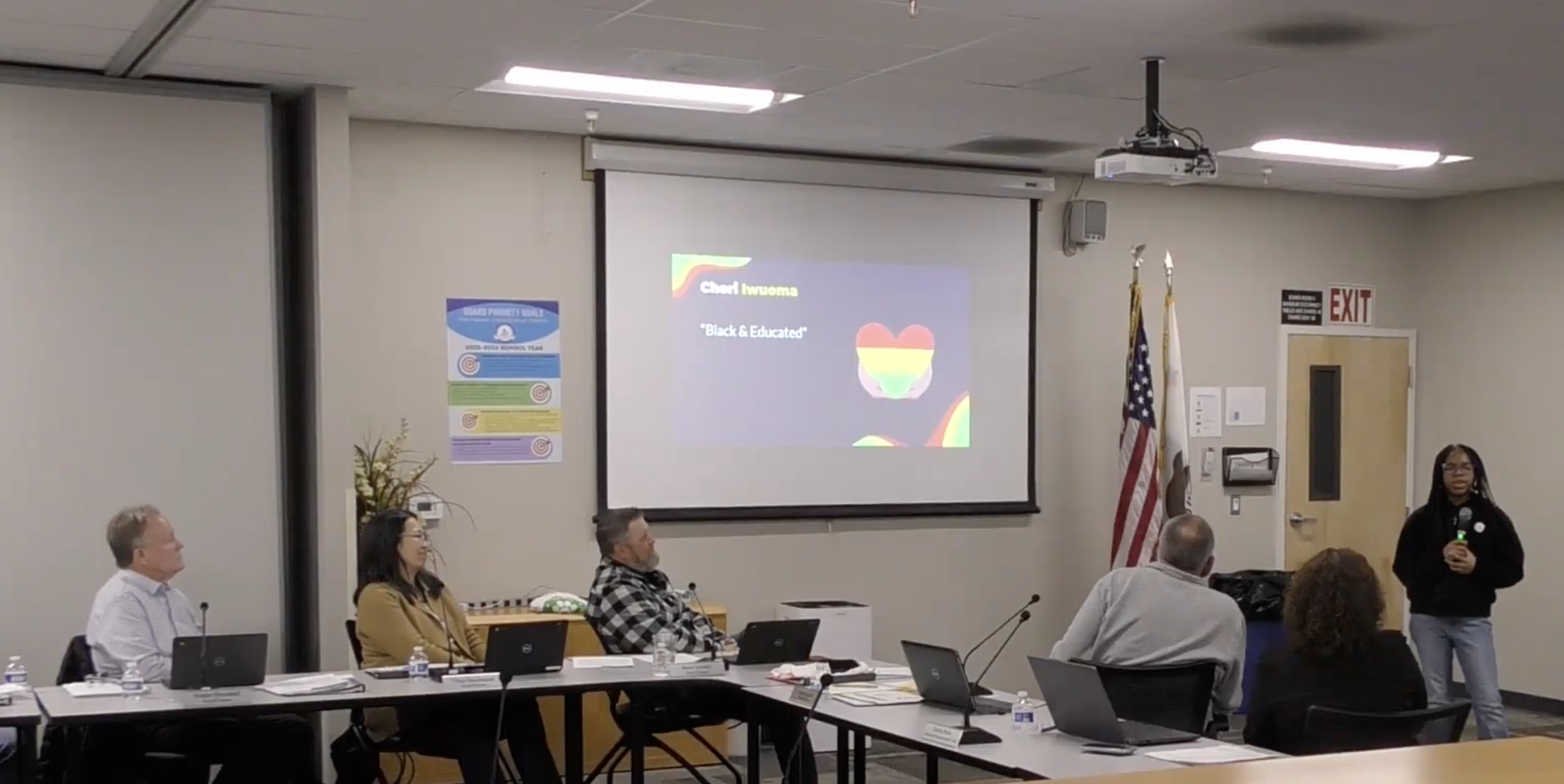
The district's fourth annual Black History Month Oratorical featured 130 students from eight schools performing 24 acts at a sold-out event at Liberty High School. Four students performed at the board meeting: Corey, a seventh grader at Adams Middle School, delivered an original poem titled "Black and Educated"; Rashawn, a TK student at Pioneer Elementary, sang "What a Wonderful World"; Sahil delivered a speech titled "Progress" about Dr. Martin Luther King Jr.'s legacy; and Jhana performed a song. Danielle Cotton, district Teacher on Special Assignment (TSA) for Belonging, and Committee Chair Anitra Simpson were recognized for their leadership. The committee was also recognized by the Brentwood mayor and city council.
Minor Items
Closed session resolutions: Resolution A (5-0) to release certain temporary certificated employees for 2025-26; Resolution B (5-0) to non-reelect certain certificated employees for 2026-27.
Inter-district attendance policy updated to comply with changes in law ahead of a March 1 deadline; BP 1011 deleted and replaced with new BP 1010. Approved 5-0.
New Board Policy/AR 1445 approved 5-0.
Board policy deletion (10.12) approved 5-0.
Delegate assembly candidates Yolanda Pena Mindrick, Marina Ramos and Mary Helen Rocha (all incumbents) endorsed 5-0.
2026-27 board meeting schedule adopted 5-0.
What to Watch
The March board meeting looms as a pivotal moment for Brentwood USD. The board will vote on the full $500,000 budget reduction package — with the fate of IXL likely the most debated line item — while labor negotiations with all three employee associations continue against the backdrop of a potential $8 million Proposition 98 shortfall. The emotional testimony from eight workers on Feb. 11 made clear that the board's fiscal decisions and its response at the bargaining table are now inextricable. Whether one-time state money materializes to soften the cuts, and whether the district can find room to address a compensation structure that workers describe as driving them to second and third jobs, will define the coming months.