
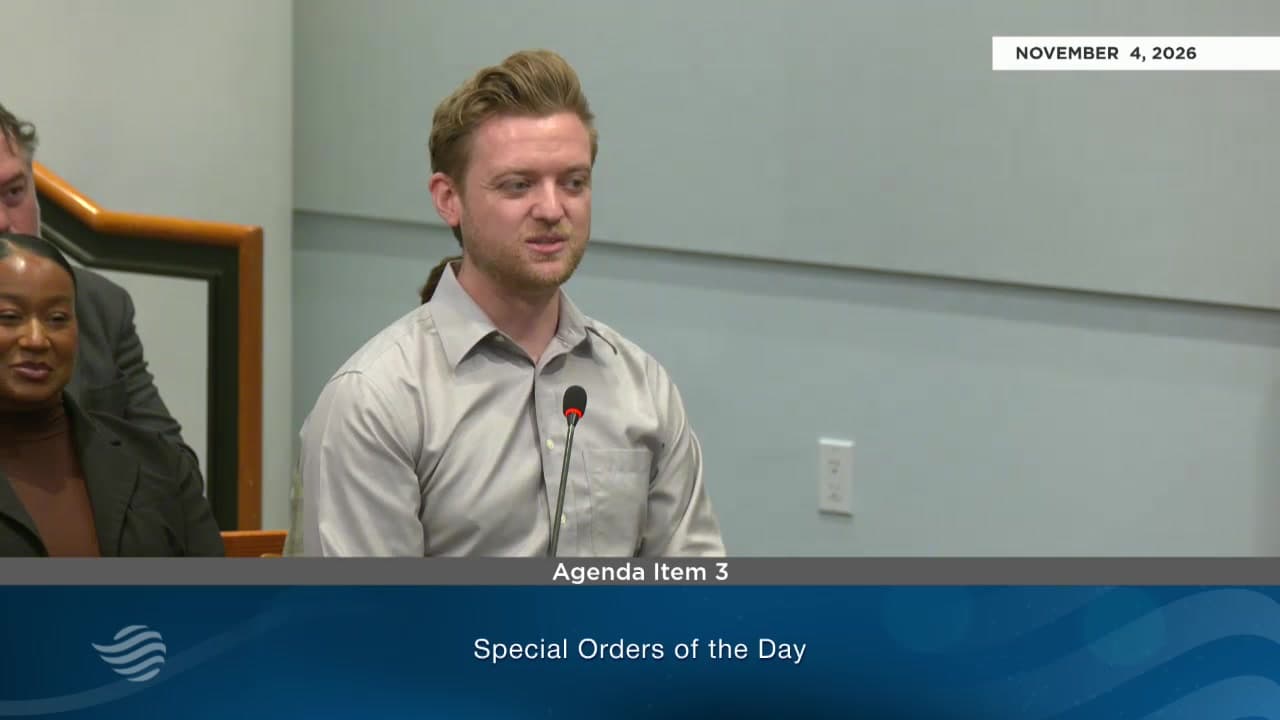
Air District Keeps Zero-NOx Water Heater Rule, Delays Start to 2028
Board of Directors • Bay Area Air DistrictNovember 4, 2026
Locunity is an independent informational service and is not an official government page for this commission. All information is sourced from public footage and an analysis of official agendas with the aid of responsible, fact-checked AI. to report an error or omission.
The Bay Area Air District's Board of Directors kept its 2023 zero-emission water heater standard on the books Nov. 4, 2026, but pushed the start date back a year and added exemptions that staff say cover about half of annual replacements. The board adopted the package through a substitute motion after setting aside a push to schedule a repeal vote and a motion to delay a decision.
- Rule 9-6 amendments adopted: the zero-NOx deadline moves to Jan. 1, 2028, and exemptions cover about half of replacements.
- Doctors, youth, PG&E and state regulators backed the rule, while small landlords warned of multifamily retrofit costs.
- Repeal push sidelined: Director Steve Young's motion to schedule a vote on dropping the mandate did not advance.
- Substitute placed on the floor 15-3, then carried on a final roll call.
Water Heater Rule Survives With a Softer Landing
The basics: Rule 9-6 regulates nitrogen oxide (NOx) emissions from gas-fired boilers and water heaters. NOx is a pollutant that contributes to smog. The board adopted a zero-NOx standard in 2023, which in practice points buyers toward electric options such as heat pump water heaters.
Why it matters: Without action, the original standard would have taken effect in January 2027 with no exemptions. "If the board does not approve the proposed amendments today, the current requirements remain in place," said Gregory Nudd, Deputy Executive Officer for Policy.
Where things stand: The adopted package includes:
- A one-year delay to Jan. 1, 2028.
- Continued sales of water heaters under 30 gallons.
- One-time exemptions for space and electrical constraints.
- Low-income and housing-cost-burdened exemptions through self-certification.
- A 2033 deadline for multifamily and similar installations.
- Flexibility for emergency replacements.
- Clarification that mobile home and propane heaters are not covered.
Staff estimated the exemptions break down this way: about 20% for space or electrical limits, 20% for low-income households and 10% for small heaters. Staff put the incremental cost of a compliant heater at about $3,500, with utility savings of $40 to $50 a year.
The Air District's Health Officer, Dr. Rohan, said pollution from gas water heaters and furnaces "causes up to 85 premature deaths and 15,000 asthma attacks in the Bay Area each year." He projected up to 300 avoided premature deaths under the amended rule.
Director Tyrone Jue of San Francisco tried to calm fears of forced replacements. "If your water heater is working, you can still keep using it," he said.
Decisions and stakeholder impacts: Contractors, manufacturers and utilities now have a firm date. Low-income households and owners of tight or under-powered buildings get relief. Multifamily owners gain five more years.
Enforcement of the exemptions will come after the fact. "We will track compliance sort of on the back end," said Dr. Fine of Air District staff.
Under a friendly amendment from Director Noelia Corzo, staff will include the recommendation on page 50 of the staff report and expand language outreach. Corzo declined a proposed permit-number requirement.
What's next: Directors asked staff to report back on contractor readiness, outreach and costs. Board Chair Lynda Hopkins vowed to raise complaints about exemption delays. The furnace rule, Rule 9-4, is expected to return in December. Multilingual summary materials are posted at baaqmd.gov/building-appliances.
Health Advocates Pack Hearing; Landlords Press for Relief
Why it matters: Public comment showed where implementation risk lies: multifamily retrofits, electrical panel upgrades and outreach. Some of those concerns came from the rule's own supporters.
Where things stand: Speakers were limited to 35 seconds each. "We have hundreds of members of the public who wish to comment on this item," Board Chair Hopkins said early in the meeting.
Support was broad and organized:
- Monica Badia, CEO of Silicon Valley Clean Energy, cited rebates offered since 2019 and more than 400 trained contractors.
- Rod Sinks, a former board chair, spoke for six former chairs and urged directors to trust staff's work.
- Julie Lindo of San Francisco Bay Physicians for Social Responsibility spoke for hundreds of health professionals.
- Matt Vespa, an Earthjustice attorney, said three years of market and workforce development show the region is ready and urged no further delay.
- PG&E's Faria Ali said the grid can handle the modest added load.
- The California Air Resources Board supported the exemptions.
- The Air Conditioning, Heating, and Refrigeration Institute, representing more than 330 manufacturers, backed the 2028 date to avoid market disruption.
The Community Advisory Council's co-chair, Messick, put it bluntly: "Preserve the zero-NOx standard and please follow through."
The other side: Anil Babbar of the California Apartment Association said the analysis leaves out multifamily retrofit cost and time. He cited $10,000 to $15,000 per unit.
Brian Wallace, president of Small Property Owners of San Francisco, asked that the 2033 extension cover buildings with two or more units, not just five or more. Tina Wong of betterhousingpolicy.org said the 500-plus small owners she represents cannot afford the mandate. She warned the costs will pass to tenants and that PG&E upgrades take a year.
A Santa Clara County Association of Realtors representative argued that residential gas combustion is a small share of regional NOx. The wholesale trade group HARDI stayed neutral.
Decisions and stakeholder impacts: Laura Calvert of Spectrum Community Services urged that low-income exemptions not become permanent. She suggested using federal LIHEAP and weatherization funds to pay for conversions. Heather Bromfield of Enterprise Community Partners backed the 2033 affordable housing timeline and staff's commitment to revisit flexibility by the end of 2030.
Repeal Fight Fizzles as Majority Holds
Why it matters: The procedural clash showed how legal noticing and required analysis narrowed the board's options. Opponents of the mandate itself never got a direct vote on it.
Where things stand: Director Steve Young, mayor of Benicia, objected before staff even presented. "Why are we not being given an option to reflect the opposition that has built since 2023 from the public," he asked. Staff said repeal had not been noticed or analyzed, though a delay to 2029 had been studied. Board Chair Hopkins stressed that direction to staff must come from a board majority.
Later, Young explained that neither option fit his position. He said a no vote would signal "I actually want no exemptions and I want to move this item forward in 2027." He also challenged staff's socioeconomic assumptions and how incentives are distributed geographically.
Supporters framed a yes vote as the path to relief. "If we don't vote yes today, we're actually cramming the mandate down onto people immediately," said Director Juan Gonzalez, mayor of San Leandro. Director John Gioia of Contra Costa County said "the exemptions are big enough to drive a truck through."
Director Mark Salinas, mayor of Hayward, shifted from skeptic to supporter, citing the extra year. "As an air district and as a board, this is on us," said Director Corzo of San Mateo County. Board Chair Hopkins added, "I think delaying is a terrible idea."
The other side: Director Shamann Walton of San Francisco described a political bind. "If we do not support this rule and the amendments, people are going to say we don't care about the environment," he said. He tied his skepticism to the lack of funding: "If the Air District was saying they were going to pay for this unfunded mandate and buy everybody a water heater, we would be having a different conversation."
Director Monica Brown of Solano County asked for senior outreach and a list of contractors and assistance programs. "I don't want to hurt people," she said. Directors Lena Tam and Otto Lee pressed for language access.
Decisions and stakeholder impacts: Young moved to place a vote on dropping the mandate on the December agenda, with Brown seconding. Staff warned that schedule was legally infeasible within 30 days.
- Walton's motion to continue: The board declined to take it up. By spoken responses, the count was For: 4, Against: 14.
- Corzo's substitute motion: Placed on the floor. For: 15, Against: 3 (Directors Young, Brown and Walton).
- Final vote: Counsel said 12 votes were needed, and the clerk declared the motion carried. Walton voted no. A full tally was not announced.
Before the vote, Board Chair Hopkins counted about 13 supporters, three opposed and one undecided. That points to a durable majority, alongside lingering unease about costs.
Minor Items
- Consent calendar: Items 4-13 passed by roll call with no items pulled and no public comment.
- $432,500 for ultrafine particle monitors at all five refinery community air monitoring stations.
- $70,000 increase to the Adaptalytics, LLC contract for configuring the district's Ceridian Dayforce HR and payroll system.
- Policy updates: The board approved Transportation Fund for Clean Air changes for FY 2026-27 and Community Advisory Council charter amendments.
- Coal project comment: Jack Lucero of the No Coal in East Bay Coalition asked for the most stringent possible environmental review of a proposed coal project.
Looking Ahead
The board next meets Wednesday, Dec. 2, 2026, at 10 a.m. Furnace Rule 9-4 is expected to return in December.