
Air Board Backs Warehouse Rule Push, Approves $65M for Refinery Communities
Board of Directors • Bay Area Air DistrictOctober 7, 2026
Locunity is an independent informational service and is not an official government page for this commission. All information is sourced from public footage and an analysis of official agendas with the aid of responsible, fact-checked AI. to report an error or omission.
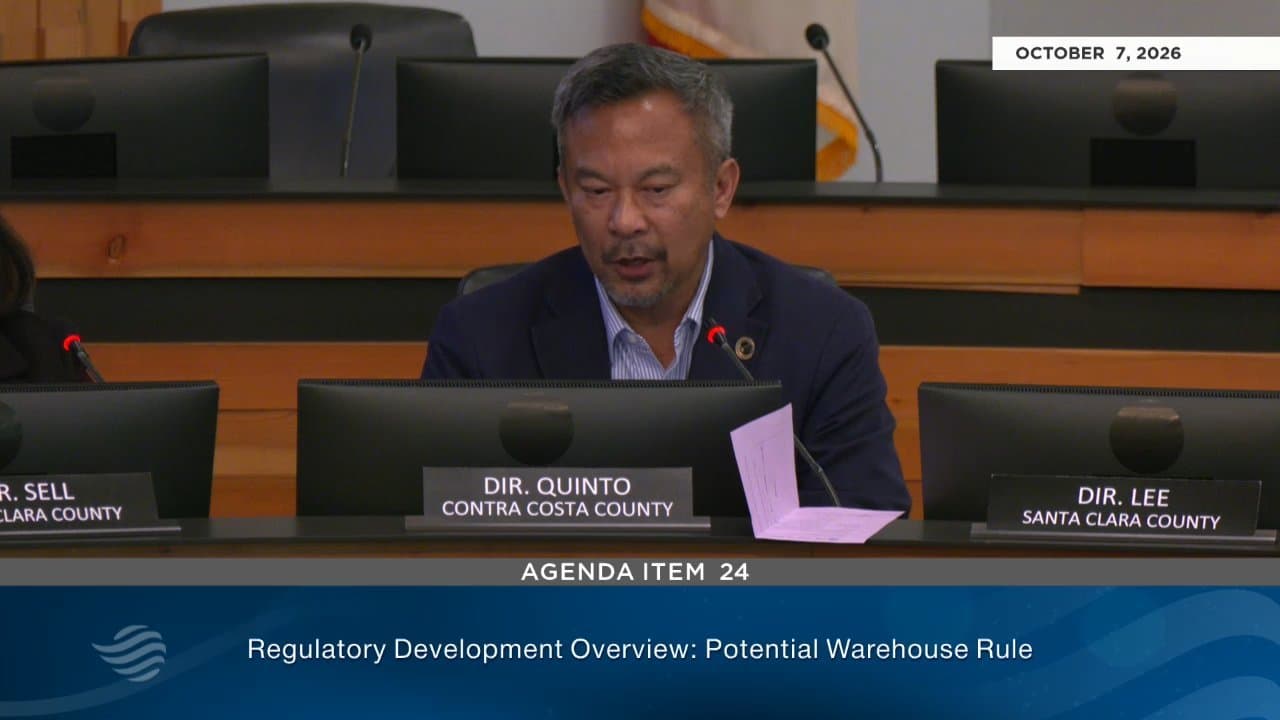
The Bay Area Air District board spent nearly two hours on Oct. 7, 2026, debating whether to regulate the diesel traffic that large warehouses draw into neighborhoods. A majority signaled staff should keep going, though no vote was taken. The board also sent roughly $65 million in refinery penalty money back to Richmond- and Benicia-area communities before the meeting ended when it lost quorum.
- Warehouse rule moves to public outreach after most board members back continued rulemaking.
- About $64M in Bay REPAIR grants approved for Richmond and Benicia areas, with a review required before any second round.
- Dozens of property owners and seniors urge repeal of the gas water heater rule ahead of a Jan. 1, 2027 compliance date.
- Seven steps to link the Community Advisory Council and the board pass despite some board members' doubts.
- COP31 travel approved 18-1 over Board Member Monica Brown's cost objection.
Warehouse Rule Clears First Political Hurdle
The basics: An indirect source rule (ISR) regulates facilities such as warehouses that attract polluting trucks and equipment, rather than regulating the vehicles directly. The Air District's model is South Coast's WARE rule, which has reported 537 tons of nitrogen oxide (NOx) reductions and more than $80M in fees.
Why it matters: A rule could cut diesel pollution near about 1,000 large Bay Area warehouses, many in overburdened communities. Industry warns of higher costs and lost jobs.
Where things stand: Staff described a two-phase approach. The first phase would require reporting and offer a flexible compliance menu. The second would target exposure reductions. The project has had five Stationary Source Committee presentations and four approved staff positions. "We're on the far left of the process in the technical assessment phase," said Christopher Easter, Senior Air Quality Specialist.
The Air District's Health Officer described the harms of diesel particulate in plain terms: "Black soot can cover windows or patio furniture."
Environmental justice groups, health advocates, students and Earthjustice pushed for a strong rule by 2027. Greenlining Institute fellow Engie Muka asked for adoption by the third quarter of 2027, with revenue reinvested in affected communities. Fernando Gaitán of Earthjustice said South Coast shows warehouses can grow while cutting NOx, with health benefits upward of $3 billion. Dr. Benjamin Liu of the American Lung Association noted that a statewide ISR bill failed.
The other side: A business coalition asked the board to send the item back to committee. That group included the Supply Chain Federation, Pacific Merchant Shipping Association, California Council for Environmental and Economic Balance, Bay Area Council, CalChamber and Western States Petroleum Association. Chris Shimoda of the Supply Chain Federation cited a San Diego finding that ISRs cost up to 75 times more per ton than alternatives. He asked for a Bay Area cost-effectiveness analysis. Mike Jacob of PMSA said state rules have already cut port truck diesel particulate by more than 98%.
Several groups also questioned whether the rule would earn credit in the State Implementation Plan (SIP), the state's federally required clean air blueprint. Executive Officer Dr. Fine said the rule would still deliver benefits regardless: "Even without that, it still achieves emission reductions." On costs, he said economic analysis must wait: "We don't have quantitative options developed yet, and we want to do that with input from the public."
Decisions and stakeholder impacts: Support came with conditions. "Every single community emissions reduction plan that was passed in the Bay Area identified a need to address this issue," said Board Member John Gioia. Board Member Steve Young said, "As a general rule, I prefer incentives over regulation, but I am willing to have this process move forward." Board Member Gabe Quinto said, "I am concerned about the job losses." Board Member Joelle Gallagher suggested a lower size threshold and said "we may want to look at incentivizing zero emission technology." Vice Chair Vicki Veenker asked how the rule would treat three 75,000-square-foot warehouses clustered close together.
"It does sound to me like we do have board majority support to move forward with this," said Board Chair Lynda Hopkins. No vote was taken.
What's next: Staff moves into public outreach. Quantitative options and a socioeconomic analysis will follow.
Refinery Penalties Flow Back to Richmond, Benicia
Why it matters: Bay REPAIR returns penalty dollars from Chevron and Valero violations to the communities around those refineries. More money may come if Chevron stays out of compliance.
Where things stand: The fund holds about $105M. Of that, $40M was already awarded to Benicia "Catalyst" projects. Round 1 drew 125 applications, 105 of them eligible, covering 181 projects. Requests exceeded available funds by more than 3.5 times, and by more than 4.6 times in Richmond. A panel of 55 community and technical reviewers scored the applications. Staff then weighed portfolio balance, feasibility and due diligence, which led to partial awards and some denials.
The board approved about $26M for Benicia-area projects and $38M for Richmond-area projects.
The other side: Young, Benicia's mayor, objected to how applications were scored: "There were a lot of things that were added in as scoring criteria that the board never talked about." Board Member Juan Gonzalez pressed staff to be open about the deliberation phase. "It's really just a transparency statement," he said.
Stacks Engineering representative Ashley Labar protested the denial of the firm's ship-emissions capture proposal. She said it scored in the fundable range but was dropped over technical feasibility concerns. Gonzalez praised the technology. Staff said other state funds and mitigation fees exist for that kind of project.
Board Member Dionne Adams asked, "What are the safeguards that are going to be in there if a project falls behind or if a grantee doesn't deliver on its commitments?" Emi Wang, Officer, Community Investments Office, answered: "We will be having monthly check-ins for the first 6 months with all grantees." Wang said grantees will also have to document expenses to get reimbursed. Brown urged careful oversight of grantees' finances.
Decisions and stakeholder impacts: Young moved approval and Gioia seconded. The motion requires a lessons-learned review before any second round, first at the Community Equity, Health, and Justice Committee and then before the full board. Gioia said roughly $20M in additional Chevron funds would likely arrive and could fund unfunded Round 1 applicants. Community steering committee member Dr. Enod Burrell thanked staff and reviewers.
Vote: For: 20, Against: 0. Board Member Shamann Walton's vote was not recorded.
Water Heater Rule Draws Sustained Opposition
Why it matters: The Air District's gas water heater standard has a Jan. 1, 2027 compliance date. Speakers said few property owners know the rule is coming.
Where things stand: The rule wasn't on the agenda, so dozens of speakers used non-agenda public comment, limited to one minute each. Small property owners, Realtors, seniors and retirees cited $20,000 to $150,000 in electrical panel and rewiring costs. They also raised PG&E delays, grid capacity, rent impacts and a lack of public notice.
Peter Reitz, executive director of Small Property Owners, said members faced costs of up to $75,000. He floated a middle path: a 10-nanogram NOx standard for gas heaters. Alan Horn, a 72-year-old owner of rent-controlled units, said an electrical upgrade could cost $150,000 and put his property at risk. Jim Hirsch said his 100-year-old, 12-unit building lacks the electrical service capacity to convert. Sandy Siscoe of the Santa Clara County Association of Realtors asked the board to repeal the rule. Enrique Navarro, from the same group, sought assurance that gas furnaces and cooking appliances aren't next. Many speakers asked that the mandate apply only to new construction or major renovations, or that it be delayed.
The other side: Earthjustice's Gaitán said the rule was carefully considered and that opposition is driven by misinformation. He urged more outreach and education, not repeal.
What's next: Hopkins said a full deep dive is planned for the November meeting. Many remote commenters weren't heard before quorum was lost.
Community Advisers Get a Seat, but No Vote
Why it matters: Advocates want a voting community seat on the board. Gioia noted that "that would involve a change in state law."
Where things stand: The board adopted seven recommendations from its Community Advisory Council (CAC):
- A non-voting CAC liaison at board and committee meetings, starting in January 2027.
- Board liaisons to the CAC.
- Annual joint retreats.
- CAC presentations to the board.
- Informal meetings every six months.
- Meet-and-greets for new members.
- "Toxic tours" for board members, led by environmental justice organizations.
Board Member Noelia Corzo said of the meet-and-greets, "I love this recommendation." CAC Co-Chair William Goodwin said, "I always believe that people closest to the issue have the best solutions."
The other side: Board Member David Haubert said, "I would rather defer item 1 until we pilot these others for a year or so." Board Member Rico E. Medina raised quorum concerns about the same item. Gioia noted that other air districts have public members and that non-voting liaisons wouldn't count toward quorum. Commenter LaDonna Williams said non-voting participation is not enough.
Decisions and stakeholder impacts: The motion, made by Gioia, passed with Haubert and Medina voting yes despite their reservations. Vote: For: 20, Against: 0. Young's vote was not recorded. Hopkins proposed rotating CAC co-chairs into the board liaison role, and staff will review compensation limits with legal and finance staff.
COP31 Trip Survives Cost Objection
Where things stand: Brown pulled the Chair's and Vice Chair's travel to COP31, the United Nations climate conference in Antalya, Turkey, from the consent calendar. She cited constituent hardship under HR 1: "It's a bad look at this stage in the game."
Dr. Fine said the Air District has long attended the conference. He argued attendance matters in the absence of the federal government and noted costs are lower than in prior years. Young questioned a $35,000 logistics contract with ICLEI. Staff said it buys access to invitation-only panels, media and experts. Veenker said similar networking "allowed me to get more involved with the data centers conversation."
Decisions: Approved. For: 18, Against: 1 (Brown). Young's and Walton's votes were not recorded.
Minor Items
- People's Air Grants: $3M awarded to 12 community projects from 61 eligible applications. Grants run two years starting January 2027 (For: 19, Against: 0).
- Hearing Board: Keoni Williams of Roots Community Health, who is not a physician, appointed medical professional alternate. Four incumbents were reappointed (For: 21, Against: 0).
- Consent calendar (For: 21, Against: 0): The board accepted up to $77M in CARB incentive funds and up to $6M for Clean Cars for All. It also approved $1.46M for air monitoring equipment.
- Prescribed burns: Smoke from Angel Island burns on Sept. 8 and Sept. 23 closed East Bay schools and a library. CAL FIRE has ended burning there for the year, and staff promised a public burn webpage.
- Fugitive dust: West Oakland advocates cited 2,500-plus complaints from 2019 to 2025 that produced only 16 violation notices. They urged a strong rule ahead of a proposed coal terminal.
Looking Ahead
The board next meets Wednesday, Nov. 4, at 9 a.m., when the water heater deep dive is expected. Staff also owes a committee update on prescribed burn procedures in the coming months.
Several roll-call responses at this meeting were not recorded, so vote totals above reflect recorded votes only.