
Air District Adopts New Economic Test for Rules, Awards $40M to Benicia
Board of Directors • Bay Area Air DistrictSeptember 2, 2026
Locunity is an independent informational service and is not an official government page for this commission. All information is sourced from public footage and an analysis of official agendas with the aid of responsible, fact-checked AI. to report an error or omission.
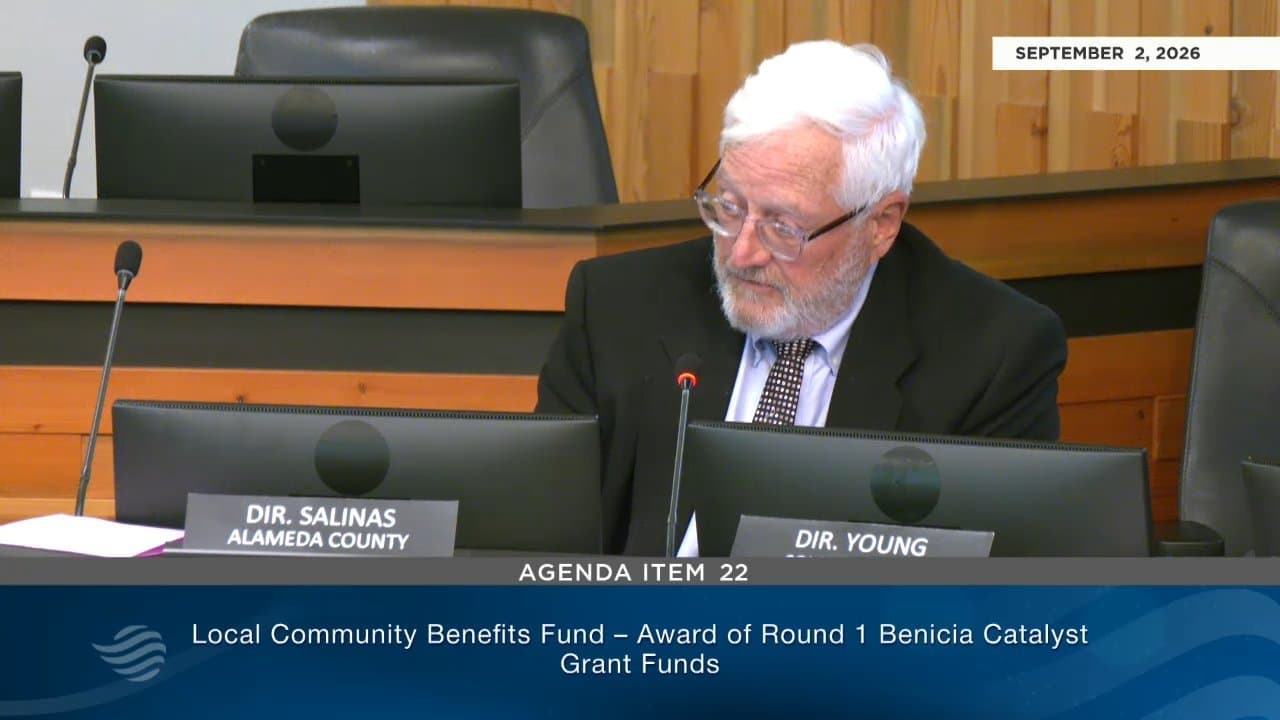
The Bay Area Air District now has a formal rulebook for weighing what its regulations cost households, workers and businesses, including breakdowns by income, race and ethnicity. At its Sept. 2, 2026 meeting, the Board of Directors adopted the socioeconomic impact analysis policy on a roll call vote. It then sent $40M in Valero refinery penalty money back to Benicia, the first major award from its Local Community Benefits Fund.
- Socioeconomic impact policy adopted, triggering deeper analysis for rules over $10M in annual costs
- $30M to the City of Benicia, $10M to Benicia Unified from Valero settlement funds
- Residents warn water heater rule costs, up to $40,000 per house, could displace low-income households
- Earthjustice, Sierra Club and allies press the District not to stall a warehouse pollution rule
- Coal terminal opponents ask the District to use its permitting power in Oakland
A New Price Tag Lens for Clean Air Rules
The basics: State law, the Health and Safety Code, already requires the District to analyze jobs affected by its rules. Until now, staff used their own judgment on when to go further, as they did with the 2023 appliance rule.
Why it matters: The policy applies to all new and amended regulations. It shapes the coming water heater amendments and the fugitive dust rule.
Where things stand: Leonid Bak, an economist in the Regulatory Development Division, walked directors through six standard elements: statutory context, baseline, affected entities, compliance cost, cost-effectiveness and regional economic impact. An enhanced analysis kicks in when direct annual costs top $10M across a rule, when the same facilities faced prior significant rules, or when a rule affects consumers, small businesses, or energy and housing costs. The enhanced review adds cumulative District costs, household affordability, and breakdowns by income, race, ethnicity and gender.
Staff said the policy does not apply to permits, costs are annualized over equipment life, and benefits such as avoided premature deaths are monetized.
"How does the socioeconomic analysis actually change the design of a rule?" asked Director Brian Colbert, a Marin County supervisor. Staff said they plan to release a draft analysis at the workshop phase, so stakeholders can weigh in earlier.
Director John Gioia, a Contra Costa County supervisor, noted "the Stationary Source Committee recommended this most recent draft." He also cautioned that "the industrial community overestimates the cost of compliance." Director Joelle Gallagher, a Napa County supervisor, stressed knowing "what the economic impact is of doing nothing."
The other side: Patrick Messick, a Community Advisory Council member speaking for himself, opposed adoption without revision. He argued the policy weighs industry costs more rigorously than health benefits. Fernando Gaetan of Earthjustice backed transparency but asked for guardrails against structural bias and for wider evaluation of health benefits and the cost of inaction. Margaret Gordon said she would support it but wanted amendments on oversight.
Director Steve Young, Benicia's mayor, pushed back: "I think it's not accurate to say that... it's a one-sided analysis."
The household squeeze: Several residents tied the policy to the gas appliance and water heater rule. Tina Flores of Concord cited conversion costs up to $40,000 and asked for instant rebates. Charmaine Robinson, an East Oakland resident on a fixed income, asked that the policy be applied to the water heater rule. Yvonne Ishman of Richmond raised gentrification fears. Staff confirmed the amendments will be analyzed under the new framework, adding that "right now there are no exemptions in the rule and the compliance date is January 1, 2027."
Decisions and stakeholder impacts: Director Ken Carlson, a Contra Costa County supervisor, called the policy "really an enhancement, a broadening" and moved approval. Director Juan Gonzalez, San Leandro's mayor, seconded. The motion carried on a roll call. A full tally was not available.
Business and labor groups won a seat at the analytical table. Tim Sibrani of the Contra Costa Building and Construction Trades Council, Matt Regan of the Bay Area Council and Mark Orcutt of the East Bay Leadership Council all urged adoption. Environmental justice advocates left with assurances, not amendments.
What's next: Incentives go to the Stationary Source Committee next week. The water heater amendments reach the Board in November.
Valero Penalty Dollars Head Home to Benicia
Why it matters: The awards return refinery penalty money to the affected community and set the template for the remaining Opportunity and SEED grants and a coming Richmond round.
Where things stand: The fund holds about $66M from the October 2024 and April 2026 Valero settlements plus interest. Staff received three Catalyst applications, found two eligible, and had six reviewers score them. Both applicants resubmitted after staff asked them to strip out fossil-fuel maintenance and weakly measurable activities.
The city's $30M package covers electrification, clean mobility, greening and a post-refinery transition playbook. City Manager Mario Giuliani said Benicia would write "the playbook for California." The school district's $10M Healthy Campuses project funds heat pumps and MERV 15 filtration. The district superintendent told directors that "487 students have asthma in our district."
Not everything made the cut. "We do not recommend funding Project 2, Student Wellness," said Emi Wang, Community Investments Officer.
Money questions: "Where is that extra $6 million going to get spent?" asked Director Young. Dr. Fine, the District's executive officer, replied that "the board has discretion, especially over the interest because it was not part of the original sort of call." Asked whether that money could fund local nonprofits, staff cited the statutory requirement that spending have a nexus to air pollution.
Grantees get a 25% advance, with the remaining 75% paid on reimbursement. Directors also probed the proposal for five years of free EV charging.
Vice Mayor Dionne Adams of Pittsburg asked what air quality and health outcomes the investments would deliver. Wang said an evaluation contractor will work with each grantee in the first year to build logic models and indicators.
The other side: A Vallejo resident called the award a money grab, saying Vallejo was shut out of the Catalyst category. Dr. Fine responded that "the Opportunity and SEED grants were available to Vallejo." Benicia resident Stephen Gallub backed the award but criticized forced partnerships, an opaque reviewer process and burdensome metrics. Director Gioia warned, "we need to make sure we're going to be consistent in how we apply the guidelines."
Decisions and stakeholder impacts: Director Young moved approval. Director Monica Brown, a Solano County supervisor, seconded. The motion carried on a roll call, and Director Otto Lee later asked that his yes vote be recorded.
Board Chair Lynda Hopkins framed the stakes: "We don't have the leverage to actually create a community benefit agreement, we're kind of actually implementing one, which is beautiful."
What's next: Director Young asked staff to agendize a lessons-learned review of the guidelines before the next round.
Advocates Push Warehouse Rule, Coal Fight
Why it matters: An indirect source rule regulates facilities, such as warehouses, that draw heavy diesel truck traffic. Speakers warned that industry opposition and missing workshops threaten its timing.
Where things stand: Five speakers in non-agenda comment pointed to South Coast's warehouse rule, saying it cut NOx emissions and health costs without stopping warehouse growth. Katrina Tomas, an Earthjustice attorney, urged staff to counter industry misinformation and hold the promised summer workshops. Imari Mars Keith, a Sierra Club organizer, sought an enforceable rule for communities like Bayview Hunters Point. Pooja Aggarwal urged local leadership amid federal rollbacks. Ashiya Ajani also backed a stronger fugitive dust rule.
On coal: Jack Fleck of the No Coal East Bay Coalition said the Trump administration committed $75M under the Defense Production Act to the proposed Oakland coal terminal. He noted that Richmond passed a resolution seeking an environmental impact report, the Legislature approved AB 40, and Berkeley will consider a resolution Sept. 15. Messick listed requests including emission limits, a volume cap, covered rail cars, enclosed storage and zero-emission equipment, and asked the Board to direct staff to respond publicly.
What's next: The Board took no action on either issue.
- Labor contract: The employees' association MOU and a $5,651,727 General Fund reserve transfer were approved on consent. Retiree Rochelle Henderson questioned why retirees are excluded from retroactive payments.
- Big-ticket contracts: The Board approved an $8M Microsoft licensing deal with SHI International Corp. and up to $3.15M for air toxics monitoring equipment.
- Smaller contracts: Directors approved $450K to InterEthnica for Clean Air Plan engagement and $341K to Fuel for Society. A CEQA support contract with Environmental Audit Inc. rose to $400,000.
- Permit backlog: Applications in review fell from 1,130 to 930 as the District hired 36 staff.
- New Health Officer: Dr. Rohan Radhakrishna joined the District.
Looking ahead: Flare rule workshops are set for Sept. 16 and 24, and a Chevron health risk assessment meeting will be held Sept. 21 in Richmond. The Board's next meeting is Oct. 7, 2026, at 10 a.m., with a 9 a.m. start proposed for November.