
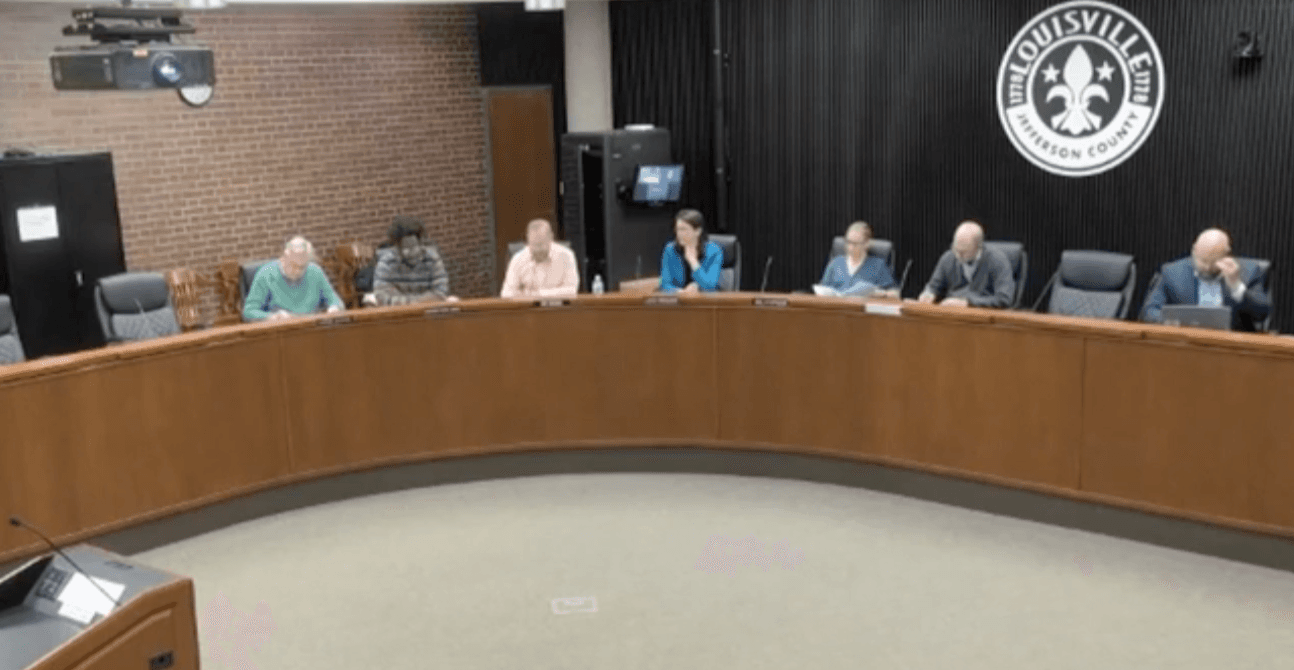
Mid-City Mall Demolition Approved 4-1 as Color Palette Clash Defines Landmark Bardstown Rd Vote
Bardstown Road/Baxter Avenue Review Overlay District Committee • LouisvilleApril 21, 2026
Locunity is an independent informational service and is not an official government page for this commission. All information is sourced from public footage and an analysis of official agendas with the aid of responsible, fact-checked AI. to report an error or omission.
The largest redevelopment in the 35-year history of Louisville's Bardstown Road overlay corridor cleared its final design review hurdle on April 21, but not before a bruising debate over whether dark brick belongs in a red-brick neighborhood. The committee's 4-1 vote to approve Branch Properties' plan to demolish Mid-City Mall and build five commercial buildings at 1250 Bardstown Rd came despite unresolved frustration from members, a retired city preservation specialist, and neighborhood advocates who called the project a missed opportunity.
- Mid-City Mall demolition and five-building commercial redevelopment approved 4-1 after three public hearings and 34 stakeholder meetings
- Developer holds firm on dark color palette, rejecting repeated calls to add red brick to commercial buildings despite corridor's historic character
- Retired preservation specialist calls the project a historic low point for overlay standards, listing over a dozen red-brick buildings she helped bring to the corridor
- New pedestrian infrastructure adds 3,700 linear feet of raised sidewalk to a site that currently has none
- Mural requirement added for Baxter Avenue loading dock wall, but critics say the facade still relegates the street to "second-tier status"
- Library building negotiations remain unresolved, raising questions about how much community-benefit credit the developer deserves
The Dark Brick Fight That Defined Three Hearings
The single biggest flashpoint across three hearings was a deceptively simple question: Should the five new commercial buildings use red brick to match the Bardstown Road corridor?
The basics: Branch Properties proposes demolishing the aging Mid-City Mall and replacing it with a grocery-anchored commercial center of nearly 100,000 square feet of retail space, reducing on-site parking by 232 spaces. The site sits within Louisville's Bardstown Road/Baxter Avenue Review Overlay District, which subjects exterior design to committee review. The committee continued the case from its March 17 hearing, asking the developer to address three concerns: pedestrian connectivity, the Baxter Avenue facade, and the color palette.
Why it matters: The overlay district was created to protect the architectural character of one of Louisville's most iconic commercial corridors — a corridor defined, according to opponents, by red brick. The committee's decision to approve a dark palette of black, white, and green brick without conditions sets a precedent for how much design autonomy developers retain on large-scale projects in the district.
Where things stand: Committee Member Aaron Givhan pressed the developer repeatedly, telling the room: "I still have a problem with why you all refuse to put brick in a brick neighborhood that red. The color palettes have not appeased a lot of people."
Jesse Shannon of Branch Properties pushed back passionately, arguing the dark brick was drawn from the corridor itself and that red brick had been studied extensively. "Black and white brick — I can say our construction management teams here, they would prefer to do red brick as well in some sections because it's about a tenth of the price. So this is about good design, not necessarily about just color palette," he said, adding that the colors were inspired by existing overlay buildings: "The green that we're using, the white bricks that we're using, the black brick that we're using came from the inspiration of the Bardstown overlay buildings."
Shannon framed the design as inseparable from the color choices, warning that swapping materials would force a complete redesign.
The other side: The most forceful opposition came from Deborah Richards Harlan, a retired city historic preservation specialist with 28 years of experience who has been involved with the overlay process since 1990. She listed more than a dozen red-brick buildings she helped bring to the corridor — Highland Cleaners, the Spectrum building, Fifth Third Bank, CVS, Kroger Highland Terrace, among others — and delivered an unflinching assessment:
"We set the bar high for many, many years. The bar is now on the ground and being stepped on. And that's a sad day for me. It should be a sad day for you, too."
She called the developer's claim that black and white brick reflects the corridor's character "laughable on many levels. That is not the character of the Quarter. And if you were from Louisville, Kentucky, you would know that. But you're not."
Committee Member JonAnthony Floyed-Jackson posed a pointed question to the developer's attorney, Cliff Ashburner: "If you think that the library changing that to red brick looks good and you're happy with the color change in the library, how is that different than changing the rest of the buildings that have the same form?" Ashburner responded that the library's design context differs because it faces residential streets, and that the commercial buildings' architectural detailing was conceived as a unified composition with the darker palette.
Decisions: Before the vote, Givhan polled his colleagues: "Is it fair to ask — are you all happy with the color palette? And I'm the only one that feels it needs to be tweaked. And if you're all happy with it, I'll just move forward." No member joined his objection, and Givhan ultimately voted affirmative despite his stated frustration.
Committee Member Emily Paprocki, who had raised the red brick issue at the prior hearing, made the motion to approve, acknowledging the tension directly: "I don't think the project is perfect. We asked for some things at our last meeting, but I do feel like I want this project to go through. I think Bardstown Road needs it."
Committee Member Christopher Fuller, who also serves as a landmarks commissioner, grounded his vote in the overlay's economic mandate: "Our article of purpose shall be to help enhance the appearance and economic vitality of one of the community's most successful appealing neighborhoods. So we do have that kind of economic vitality to be kept in mind with this situation."
The final vote: 4-1 (For: Givhan, Floyed-Jackson, Paprocki, Fuller; Against: Committee Chair Kendal Baker; Absent: Kelly Estep, Julia Williams). The project was approved with all staff conditions, including applicant-requested modifications to condition 1 (updated date), condition 3 (flexibility on window tinting), and condition 8 (lighting language referencing the land development code). No additional color palette conditions were imposed beyond the developer's voluntary inclusion of red brick on the colonnade and library building.
3,700 Feet of New Sidewalk Where None Existed
Why it matters: The Mid-City Mall site currently has no internal sidewalks beyond painted asphalt — a significant barrier for pedestrians trying to reach the grocery store from Bardstown Road. The updated plan creates two full pedestrian connections from Bardstown Road through the site to the grocery store, with one path wrapping to Baxter Avenue.
Where things stand: Ashburner described the new walkway as roughly 80% raised sidewalk and 20% at-grade crossings with ADA-accessible breaks. "The proposal includes about 3,700 linear feet of raised separated sidewalk. So we do think that the pedestrian experience is going to be much improved with this plan over the existing conditions," he told the committee.
Fuller asked whether speed tables had been considered for the at-grade crosswalks. Ashburner said they had been studied but that drainage issues and grade changes across the site made striped crossings preferable. Floyed-Jackson proposed a more ambitious redesign with a central plaza and shifted buildings, but the applicant explained that repositioning structures would affect Rosewood Alley neighbors, eliminate parking required by the grocery tenant, and conflict with the already-approved circulation plan. The Board of Zoning Adjustment had voted unanimously to approve the site design the previous day.
Baxter Avenue Gets a Colonnade — But Critics Say It's Still the Back Door
Why it matters: Baxter Avenue is one of two major street frontages for the largest redevelopment in overlay history. Opponents worry the loading-dock-facing design permanently relegates it to back-of-house status while Bardstown Road gets all the retail activation.
Where things stand: In response to March concerns, the developer added a red-brick colonnade with heavy timber caps, enhanced board-and-batten treatment along the top of the facade, more detailed corner elements, and a trash compactor screening wall providing depth variation. Senior Planner Kat Groskreutz introduced new condition 12: "The public art will need its own overlay permit, shall be installed on the loading dock screening wall facing Baxter Avenue within six months of construction completion." The screening wall will be painted a contrasting color in the interim. The pedestrian experience on Baxter also improved: a 7-foot planted verge, a sidewalk pulled away from the street, an additional 5-foot planting strip, the colonnade, and another 14-foot buffer before parking.
The other side: Anita Hall, a public commenter from the Germantown neighborhood, said she generally supports the development but found the Baxter Avenue treatment unacceptable: "The proposal dramatically reduces Baxter to a second tier status. I am not a developer or a planner, but there are many smaller buildings and parking areas in this plan and it feels absurd that there is no way to place some of those smaller buildings between the loading dock and Baxter."
Hall also questioned how much credit the developer deserves for including a library building on the site, noting that "it feels like the developer is getting a lot of unearned credit around the inclusion of the library when this is not yet certain if the city and library are shopping at market rates or close to market rates." The library sits outside the overlay review boundary and is not subject to the committee's approval. Ashburner declined to discuss negotiation details publicly but confirmed 17 meetings had taken place between the developer and library decision-makers, and that the intent is to keep the library on site.
Floyed-Jackson suggested rotating the grocery store 90 degrees to improve the Baxter facade, but Ashburner explained this would either point the loading dock toward the library or toward Rosewood, creating conflicts with residential neighbors.
What's next: The project now moves to staff-level review of final materials. The mural or public art on the Baxter Avenue screening wall must be installed within six months of construction completion and will require its own overlay permit. Branch Properties cited support from the Cherokee Triangle Association, Tyler Park Neighborhood Association, Highlands Commerce Guild, and Friends of Bardstown Road, along with 34 stakeholder meetings over the course of the project.
Minor Items
- Public commenter James Brannon, a lawyer from Paris, Ky., attending for a University of Kentucky historic preservation class, spoke in support of the project and suggested commemorating the site's cultural history with a plaque or video installation near the planned mural.