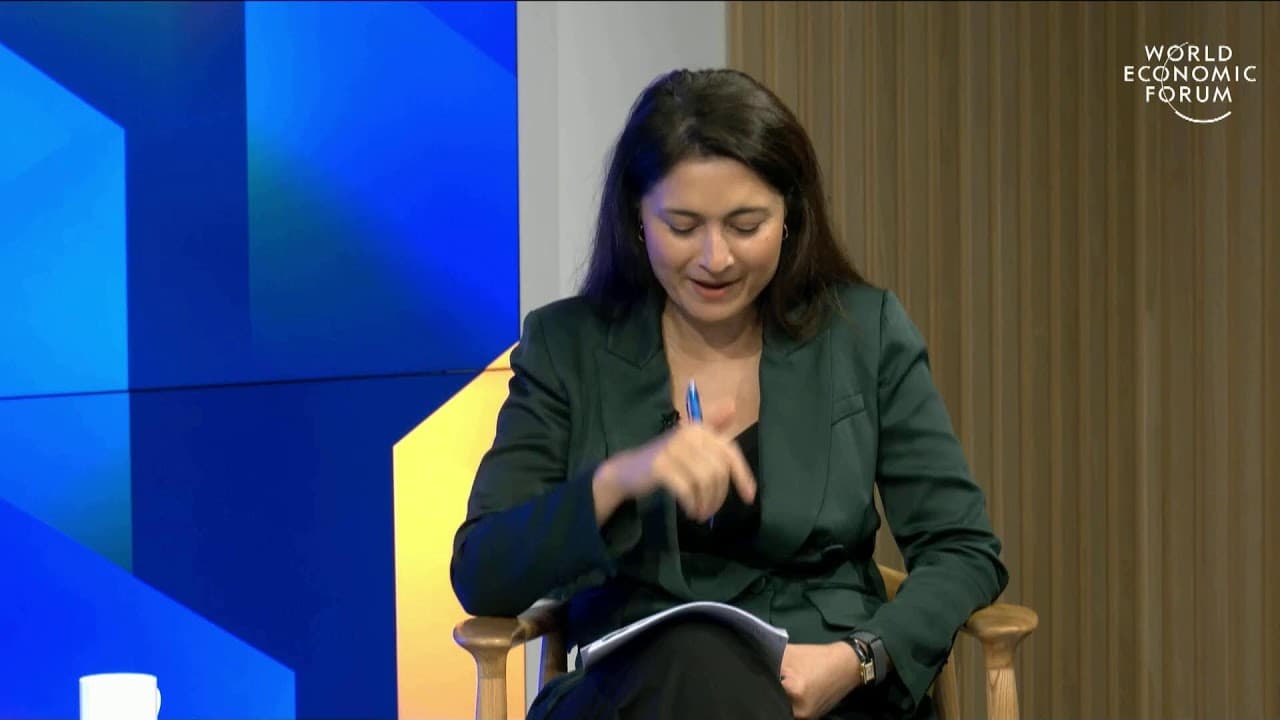
World Economic Forum - Sep 22, 2026 - Meeting
World Economic Forum • United NationsSeptember 22, 2026
Locunity is an independent informational service and is not an official government page for this commission. All information is sourced from public footage and an analysis of official agendas with the aid of responsible, fact-checked AI. to report an error or omission.
Chief Economists See Stabilization, but Warn of Wage Erosion, Debt Limits and AI's Uneven Reach
The World Economic Forum's latest Chief Economists Outlook briefing revealed a striking reversal in global sentiment — from near-unanimous pessimism just four months ago to cautious stabilization — even as panelists warned that the structural damage beneath the surface may define the next economic era. Three leading economists from the World Bank, ADP, and Indeed laid out a picture of an economy that has absorbed its initial shocks but now faces harder questions: who actually benefited, what tools remain, and whether AI will widen or narrow the gap.
- Chief economist pessimism drops sharply — from 89% expecting weakening in May to 45% in September — as governments and businesses adapt to energy and trade disruptions
- 43% of U.S. workers lost real purchasing power during the 2021–2024 inflation surge, with average declines of 9%, according to new ADP research
- AI adoption is strongest among one-person firms, creating a U-shaped pattern that could fuel entrepreneurship — if foundational AI markets remain competitive
- Fiscal support falls from top resilience factor to 9th place for the next 12 months, as U.S. sovereign debt hits $40 trillion
- European firms respond 50% less than U.S. firms to the same technology shock, raising alarms about regulatory rigidity and productivity stagnation
Sentiment Swings: From Crisis Mode to Cautious Stabilization
The basics: The Chief Economists Outlook Report, released at the briefing, surveys leading economists worldwide on their expectations for global conditions. In May, 89% expected the outlook to weaken. By September, that number had dropped to 45%, with 56% now expecting conditions to hold steady or improve.
Why it matters: The speed of the shift suggests the global economy absorbed the initial energy and trade disruptions — fragile shipping routes, volatile energy prices, disrupted fertilizer and food markets — without the synchronized downturn many feared. But the moderator, Sadia, framed the stabilization as surface-level: "56% of respondents expect the outlook to remain unchanged or even to improve, while 45% still expect conditions to weaken. This number is down significantly from the 89% that expected weakening back in May."
Where things stand: Panelists attributed the sentiment swing to several factors: governments and businesses adapted faster than expected, concentrated technology investment (particularly in AI and data centers) propped up headline growth, and more economic data became available to replace worst-case assumptions. Yet beneath the improving numbers, traditional goods trade and industrial activity remain under pressure, public finances are tightening, and borrowing costs continue to squeeze the smallest businesses hardest.
What's next: All three panelists predicted chief economists will be more upbeat by the January 2027 survey, citing improving data, AI productivity potential, and labor market resilience — though each added caveats about the fragilities still in play.
The Inflation Hangover: 43% of Workers Lost Ground
Why it matters: Even as headline inflation moderates, the cumulative damage to workers' paychecks is locked in — and the usual escape hatch is closing.
Where things stand: Neela Richardson, Chief Economist and ESG Officer, ADP, presented research conducted with University of Chicago economists examining 16 million workers who stayed with the same employer during the 2021–2024 high-inflation period. The findings were stark: "43% of those workers saw real wage declines because of inflation, and the average decline was 9%."
The problem extends beyond those who stayed put. "Even when you include job changers into our data, there's still 37%. So more than a third of workers saw real wage declines," Richardson said. She emphasized that the traditional antidote — switching jobs for higher pay — is increasingly unavailable in what she described as a "low-hire, low-fire" labor market.
The other side: Richardson also cautioned against assuming central banks will continue to move in lockstep on rate policy. "I don't think we should get very comfortable with that coordination because the likely effect of inflation on different economies will be very idiosyncratic. This is not a COVID response. This is more the geopolitics involved in higher energy policies." She noted projections suggest the U.S. will not return to its 2% inflation target for at least a couple of years.
Svenja Goodell, Chief Economist, Indeed, reinforced the uneven picture from the job seeker side: "If you are not currently employed and you're searching for a job, it is hard out there. So I think the sentiment on the job seeker side is not so great right now."
AI's U-Shaped Promise: Solo Entrepreneurs Gain, Entry-Level Workers Feel the Squeeze
Why it matters: AI is reshaping labor markets in ways that defy simple "jobs gained vs. jobs lost" narratives — and the policy choices around market concentration could determine whether the technology widens inequality or fuels a new generation of businesses.
Where things stand: Ufuk Acit, Deputy Chief Economist and Director of Private Markets, World Bank, presented data revealing a surprising adoption pattern. "The AI adoption rate shows a U shape at the very bottom of the firm size distribution. So one-worker firms are more likely to adopt AI than two, than three, than four," he said. Solo entrepreneurs are using AI to expand capabilities they previously could not afford — essentially substituting for staff they never had.
Acit warned that keeping AI markets competitive is essential. "The concentration in the foundational layer of AI market will be very, very critical to maintain the accessibility to AI so that entrepreneurship can flourish and small businesses and young entrepreneurs can come in and create companies that we could not even imagine." He noted that incumbent firms will primarily use AI to cut costs in the short term, meaning medium-term job creation depends on new market entrants.
Goodell offered a counterpoint to fears of mass displacement, reporting that only 1 in 5 companies currently use AI in daily production. "In general, I would actually argue that AI has been creating more jobs than it has been destroying," she said, citing novel occupations appearing on Indeed such as "AI test truck driver" and "AI literacy teacher."
But she identified a deeper structural problem — a "great mismatch" between where workers are leaving and where AI can help. "Education, governments, manufacturing — some of those sectors are much harder hit and could potentially experience labor shortages. But these are also the sectors that are less likely to be helped by AI, because a lot of that work is much more hands-on."
Richardson shared findings from forthcoming ADP-Stanford research showing AI disproportionately affects early-career workers in exposed fields, but noted that most U.S. job creation comes from non-AI-exposed sectors like healthcare. She argued AI's true impact is at the task level rather than the occupational level — and could ultimately be a productivity booster that helps solve inflation.
Small Businesses Squeezed: Credit Card Financing and a 77% Share of the Economy
Why it matters: Businesses employing nine or fewer people represent 77% of U.S. firms. Their health is a leading indicator of future innovation and employment — and right now, they are struggling.
Where things stand: Acit reported that the smallest firms cite inflation and borrowing costs as their top problems, with employment declining especially after March 2022 when borrowing costs rose substantially. These firms primarily finance themselves through credit cards — the most expensive form of business credit.
He framed the stakes in generational terms: "Small businesses are particularly important because even the superstar firms are starting their journey as being small. Tomorrow's superstars are today's small businesses."
On Europe, Acit cited the Draghi report and described a long-term productivity slowdown driven by lack of entrepreneurial appetite and regulatory rigidity. "European firms on average are responding 50% less compared to the US firms for the same technology shock," he said, adding that 50–75% of growth comes from successful reallocation of resources from less productive to more productive firms. For developing economies, he warned that many lack AI strategies and fail to prioritize key deficiencies like energy, human capital, and digital infrastructure.
The Fiscal Wall: Sovereign Debt Shifts From Solution to Constraint
Why it matters: The tool that carried the global economy through successive crises since 2020 — government spending — is running out of room just as new shocks loom.
Where things stand: The Chief Economists Outlook Report found that 69% of respondents credited fiscal support as the primary factor sustaining economies through recent disruptions. But for the next 12 months, fiscal support dropped to 9th place, with only 28% expecting it to be available. Sadia noted that supply chain flexibility rose to the top, followed by technology at 67% and energy market adaptation at 61%.
Richardson was blunt about the implications: "Sovereign debt is looking like less of a solution and more of a problem. And I think that's why you're seeing other things in the private sector rise to the fore of more long-term sustainable solutions to support that resilience." She described U.S. debt reaching $40 trillion as "the elephant in the global economy" and pointed to a K-shaped recovery where certain pockets — like data centers — resist the demand destruction tools central banks rely on.
Acit stressed that whatever fiscal constraints exist, credit must keep flowing to the right places. "Cutting the credit lines, especially from those type of transformative entrepreneurs during the turbulent times, is making the crisis prolonged," he said. "One thing to keep in mind is to make sure that the credit lines, especially for these productive entrepreneurs, have to remain open for us to be able to recover more quickly."
Goodell acknowledged the severity of the debt challenge but struck a note of cautious optimism: "I do think we've planted some really good tools along the way that are further along this time around. So I'm not quite ready to bet against all the options we have available and bet against the labor market specifically as we face perhaps the next crisis."