
MSD Lays Out $795M Sewer Overhaul Centered on Woodfin Plant
Town Council • WoodfinSeptember 15, 2026
Locunity is an independent informational service and is not an official government page for this commission. All information is sourced from public footage and an analysis of official agendas with the aid of responsible, fact-checked AI. to report an error or omission.
The regional sewer utility told Woodfin Town Council that most of a $795M, 10-year construction push will land at the treatment plant inside town limits. The plan will be financed by 7% rate increases and a $120M bond. Council also went on record defending a federal forest rule, filled a planning board seat and pushed a knotty Baird Cove rezoning to October.
- 1 big thing: MSD's $795M capital plan steers $553M to the Woodfin plant and pump stations.
- Sewer rates rising about 7% as MSD's debt more than doubles with a $120M bond.
- No speculative sewer expansion. Septic neighborhoods need documented failures or a developer.
- Baird Cove rezoning continued to October after the applicant didn't appear. The debate exposed a buffer gap.
- Resolution 2026-09 passes, urging the U.S. Forest Service to keep the Roadless Rule.
- Melanie Petrolo appointed to the Planning Board of Adjustment, restoring a full board.
MSD's $795M Bet on the Woodfin Plant
Metropolitan Sewerage District General Manager Tom Hardy gave council a nearly 50-minute briefing on the special district, which state statute created in 1962. MSD serves 277,000 people across 264 square miles.
Why it matters: Woodfin hosts the regional plant, where most of the money will be spent. Residents' sewer bills will help pay for it.
Where things stand: "But that's going to change a little bit because in the next 10 years we're going to do $795 million worth of work," said Hardy.
The plan breaks down this way:
- $553M for the plant and pump stations. The largest projects are a $171M thermal sludge dryer, which will replace the incinerator and produce a Class A fertilizer-type product, and a $240M–$250M biological process upgrade.
- $65M for interceptors.
- $177M for smaller collection lines.
New nutrient and ammonia rules set a 2037 deadline for the biological upgrade. The dryer will enlarge the plant's footprint, while everything else stays within it.
Capacity isn't the problem. The plant averages about 19.5 million gallons per day but is rated for 40 MGD. The pressure comes from aging equipment: its 152 rotating biological contactors date to 1987. Hardy noted the plant ran the whole time during Hurricane Helene on backup power.
Paying for it: MSD's budget is about $117M, and nearly 80% goes to construction and debt service. In response to a council member's question, Hardy said current debt is about $80M. A $120M bond resolution was set for MSD board approval the day after the council meeting, with an Oct. 7 sale. Hardy conceded it is "not a good time for the bond market." MSD holds AAA ratings from Fitch and Moody's.
"We're going to be increasing our rates. It's going to be at 7%, and the industry as a whole has been going at about 5%," Hardy said.
Who pays for growth: Expansion is developer-driven. Neighborhoods on septic qualify for MSD help only if the health department documents failures. Asked about neighborhoods with no failures, Hardy said they don't qualify. MSD lacks special assessment authority, the power to bill properties that benefit from a new line. Hardy said the district sought that power around 2000, but it was seen as government overreach.
"We're not a land planning and zoning entity. That's your all's job," Hardy said.
What's next: the dam. MSD's appraisal of its 2,880 kW hydroelectric dam, which saves $300,000 to $600,000 a year in power costs, is nearly done. American Rivers, which is pushing for removal, has hired a consultant but has not started in earnest. "Otherwise you're gonna have 40 million gallons a day going into the river," Hardy said, explaining that removal would require costly protection of MSD's interceptor. The Mayor said the issue "will require a lot of time down the road."
Baird Cove Infill Rezoning Hits Pause
The applicant didn't show and couldn't be reached, so council opened the public hearing and then continued it to October.
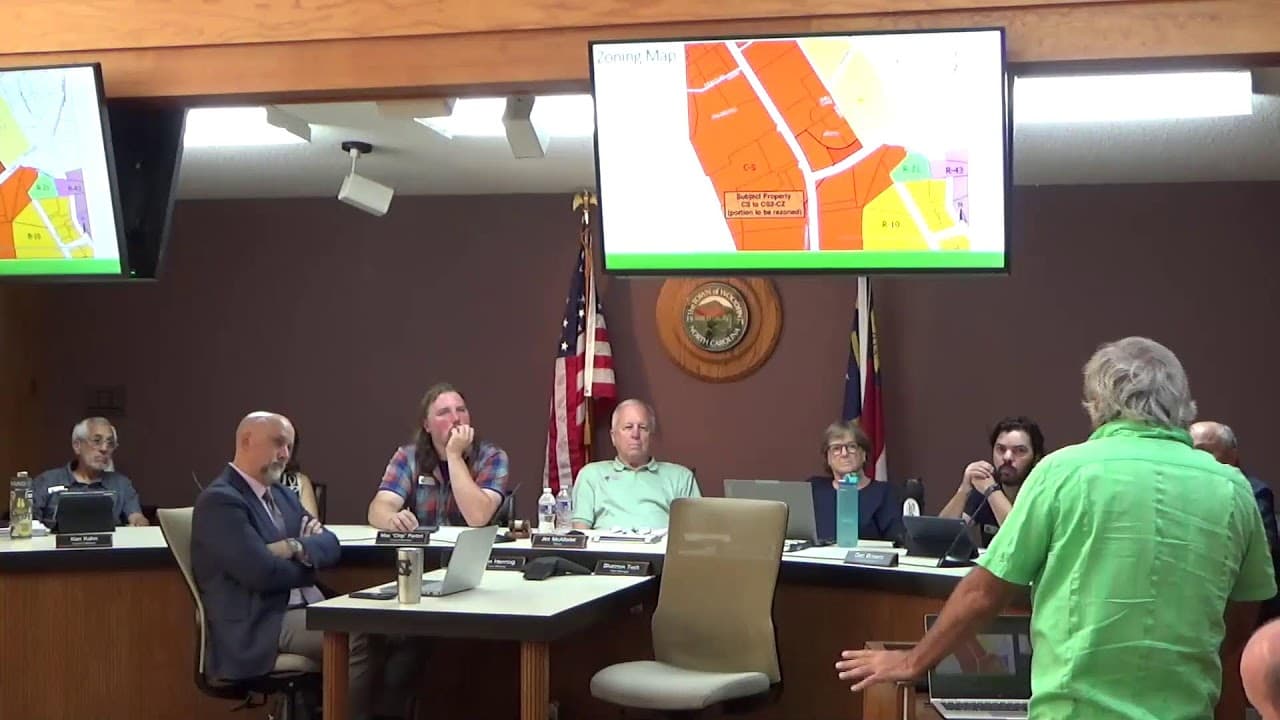
The basics: The request would move about half an acre of a 1.67-acre parcel at Weaverville Road and Baird Cove Road from Community Shopping (CS) to CS-2. That change would allow four single-family lots of roughly 5,000 square feet each. "By making it CS2 opposed to R7 or some other modification, we don't need to change the FLUM," said town staff member Ricky Hurley, referring to the future land use map.
Where things stand: CS-2 has no minimums for lot size, setbacks or frontage, so staff is adding conditions. Residents of Silver Terrace, a private easement drive serving two or three homes, objected to driveways and construction traffic on their road. The compromise limits the project to two shared driveways onto Baird Cove Road. The Mayor asked whether drivers would see the backs of houses. Staff said orientation could become a condition, but only with the applicant's agreement.
The buffer gap: Councilmember Young asked whether existing homes would be shielded. "Commercial-wise, we require a buffer. Housing-wise, we would not," Young said.
Hurley confirmed: "There is no buffering required against commercial-commercial regardless if it's single-family use and a Dollar General right here." He offered to ask Silver Terrace owners to voluntarily rezone to R-7, which would trigger buffers.
The other side: One council member argued that the homes are less incongruent with neighbors than a commercial use, and that buyers accept existing conditions: "they're not going to be heard to complain about a nuisance later."
Public commenter Jonathan Gilbert, who owns about 10 acres nearby, said about 100 homes feed onto Baird Cove Road with no other exit. He called the plan "a little tight" and said traffic backs up because Weaverville Highway was slowed to 35 mph and I-26 detours route through the area. He asked for no-parking zones on both sides of Baird Cove Road from Fisher Lane. He also pressed for a sidewalk on Weaverville Highway: "maybe the council should be able to ask back and say, we need you to put a sidewalk in."
Decisions and stakeholder impacts: No vote was taken. Silver Terrace households, Baird Cove commuters and the absent applicant all have leverage over the final conditions. "You can see why PBOA struggled with this one a little bit," the Mayor said.
What's next: The hearing remains open at the October meeting.
Woodfin Backs Federal Roadless Rule
Council passed Resolution 2026-09, co-proposed by the Mayor and Vice Mayor. It marks the 25th anniversary of the 2001 Roadless Area Conservation Rule and urges the U.S. Forest Service to keep it.
Why it matters: The resolution says the proposed rescission puts 144,000 North Carolina acres at risk, including Craggy Mountain. It ties roadless lands to drinking water and wildfire prevention, noting most wildfires start within 50 yards of a road. It also links them to more than $2.5B in recreation revenue supporting nearly 13,000 jobs.
Where things stand: "We're proud of our relationship with the Sierra Club," the Mayor said. Copies go to the Forest Service, the President, members of Congress and the Buncombe County Commission.
Decisions: The resolution passed by voice vote with no discussion and no opposition heard. Individual tallies were not recorded, and members were asked to sign it. "Sometimes it's the little things, and we can't not fight back," the Mayor said.
Planning Board Gets a Full Bench
Council interviewed and appointed Melanie Petrolo, an environmental scientist and engineer, to the Planning Board of Adjustment. She works for the U.S. Forest Service in air resource management but stressed she was not appearing in that capacity.
Councilmember Bowers asked how she would weigh the housing shortage against preservation. "There's always a balance between the housing shortage that we have, especially with affordable housing, and maintaining green space," Petrolo said. She favored infill on vacant lots.
She named the prison relocation and the future of its land, along with an I-26 expansion that could further divide the community, as top development challenges. She also cited her interest in advancing the Woodfin Together plan.
Decisions: She was appointed by voice vote with no opposition heard. Staff welcomed having a full board again.
Minor Items
- New patrol lieutenant: The police chief introduced Ryan Craig, who has 15-plus years of experience with Concord, Asheville and Waynesville.
- Consent agenda approved by voice vote, releasing some previously closed-session meeting minutes.
- Locked out: The front door locked automatically at 5 p.m., and people were left waiting outside until staff noticed.
Looking ahead: The Baird Cove hearing resumes in October. MSD's bond sale is set for Oct. 7, and the dam debate is expected to return to council.