
Woodfin Previews Personnel Overhaul Ending Longevity Pay, Retiree Health for New Hires
Town Council • WoodfinOctober 20, 2026
Locunity is an independent informational service and is not an official government page for this commission. All information is sourced from public footage and an analysis of official agendas with the aid of responsible, fact-checked AI. to report an error or omission.
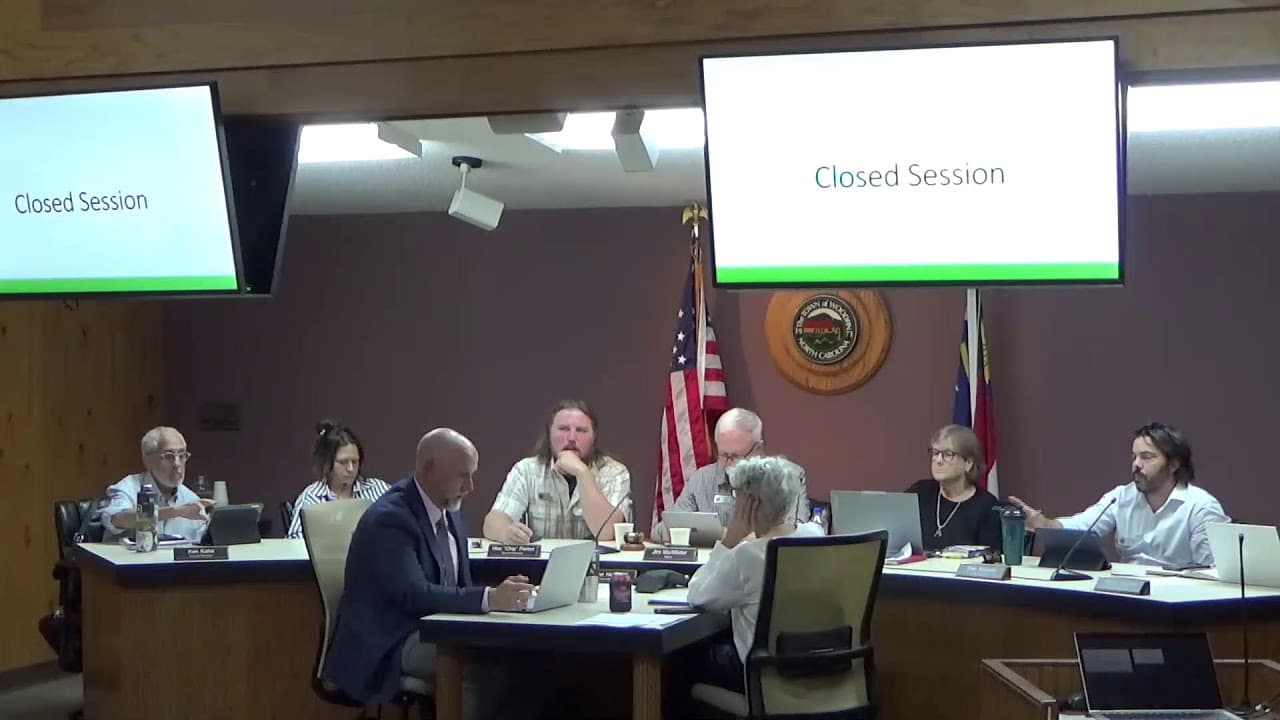
Woodfin's town manager walked the Town Council through the first major rewrite of the town's personnel policy since 2017 at its Oct. 20, 2026, meeting, and council pushed back on new at-will rules and benefit cuts for future hires. No vote was taken; the policy returns in November. Council also heard a regional greenway study that may route around the town's business corridor and delayed a contested Weaverville Road rezoning to Nov. 17.
- Personnel policy overhaul: New hires would be at-will and lose longevity pay and retiree health insurance. Action is expected in November.
- Greenway study favors I-26 route: The study ranked an I-26 side path highest. Council worried it bypasses Woodfin's business corridor.
- Rezoning delayed: Ordinance 2026-11 for 291 Weaverville Road was continued to Nov. 17 on a 6-0 vote.
- Crime rate halved: The police chief reported a 5.7 crime rate and previewed a license plate reader discussion.
- Stormwater enforcement tightens: In the town's first MS4 permit cycle, 9 property owners ignored inspection notices.
Personnel Rewrite Draws Council Scrutiny
Why it matters: The draft reshapes job security and benefits for future town employees. Council members warned it could leave staff exposed to turnover after political change.
The basics: The policy is modeled on Buncombe County's and was drafted with help from a grant-funded HR consultant. Of 14 material changes, four do not apply to current employees.
Where things stand: The draft makes new hires at-will. It extends probation to 12 months for three director positions. It caps unpaid leave at 90 days and removes employees on extended unpaid leave from the health plan. New hires would no longer receive longevity pay or retiree health insurance. In exchange, the draft adds comp time, a health reimbursement arrangement (HRA) and a floating holiday.
The manager framed the session as a preview. "I am not expecting council to adopt this tonight," said the town manager.
The other side: At-will status drew the sharpest concern. Council members asked what would protect staff from a wholesale "house-cleaning" after an election.
"There have been several instances throughout the state where towns have come in to change of guard, and then they wipe the entire departments out," said Councilmember Johanna Young.
Longevity pay and retiree health also drew debate. In response, the manager offered a softer landing. "I would be happy to return next month with some alternative structures for a step down," said the town manager.
Decisions and stakeholder impacts: No action was taken. Current employees are largely shielded from the biggest changes. Future hires would trade long-tail benefits, including longevity pay and retiree health coverage, for more immediate ones such as comp time and an HRA. Department directors face the longest probation. The trade-off is lower long-term liability for the town against a potentially weaker recruitment and retention pitch in a regional labor market where Buncombe County uses a similar framework.
What's next: The policy returns in November, with step-down options for longevity pay.
Greenway Study Favors I-26, Sidestepping Main Street
Why it matters: The route will determine whether a regional trail brings foot traffic to Woodfin's Weaverville Highway businesses or passes them by. Funding depends on state transportation timelines, and the trail is likely years away.
The basics: The French Broad River MPO (metropolitan planning organization) and consultant McAdams produced the roughly $120,000 feasibility study. The MPO covered 80% of the cost, and Woodfin and Weaverville split the remaining 20%.
Where things stand: The team screened 31 segments and evaluated three options: Alternative A along I-26, Alternative B along Weaverville Highway and Alternative C, a hybrid. Alternative A ranked highest on right-of-way, permitting and funding. Alternative B would eat into business parking.
Funding rules shape the ranking. "In the state of North Carolina, the state is prohibited from using their funds towards bicycle and pedestrian projects," said a presenter with the study team. The presenter was describing limits on NCDOT money for standalone trail projects.
The other side: Council members said the preferred route could cost Woodfin its share of the benefit. "This looks like it's at the expense of sidestepping Woodfin's business corridor," said a council member.
Mayor Jim McAllister described the trade-off bluntly: "The result of this will be to channel traffic to Weaverville Business Association."
Running a full greenway down Weaverville Highway carries its own costs. "It would be like stripping Haywood Road out of West Asheville for us," said Councilmember Maxwell "Chip" Parton III. Council also asked whether lighter options, such as sidewalks or bike lanes, could serve the corridor instead.
Decisions and stakeholder impacts: The study was received with no vote. Presenters stressed that the work is preliminary and all options remain on the table. Weaverville Highway business owners have the most at stake in the final alignment.
What's next: No date was set. Any route depends on NCDOT funding timelines.
Weaverville Road Rezoning Pushed to Nov. 17
Why it matters: The applicant now faces a firm deadline. If the site plan is not ready on Nov. 17, the item comes off the agenda and must restart at the planning board.
Where things stand: Staff requested the continuance. They said the applicant for Ordinance 2026-11, a conditional zoning request for 291 Weaverville Road, still needs to provide detail on driveway locations, house orientation and access from Silver Terrace.
The other side: Andrew Bela, a public commenter who lives on nearby Starling Pass, urged council to keep denying the request until the town identifies the minimum lot size that applies. He asked for a public, binding construction management and access plan for Baird Cove Road. He also said the hearing notice sign had been down and showed outdated dates.
Decisions and stakeholder impacts: Council voted to continue the ordinance and public hearing (For: 6, Against: 0). The delay gives neighbors more time to weigh in and puts the burden on the applicant to answer the access questions.
What's next: The hearing resumes Nov. 17, 2026.
Crime Rate Halves; License Plate Readers Next
Why it matters: The police chief signaled a coming debate over surveillance technology, and the numbers will frame it.
Where things stand: "Our crime rate is 5.7. That's half of what it was last year," said the police chief. The department logged 47 Part 1 crimes through September.
Average on-scene time for emergencies was 4:31, about 7 minutes from the initial call. Response across all calls averaged 27 minutes. Accreditation through the state and the League of Municipalities is 88% complete and grant-funded. The chief also noted that the year's only attempted murder case was domestic-related.
The chief credited a quick arrest to the Buncombe County Sheriff's Office's use of license plate readers. "It's important that we leverage technology to our benefit," the chief said. He added that guardrails for the technology will come before council in the coming months.
Decisions and stakeholder impacts: No vote was taken. Council members suggested a press release on the results and pointed to possible intern sources for the department.
What's next: The license plate reader discussion will come to council in the coming months.
Stormwater Program Grows Teeth in First Permit Cycle
Why it matters: Woodfin's federally required MS4 stormwater program had lapsed until the town received its first permit last year. The town has also taken over stormwater permitting from Buncombe County.
Where things stand: "We have 65 total stormwater permits," said a town stormwater staff member, who presented on his last day. The town sent 30 annual inspection notices. Of those, 18 properties passed, 3 failed and 9 did not respond. Staff also reported 18 notices of violation.
Other work included a $25,000 drop inlet cleaning, outfall mapping and a $55,000 sinkhole repair. A trash trap with Asheville Greenworks is planned.
Because of the non-responses, staff will "announce penalties for non-compliance in first letter that goes out."
Decisions and stakeholder impacts: Property owners with stormwater permits should expect stricter follow-through on inspections. "This is the most detailed presentation I've seen on stormwater in Woodfin," said a council member.
Minor Items
- Taylor's Wave complete: A freestyle kayaking event is likely in early November, with parts of Riverside Park cordoned off. The town is seeking grant reimbursements of about $1M per half.
- Helene recovery: All but one public assistance project has been reimbursed. The stormwater project's estimate rose from about $1.4M toward $2M, mostly due to the Sunny Ridge crossing. FEMA covers the cost.
- Consent agenda approved (For: 6, Against: 0): The agenda included a budget amendment for fill material for the Silver Line Park restrooms, which arrive Nov. 11.
- Proclamation: Young read a proclamation declaring October 2026 Domestic Violence Awareness Month.
- Retreat planning: Council chose an all-council work session over a subcommittee. "After all, it is council's retreat," said Mayor McAllister.
Looking Ahead
The Weaverville Road rezoning and the personnel policy both return in November, with the hearing set for Nov. 17, 2026. The manager will poll members on dates for a retreat work session before that meeting. Council ended the night in closed session to consult with the town attorney.