
MSD Lays Out $795M Overhaul, 7% Rate Hike for Woodfin Plant
Town Council • WoodfinSeptember 15, 2026
Locunity is an independent informational service and is not an official government page for this commission. All information is sourced from public footage and an analysis of official agendas with the aid of responsible, fact-checked AI. to report an error or omission.
The region's sewer utility is about to spend most of a decade rebuilding the treatment plant on Woodfin's riverfront. Metropolitan Sewerage District General Manager Tom Hardy told Town Council on Sept. 15, 2026, that the work will be financed by a new $120M bond and a 7% rate increase. Council also adopted a resolution defending federal forest protections, filled its planning board and pushed a contested Baird Cove Road rezoning to October.
$795M, 10-year MSD capital plan centers on $553M of plant and pump-station work
$120M bond sale set for Oct. 7 will more than double MSD's $80M debt, with rates rising 7%
MSD won't extend sewer to existing neighborhoods unless new development or a documented septic failure drives it
Dam-removal fight looms as MSD's own appraisal of its hydroelectric dam nears completion
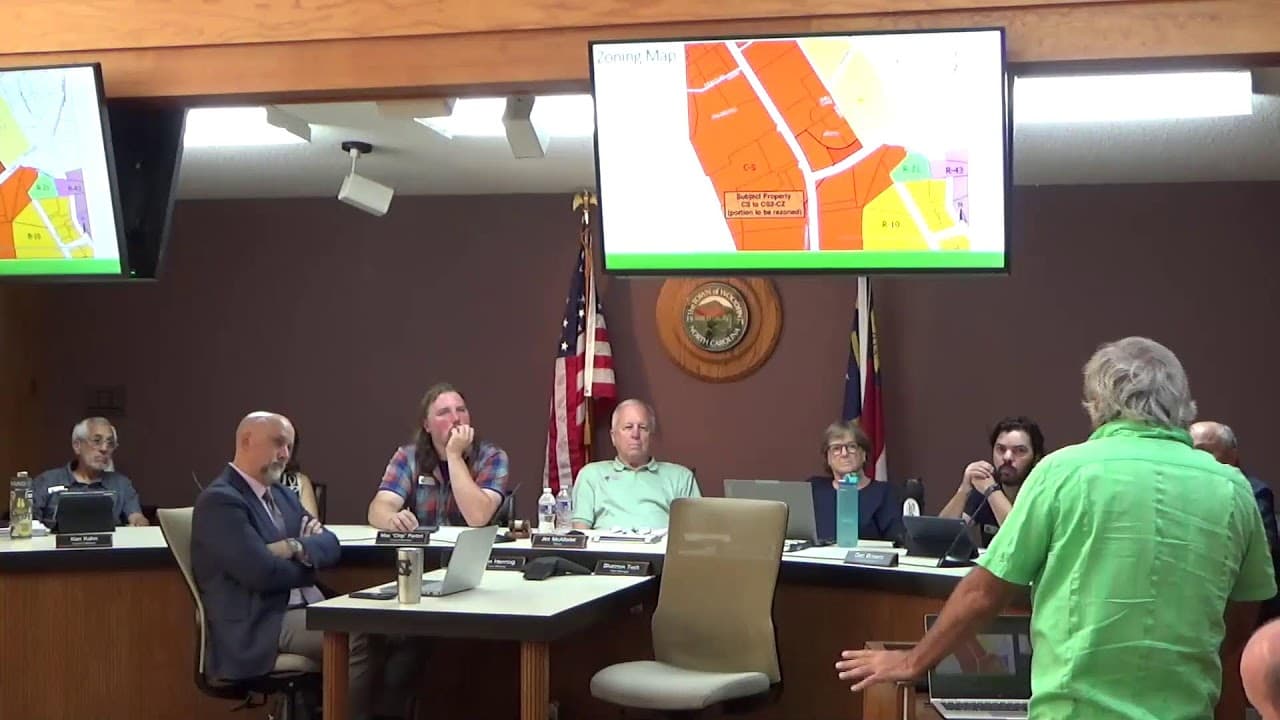
Baird Cove Road rezoning continued to October after the applicant went silent and a buffer gap surfaced
Council backs the federal Roadless Rule and appoints Melanie Petrolo to fill the planning board
1 Big Thing: MSD's Decade of "Open-Heart Surgery"
Why it matters: The regional plant serving 277,000 people sits in Woodfin. A decade of construction, a new sludge dryer and rising bills will shape the town's riverfront and household budgets.
The basics: The state created MSD in 1962 as a special district. It runs 1,200 miles of line, 35,000 manholes and 39 pump stations across 264 square miles with 153 employees.
Where things stand: The Woodfin plant is permitted for 40 million gallons a day (MGD) but averages about 19.5 MGD. Its 2,880-kilowatt hydroelectric facility avoids $300,000 to $600,000 a year in power costs. Metropolitan Sewerage District General Manager Tom Hardy said the plant ran on backup power throughout Hurricane Helene with no interceptor breaches. Sanitary sewer overflows have fallen from 263-288 a year around 2000 to 10.
"After Helene, it kept working when nothing else worked," said Mayor James McAllister.
The spending plan: The 10-year program includes $553M for the plant and pump stations, $65M for interceptors and $177M for smaller lines. The two largest projects at the plant are:
Sludge dryer ($171M): A thermal drying facility will replace the incinerator and produce Class A fertilizer.
Biological upgrade ($240M-$250M): New treatment will replace the 152 rotating biological contactors (RBCs) installed in 1987. The upgrade is driven by a nutrient and ammonia regulation that takes effect in 2037. Pilot testing is under way.
"It's going to be like open-heart surgery to replace all these things," said Hardy, describing the RBC replacement.
Councilmember Betsy Ervin asked whether the plant's footprint would grow. Hardy said only the dryer would move "up above." Everything else stays within the current site, which is squeezed between a rock cliff, the river and the railroad.
The money: MSD's budget is $117M, funded mainly by user fees. Construction and debt service account for almost 80% of spending. Capital work has been paid 68% in cash and 32% with bonds, a mix Hardy said will shift. The MSD board was set to approve a $120M bond resolution Sept. 16, with a sale Oct. 7. MSD currently carries $80M in debt and pays about $8M a year in debt service.
No borrowing cap: A council member asked about limits. Hardy said MSD has no cap and is instead governed by a 1.2 debt-coverage ratio.
State sign-off required: Hardy confirmed the Local Government Commission must approve the bonds.
Strong credit: Fitch and Moody's rate MSD AAA, and Hardy expects S&P to upgrade it from AA+.
"We're going to be increasing our rates. It's gonna be at 7%," said Hardy. He noted the industry average is about 5% but said MSD bills remain competitive with peers in EPA Region 4 and across North Carolina.
Woodfin lines: MSD has completed the $1.17M Elk Mountain Place project. Upcoming work includes Parkwood Avenue, Riverside at Woodfin, Elkwood/Norman Austin Drive, Middle Beaver Dam Creek ($1.5M), Elk Park Drive and Riverside Drive. The French Broad River pump station is being rebuilt to expand from 22 to 40 MGD. Its river crossings were finished in late June, and the full station is expected around 2028.
What's next: The bond sale is scheduled for Oct. 7. The presentation was informational, and council took no action.
Sewer Follows Development, Not Neighborhoods
Why it matters: Woodfin neighborhoods on septic that want public sewer will have to organize, grant easements or prove their systems are failing.
Where things stand: Ervin asked how an existing neighborhood could get service. Metropolitan Sewerage District General Manager Tom Hardy described MSD's private sewer rehab program, which requires a neighborhood leader and deeded easements. He called the easements "usually sort of the rub."
Under a separate septic-failure policy, triggered by health department findings, MSD pays the cost of larger line sizes plus roughly 10 years of future service fees. Hardy called it MSD's "most aggressive participation." Neighborhoods without documented failures don't qualify.
"So you really don't extend service areas to existing areas primarily," said Councilmember Betsy Ervin. Hardy agreed: expansion is "all development driven."
Developers pay for standard 8-inch extensions. For larger master-plan trunk lines (12 to 48 inches), MSD covers the cost difference, design and right-of-way. Hardy said MSD bases its master plan on town planning documents.
"We're not a land planning and zoning entity. That's your all's job," said Hardy.
The policy backstory: MSD lacks special assessment authority, the power to bill benefiting property owners for new lines. Hardy said MSD sought that power around 2000, but it was seen as government overreach tied to eminent domain. He said the New London, Connecticut, controversy made the legislature less likely to grant it.
The dam: A council member asked about the MSD board's move to value its hydroelectric dam. Hardy said MSD's appraisal is "nearly done." He said American Rivers, which has studied removing the dam, has hired a consultant but hasn't started in earnest, and its work "is really not gonna be a full appraisal." Hardy argued removal would endanger the plant's interceptor without new support construction.
"Otherwise you're gonna have 40 million gallons a day going into the river," said Hardy.
What's next: "That's a topic that'll come back and … will require a lot of time down the road," said Mayor James McAllister.
Baird Cove Rezoning Exposes a Buffer Gap
Why it matters: Woodfin's code requires no buffer between properties that are both zoned commercial, even when one of them holds homes. That leaves existing neighbors without protection as housing moves onto commercial corridors.
The basics: The request would move about a half-acre of a 1.67-acre Community Shopping (CS) parcel to CS-2, near the corner of Weaverville Road and Baird Cove Road. CS-2 allows single-family homes with a special use permit. The plan calls for four lots of about 5,000 square feet each. The roughly one-acre Weaverville Road frontage would stay CS.
"By making it CS-2 opposed to R-7 or some other modification, we don't need to change the FLUM," said Ricky Hurley, Planning Director, referring to the Future Land Use Map.
Because CS-2 has no minimum lot size, setbacks or frontage rules, staff is adding conditions, including a setback.
Where things stand:
Driveways: Staff first proposed barring driveways on Baird Cove Road to avoid turning conflicts.
Neighbor objections: Silver Terrace residents, who share a private easement drive, objected to construction and utility disruption.
The compromise: The plan shifted to two shared driveways between Baird Cove and Lower Barton.
Further options: Ervin asked about separating construction access from permanent driveways. The mayor asked whether the homes could be required to face Baird Cove Road. Hurley said that could become a condition only if the applicant agrees.
The other side: Councilmember Johanna Young pressed on protections for current residents.
"Commercial-wise, we require a buffer. Housing-wise, we would not," said Young.
"There is no buffering required against commercial-commercial regardless if it's single-family use and a Dollar General right here," said Hurley.
Hurley argued homes next to homes would give neighbors more protection than a late-night restaurant would. He suggested inviting neighbors to voluntarily rezone to R-7, which would trigger a buffer, though owner permission is required. Another council member said the application adds residential use that is "less incongruent" with its surroundings.
Public hearing: Jonathan Gilbert, a public commenter from Mostert Drive, said about 60 homes rely on Baird Cove Road, with roughly 40 more from Sunny Ridge, and the road has no other exit. He blamed worsening backups on the Weaverville Highway speed cut from 45 to 35 mph and on I-26 detours.
"Essentially putting 4 houses there is a little tight," said Gilbert. He urged rear access toward Fisher Lane and no parking on both sides of Baird Cove Road. He also asked council to require Weaverville Highway sidewalks as a condition of special approvals.
"I don't want to be the first person to die so we can get the—" said Gilbert.
Decisions and stakeholder impacts: The applicant did not attend and had stopped responding to staff. The mayor continued the open hearing and the item to the October meeting without a recorded vote, avoiding the need to re-advertise. Silver Terrace residents, Baird Cove commuters and the absent applicant all have leverage to reshape conditions before any vote.
What's next: The public hearing remains open until the October meeting.
Council Pushes Back on Roadless Rule Rollback
Why it matters: The U.S. Forest Service proposes rescinding the 2001 Roadless Area Conservation Rule. The resolution says rescission would put 144,000 acres of North Carolina roadless area at risk.
Where things stand: Mayor James McAllisterread Resolution 2026-09, which he co-proposed with the vice mayor. He cited the town's relationship with the Sierra Club and coordinated action by governments nationwide.
The resolution's findings include Forest Service data showing most wildfires start within 50 yards of a road. It also cites 25 endangered and threatened species around Craggy Mountain. Recreation brings in more than $2.5 billion, including $1.38 billion from trout fishing, and supports nearly 13,000 jobs.
"Sometimes it's the little things, and we can't not fight back," said McAllister.
Decisions and stakeholder impacts: Council adopted the resolution by voice vote with no opposition heard, and members signed it. Copies go to the Forest Service, the president, Congress, the Buncombe County Commission, the public and the press. The mayor said copies would also go to the vice president, U.S. senators and General Assembly members.
Planning Board Full Again With Petrolo
Melanie Petrolo, an environmental engineer with deep Buncombe County roots, was appointed to the Planning Board of Adjustment by voice vote. Staff said the appointment fills the board. Petrolo works for the U.S. Forest Service but said she was not appearing in that capacity.
Councilmember Dan Bowers asked how she would balance Woodfin's housing shortage with preserving natural areas. She endorsed infill development, green space and affordable housing.
Asked by Ervin which areas need the most careful planning, she pointed to Woodfin's geography: "I feel like Woodfin has pockets that are then divided," said Petrolo. She identified the prison relocation and the future of that land, along with I-26 expansion, as top challenges.
New patrol lieutenant: The police chief introduced Ryan Craig, a 15-year veteran of the Concord, Asheville and Waynesville departments.
Consent agenda: Approved by voice vote, including the release of some closed-session minutes.
Locked out: Staff said the front door auto-locked at 5 p.m., briefly keeping residents outside. The one late sign-up spoke at the rezoning hearing.
No closed session: Council held no executive session.
Looking ahead: MSD's $120M bond sale is set for Oct. 7. The Baird Cove Road hearing resumes at council's October meeting. The dam-removal question is expected to return to council later.