
Woodfin Trims River Study Grant to $15,000, Defers RiverLink Wave Deal
Town Council • WoodfinNovember 17, 2026
Locunity is an independent informational service and is not an official government page for this commission. All information is sourced from public footage and an analysis of official agendas with the aid of responsible, fact-checked AI. to report an error or omission.
Woodfin's Town Council spent its longest debate of the Nov. 17, 2026, meeting on whether a small town should help pay for a 146-mile study of who uses the French Broad River. The council cut the request from $20,000 to $15,000 and made it contingent on the project raising the rest of its money. In the same session, the council changed job terms for future town employees, rewrote a 1995 animal code and put off a decision on who will run Taylor's Wave.
- $15,000 river use study grant approved, down from $20,000 and contingent on full funding
- New hires move to at-will status and flat longevity pay starting Jan. 1, 2027
- RiverLink's $2,000-a-month fundraising offer deferred, leaving Wave management unresolved
- Animal ordinance unanimously replaced for the first time since 1995; livestock rules held back
River Study Wins Smaller Check, With Strings Attached
The basics: The French Broad River Partnership is leading a river use study that runs from Transylvania County to Cocke County, Tennessee. It will use 13 to 14 cameras, intercept surveys, Placer AI location data and IMPLAN economic modeling to measure who uses the river and what they spend.
Why it matters: Woodfin needs baseline visitor data for Tourism Development Authority (TDA) reporting and future grant applications. Taylor's Wave now draws visitors to the town, but Woodfin has no visitor counts of its own.
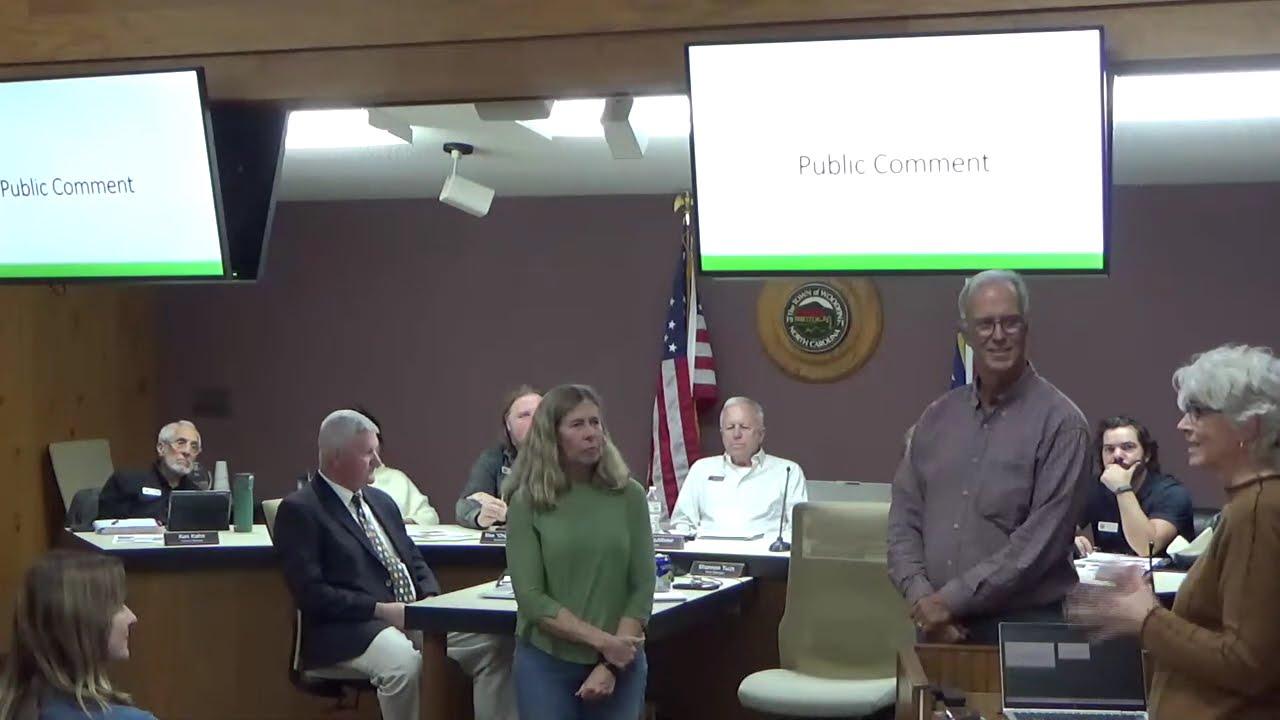
Where things stand: Jay Hawthorne of the French Broad River Partnership presented the study with Jack Anderson. They asked Woodfin for $20,000 toward a $37,250 funding gap.
"The total project's just under $90,000, and that covers everything," said Hawthorne.
Town Manager Shannon Tuck said the data would help with TDA reporting. She estimated that buying Placer AI data directly would cost the town "somewhere in the neighborhood of $40,000 to $60,000." Tuck recommended making any grant conditional on the project raising its full budget.
Mayor Jim McAllister asked the presenters to coordinate with the North Carolina Department of Transportation (NCDOT), which is running its own tourist survey. The presenters agreed.
The other side: Councilmember Johanna Young questioned the size of the request. She also asked whether the study fits the purpose of the town's community grants program.
"But for a town of our size, it gives me pause," said Young.
Councilmember Ken Kahn favored partnering. "I feel like we need to be a willing partner in this," said Kahn.
Decisions and stakeholder impacts: Councilmember Betsy Ervin moved Budget Amendment 2026-15. It approves a $15,000 community partner grant to the Land of Sky Regional Council to complete the study, contingent on raising all funds, and authorizes the town manager to sign an agreement. Vote: passed by voice vote; tally not recorded.
The town gets data at a fraction of the direct cost. Regional partners still need to close the remaining gap.
What's next: The grant takes effect only if the project secures its full funding.
New Hires Lose Covered Status, Percentage Longevity Pay
Why it matters: Resolution 2026-11 changes the employment deal for anyone Woodfin hires from now on. Current employees are not affected. Staff said the goal is to match peer towns and limit liability.
Where things stand: The personnel policy was carried over from October. Staff presented 14 material changes. Two drew the debate:
- New hires move from "covered" status to at-will employment, under which either side can generally end the job without cause.
- Percentage-based longevity pay is replaced. Staff recommended Option B, a step-down to flat payments.
Staff also recommended an effective date of Jan. 1, 2027. A third change adds four weeks of town-paid health insurance after work-related injuries.
Councilmember Johanna Young asked how the changes interact with the Family and Medical Leave Act (FMLA) and health insurance. Councilmember Ken Kahn backed the flat approach as a predictable way to reward loyalty. "I'd be okay personally with Option B," said Kahn.
The other side: Councilmember Betsy Ervin argued that removing longevity pay takes away a retention tool.
"When you replace longevity with merit-based pay, that takes it pretty much from being objective to subjective," said Ervin.
Decisions and stakeholder impacts: Kahn moved to adopt the resolution with Option B. Vote: passed by voice vote; tally not recorded.
Future employees get fewer job protections and smaller, flat longevity payments. They also gain extra health coverage if injured on the job. Town management gains flexibility in hiring and pay.
What's next: The changes take effect Jan. 1, 2027.
Wave Activation Plan Stalls as RiverLink Offer Waits
Why it matters: Taylor's Wave opened Oct. 23. The town still has no parks director or consultant to manage events, parking and programming there.
Where things stand: Councilmember Ken Kahn, the council's Wave liaison, pushed for intentional activation of the Wave and the parks. He proposed an expanded working group and an outside consultant.
Under Budget Amendment Ordinance 2026-14, RiverLink offered to seek grant funds for a consultant at $2,000 a month. Kahn said a full-time parks director would cost $100,000 to $145,000. He called a $50,000 consultant figure made-up. He also urged caution with public money: "I'm not sure the government's job is to speculate with the town's money," said Kahn.
The other side: Other members questioned the timing and how residents would benefit. They also asked why PACE could not take on the work.
"So my concern is the park is not even going to be open, open until spring at the earliest," said Councilmember Johanna Young.
Decisions and stakeholder impacts: Kahn moved to not accept the RiverLink proposal for now and to continue the discussion in December, January or at the council retreat. Vote: carried by voice vote; tally not recorded.
RiverLink's fundraising window may close while the council waits. Neighbors near the Wave still have no plan for parking and event management.
What's next: Wave activation returns in December, January or at the retreat.
Animal Code Gets First Overhaul Since 1995
Why it matters: Ordinance 2026-13 replaces Chapter 6, Animals. It is the first major update since 1995 and brings town rules in line with state law.
Where things stand: Town Manager Shannon Tuck said the rewrite:
- Fixes deficiencies in the old code
- Adds cats and ferrets
- Expands care standards
- Eliminates most permits
- Clarifies enforcement
Enforcement is shared among Buncombe County Animal Control, Woodfin police and code enforcement. Fines are not a source of town revenue. "Any penalties that are collected are turned over to the county school board," said Tuck.
Members asked about bears, deer, bees, poultry, records and appeals.
Decisions and stakeholder impacts: Councilmember Betsy Ervin moved approval, excluding the livestock and fowl sections (6.3.5 and 6.3.6) and repealing inconsistent provisions. Councilmember Johanna Young seconded. Mayor Jim McAllister declared the vote unanimous; no numeric tally was stated.
Pet owners now face updated rules with fewer permits. Residents with backyard livestock or poultry remain under the existing rules for now.
What's next: The livestock and fowl sections return in December or later, after staff reviews a 2015 state law.
Minor Items
- Town Manager's report: Woodfin received $1.3M, the first of two TDA disbursements for Taylor's Wave. FEMA approved one Hurricane Helene demolition in a three-county area. The 2026 strategic plan review covered six goals, 21 objectives and 57 action steps. Still open are the land development ordinance, housing, town hall and community center options, and carbon reduction.
- Community Garden: Leaders at Geneva Mannie Park reported 33 workdays, 78% resident volunteers and a waitlist for rental beds ($20 to $100 sliding scale). They plan a farm stand and donation growing in 2027. A possible second garden site is with town attorneys.
- NDA policy: Resident Walt Brewer asked whether Woodfin has a nondisclosure agreement policy, citing data-center deals elsewhere. The mayor said none exists. Tuck said the town "would be reluctant to enter into an NDA unless under some extraordinary circumstances."
- Wave champion honored: Mark Hunt was thanked for a decade of work on Taylor's Wave. He credited residents' 2016 vote on a $4.5M bond referendum as the seed of what is now a $36M project.
- Consent agenda: Approved by voice vote, including disposal of four surplus Woodfin Police Department vehicles.
Looking ahead: Several items return soon. Wave activation comes back in December, January or at the retreat. Livestock and fowl rules come back in December or later. The river study's $15,000 depends on regional partners closing the funding gap.