
Windsor Adopts Water Plans Warning of Airport-Area Shortfall by 2035
Town Council • WindsorSeptember 16, 2026
Locunity is an independent informational service and is not an official government page for this commission. All information is sourced from public footage and an analysis of official agendas with the aid of responsible, fact-checked AI. to report an error or omission.
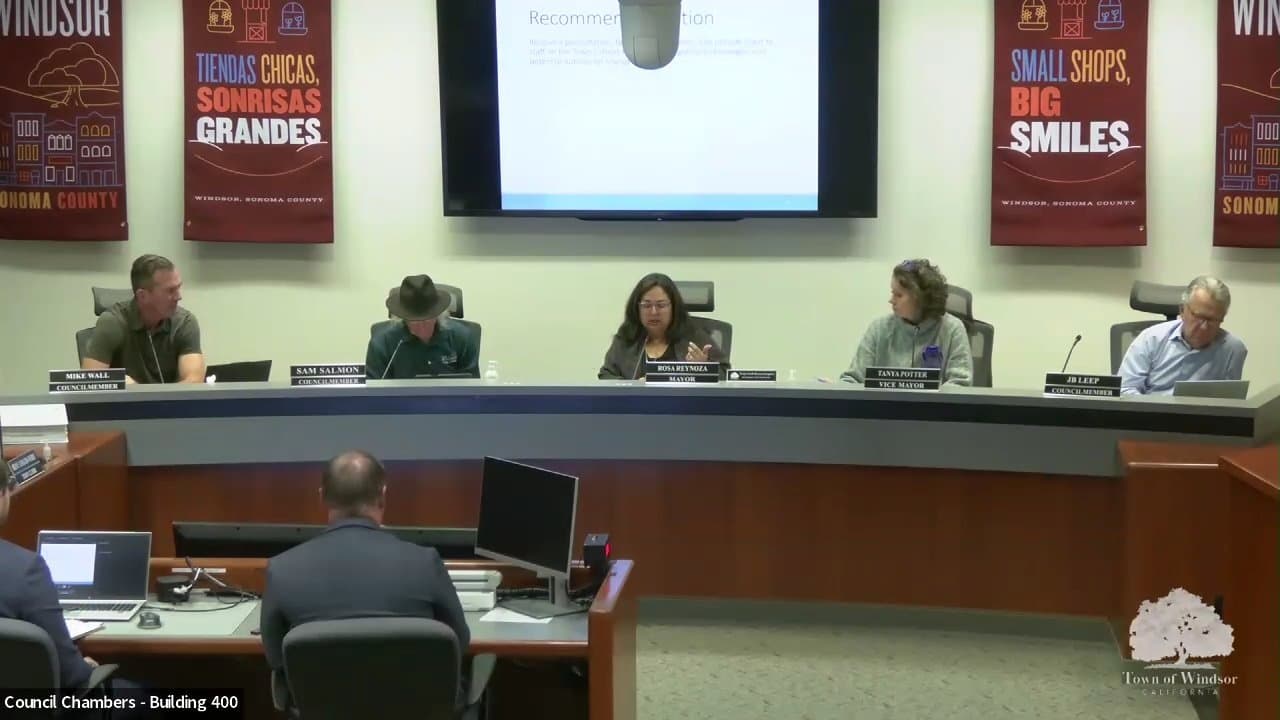
Windsor has enough water for itself through 2050. The Sonoma County airport area it also serves does not. On Sept. 16, 2026, the Town Council, sitting as the Windsor Water District board, adopted state-required water plans that project an airport-area shortfall by 2035 if county-approved growth proceeds. The meeting also renewed the town's hazard plan, exposed a 109-acre loss in tree canopy and gave Windsor's delegates a clear instruction on local control.
- Water plans adopted with four recorded yes votes, flagging an airport-area shortfall by 2035
- Hazard mitigation plan passes 5-0, adding extreme heat, cold and wind to Windsor's risk list
- Windsor lost about 109 acres of canopy from 2018 to 2022, prompting staff direction on street trees
- Measure I sales tax draws organized backers and critics ahead of a Sept. 30 town hall
- Delegates told to vote yes on Cal Cities resolution to restore local housing authority
Water for Growth Windsor Doesn't Control
The basics: State law requires the Urban Water Management Plan and the Water Shortage Contingency Plan to be updated every five years. The first forecasts long-term supply and demand. The second sets the rules that apply during shortages.
Why it matters: The Windsor Water District may have to find new water for development in the airport area. The county approves that growth, not Windsor.
Where things stand: For the first time, staff split the district's two supplies:
- In-town: 4,725 acre-feet a year from the Russian River well field. Windsor used 2,566 acre-feet in 2025.
- Airport area: 900 acre-feet a year, delivered by aqueduct under a Sonoma Water contract. That area used 421 acre-feet in 2025.
The in-town outlook improved from five years ago for three reasons: a pandemic-era population dip, lasting efficiency gains after the state's 20% mandatory cuts (Windsor achieved 21%) and better reservoir management by the Sonoma County Water Agency.
The airport area is a different story. If the county's 2019 preferred plan is built out, "there would be shortfalls in water supply by 2035," said Christina Goulart, Environmental Program Manager for Water Conservation and Water Supply Planning. She said that even with an in-town surplus, "we still do need to go ahead and develop our off-river well supplies for resilience."
Shortage rules get friendlier: The updated contingency plan makes four changes:
- Drops the requirement that power washers recycle water.
- Replaces the pool-filling ban with a pause on pool permits at Level 3.
- Allows bubblers and small fountains for pollinators.
- Exempts irrigation of food gardens, which Goulart called "a food security issue."
The other side: Mayor Rosa Reynoza pressed staff on who carries the load for growth Windsor doesn't approve. "Is that going to put a burden on our staff to find them water?" she asked.
Shannon Katula, Public Works Director and Town Engineer, answered: "It will be the Windsor Water District that needs to develop that water supply." He said the district would have to do that work with the county and developers. He also warned that requests for new demand far outpace what past zoning anticipated. "It makes me nervous, and that makes me cautious," he said.
Another councilmember asked about termination clauses in the aqueduct contract and about rate differences between the two service areas. During public comment, resident Betsy Malice asked whether the town would be liable for supply if the county approves airport-area growth. She cited a 1,000-home proposal and a possible data center.
Decisions and stakeholder impacts: The resolutions passed. For: 4 (Councilmember Sam Salmon, Vice Mayor Tanya Potter, Councilmember Mike Wall, Mayor Reynoza). Against: 0. Councilmember JB Leep's response was not recorded in the roll call, and the official minutes should confirm the final tally.
- In-town residents keep a cushion through 2050 and get looser shortage rules for gardens and pools.
- Airport-area developers and the county face a supply ceiling.
- District ratepayers could be exposed to the cost of new supply, a question raised but not resolved.
What's next: Staff will continue developing off-river wells. Who pays for airport-area supply remains open.
Hazard Plan Adds Heat, Cold and Wind
Why it matters: Adoption keeps Windsor eligible for state disaster mitigation funding. It also positions the town for a 2028 requirement to fold these hazards into the general plan's public health and safety element.
Where things stand: The council adopted Volume 1 of the countywide 2026 Multi-Jurisdictional Hazard Mitigation Plan and Windsor's annex in Volume 2. The annex replaces the 2021 plan, which covered seven hazards and listed 56 mitigation actions.
What changed:
- More hazards: "Extreme weather" became extreme wind, and extreme heat and extreme cold were added, for a total of nine.
- Bigger partnership: Participating jurisdictions grew from 14 to 22.
- Shifted risk rankings: Dam failure dropped from high to low after the Army Corps remapped it. Earthquake ranks high for Windsor.
- Fewer, targeted actions: The annex lists 22 mitigation actions. Top priorities are dam-failure outreach through Windsor Ready, warming and cooling centers, and education on hardening buildings against wildfire.
"The plan provides a roadmap to reduce the impacts of the hazards that are identified, and it makes the town eligible for grant funding," said Kim Jordan, Planner. She added that "the town is not required to implement them in the order of priority."
Cal OES and FEMA reviewed the plan before the council acted. It is exempt from CEQA, and the general plan incorporates it by reference.
Decisions and stakeholder impacts: The plan passed with no public comment and no council questions. For: 5 (Vice Mayor Potter, Councilmember Leep, Councilmember Salmon, Councilmember Wall, Mayor Reynoza). Against: 0. Absent: 0.
- Residents vulnerable to heat and cold gain a formal claim on warming and cooling centers.
- Homeowners in wildfire areas are the target audience for hardening education.
A Shrinking Canopy and a Sidewalk Problem
Why it matters: "The town lost around 109 acres of urban canopy between 2018 and 2022," said Kevin Locke, Planner. That loss runs against the town's no-net-loss goal.
Where things stand: The tree preservation ordinance (zoning code 17.22.030) protects street trees. But adjacent homeowners are responsible for sidewalk maintenance, and "the town's code enforcement is complaint-based," Locke said. Deferred maintenance often ends with a tree being removed.
Staff cited four drivers of canopy loss: removals by property owners, the Mediterranean oak borer, PG&E line work and aging subdivisions. Patrick Streeter, Community Development Director, put it this way: "Right now we're at a deficit, it seems."
Staff outlined three paths:
- An urban forestry management plan under general plan policy ER-16, likely paired with zoning text amendments
- Zoning text amendments alone
- An internal staff policy
The other side: Councilmember Leep pushed for tree replacement and community giveaway events. He warned that a plan could become a "booklet" without follow-through, saying "we don't have the ability to do the enforcement or do the implementation and getting the trees planted."
Vice Mayor Potter favored starting with an internal policy and partnerships with nonprofits.
Decisions and stakeholder impacts: The council took no vote. Members gave informal direction to explore an internal policy, outreach and replacement ideas. Staff noted that an earlier outreach and homeowner-assistance program was shelved for budget reasons. Homeowners bearing sidewalk costs and neighborhoods with aging trees have the most at stake.
What's next: Staff said options with cost estimates would likely return during the budget process.
Measure I Splits Public Comment
Why it matters: Measure I is a sales tax that would stay in effect until voters end it. It goes before voters in November, and both organized camps showed up.
Where things stand:
- Supporters: Teresa Hendricks of the Citizens Committee for Yes on Measure I invited residents to march with the campaign in the Windsor Day Parade. Deborah Doyle of the Yes on Measure I campaign argued that federal and state dollars will be scarce and future storms will be costly.
- Opponents: Marianne Bainbridge Krause of Windsor Concerned Citizens opposed the measure as written because it has no sunset date. She argued it could ease pressure to fix the town's structural deficit. Public commenter Betsy Malice called it a regressive tax that puts the burden on voters to end it.
What's next: The town will host "Understanding Measure I" on Sept. 30 at 6 p.m. at Huerta Gym.
Delegates Told to Back Local Control
Where things stand: Irene Camacho Werbe, Town Clerk, explained that the Cal Cities resolution "was introduced by the City of Murrieta with concurrence from 6 other cities, along with 2 mayoral endorsements." If adopted, Cal Cities would convene a group to study state constitutional amendments and ballot strategies for restoring local authority over housing and land use.
Public commenter Betsy Malice urged the council to back the resolution rather than leave the decision to its delegates.
Decisions and stakeholder impacts: Vice Mayor Potter supported the resolution, citing the loss of local control. "I read all of this, and like Betsy, I feel the same way she does," said Councilmember Leep. Another councilmember said the effort may produce "a carrot instead of a stick."
"Yes, you have direction," Mayor Reynoza confirmed. The council reached consensus without a formal vote.
What's next: Councilmember Salmon will vote yes as the primary delegate at the Cal Cities General Assembly. Councilmember Leep and Vice Mayor Potter are alternates.
Minor Items
- Consent calendar passed 5-0. It included an $82,500 Office of Traffic Safety grant and a Cunningham House agreement increase fully funded by the Windsor Historical Society. Annie Lovie of Windsor Mobile Country Club asked that the grant pay for radar signs and noise reduction on Condie Lane.
- Town Manager Jon Davis reported that SCTA approved "the $5 million that we were up for in this cycle for the underpass and streets projects." He also said a new code enforcement contractor has started work.
- Gallagher Community Housing presented a Windsor Creek redesign with fewer units and lower buildings to about 70 neighbors.
- Public commenter Emil Iman urged the council to drop the Flock AI cameras and limit assistance to ICE. Mayor Reynoza later said she wants more transparency on the issue.
- Proclamations: The council proclaimed Creek Week (Sept. 19–27) and Hispanic Heritage Month (Sept. 15–Oct. 15). Kiwanis named Larry and Monica McCabe as Duke and Duchess of the Sept. 26 Windsor Day Parade.
Looking Ahead
Councilmember Salmon requested a future agenda item. "I am really interested in studying the coordination of the mill, the new mill project, the Windsor Creek School site, and the Core Creek," he said. He wants the Planning Commission involved.
A councilmember also reported that "the County of Sonoma has put forth either $1 million or $2 million to do a study" of a joint Russian River watershed authority.