
Council Votes 5-0 to Shift More School Officer Costs to District
Town Council • WindsorNovember 4, 2026
Locunity is an independent informational service and is not an official government page for this commission. All information is sourced from public footage and an analysis of official agendas with the aid of responsible, fact-checked AI. to report an error or omission.
Windsor will keep its police officer on school campuses, but Windsor Unified School District will pay a much bigger share of the cost. The Town Council voted 5-0 on Nov. 4, 2026, to approve a two-year cost-sharing agreement, then heard that a housing fee discount is helping get 211 units built while bringing in less money for infrastructure.
- School resource officer deal approved 5-0; district share rises from 15% to 40%, then 50%
- Impact fee pilot linked to 211 units under construction, but the town has collected zero fees so far
- Residents push for dog park safety fixes now, rather than waiting for the 2028 budget
- Oak borer has killed about 17 town trees, and staff are unsure their treatments are working
School Officer Stays, District Pays More
Why it matters: The new split is estimated to save the town's general fund about $175,000, according to one councilmember's estimate. It also keeps a campus officer that officials called vital to student safety.
Where things stand: The town has carried most of the cost of the school resource officer (SRO) position, with the district paying 15%. Under the new agreement, that share climbs sharply.
"The district would contribute 40% in the first year and 50% in the second year," said Greg Piccini, Chief of Police.
The agreement also shortens the term from five years to two. A new pay code lets the town bill the district for actual costs. The deal covers the current school year.
Piccini argued that cutting the position would not make the workload go away. In 57 school days, the officer took 23 reports and handled far more calls. "Those 243 calls would fall back on the two day-shift officers if we cut this position," he said.
The other side: No one asked the council to end the program. The debate was over who should pay. Councilmembers and public commenters argued the district should cover more.
- Kevin Scanlon, a public commenter, backed the agreement. He said the district has the money to pay more and criticized its claims of financial need.
- Marianne Bainbridge Krause, a public commenter, said the district should pay at least 50% in year one and 75% to 85% in year two. She noted the officer serves campuses for 22 of 26 pay periods.
- Betsy Malice, a public commenter, asked when the deal starts and whether the district had agreed. She called the town's past share inequitable and said the phase-in seems fair.
- Casey Miles, a former Windsor Unified student, said an SRO helped him and urged the council to keep the position.
Decisions and stakeholder impacts: The council authorized the town manager to sign the agreement. Vote: For: 5 (Mayor Rosa Reynoza, Vice Mayor Tanya Potter, Councilmembers JB Leep, Sam Salmon and Mike Wall), Against: 0, Absent: 0.
- Town taxpayers get general fund relief.
- The district absorbs a larger, actual-cost bill.
- Patrol officers avoid taking on school calls.
What's next: Because the term is now two years, the cost split will come back for negotiation much sooner than under the old five-year deal.
Impact Fee Pilot: 211 Units, Zero Fees Collected
The basics: Impact fees are one-time charges on new development. They pay for the roads, parks and other infrastructure that new residents use. In October 2025, Windsor adopted a pilot for attached multifamily housing. It scales fees to unit size, measured against a 1,200-square-foot average, so smaller units pay less. The pilot sunsets Oct. 1, 2027.
Why it matters: The pilot trades fee revenue for faster housing starts. The council will soon have to decide whether that trade is worth continuing.
Where things stand: Three projects with 211 units total are under construction using the discount:
- Cora Creek: 106 units under 600 square feet, with fees cut by more than 50%.
- Redwood Glen: 43 units, saving about $300,000.
- Elowyn Oak: eight eligible units, saving about 3.6%.
"So far we've collected zero impact fees under this program," said Patrick Streeter, Community Development Director. He added that "the developers for all 3 of these projects noted that the pilot program was influential in actually getting them to begin construction."
State law is moving in the same direction. AB 602 will require impact fee studies based on square footage.
The other side: Public commenter Betsy Malice said Gallagher's Cora Creek project received about $2 million in discounts. She asked where the roughly $2.4 million needed to cover the projects' impacts would come from. Councilmembers raised similar questions about how the town will offset impacts with less fee revenue.
Streeter rejected the idea that the pilot is a giveaway, saying "it's right-sizing the fee." Staff said fee revenue goes into a dedicated development impact fee fund.
Decisions and stakeholder impacts: The report was informational, and the council took no action.
- Developers of small-unit projects benefit most.
- The infrastructure fund receives less money per project.
What's next: Staff will return before the Oct. 1, 2027, sunset. At that point, the council will decide whether to extend, change or end the pilot.
Dog Park Users Want Fixes Before 2028
Why it matters: Residents described repeated falls at the dog park and warned the town could face lawsuits. They want repairs done before the rainy season, not years from now.
Where things stand: Marianne Bainbridge Krause serves on the Senior Advisory Commission but spoke as an individual. She said residents sent a nine-item letter about the dog park and David Smith Park. Parks and Recreation responded with a 2028 timeline. She urged the council to pay for the fixes from general fund reserves instead.
Other residents described the conditions:
- Catherine Marquez, a resident since 2002, said the fixes are modest: dirt, bark and drainage.
- Betsy Malice, who uses the park daily, said falls happen weekly and go unreported. She said tree-trimming debris sat for more than a month and that residents want a safe park, not lawsuits.
Decisions and stakeholder impacts: The council could not act because the issue was not on the agenda. Later in the meeting, a councilmember said the dog park issue should come back to the council.
Another speaker congratulated the election winners and praised the Old Redwood Highway paving. The speaker also called for accountability on Measure I revenue, oversight of flock cameras, attention to the Gallagher Windsor Creek development and mobile home rent protections.
Oak Borer Keeps Spreading as Heritage Oak Fades
Where things stand: The Mediterranean oak borer, a beetle that attacks oak trees, was found in Windsor in July 2023. In 2024, the town injected 545 trees and bark-sprayed 200 more. About 17 trees have still been removed, and there is no known remedy.
"I'm still 50/50 if it's working," said Charlie Johnson, Parks and Facilities Maintenance Superintendent.
Rainbow EcoScience ran a treatment trial at Michael Hall Park. "This complete trial was at no cost to the town," Johnson said.
The coast live oak at Esposito Park is estimated to be 350 to 400 years old and is in natural decline. The town's arborist suggested adding signs to make it a learning opportunity. Staff also reported fire blight, a bacterial disease, in ornamental pear trees.
What's next: One councilmember asked for trial results. Vice Mayor Tanya Potter asked staff to publicize the issue on the town website, on social media and with QR codes.
Minor Items
- Housing and recycling programs: Town Manager Jon Davis announced several new programs:
- A $250,000 home accessibility program, run by Rebuilding Together Petaluma, has received three applications so far.
- ADU rebates of up to $40,000 are available first-come, first-served. Both programs are funded by state money tied to Windsor's pro-housing designation.
- Free recycling can swaps are underway and expected to be done by Nov. 20. "The rates will actually go down when we start the new contract," Davis said.
- Volunteer program: Staff outlined about nine Saturday park stewardship days per year. Volunteers help with work along Windsor Creek that a FEMA fire-fuel grant did not cover, and all opportunities are now listed on one "Volunteer With Us" web page.
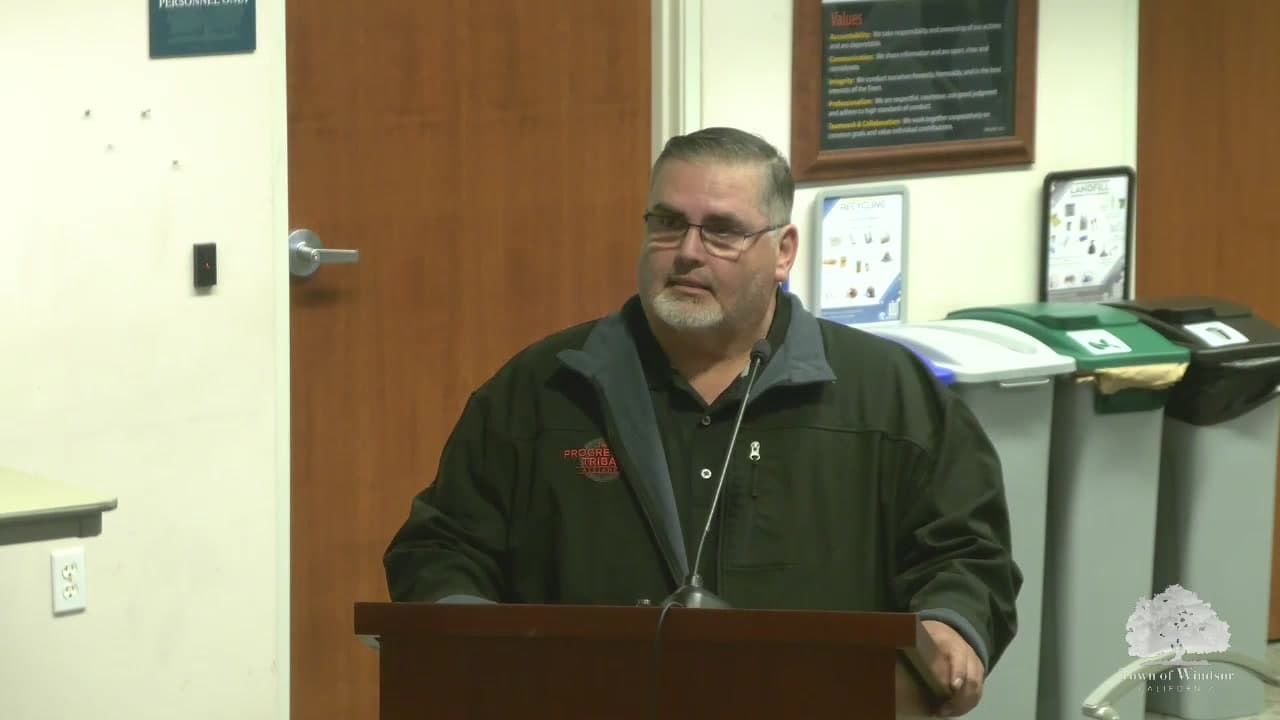
- Native American Heritage Month: The council proclaimed November Native American Heritage Month. A Progressive Tribal Alliance representative thanked the town for partnering "to host the largest Native Arts Festival in the county."
- Kiwanis honored: The Windsor Kiwanis Club received a certificate of appreciation for running the Windsor Day Parade, which it has organized since 1990.
- Minutes approved: The Oct. 21 minutes passed. Vote: For: 5, Against: 0, Absent: 0.
Looking Ahead
Councilmembers floated several possible future agenda items, with mixed support:
- The dog park
- Revisiting flock cameras (an earlier request lacked a second)
- Safe routes to school
- Local control over state housing mandates
- E-bike policy
- Last-mile bus service for SMART trains
An item needs a second to reach the agenda, and none was confirmed. The council then went into closed session on anticipated litigation, the town manager's evaluation and labor negotiations. No outcome was reported.