
**West County Leaders Press for Control as Measure J Renewal Talks Begin**
Board of Directors • West Contra Costa Transportation CommissionAugust 20, 2026
Locunity is an independent informational service and is not an official government page for this commission. All information is sourced from public footage and an analysis of official agendas with the aid of responsible, fact-checked AI. to report an error or omission.
West County Leaders Press for Control as Measure J Renewal Talks Begin
The countywide half-cent sales tax that funds West Contra Costa's buses, BART access and road work expires in 2034, and planning for its successor is underway. At an Aug. 20, 2026, special meeting, the West Contra Costa Transportation Commission (WCCTC) heard the Contra Costa Transportation Authority's (CCTA) opening pitch for a 2028 renewal. Commissioners made clear they want West County, not the countywide board, deciding how its share is spent.
- CCTA targets the 2028 ballot for a straight Measure J extension, with a draft plan due in January or February
- Only $6M of West County's $452M Measure J share is flexible, CCTA's director says
- Commissioner John Gioia urges sub-regional control over program dollars, and CCTA says that process will continue
- SB 63 looms: Commissioners ask how CCTA will work with BART and AC Transit, and what happens if the November regional measure fails
- Roads vs. buses: Commissioners weigh capital repairs against transit programs in the next plan
CCTA Lays Out Its Path to a 2028 Renewal
The basics: Measure C created CCTA's sub-regional structure in 1988. Measure J, passed in 2004, extended the half-cent sales tax from 2008 to 2034. The Transportation Expenditure Plan (TEP) is the voter-approved spending blueprint attached to the tax.
Where things stand: "We're planning on placing a renewal of Measure J on the 2028 ballot," said Tim Haile, Executive Director, CCTA. A "listening phase" runs through about the end of the year. A draft plan follows in January or February, priorities are confirmed in summer, the plan is finalized by the end of 2027, and adoption comes in early 2028.
Adoption requires resolutions of support from cities representing a majority of the county's population, followed by a CCTA ordinance and placement by the Board of Supervisors. Haile said the statutory deadline falls in spring 2028. Separately, legislation on the Assembly floor would move the half-cent outside the state's 2% sales tax cap and set a 2042 sunset.
CCTA measures failed in 2016 and 2020. Haile noted those were additional half-cent taxes, while this would be an extension.
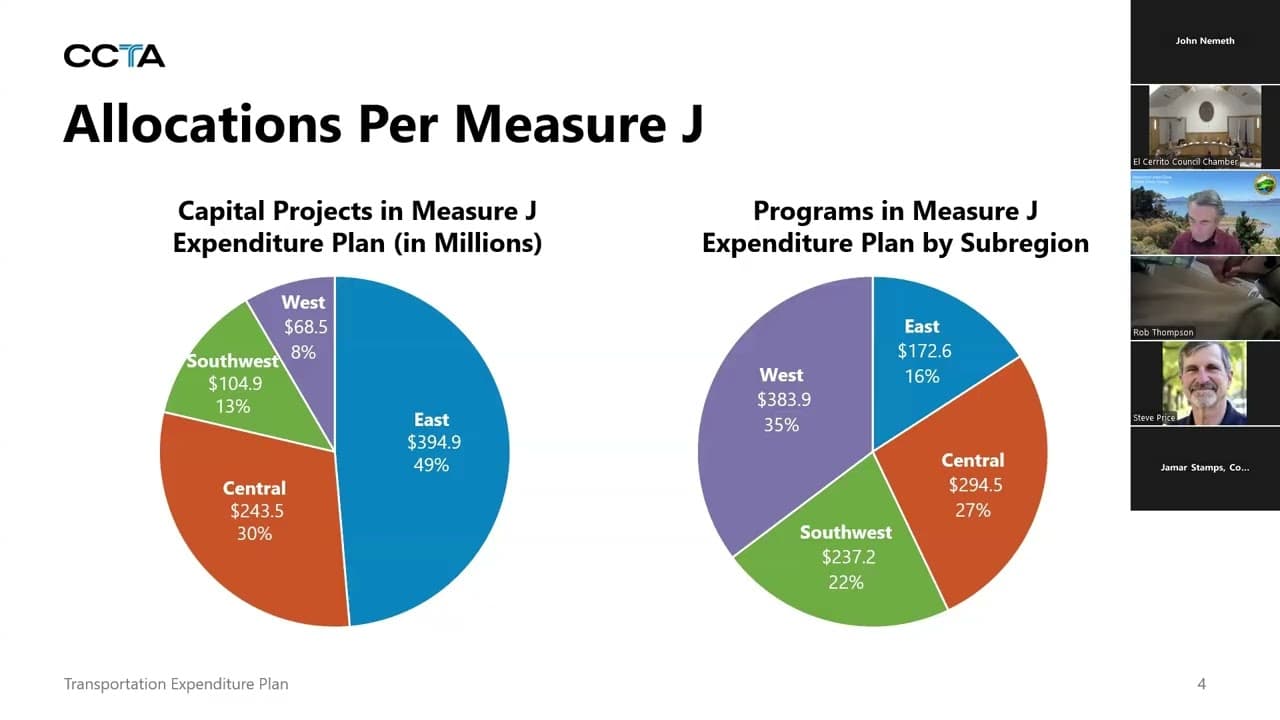
The money behind the plan: Measure J was projected at $2B in 2004 dollars and is now projected at about $2.6B over its life. Because of economic downturns, only about $1.4B of the original-dollar projection will be realized. West County received $452M, allocated by population and lane miles. About 42% went to projects, including the Hercules Hub and the I-80 interchanges at San Pablo Dam Road and Central Avenue. The other 58% went to programs such as BART, local streets, bus service, paratransit, student passes and ferries.
"The only flexible dollars we have in the entire expenditure plan is the six million in the West County," Haile said.
CCTA has funded 97% of the plan's capital projects, he said, and stretches sales tax revenue roughly 4 to 1 through bonding. That leverage has a cost: about $42M of the roughly $120M collected each year goes to debt service. Making the case for the tax, Haile said "everyone's commutes would be at least on average anywhere from 20 to 30 minutes longer in Contra Costa County."
Why it matters: The 2004 plan locked in spending for three decades. How much flexibility the next plan builds in will decide whether West County can respond to needs that emerge after 2028.
What commissioners want: In a live poll with about 8 to 9 respondents, bicycle and pedestrian safety ranked as the top challenge. Senior and accessible transportation tied with public transit for second, and school student transportation received no votes. Open-ended answers stressed bus frequency, road maintenance, BART reliability, transit priority on I-80 and a greater share of funding for AC Transit. For travel outside West County, limited transit routes and schedules were the top barrier. Haile said the results mirror what CCTA has heard from other sub-regions.
What's next: A TEP evaluation framework goes to technical advisory committees in September and to WCCTC in October. Investment categories and the plan's structure will also come up in October.
Who Decides West County's Dollars
Where things stand: After Commissioner Harpreet Sandhu asked why spending categories differ by region, Commissioner John Gioia, who said he was involved in 2004, explained the history. Only the regional totals tracked population. Each sub-region then chose how to spend its own program dollars.
"I strongly, strongly urge that that be the process again, that it's not the CCTA Board that's making those judgments, but it's each sub-regional body that makes recommendations to CCTA," Gioia said.
He noted that Measure J drew its strongest support in West County. "We don't want CCTA members from other parts of the county telling us how to spend our program dollars," Gioia said. Haile confirmed that the regional transportation planning committees will have a key role and a chance to weigh in on investment categories.
The other side: Local control does not settle what to fund. "West County has the smallest percentage in capital projects, but we have the largest percentage in programs," said Commissioner Toms, an alternate. She said residents in her city are loudly frustrated with infrastructure conditions and may favor capital projects. Haile said West County's sub-regional project total is $53.5M in 2004 dollars, or about $68.5M in current projections. Any shift toward projects, he said, would be a group decision that he and the WCCTC chair would help facilitate.
Commissioner Sandhu backed local control of sub-allocations and made the equity case for transit: "3/4 of people that ride buses are people of color, and 2/3 are low income."
Decisions and stakeholder impacts: No vote was taken. Keeping control at the sub-regional level gives West County cities leverage over priorities such as bus service and ferries. Bus riders, who are disproportionately low-income, have the most at stake if program money shifts toward road and capital work. Residents frustrated by deteriorating streets could benefit from that shift. AC Transit and BART stand to gain or lose depending on how the split lands.
SB 63 Hangs Over the Plan
Why it matters: SB 63, the regional Connect Bay Area transit measure, goes to voters in November. CCTA extended its listening phase partly because of that vote, and its outcome could reshape the county plan.
Where things stand: Commissioner Barnali Ghosh, citing a planning background, praised the open-ended outreach but urged CCTA to ground it in real projects. She asked how individual responses would be weighed against fundamentals such as accessibility, aging BART infrastructure and green infrastructure. "How are you planning on engaging transit agencies?" Ghosh asked.
Haile said CCTA meets quarterly with BART and monthly with bus operators, and is holding one-on-one meetings with general managers. He said BART and AC Transit are "being invited to the September board meeting to talk about Connect Bay Area." He added that the TEP framework will guide how input is weighed and agreed that aging infrastructure is critical.
Ghosh pressed for a contingency: "What I would like to know what CCTA's plan is if the measure fails." Haile answered, "If it's not successful in November, then a lot of things will change." A failure would trigger conversations about the roles of the Metropolitan Transportation Commission, CCTA and the state, he said, which is why the draft plan waits until early next year. Ghosh also asked CCTA to cover SB 63 on its podcast.
The other side: Commissioner Chris Kelley asked whether residents are "confused about our TEP here and then also SB 63." Haile said CCTA is keeping public conversations focused on needs and pain points, not a future measure. He asked commissioners to act as ambassadors, using a postcard survey, a short slide deck and community events, without telling residents that CCTA is planning a 2028 measure.
Kelley said many people at a Crockett chamber event asked for a BART extension. She called that infeasible because of grade and cost and suggested better coordination instead. Backing a smart-signals approach, she said, "We cannot add more lanes to our major thoroughfares."
What's next: BART and AC Transit are expected at the September board meeting. The November SB 63 result will shape CCTA's draft plan.
Minor Items
- Consent calendar approved 7-0: The board approved the July 24, 2026, minutes and a $43,500 Measure J Program 21b allocation to John Swett Unified School District for yellow school bus service for low-income students. Commissioner Sandhu made the motion; the seconder was not identified. (For: 7 — Gioia, Saltzman, Xavier, Ghosh, Sandhu, Hansen, Toms; Against: 0; Absent: 0)
- No general public comment: No members of the public addressed the board.
Looking Ahead
WCCTC's next regular meeting is Sept. 4, 2026, at 8:30 a.m., and the TEP framework comes to the board in October. This edition's coverage ends during Commissioner Sandhu's remarks. The close of the Measure J discussion, board and staff comments, and general information items are not included.