
Weaverville Rezones Parker Cove Parcel, Questions Floodplain Density Math
Town Council • WeavervilleSeptember 28, 2026
Locunity is an independent informational service and is not an official government page for this commission. All information is sourced from public footage and an analysis of official agendas with the aid of responsible, fact-checked AI. to report an error or omission.
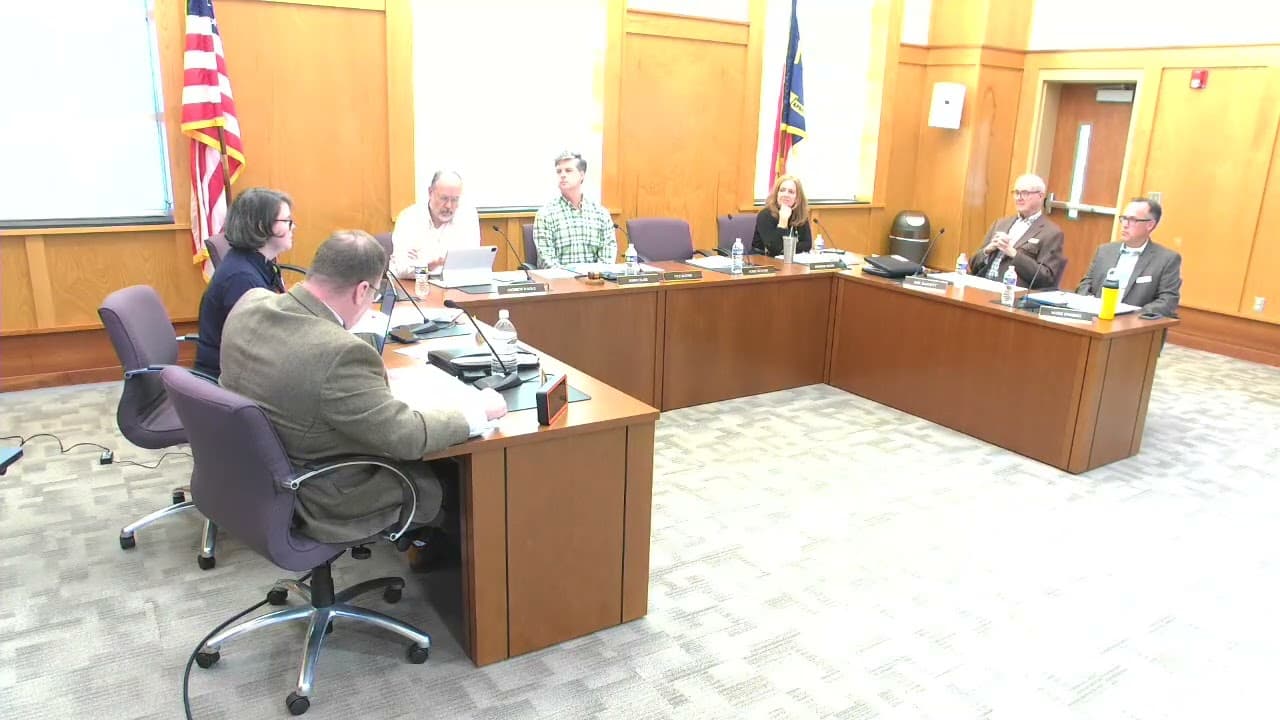
Weaverville's Town Council traded a shelved 27-unit plan at 21 Parker Cove Road for standard single-family zoning, then turned to a question that could shape future development: why does land that can't be built on still count toward density? Council also approved a $2.095M equipment loan, heard staff explain how a new state law strips the town's power to require parking, and heard a resident's warning about fire department staffing.
- Parker Cove Road rezoned to R-1, ending a denser conditional plan next to Maple Trace
- Floodplain acreage counting toward density draws council fire; Planning Board may study it
- $2.095M, five-year loan at 4.02% funds two fire trucks, police cars and equipment
- State law ends off-street parking mandates; staff warns residential streets will feel it
- Resident says fire shifts run at 4 or 5 against a nine-person standard
- Water plant expansion permit approved after a nearly two-year state wait
Parker Cove Goes R-1, Floodplain Fight Begins
Why it matters: The rezoning removes a protected do-not-disturb area next to the Maple Trace subdivision, and the town says it can't require a buffer under R-1.
The basics: The 8.87-acre parcel (PIN 9752442568) sat in a conditional zoning district, a site-specific zone tied to an approved plan. That plan originally proposed 27 units and included a do-not-disturb area, not just a planted buffer. R-1 is the town's standard single-family district, with set setbacks and minimum lot sizes but no project-specific conditions.
Where things stand: The Planning Board unanimously recommended the change on Aug. 3, finding it consistent with the Comprehensive Land Use Plan. Jennifer Jackson, town staff standing in for the planning director, said the owner has changed course.
"They really have abandoned this fairly dense residential development and are really more looking at true single-family development, 2 or 3 lots, maybe just 1, as opposed to the high-density," said Jackson.
No one signed up to speak at the public hearing. One Maple Trace resident emailed asking that a buffer be left between any new development and the subdivision. "We won't have any control over that," Jackson said.
The density problem: One councilmember calculated the parcel could theoretically yield about 36 units, because floodplain acreage still counts toward allowable density even though it can't be built on. Using a county GIS tool, the member estimated only about 5.8 acres are usable.
"I think it's idiotic that we count that acreage that's in a floodplain for density," said the councilmember.
Others noted that the road and Reems Creek split the property, the slope toward Maple Trace is steep, and a spring crosses the site.
The other side: One councilmember suggested the town adopt stricter floodplain rules and have Buncombe County enforce them. Staff pushed back. "Buncombe County will not administer something that's more stringent or more restrictive than their policy," said Jackson, adding the town would have to enforce stricter rules itself. The councilmember said a phone conversation with the county suggested otherwise. Another member floated asking state representatives for help if the counting rule is set by state law.
Decisions and stakeholder impacts: The ordinance passed by voice vote with no opposition recorded; individual tallies were not announced. Councilmember Peter McGuire had not yet arrived. Members said R-1's setbacks and lot sizes eased their concerns. "I feel a lot more comfortable with it being R-1 as opposed to what was originally planned," said one councilmember. Maple Trace neighbors gain lower density but lose the guaranteed buffer.
What's next: Vice Mayor John Chase, who presided, suggested the Planning Board weigh the pros and cons of excluding floodplain acreage from density calculations.
$2.095M Loan Locks In Fleet Funding
Why it matters: Borrowing at a fixed 4.02% while town cash earns 3% to 3.5% keeps general fund reserves intact for a major fire and police fleet refresh.
Where things stand: Director Dozer presented a resolution authorizing a five-year, $2,095,000 installment loan with United Community Bank. During spring budget workshops, council chose to finance most vehicle and equipment purchases this fiscal year rather than pay cash.
The package covers:
- Fire truck No. 1, ordered in 2023 and due at year-end: just over $1M
- Half the remaining cost of fire truck No. 2, already in service: $409,000
- Four police vehicles: about $346,000
- A swap loader: $180,000
- Two public works pickups: $100,000
A broker-led request for proposals went to 25 lenders and drew 8 bids ranging from 4.02% to 5.08%. The town can prepay after year three and may hold the proceeds in its capital management trust. Issuance costs run just over $22,000.
The other side: One councilmember, a longtime skeptic of debt, noted that a colleague not yet present believes "some debt's good debt," but said the numbers were close to a wash. Dozer confirmed the town no longer has a bond rating; it stopped needing one after refunding its water bonds. She also warned that lenders are "predicting more rate increases before the end of the year."
"So the value to the town here is essentially where our general fund reserves are not taking a hit for this purchase, which I think is worthy," said another councilmember.
Decisions and stakeholder impacts: The resolution passed by voice vote with no opposition recorded; tallies were not announced. Councilmember McGuire arrived immediately after. Dozer confirmed the payments are already in the debt service budget, so taxpayers see no new line item.
What's next: Closing is set for Oct. 6, with the first payment due in June.
State Law Takes Parking Out of Town Hands
Why it matters: New homes in Weaverville may soon be built without driveways, pushing parking onto streets that police and public works will have to manage.
Where things stand: The North Carolina General Assembly curtailed local parking authority, and the town made a major code change a few months ago. A second review found more Chapter 20 provisions requiring off-street parking. The Planning Board reviewed the fixes Aug. 3 and Sept. 8 and recommended them.
"We can no longer require off-street parking," said Jackson. Commercial uses will likely still provide parking, she said, but "where it's going to get tricky is for residential purposes."
The other side: One councilmember confirmed a new house would no longer need a driveway, linked the state policy to affordable housing goals and recalled on-street parking conflicts in Malvern Hills. Jackson called the change purely about compliance and said the Planning Board itself acknowledged "this is legislation that will cause some problems."
Decisions and stakeholder impacts: Asked about House Bill 162, Jackson said the rules apply only to new development; existing approvals are unaffected. No one spoke during public comment, and council took no action.
What's next: Staff will fold these changes into a single amendment with compliance updates for another state bill to save costs. Some provisions take effect Jan. 1.
Resident Sounds Alarm on Fire Staffing
Why it matters: A taxpayer advocate says the department is running well below its staffing standard, raising questions about response capacity and safety.
Where things stand: Town Manager Harris reported the fire department recently hired two fully certified firefighter EMTs and three trainees starting in October, and is still recruiting. Asked by a councilmember for a vacancy count, Harris said, "I know we just made offers for 5 positions," and deferred to the fire chief.
During public comment, Missy Paris, speaking for taxpayers of the North Buncombe Fire District, said the department has averaged a new chief every 7 to 8 months over four years and lost 25 firefighters. She said the standard is eight full-time and one part-time firefighter per shift, but no part-time staff have worked in months.
"Currently we have 1 shift with 4 and 2 shifts with 5," said Paris. She also said "mutual aid is not the answer to the staffing crisis," warning of injuries, deaths and lawsuits.
She urged council to interview current and former firefighters and chiefs under the State Whistleblower Act. "These firefighters and chiefs did not leave a bad job. They left bad leadership," she said.
What's next: Council thanked Paris and took no action. Late in the meeting, council entered closed session under NCGS 143-318.11 for legal advice, terms of a proposed real property acquisition and confidential personnel matters; no connection to the fire department was stated.
Water Plant Permit Arrives After Long Wait
Why it matters: The expansion can finally go to bid, and new street and stormwater studies will steer capital spending and grant applications.
Where things stand: Public Works Director Angela Reese and Harris reported the town requested its plant expansion permit from state regulators on Nov. 15, 2024; it was approved Sept. 25, 2026. A bid is expected by year-end. Average daily use from May to July was 645,016 gallons, 43% of the plant's 1.5 million-gallon daily capacity.
The Wall Water Treatment Plant's generator is online and its conversion from chlorine gas to liquid is essentially complete, eliminating dangerous compressed gas cylinders. The Stony Knob water line replacement is done, and new modeling software will replace an inaccurate spreadsheet for water allocation.
Three Notch is surveying about 20 miles of town streets and sidewalks, and Kimley-Horn is building a stormwater capital plan. "Because I can use this information to apply for grants," said Reese.
The other side: The 2.5-year-old Lake Louise playground has been vandalized; Reese plans a camera upgrade, with a camera head costing about $3,800, plus signage. Police can view the cameras. She dropped plans to pump water over the park's water wheel: "That is a safety hazard and a liability to the town." One councilmember noted the non-functioning wheel still draws photographers.
What's next: A plant walkthrough is set for Oct. 7. Reese will report back on how curbside recycling has cut landfill tonnage.
- Meetings move to Tuesdays: Workshops shift to 2nd Tuesdays and regular meetings to 4th Tuesdays at 6 p.m., starting in October, by voice vote; one member flagged access for Tuesday workers.
- "C-1 Light" study: By consensus, council asked the Planning Board to craft a lighter commercial district excluding uses like gas stations near homes, citing a Weaver Boulevard parcel behind Goodwill.
- Consent package: Adopted the WEDAC Economic Development Policy, reappointed Rob Chasen as ABC Board chair, added precious-metals permit fees and recognized $12,308.75 in insurance proceeds.
- HCA Mission Health: A councilmember said CEO Sam Hazen met community leaders after Weaverville and more than a dozen municipalities passed resolutions, and "vowed to do better."
- Community recognition: Council honored Army veteran John Connolly for seven years of daily litter pickup around Lake Louise, Main Street and Weaver Boulevard.
Looking ahead: Leaf collection runs Oct. 15 to Dec. 15. The Ball Crank Arcade grand opening is planned for Oct. 24. An Urban 3 presentation by Joe Menegozzi moves from Oct. 26 to Oct. 27 under the new schedule, and November's regular meeting shifts to Tuesday, Nov. 17.