
Town Attorney: Raleigh Has Left Waynesville Little Power Over Growth
Town Council • WaynesvilleSeptember 22, 2026
Locunity is an independent informational service and is not an official government page for this commission. All information is sourced from public footage and an analysis of official agendas with the aid of responsible, fact-checked AI. to report an error or omission.
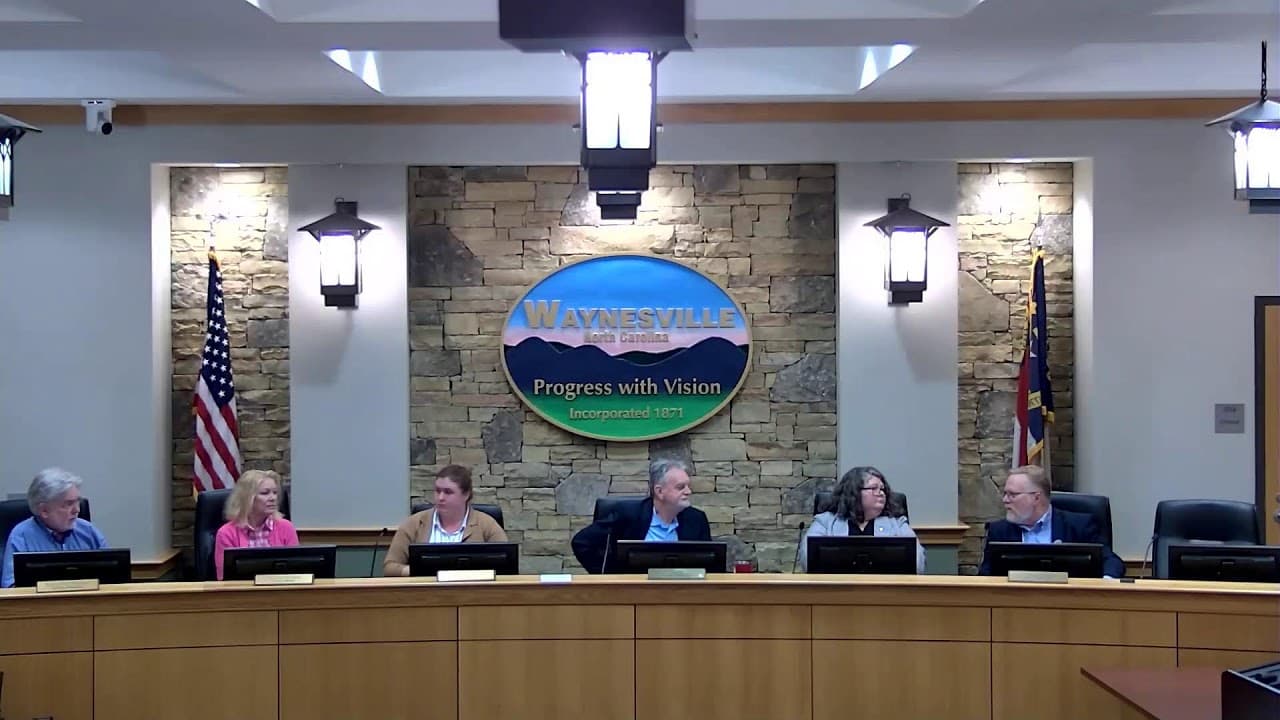
Waynesville's elected leaders learned Sept. 22, 2026, that state law now decides most of what happens to land inside town limits. The town attorney delivered a 37-minute briefing on that shift, and a grant-funded Richland Creek restoration offered a rare piece of good news: storm repairs and a long-sought greenway link at no cash cost to the town. Council also adopted fire code changes and approved $130,500 in water plant repairs.
State preemption briefing: Town attorney warns new laws on downzoning, parking and fees sharply limit local zoning control
$267,000 first phase of a $2M Helene grant will restore Richland Creek and close a greenway gap
Fire code amended to tie inspections to the state code and require key boxes when commercial occupancy changes
$130,500 from surplus water revenue pays for a plant roof, filter media and watershed road repairs
1 Big Thing: The Zoning Toolbox Is Nearly Empty
The basics: North Carolina follows Dillon's Rule, meaning towns hold only the powers the General Assembly grants.
"We are all at the mercy of Raleigh, including Raleigh," said Martha Sharpe Bradley, Town Attorney.
Why it matters: Residents who bring growth concerns to council were told that most answers now sit in Raleigh. One lost zoning case could cost the town six figures in the other side's legal fees.
Where things stand: Sharpe Bradley walked council through a stack of state changes:
A 2024 "no downzoning" provision tucked into a storm recovery bill has frozen planning changes. Other towns, including Pittsboro, sought exemptions and failed. "No one knows what no downzoning means," Sharpe Bradley said.
Under Chapter 160D, expanded permit choice and vested rights let applicants pick the most favorable rules, and reapplication waiting periods are gone.
The state banned minimum building sizes for one- and two-bedroom units. The 2026 session outlawed minimum on-site parking requirements, with coastal communities exempted.
"So the applicants and developers have more options, whereas the town has fewer," Sharpe Bradley said.
Legal exposure: Attorney's fees are now mandatory. The window to sue grew from one year to three, and more decisions go directly to Superior Court. Sharpe Bradley said fee awards, one cited at $15,000, are rarely scrutinized. Councilmember Chuck Dickson said fees could reach $25,000 to $100,000 on appeal.
Sharpe Bradley pointed to Asheville, which turned down a $4.1M settlement in a hotel case. The city then lost at every level after denying a permit on speculative parking evidence. She warned council against seeking quasi-judicial discretion: "If an applicant presents evidence that their project complies with the building code, they are entitled to their permit. Period."
"If we lost, we would be required to pay the other side's attorney fees, and they may have hired a firm that charges half a million," said Mayor Gary Caldwell.
The other side: Councilmember Jon Feichter said council has effectively lost its ability to regulate development within town limits and the extraterritorial jurisdiction. Feichter questioned whether sidewalk and ridgeline rules still mean anything. "I absolutely believe in by-right development," he said, adding: "we are effectively blocked from being able to respond to the needs, wants, and desires of the people."
Sharpe Bradley said ridgeline and slope rules remain valid for now but could disappear, and sidewalk requirements are limited. She named the tools that remain: retracting the urban services boundary to municipal limits, annexation decisions and development incentives, such as for the South Main site. Annexation gives the town the most discretion, she said, but still carries litigation risk. The mayor noted that "even if you deny annexing, you can't deny giving them water and sewer. They'll just pay outside rates."
Dickson said the community-driven 2035 plan cannot now be changed. "We should be very cautious about challenging that because it could cost us an awful lot of money," he said.
Decisions and stakeholder impacts: Council took no action. Developers and applicants gain leverage. Residents lose a local venue for land-use fights. Sharpe Bradley urged council to "allow better-funded municipalities to test the boundaries of that statute." She also noted a pending Henderson County case testing a constitutional "fruits of their labor" claim.
What's next: Sharpe Bradley urged residents to contact state legislators and credited the League of Municipalities for its advocacy. Dickson flagged a November constitutional amendment that he said could limit towns' ability to set their own tax rates.
Richland Creek Repairs Will Close a Years-Old Greenway Gap
Why it matters: Hurricane Helene left eroded, caving banks along Richland Creek. Preston Jacobson, Director of Haywood Waterways, called the project "the largest restoration project that has been planned and will be funded for restoration construction in Richland Creek's history."
Deal math: A North Carolina Department of Environmental Quality Helene recovery grant is expected to total $2M. The team used $78,000 for design, permitting and planning, which Jacobson said will count as a cash match for future grants. About $267,000 goes to construction in work areas 1–3 this fall into winter or early spring.
"So we have $267,000 to put into the dirt. This is with no cash being offered up and/or used by the Town of Waynesville," Jacobson said. He added that most grants allow three years, but this one must be spent in one.
Where things stand: The full project covers 13 work areas, from the Russ Avenue Bridge to the pedestrian bridge at the Waynesville Rec Center, plus part of Shelton Branch. The design team from ES Engineering and PCE Enviroscience laid out the first three areas:
- Work area 1: Bank repair behind Zaxby's, plus a formal stream access point.
- Work area 2: Removal of levees in front of Mountain Creek Apartments. Haley, Project Engineer, said the levees contain embedded waste.
- Work area 3: Rebuilding the eroded bank behind Mountain Creek Apartments, adding a stormwater capture area and placing a trail on top.
That trail solves a long-standing problem. "We weren't able to secure easement from the storage units for many years to connect those 2 segments between Mountain Creek Plaza Apartments and Ben Street Park," said Olga Grooman, Town Development Services Staff. The rebuilt bank allows an ADA-accessible bypass. Today, "people currently walk through the parking lot, not super safe," said Emily of the design team.
Floodway permitting is still being worked out with the state. Any increase in flood levels is limited to between zero and one-tenth of a foot.
The other side: Council members pressed on limits. Asked whether the work would reduce flood risk, Jacobson said "there is no silver bullet for flooding" and that the project won't necessarily mitigate upstream effects. He said bigger resiliency gains will come from a U.S. Army Corps of Engineers study. That study may produce a prioritized project list of more than $100M stretching into the 2030s, with a local cost share.
One councilmember asked, "So if you restore the trout habitat in this 1 mile, what about all the stuff upstream that's coming down?" Jacobson said stocked trout tend to stay near where they are stocked.
Decisions and stakeholder impacts: The presentation was informational, and no vote was needed. Jacobson said the rain gardens are designed to need almost no maintenance. Haywood Waterways will coordinate plantings with the town's new tree board. Grooman said the town's stormwater ordinance requires maintenance agreements and annual inspections by development services, at no inspection cost.
What's next: The town attorney will review construction easements before work begins. Jacobson estimated finishing all phases will cost $1.5M to $2M over time.
Fire Code Now Tracks the State, Expands Key Box Rule
Where things stand: At the fire marshal's request, council amended Chapter 30 of the town code. The town will no longer write its own inspection schedules by occupancy type. Instead, inspections must happen at least as often as the most recent state fire code requires, and a new code is expected in January. The fire code official may also require a UL 1037-listed key box, a locked box holding building keys for firefighters, when a commercial building changes occupancy classification.
"This stems from existing issues to where we can't access facilities now because there is no Knox box installed," Olga Grooman, Town Development Services Staff, said. Planning board attorney Ron Sneed reviewed the amendment.
Decisions and stakeholder impacts: No one spoke at the public hearing. Councilmember Chuck Dickson moved to adopt the amendments, and Councilmember Julia Freeman seconded. The motion passed on a voice vote with no opposition recorded; individual tallies were not recorded. Commercial owners changing a building's use may now face key box requirements.
Surplus Water Revenue Covers Helene-Era Plant Repairs
Deal math: Council approved a $130,500 amendment drawn from about $400,000 in prior-year excess water revenue:
- $73,000 for a new treatment plant roof
- $20,000 to replenish filter bed media
- $37,500 for watershed road repairs, including hydroseeding, regrading and added rock
Why it matters: "The watershed continues to experience impacts from Hurricane Helene," said Cody Stiles, Water Treatment Plant Staff. Those impacts include exposed soils and higher turbidity, or cloudy water, after rain. Using surplus revenue preserves money for larger needs such as spillway repairs.
Where things stand: Councilmember Jon Feichter asked whether the money would shore up an eroding stretch of the access road. "Yeah, we've actually already stabilized that. That was a FEMA repair," Stiles said. On a larger slide that washed out the road, Stiles said the manager chose not to pursue quoted repairs. Staff hope to build a bypass access road above the slide instead.
Decisions: The amendment passed on a voice vote with no opposition recorded.
Minor Items
Electric Cities board: Rick Howell and Paige McCurry were appointed through the consent agenda, which passed on a voice vote.
Public Power Week: Mayor Caldwell proclaimed Oct. 4–10, 2026, Public Power Week, praising the town's utility workers.
DWI task force: Ellen Pitt, leader of the WNC Regional DWI Task Force, reported one alcohol vendor per 92 residents in town and warned of rising daytime DWIs and "super kratom."
Campaign signs: Councilmember Dickson counted six political and commercial signs on town property. Councilmember Feichter cited court cases limiting removal, and staff will research the question.
Looking Ahead
First Friday returns to Main Street Oct. 2. The Church Street Art and Craft Show follows Oct. 10. Council next meets Oct. 13.