
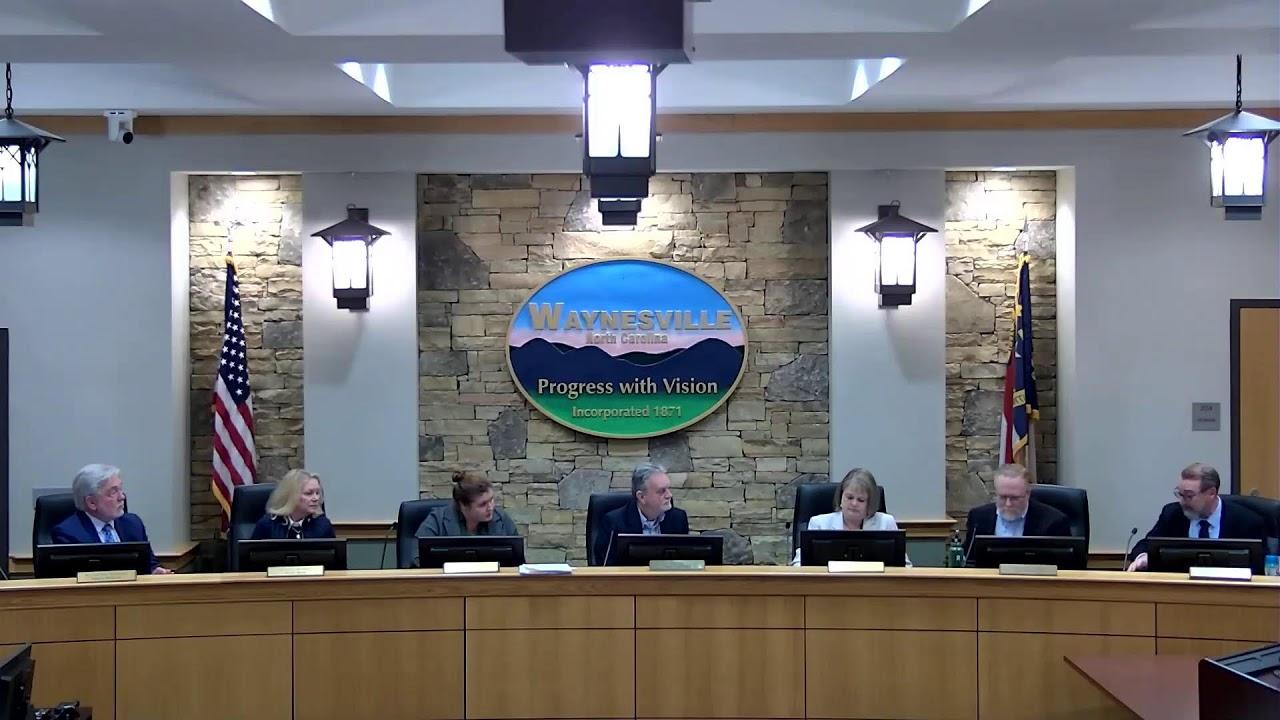
Waynesville Approves $2.9M Design Deal for Tri-Town Emergency Water Link
Town Council • WaynesvilleNovember 10, 2026
Locunity is an independent informational service and is not an official government page for this commission. All information is sourced from public footage and an analysis of official agendas with the aid of responsible, fact-checked AI. to report an error or omission.
Waynesville took its biggest step yet toward an emergency water connection with Canton and Clyde on Nov. 10, 2026. The Town Council approved a $2.923M engineering contract for a roughly $19.5M project, but only after members pressed for clear rules on when the town's water could flow to its neighbors. The council also heard a warning about vague new state fee laws, tightened site plan review after a contested Hyatt Creek vote, and swore in a new town manager.
- $2.923M McGill and Associates contract approved for the Canton-Clyde-Waynesville water interconnect.
- Councilmembers want written triggers for when the "emergency" link is used.
- State fee laws bring binding estimates and $100/$25/$10 permit surcharges starting Jan. 1, 2027.
- Council removes subjective review from major site plans after a 4-3 Hyatt Creek vote.
- Storefront window rules capped at the state's 35% glazing maximum.
Three Towns, One Pipe, Many Questions
Why it matters: The interconnect would let Waynesville, Canton and Clyde share water during emergencies. The approved contract covers design and administration for a regional project budgeted at about $19.5M. Clyde and Canton had already approved the agreement.
Where things stand: Rob Hines, representing the Council of Governments, Clyde and Canton, walked the council through the contract.
"What you have is a $2,923,000 contract, which represents 15.25% of the total project budget of $19.5 million," said Hines.
The contract includes $200,000 for an easement company. It also covers funding administration across three State Revolving Fund (SRF) loan-grant contracts and $65,000 for a preliminary engineering report (PER) and a finding of no significant impact (FONSI), the environmental clearance federal and state funders typically require. Hines said using two design teams and three bid contracts would shrink a four-year schedule to about two years.
The other side: The sharpest questions concerned control of Waynesville's water. "What would invoke usage of this interconnect?" asked Councilmember Jon Feichter.
Hines pointed to water main breaks and Stage 3 drought conditions. He said the team is recommending a "wet" interconnect, meaning water stays in the line and ready to move. He also noted that the word "emergency" is underlined in the agreement, citing development pressure as the reason. "That's the reason the word emergency is underlined," Hines said.
Feichter was not fully satisfied. "I do think having some guidelines as to when and under what conditions it would be invoked would be very helpful," he said. Hines agreed to consider adding defined criteria.
Councilmember Julia Boyd Freeman put the threshold question directly: "Is this advantageous for the citizens of the town of Waynesville?"
Mayor Pro Tem Chuck Dickson asked whether the $200,000 easement budget pays landowners. Hines also addressed property owners who might refuse to sell. "If we have a recalcitrant person, we would say that the town of Waynesville, Clyde, or Canton would use their condemnation," he said. Under that approach, each town would use eminent domain only within its own section of the line.
Decisions and stakeholder impacts: Freeman moved approval, and the council passed the agreement by voice vote. No tally was announced. Residents gain a backup supply in case of main breaks or drought. Property owners along the route face easement negotiations and possible condemnation. The council's push for defined triggers signals sensitivity about sharing water with growing neighbors.
What's next: The council separately accepted $506,840 in N.C. Department of Public Safety funds, passed through Haywood County, for Waynesville's section of the line. The money covers easements, acquisition, legal costs and land for the waterline, pump station and storage tank, with no local match. Staff presenter Paige, the town's project coordinator, flagged that the town must show progress by March 15, 2027. The performance period runs through June 30, 2028. That agreement also passed by voice vote.
State Fee Mandates Land on Permit Counters
Why it matters: Two new state laws change how Waynesville charges for development. Starting Jan. 1, 2027, the town must also collect fees on behalf of the state, and those fees have no exemption.
The basics: The fee transparency law took effect Aug. 11, 2026. It requires:
- A published fee schedule
- A methodology for each fee
- Annual reporting to the Local Government Commission
- A fee estimate within 10 business days of a complete application
The town cannot exceed that estimate unless the project has a "material change," a term the law does not define.
Where things stand: Development Services Director Olga Grooman said the binding estimate leaves staff little choice. "We have to overestimate because the legislation is clear," Grooman said.
The second law adds mandatory surcharges on building permits:
- $100 for commercial permits
- $25 for residential permits
- $10 for "all other" permits
The town must send these fees quarterly to a new building codes bureau within the state Department of Labor. "There is no exemption," Grooman said.
The other side: Councilmembers asked how utility fees under Article 8 would be handled and how often fees change after a permit issues. Feichter asked how often Waynesville has had to charge additional fees after permits were granted. Members also raised the risk of over-estimating.
Decisions and stakeholder impacts: This item was informational, so no vote was taken. Staff plan to raise fees only for major site plans and subdivisions, to cover legal costs. Builders and homeowners should expect higher estimates and new state surcharges on every permit.
What's next: Staff will bring a fee ordinance to council in December. At that meeting, council will decide how to handle state fees on permits where the town waives its own fees.
Taking Subjectivity Out of Site Plan Review
Why it matters: The council removed discretionary tools from major site plan and preliminary plat approvals. The change follows a contested planning board vote on Hyatt Creek and concerns about litigation risk.
Where things stand: The amendment to Land Development Standards 15.8.2 and 15.9.3 was suggested by attorney Ron Sneed. It removes three provisions from these administrative decisions:
- The consistency requirement
- The planning board's power to attach conditions
- The written-decision provision
Staff said these decisions rest on objective standards, with the planning board acting as administrator rather than policymaker. "There should be no subjectivity in them," Grooman said.
Grooman cited Hyatt Creek as an example. "It passed by the vote of 4 to 3, but they comply with everything and more," she said.
The other side: Dickson asked whether the change would take the Hyatt Creek decision out of the planning board's hands. Council members also asked about appeals to Superior Court. The Town Attorney, identified as Martha, said local rules carry little weight on standing in court: "What our ordinance says about the appeal process is really immaterial."
Decisions and stakeholder impacts: No public speakers came forward at the hearing. Mayor Gary Caldwell moved to find the ordinance consistent with the 2035 Comprehensive Plan (Goal 1), and Feichter seconded. Councilmember Anthony Sutton moved adoption, with Feichter seconding. Both motions passed by voice vote, with no tally announced. Developers of code-compliant projects gain predictability. Neighbors lose a lever to seek conditions on administrative approvals.
Storefront Windows Meet the State Ceiling
Where things stand: Waynesville requires windows covering at least 50% of a facade band running from 4 feet above grade to the top of the door. State law caps transparency requirements at 35% of the wall area from grade to 10 feet.
On a 100-foot building, staff said, the town's rule requires roughly 130 square feet of glass, against up to 350 square feet the state allows. "We don't actually believe that our requirement exceeds the maximum imposed on us by the state," said Alex, a staff presenter. Staff still recommended a safeguard for unusually tall doors.
Decisions and stakeholder impacts: Council debated whether the rule should refer to the "building" or a "portion" of it. No one spoke during public comment. Sutton moved the consistency finding, and the amendment passed by voice vote with Feichter seconding. The town keeps its 50% standard while protecting itself from conflict with the state cap.
A Sewer Easement Deal at Palmer Hill
Where things stand: Staff asked the council to honor an earlier verbal agreement with the owner of 11 Palmer Hill Drive. Under that agreement, the owner would grant an easement for the Balsam Edge subdivision's 8-inch sewer main in exchange for a sewer connection without annexation. The attorney's review sent the agreement to council for approval.
"We're asking the council to honor that agreement by approving the exception to the annexation requirements to the town sewer ordinances," said Laura, a staff presenter.
Public commenter Dawn Jones Marshall, the homeowner, thanked staff for their responsiveness and said she hopes to be a good neighbor. She said she consulted outside advisers because the easement document was complex. She also said she hopes to live in the family property.
Decisions and stakeholder impacts: Caldwell moved a combined motion, seconded by Freeman. It approves the annexation exception and waives the $3,260 sewer connection fee, contingent on the easement being granted. The motion passed by voice vote. The owner will continue paying outside-rate fees. The town keeps its planned sewer alignment and avoids costlier rerouting.
Minor Items
- Amanda W. Owens sworn in as town manager by Town Clerk Candace Poolton; she is the third manager hired during Caldwell and Freeman's tenure.
- Owens previewed a 3-to-5-year strategic plan and capital improvement planning with council.
- Hazelwood Christmas Parade permit added to the consent agenda, which passed by voice vote.
- Board reports covered the Energy Fair, the MPO chair term, the TDA website, bridge repairs and holiday employee payments.
Looking Ahead
Town offices close Nov. 11 for Veterans Day, and the tree lighting is set for Nov. 20. Watch for the fee ordinance in December, when council must decide how state surcharges apply to permits where the town waives its own fees.