
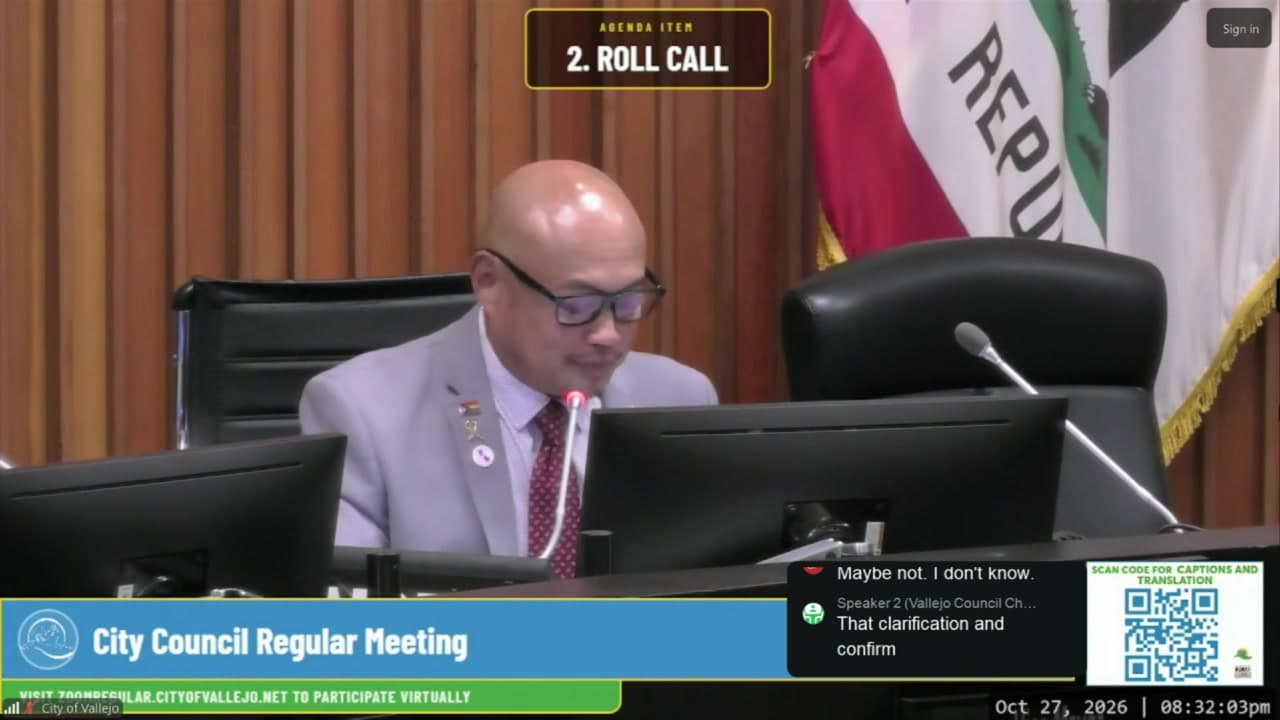
Vallejo Council Backs Tougher Inclusionary Housing Rules Than Staff Proposed
City Council • VallejoOctober 27, 2026
Locunity is an independent informational service and is not an official government page for this commission. All information is sourced from public footage and an analysis of official agendas with the aid of responsible, fact-checked AI. to report an error or omission.
Vallejo moved closer to its first mandatory affordable housing requirement on Oct. 27. The City Council sided with its Planning Commission over city staff and pulled smaller projects into the rule. The ordinance was introduced 5-1 after a public hearing of more than 90 minutes, in a meeting that also funded a fireboat and drew sharp demands for data on homelessness spending before adjourning at 11:56 p.m.
- Inclusionary housing ordinance introduced 5-1, covering projects of 10 or more units and taking effect after 90 days
- Roughly $690,000 federal grant plus $500,000 in Measure P funds approved 7-0 for a $1.19M fireboat
- $76,400 for a 150-day warming center passes 5-0 as members fault missing homelessness metrics
- Meador Public Funds picked as city investment manager under a $318,000 three-year deal; six ayes recorded
- Police union health-contribution item sparks process concerns during live labor negotiations
Planning Commission Wins the Housing Fight
The basics: Inclusionary housing rules require developers to set aside a share of new homes as affordable or pay a fee instead. Vallejo has no such rule today. Staff said affordability is voluntary and usually tied to density bonus incentives.
Why it matters: The ordinance is a required program in the housing element the city adopted in December 2024. Vallejo's Regional Housing Needs Allocation is 2,900 units, and 1,446 remain unbuilt.
Where things stand: Staff's Option A would have covered projects of 20 or more units. It set 5% to 8% set-asides, a 180-day delay and 55-year affordability, with on-site units, an in-lieu fee or alternatives. Long-range Planning Manager Hector Rojas summarized the consultant EPS's feasibility finding: “Any additional requirements related to housing development, they’re difficult to meet.”
The Planning Commission voted 7-0 for a tougher Option B. It set a 10-unit threshold, 4% to 10% set-asides, annual reporting and a feasibility review within two years.
The other side: Staff said developer letters called the commission version infeasible. A coalition pushed back. David Lindsay of Common Ground, Paul Tice of the Sierra Club Solano County executive committee and Crystal Gallegos, a District 4 tenant organizer, all backed the commission's terms. Tice argued Vallejo has over-relied on market-rate housing. Gallegos warned a 20-unit threshold would exempt most projects.
Members worried about weak spots. “A developer reaches for the in lieu fee button, and it’s just another price to develop something,” said Councilmember Charles Palmares. Councilmember Alexander Matias said he preferred the commission's rental set-asides as “responsive to our city, not stuff in a vacuum.”
Legal guardrails: Members asked about flexibility for projects just short of feasibility. City Attorney Nebb said variances do not apply and development agreements are not a proper vehicle. Nebb warned against mixing options because the study tested each one as designed. Nebb advised the council to “pick one of the options as it is presented to you now” and adjust later: “Take your step, see how it works.”
Decisions and stakeholder impacts: The ordinance cannot change between first and second reading. So the motion adopted the commission's redlines in Exhibit B to Resolution PC 26-17 and found the ordinance exempt from CEQA, the state's environmental review law. It also cut the delay to 90 days, as Councilmember Peter Bregenzer had recommended. Vote: For: 5 (Bregenzer, Helen-Marie Gordon, Tonia Lediju, Matias, Palmares); Against: 1 (Matulac); Absent: 1 (Mayor Andrea Sorce).
“No, with the understanding that I don’t think 90 days is enough for the staff to implement,” said Vice Mayor Diosdado “JR” Matulac.
Tenant, environmental and homelessness advocates won the threshold fight. Developers of 10 or more units now face set-asides or fees, and staff faces a compressed rollout.
What's next: Second reading. A resolution setting the in-lieu fee and an Affordable Housing Trust Fund are still to come.
Fireboat Grant Sails Through 7-0
Why it matters: Vallejo has 18 miles of shoreline and no local fireboat. Fire Chief Jonathan Goulding cited a March dock fire, when boats came from Tiburon and San Rafael and took about an hour to arrive. With a local boat, “you would have a boat on scene in less than 10 minutes versus over an hour,” he said.
Where things stand: The city sought a larger vessel but received a reduced award, so it scaled down. Staff compared three proposals on firefighting capability and cost and chose the locally built Moose Boat M3-36, a $1.19M purchase. Funding combines a roughly $690,000 federal Port Security Grant with $500,000 from Measure P. That covers the match plus about a 10% contingency, and unused contingency returns to Measure P. The Measure P oversight body recommended the spending unanimously. Mayor Andrea Sorce called it a sensible one-time Measure P expenditure.
The other side: Councilmember Tonia Lediju pressed on long-term operating costs. Goulding expects to absorb them in the department's operating budget. “Everything that we are doing from this point forward must be budget neutral,” said City Manager Harry Black.
Decisions and stakeholder impacts: The council amended the motion so the notice of intent to amend the FY26-27 budget includes the $500,000 Measure P appropriation. It passed 7-0. Waterfront businesses, marinas and residents gain faster emergency response.
What's next: This was step 1 of 2. A second budget action is still required.
Warming Center Funded, Oversight Questioned
Where things stand: The council approved $76,400 in Measure P funds for a 150-day warming center at the Vallejo Navigation Center, running November through March. The package also included a second amendment to the operator agreement with Five Keys and a grant agreement with Solano County Transit for rides to the warming center. City housing staff said last year's operation, Jan. 19 to May 30, logged 221 overnight stays by 54 unique people. An added staff person will cover 20 mats.
The other side: Matias pulled the item from consent. He said earlier direction on a strategy for unhoused residents, RV questions and pipeline updates went unanswered: “We have not seen anything around that.” He also warned of funding challenges in later years. Lediju was blunter. “I’m still waiting for a scorecard that I’ve asked for over a year ago,” she said.
Councilmember Helen-Marie Gordon asked where guests go during the day and whether they can get showers and food. Staff said guests leave around 8 a.m. and may use libraries during weather events. Black, five months into the job, acknowledged the programs had not been properly put into operation and said fixing that would take time.
Decisions and stakeholder impacts: The resolutions passed 5-0, with Sorce and Palmares absent. Unhoused residents get a longer season. Staff now faces explicit pressure to produce outcome data.
Meador Replaces Chandler on City Investments
Where things stand: Assistant City Manager Nolingo Connolly said the contract with Chandler Asset Management expired and was extended. A July request for proposals then led a selection panel to choose Meador Public Funds. The agreement runs Jan. 1, 2027, through Dec. 31, 2029, and will not exceed $318,000. Meador representatives Greg Balls and Paulina Wu said the firm would set performance benchmarks with staff.
The other side: Gordon asked who sat on the panel and why Meador won. Black offered to brief her later rather than discuss competitive procurement materials publicly. Matias asked that quarterly reports show the value the firm adds. A new finance director starts Nov. 14.
Decisions and stakeholder impacts: The roll call recorded six ayes, with Sorce absent. The result was not formally announced from the dais. No public speakers addressed the item.
Police Health Item Hits Procedural Snag
Where things stand: Bregenzer pulled a resolution on the CalPERS health contribution, known as PEMHCA, for employees represented by the Vallejo Police Officers Association. He worried other groups would demand similar terms. “I’m not sure why this item was not just part of the negotiations,” he said. The fire union and another group are currently negotiating.
HR Director Stephanie Cifuentes said CalPERS rejected a tiered structure in the 2023 labor agreement. The city will keep the minimum contribution equal for employees and retirees and pay any excess through a pass-through account. “This is just formalizing the change with CalPERS,” she said. She added that it carries no new costs and leaves the agreement's terms unchanged.
Decisions and stakeholder impacts: Black said the council seemed unlikely to pass it. He suggested outside labor counsel brief members in closed session. A motion to continue the item to closed session followed. Legal advice from the dais then noted the action had to be handled in open session. A roll call carried 5-0, with Sorce and Palmares absent. The final status of the resolution is unclear.
Minor Items
- Consent calendar approved 7-0. Warming center and police health items were pulled for discussion.
- Landscape districts: Public Works Director Leonard Jobe said 27 districts cover about 14,000 parcels, $4.6M in annual assessments and $27.1M in neighborhood-restricted accounts. He noted 12 districts have gone more than 15 years without increases. No vote was taken.
- Closed session produced only direction to counsel, including on litigation with American Canyon.
- Community forum: Matthew Aguilar raised police response times and the sheriff's contract ending Dec. 31. Another speaker urged a citywide ban on self-driving vehicles.
- Item 10A was recommended for tabling because of the late hour.
Looking Ahead
The inclusionary ordinance returns for second reading, followed by an in-lieu fee resolution and trust fund. The fireboat needs a second budget action. Public Works plans resident engagement before proposing landscape assessment changes. Lediju pressed for that: “We don’t want to do things to community. We want to do things with community.”