
Vallejo Council Advances $464,000 Axon Deal, Questions Measure P Reliance
City Council • VallejoSeptember 22, 2026
Locunity is an independent informational service and is not an official government page for this commission. All information is sourced from public footage and an analysis of official agendas with the aid of responsible, fact-checked AI. to report an error or omission.
Vallejo's City Council spent a marathon session on Sept. 22, 2026, sending more than $1 million in Measure P and related spending forward. The biggest items were $464,000 for Axon police technology and $300,000 to reopen a Housing Authority office that residents described as failing. Council members advanced nearly every request, but warned staff that recurring department costs must move into the regular budget, a signal reinforced by a new Baker Tilly contract to build a long-range financial plan.
- $464,000 Axon body-camera package advances, despite the Measure P committee recommending against it
- Councilmembers Lediju and Matias say Measure P can't keep covering operating costs
- $300,000 for Housing Authority staffing advances after testimony on Section 8 terminations
- Baker Tilly hired 5-0 to build a city-owned 10-year financial model
- $375,000 for a police grant lobbyist advances as police cite about $11.5M in awarded grants
- Two development moratoria head to a future agenda
Axon Funding Advances, With a Warning Attached
The basics: The council approved step 1 of 2, a notice of intent, to appropriate up to $464,000 for Axon Enterprise. The money covers year 3 of a five-year plan that includes data storage, about 115 body cameras, Taser 10 devices and in-car cameras.
Why it matters: Body cameras are central to Vallejo's settlement with the California Department of Justice. Members said the bigger issue is how the city pays for them.
Where things stand: Police staff framed the contract as nonnegotiable. "This is an absolute requirement," said Police Chief Tao. City Manager Harry Black said the regular budget has no room: "The general fund budget is at the brim."
Members agreed the cameras are needed but objected to the funding source. "It is an ongoing operational cost whether Measure P was here or not," said Councilmember Tonia Lediju. Councilmember Alexander Matias said the item "shouldn't be something that comes through Measure P because this is a no-brainer," and drew a line for next year: "I will not vote for this if it comes back as a standalone item and it's not part of an operational budget going forward."
The other side: Public comment split. RJ, a public commenter, urged ending both the Axon and Flock license-plate reader contracts and shifting the money to housing and services. Demi T urged a no vote, citing the Measure P Oversight Committee's recommendation against the item. Chris Kelly, speaking for Mario Romero, said body cameras are not optional under police reform but asked for proof the police budget lacks the funds. Michael, a Vallejo resident, backed body cameras but urged scrutiny of Axon and cloud vendors over liability and data. Eric McGovern questioned payment figures and a tax line in the agreement's appendix.
Councilmember Helen-Marie Gordon pressed on surveillance risk: "And how can we guarantee that there will be no misuse?" Chief Tao responded that access is logged and audited, and that Axon is not Flock.
Decisions and stakeholder impacts: Matias moved to let the city pay with Measure P funds, Monsanto settlement funds or a combination, giving staff an alternative before step 2. The motion passed unanimously by members present. Police keep their equipment pipeline, while Measure P advocates gain a clear commitment from at least two members to resist future operating requests.
Same debate, different outcome: The council also advanced up to $375,000 in Measure P money over FY2026-27 and FY2027-28 for Capital Advocacy Partners, a firm that handles police lobbying, grant writing and grant management. Police said the firm helped secure about $11.5M in grants over four years, a return of more than 3,011% on cost. They said the state SLEF grant fund caps administrative overhead, so grant money can't cover the firm's fees. Unlike Axon, this item carried the Measure P committee's support, and Demi T backed it, citing prevention programs. Lediju again called the contract an operating cost. It passed unanimously by members present.
What's next: Both items return for step 2. The city manager agreed the next budget cycle will require tradeoffs.
Housing Authority Gets $300,000 After Residents Describe Breakdown
Why it matters: Residents said Section 8 voucher holders are facing terminations without timely hearings, and the office has been effectively closed to walk-ins for more than a year.
Where things stand: The Housing Authority dominated both rounds of public comment. Lena Stojanovski contested the termination of her daughter's voucher and asked to meet with the mayor and city manager. City Attorney Nebb said a hearing extension would be honored. Lily Heard described staff turnover and a toxic environment at the office. Chop S of the Housing Justice Coalition said he was escorted out of a hearing, called $300,000 the tip of the iceberg, and asked for a public 30-60-90 day plan. Cristal Rocha, a former organizer with the Vallejo Housing Justice Coalition, called for a formal investigation. Crystal Gallegos called a recent hearing negligent and urged urgency proportionate to the harm. Demi T asked for monthly progress reports and pointed to underspending flagged in the city's CAPER, its annual federal housing performance report.
Staff said contractors would add two administrative clerks and a housing specialist starting around November. They are also evaluating a customer-ticketing system. The office's kiosks are currently inoperable.
The other side: The request skipped review by the Measure P committee. Asked about that, Black said: "It's an advisory body, okay?" He described the money as "temporary staffing support to serve as a bridge."
Decisions and stakeholder impacts: Lediju moved the $300,000 notice of intent, and it passed unanimously by members present. She asked staff to bring service-level standards for returning calls, backlog targets, staffing plans and audit findings before the final vote. Voucher holders could see in-person service restored. Advocates now have specific benchmarks to hold staff to.
What's next: Step 2 returns Oct. 13, 2026.
Baker Tilly to Build 10-Year Financial Roadmap
Why it matters: Vallejo faces a structural deficit of roughly $29M. The new model is meant to test major budget and development decisions against long-term sustainability.
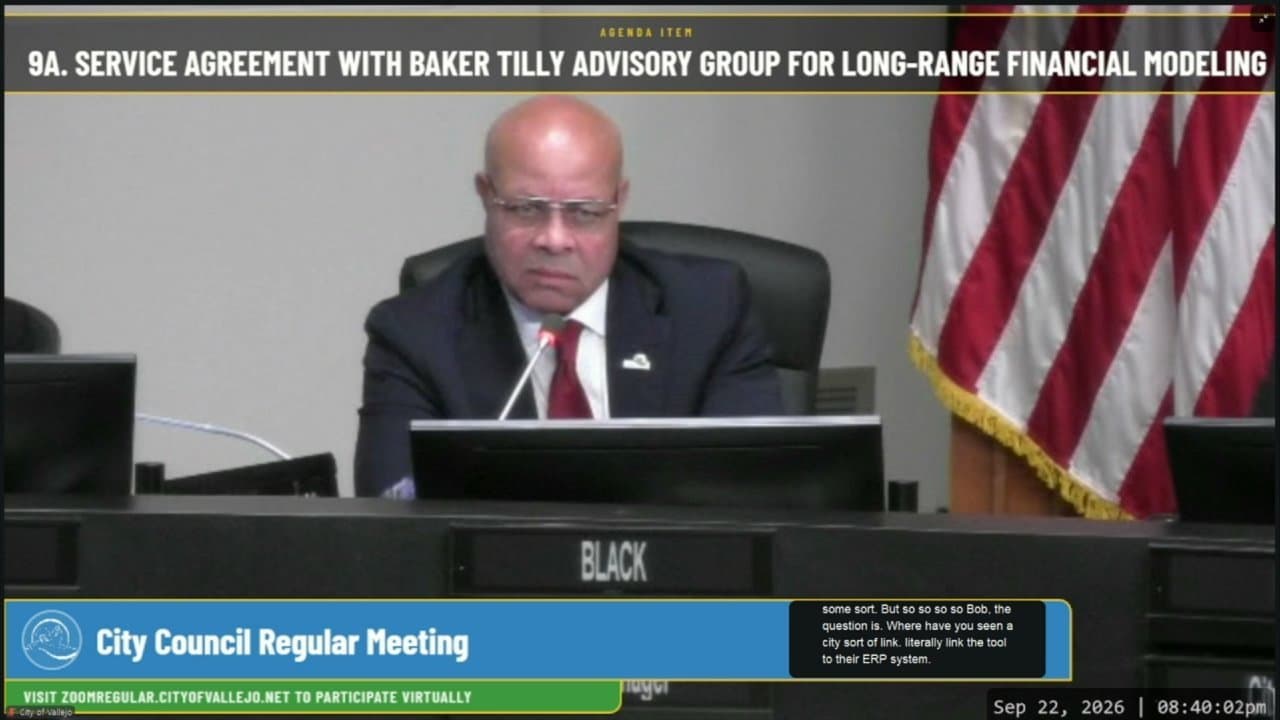
Where things stand: Baker Tilly outlined an eight-step process. It will produce a forecasting model, an assessment of the structural deficit, strategies to close it and a long-range plan, with results targeted for mid-February. "You own the model," said Bob Leland, special advisor with Baker Tilly.
Council questions focused on equity and growth. Councilmember Charles Palmares asked that the plan guard against development that creates long-term liabilities: "I don't want us to accidentally go down a road where we're approving tons of single-family homes." Gordon, citing underinvestment in District 6, said, "I hope you look at it per district as well." She also pushed to make community engagement required: "Can we make this a plan instead of it being optional?" Lediju asked, "How will we define fiscal sustainability?"
Public commenter Jessica Martinez asked for a district sustainability scorecard and an analysis of housing voucher spending relative to revenue.
Decisions and stakeholder impacts: Black promised public dashboards and community engagement. He said staff would push the council to stay aligned with the plan, which he said will take "relentless discipline." The motion text cited up to $250,000. Vice Mayor Diosdado "JR" Matulac clarified that the staff report lists $225,000. The resolution passed by roll call (For: 5, Matulac, Gordon, Lediju, Matias, Palmares; Against: 0; Absent: 2, Mayor Andrea Sorce and Councilmember Peter Bregenzer).
What's next: The model is due around mid-February, ahead of what members expect to be a tougher FY27-28 budget.
Moratoria Head Back to the Agenda
Where things stand: After midnight, members voted to bring back two possible development pauses. Lediju proposed directing staff to establish a temporary moratorium on new development in the Sonoma Boulevard, downtown and waterfront planning areas. Gordon added a friendly amendment extending the zone along Sonoma Boulevard to the Carquinez Bridge. "My request is not to stop development," Lediju said.
Matias sought renewed direction on a moratorium on car washes, parking lots and self-storage units. "I would like the council to take a second vote, since we already took the first one many months ago," he said. Staff noted that the council's referral list holds stalled items.
Decisions and stakeholder impacts: Members also voted to agendize funding for memorial markers honoring Pearl Pinson. Black put the cost at about $4,300 to $4,500 but opposed a blanket policy on such markers. All three requests passed unanimously by members present, though the chair noted quorum concerns. Gordon also asked colleagues to support a Down Syndrome Awareness Month proclamation.
What's next: Staff reports were deferred. The items will return to a future agenda.
- Coastland Civil Engineering: Road design contract raised to $1.9M using already-budgeted Measure P paving funds. Public Works Director Jobe said, "We would far prefer to do that with city engineers, but we just have a really hard time hiring engineers because of our pay scale."
- Stormwater MOU: Approved a permit compliance agreement with the Vallejo Flood and Wastewater District as the city faces a regional water board violation over trash capture devices.
- Youth funds: $880,000 in Measure P youth money returned to fund balance while the youth coordinator is unavailable. Public commenter Anna Bergman criticized past youth council spending on out-of-state trips.
- Roosevelt Group: $65,000 advanced for economic development advocacy and site marketing, with added reporting to the Economic Development Commission.
- Item 9B: A planning director item was tabled because of the late hour and possible loss of quorum.
Looking ahead: The Housing Authority funding returns for its final vote Oct. 13, 2026. The Axon and Capital Advocacy Partners items also need second votes. Anton T, owner of Terrell Trucking, asked the city to create a local business enterprise program modeled on San Francisco's, and the city manager promised follow-up.