United Nations – Unstoppable Africa – Sep 21, 2026
Unstoppable Africa • United NationsSeptember 21, 2026
Locunity is an independent informational service and is not an official government page for this commission. All information is sourced from public footage and an analysis of official agendas with the aid of responsible, fact-checked AI. to report an error or omission.
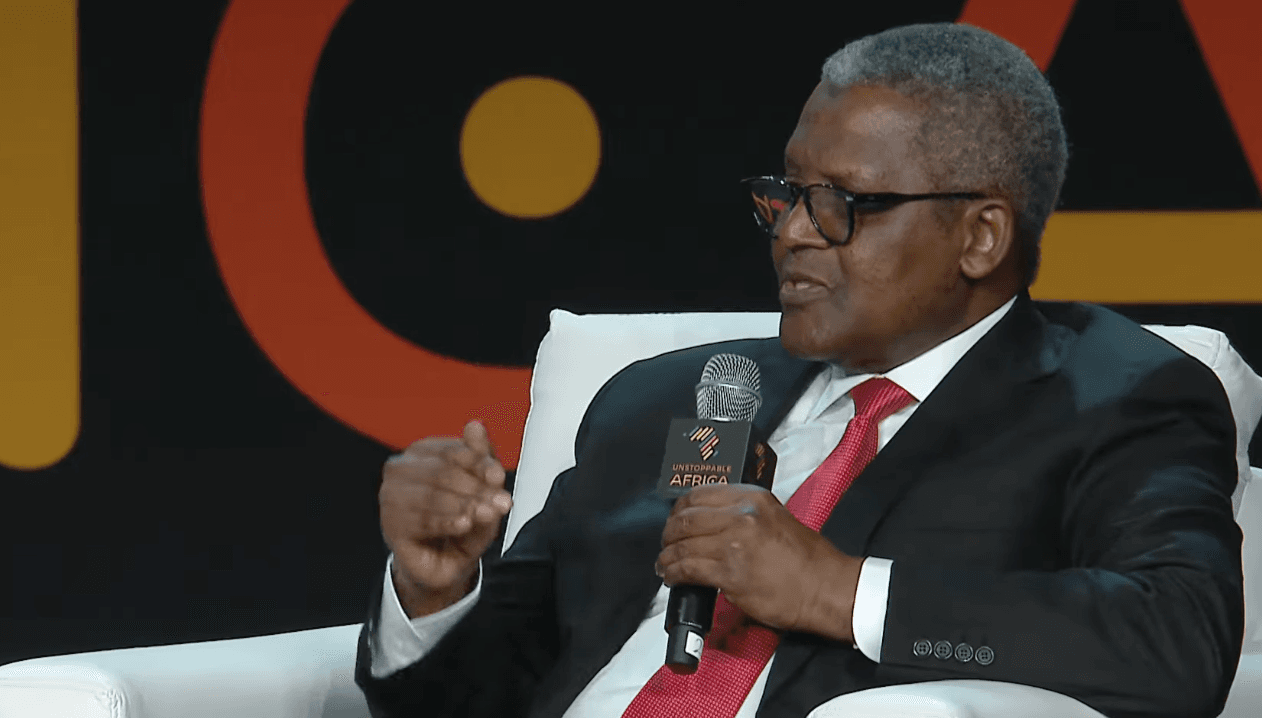
Dangote Lists Africa's Largest IPO, Announces $16B Kenya Refinery
Day 2 of Unstoppable Africa 2026 at the United Nations delivered a cascade of concrete commitments — from a $16 billion refinery to Africa's first national AI agency to a new continental credit rating agency launching in weeks. Across 11 panels and firesides, heads of state, billionaires, and founders mapped out an agenda that treats African sovereignty not as aspiration but as infrastructure to be built, financed, and owned.
- Dangote confirms $16B Kenya refinery launching Sept. 30, announces $700M education foundation and Africa's largest-ever IPO
- Rwanda's prime minister unveils Africa's first national AI agency, defines sovereignty through three tests on data, compute, and margin
- PM Mottley and Afreximbank president challenge the continent to "just do it" — Africa Credit Rating Agency launches Oct. 7
- SABI launches as GABI's first national chapter, anchoring South Africa's cross-border special economic zone strategy
- Food for Education targets 1 million kids fed daily in Kenya, backed by a $100M African Development Bank fund
- ABLC proposes African stablecoin to slash 14% cross-border payment fees and break the 16% intra-African trade ceiling
- NBA Africa reveals Basketball Africa League generated $250M GDP in four seasons; Vista Bank announces athlete banking products
The $16 Billion Bet: Dangote's Refinery Empire Goes Continental
The basics: Aliko Dangote, President & CEO, Dangote Group, sat for a fireside detailing the trajectory of the 700,000-barrel-per-day Lagos refinery — now the largest single-train refinery ever constructed — and announced its sequel: a $16 billion refinery in Lamu, Kenya.
Why it matters: Africa has long exported crude and imported refined fuel. Dangote's operation has inverted that relationship. The Lagos refinery is now running at full capacity and supplying most of Europe's jet fuel, a fact Dangote framed with characteristic bluntness.
"Somebody asked me yesterday, oh, Africa was so lucky because of this refinery during this Hormuz crisis, they would have been in trouble. I said, no, Europe is lucky because we are supplying most of their jet fuel," said Aliko Dangote, President & CEO, Dangote Group.
Where things stand: The refinery's IPO launched Sept. 14, listed deliberately on African exchanges first. Demand was so intense it overwhelmed the trading platform on launch day. Dangote explained why no global EPC contractor would take the project — industry resistance forced the company to assemble its own engineering team to build what he described as unprecedented in scale.
"You're talking about a refinery that has never ever been built before in the world, not in Africa, by anybody. The largest single train that was built by mainly the multinationals like Saudi Aramco and Co. is 450,000 barrels per day refinery," Dangote said.
The Kenya refinery launches Sept. 30, with a three-year completion target. It is part of Vision 2030 to double Nigerian refining capacity to 1.4 million barrels per day: "We're spending $16 billion in that project. I need to be ready within the next 3 years."
Foundation commitment: Separately, Dangote announced the Aliko Dangote Foundation will invest $700 million over 10 years in education — 30,000 university scholarships, 10,000 girls' education slots, and 10,000 vocational training positions annually. The foundation also pledged to match shares purchased by widows through state government partnerships: for every 10 minimum shares bought, the foundation donates an additional 10, targeting 2 million women.
What's next: The Lamu refinery groundbreaking is scheduled for Sept. 30. The IPO's first days of trading will test whether African capital markets can absorb the continent's largest-ever listing without structural growing pains.
Rwanda Draws the Line on AI Sovereignty
Why it matters: As global tech companies race to build data centers and AI infrastructure across Africa, Prime Minister Justin Tsenyumba of Rwanda used his keynote to draw a line between participation and extraction — framing the question not as whether Africa should adopt AI, but on whose terms.
Where things stand: PM Tsenyumba announced that Rwanda's cabinet has approved Africa's first national AI agency and laid out three tests for whether a country is a sovereign participant in the AI economy or merely a market:
"Can a state govern the data its own citizens produce? Can institutions reach the infrastructure they need on terms they can predict? Can African firms earn margin or only distribute? If the answer to all three is no, then that country is a market, not a participant," he said.
Rwanda has invested in fiber optic backbone, 4G coverage, 5G pilots, and more than 250 digitized government services as foundational infrastructure.
The other side: The panel featured sharp perspectives from across the tech ecosystem. Olugbenga Agboola, CEO, Flutterwave, discussed tokenization of African stocks and continental payment defragmentation. Lisa Monaco, President, Global Affairs, Microsoft, emphasized sovereignty as "self-determination" and announced expansion of Azure's hyperscale cloud in South Africa. Fatima Tambajang, Head of Developer Relations for Emerging Markets, NVIDIA, cited 690-plus AI organizations building in Africa, highlighted the $700 million InstaDeep acquisition, and noted NVIDIA has trained 100,000 developers in three years.
David Moinina Sengeh, Chief Minister & Chief Innovation Officer, Republic of Sierra Leone, described his government's "Country as AI Lab" framework and a partnership with Google DeepMind that achieved the equivalent of two additional years of math learning for students.
What's next: Rwanda's national AI agency will be watched closely as a regulatory template. The sovereignty framework — data governance, predictable infrastructure access, value retention — may shape how other African governments negotiate with global tech platforms.
'Just Do It': Mottley and Afreximbank Close With a Challenge
Why it matters: The closing fireside between Prime Minister Mia Mottley of Barbados and George Elombe, President and Chairman of the Board, Afreximbank, was part policy seminar, part sermon — an argument that Africa and its diaspora must stop asking for permission and start building parallel institutions.
Where things stand: Elombe delivered the session's sharpest anecdote. He described confronting an African central bank governor who had borrowed $750 million from Afreximbank but refused to deposit funds with the institution because it lacked an AAA credit rating.
"We are good enough to give you 400 million without a rating. And we are good for another 350, but we have no rating. We are junk. Why is it that those fellows who are rated, with whom you deposit the money, cannot give you this 750 you're asking for? Why are we good to give but not good to receive?" Elombe said.
The confrontation led Nigerian regulators to change rules allowing deposits in African multilateral institutions — a concrete policy shift born from institutional pressure, not theory.
Elombe announced the Africa Credit Rating Agency will launch Oct. 7, designed to counter what panelists described as biased external ratings that inflate borrowing costs for African sovereign and corporate debt.
The other side: PM Mottley brought the Caribbean diaspora perspective, calling for direct Africa-Caribbean air and maritime routes. She noted that "the flight between Barbados and Dakar is 6 hours, that the flight between Barbados and Accra is 7 hours, that the flight between Barbados and Lagos is 7.5 hours" — yet current commercial routes go through the North Atlantic.
She highlighted three compromised global trade corridors — the Straits of Hormuz, the Red Sea, and the Panama Canal — as proof that South-South trade routes are no longer aspirational but urgent.
"At the end of the day, we cannot be tenants in our own land, and ownership matters," PM Mottley said.
UN Under-Secretary-General Ahunna Eziakonwa moderated the conversation, which was framed around Afreximbank's Caribbean expansion as proof that the diaspora functions as Africa's "sixth sub-region."
What's next: The Africa Credit Rating Agency launch on Oct. 7 will be the first concrete test of whether institutional alternatives can gain traction against entrenched global rating systems.
SABI Launches With Cross-Border Economic Zones and Reform Agenda
The basics: The South Africa Business Initiative for Impact (SABI) officially launched as the first national chapter of the Global Africa Business Initiative (GABI), anchored by four pillars: digital inclusion, energy transition, climate-smart agriculture, and youth skills.
Why it matters: Parks Tau, Minister of Trade, Industry and Competition, Republic of South Africa, outlined a three-pronged reform agenda — macroeconomic stabilization targeting 3% inflation, structural reform opening power generation, rail, and ports to private investment, and industrial policy built on decarbonization, digitalization, and diversification.
Where things stand: Minister Tau detailed cross-border special economic zones with Eswatini, Mozambique, and Zimbabwe, plus reciprocal SEZs with Egypt designed to serve as regional gateways under the African Continental Free Trade Area. He addressed anti-migrant violence candidly, condemning criminal targeting of migrants while acknowledging legitimate concerns about undocumented immigration.
Phuthi Mahanyele-Dabengwa, South Africa CEO and Executive Director, Naspers, highlighted 24,000 youth employed in digital call centers, the role of Business Unity South Africa in government partnerships, and Naspers's 5 million entrepreneurs operating on its platforms.
What's next: SABI provides a replicable national-chapter model. Other GABI countries will be watching whether the South African framework translates global commitments into measurable local outcomes.
30 Cents, 700,000 Meals, and a $100M Fund
Why it matters: Wawira Njeru, CEO, Food for Education, described how her organization grew from feeding 25 children with $1,200 to 700,000 children daily across Kenya — and announced a partnership with the African Development Bank on a $100 million End School-Age Hunger fund, with Uganda, Ethiopia, Benin, and Nigeria already lined up.
Where things stand: Food for Education sources 130 tons of food daily and has created a $50 million market for Kenyan farmers and 6,000 jobs, deploying more than $200 million into the national economy. Njeru framed the work as economic infrastructure rather than charity.
"Right now, here in the US, a kid who's born here is likely to achieve 80% of their potential. In Africa, that number is 40%," she said, arguing human capital investment is strategic, not philanthropic.
She plans to reach 1 million children daily in Kenya by next year and expand to Zambia.
What's next: The $100 million AfDB fund and planned expansion into multiple countries will test whether government-kitchen partnerships can scale beyond Kenya at the same cost — currently 30 cents per meal.
Breaking the 16% Ceiling: ABLC's Trade Proposals
Why it matters: Intra-African trade sits at 16%, compared with 60% in Europe. The Africa Business Leaders Coalition dialogue explored why — and proposed solutions ranging from an African stablecoin to SME invoice factoring.
Where things stand: BCG's Kahir Dhanani cited a 4.7% average increase in border taxes on African exports as evidence of growing, not shrinking, trade barriers. He proposed an African stablecoin to bypass the 14% correspondent banking fees that make cross-border payments prohibitively expensive.
An illustrative anecdote captured the gap between policy and reality: slow solar panel border crossings were traced not to tariff disputes but to border agents' slow internet connectivity — the kind of problem only lived business experience can diagnose.
Tom Gitogo of Britam Holdings proposed dedicating a percentage of corporate spend to SMEs and enabling invoice factoring. Kola Karim of Shoreline Energy argued that 25 years of promises on African power pools have gone unfulfilled, calling for decisive action over theorizing.
What's next: The ABLC's 75 CEOs framed intra-African trade as the only meaningful portfolio diversification against geopolitical shocks. Whether the stablecoin proposal advances will depend on central bank engagement.
African Stories, African Ownership
Why it matters: Africa receives less than 2% of global film financing — yet 2025 was the first year non-English content surpassed English in global demand, creating an opening for African-language storytelling.
Where things stand: Lavaille Lavette, CEO, Pan-African Film Fund, described plans to build the entire ecosystem — theaters, distribution, and a youth development program launching in the third or fourth quarter of next year.
Akunna Cook, Founder & CEO, Next Narrative Africa Fund, called for blended finance models combining grants, debt, and equity, and warned against AI being used to compress African creators' budgets while Western creators retain large ones. She noted that 2025 marked the first year non-English content outpaced English in global demand.
Wanuri Kahiu, Co-founder, AFROBUBBLEGUM, coined the "Afro Bubblegum test" for films showing Africans thriving — not just surviving — while also defending the value of war films told from African perspectives.
CEO Cameron Bailey of the Toronto International Film Festival argued that enabling artistic freedom is essential and referenced South Korea's post-dictatorship creative explosion as a model.
What's next: The Pan-African Film Fund and Next Narrative Africa Fund are building complementary infrastructure — one focused on physical distribution, the other on blended financing — to keep IP ownership with African creators.
Sign Language Meets AI: Signvrse Debuts at UNGA
Elly Savatia, Founder & CEO, Signvrse, live-demonstrated the Terp360 platform — its first public debut — converting speech to 3D sign-language avatars in real time. The 26-year-old founder was motivated by witnessing 400 deaf students served by a single interpreter in northern Kenya in 2019. Google funded $2 million to scale data collection, and the team has built the largest documented dataset for Kenya Sign Language. Expansion targets include the US, Gulf states, South Africa, UK, and East Africa.
$250M in GDP, Zero African Banks: The Sports Economy Gap
Why it matters: Claire Akamanzi, CEO, NBA Africa, revealed that the Basketball Africa League generated $250 million in GDP across just four countries in its first four seasons, projecting $5.4 billion and 650,000 jobs within a decade through permanent team ownership.
"The first 4 seasons of BL's existence generated $250 million in GDP, primarily in 4 countries that we played in," Akamanzi said.
Simon Tiemtore, Chairman, Vista Bank Group, announced plans to create financial products specifically for African athletes, noting that prominent players like Drogba, Eto'o, and Sadio Mané all bank with European institutions. Kingsley Pungong of Rainbow World Group argued that sovereign government support is the missing ingredient, comparing Africa's lack of sports infrastructure to what Saudi Arabia and China invested over 40- to 50-year horizons.
Namibia's President Netumbo Nandi Ndayitwa announced sports and creative industries as her government's top priorities and signed a partnership between her NNN Foundation and Chiney Ogwumike's Queens of the Continent Foundation on stage.
Fashion's Dumping Ground Problem
Lagos alone generates 21,000 tons of textile waste monthly. Africa exports $15 billion in raw textile materials but imports $25 billion in finished goods. The fashion panel tackled this imbalance head-on.
Laduma Kokolo of Maxhosa described building a vertically integrated luxury knitwear brand employing 400 people using South African wool and mohair, competing alongside Gucci and Louis Vuitton in retail. Afreximbank's CANEX program has secured more than 120 offtake agreements through global trade show partnerships, with Zimbabwe's Van Vamwerk now in 50-plus retail stores.
Amira Rasool of The Folklore identified shipping costs as the single biggest barrier, describing how she personally flew between Cape Town, Johannesburg, and Lagos to collect products because DHL costs were prohibitive. Fiskani Kyra called for textile manufacturing revival and waste-to-energy plants. Panelists argued the continent needs systems-level investment — not just brand incubation.
Minor Items
- Lagos Governor Babajide Sanwo-Olu pitched electricity as the city's top investment priority, citing new approvals for 13-14 off-grid power companies.
- AfCFTA Secretary-General Wamkele Mene participated in discussions on continental trade integration.
- Queens of the Continent Foundation and the NNN Foundation formalized their youth sports development partnership on stage.