
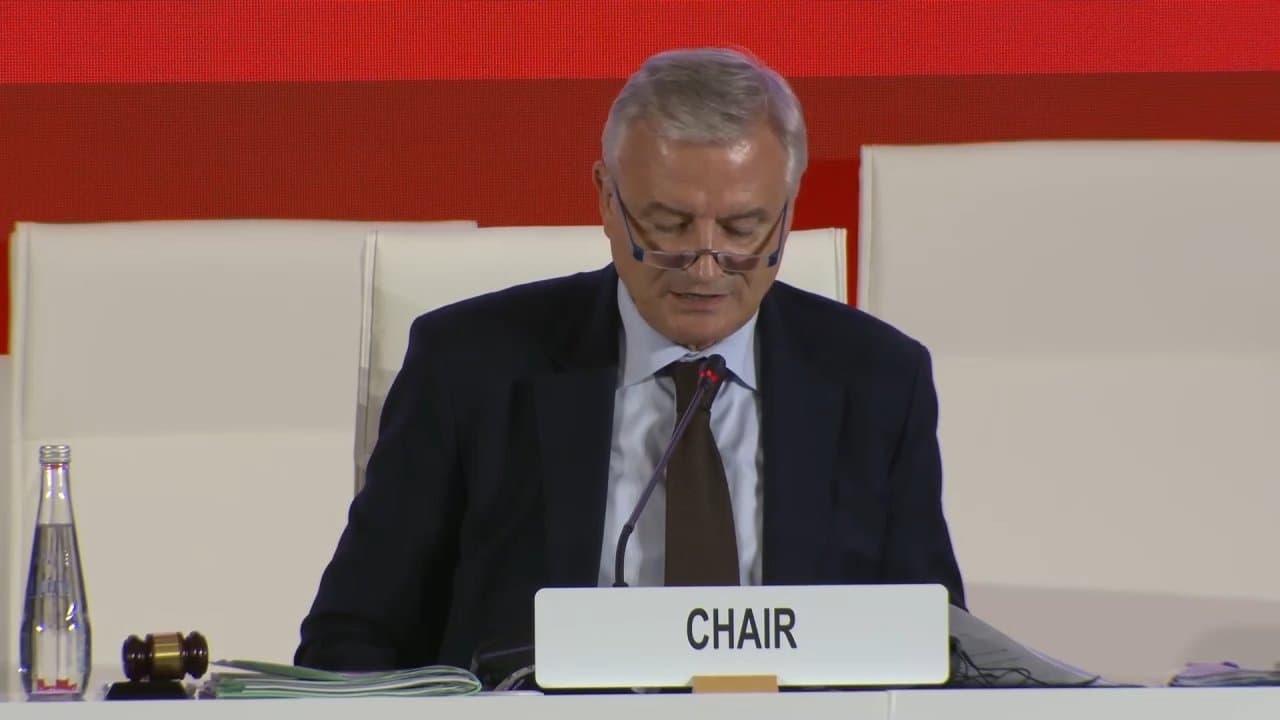
Abu Dhabi Declaration Heads for Adoption as Budget Crisis Strips Interpretation From Congress Committees
United Nations Congress on Crime Prevention and Criminal Justice • United NationsSeptember 25, 2026
Locunity is an independent informational service and is not an official government page for this commission. All information is sourced from public footage and an analysis of official agendas with the aid of responsible, fact-checked AI. to report an error or omission.
The 15th United Nations Congress on Crime Prevention and Criminal Justice finalized its organizational blueprint on Sept. 25, 2026, recommending the UAE's justice minister as president and locking in a week-long schedule — but a UN liquidity crisis will force committee sessions to proceed without interpretation in any language, raising equity alarms at the world's largest criminal justice policy gathering. Japan and Iran signaled they will register substantive reservations before the Congress's headline political declaration is adopted by acclamation.
- UAE Justice Minister recommended as Congress president by acclamation; 28-member General Committee nominated across regional groups, with vice president vacancies in two blocs
- Committee meetings will run without interpretation services due to UN budget constraints — a significant departure from multilateral norms
- Abu Dhabi Declaration set for adoption by acclamation; Japan and Iran register to deliver substantive statements before the ceremonial opening
- Over 40 countries sign up for Pledge for Justice initiative, a new accountability mechanism requiring concrete, time-bound national commitments
- Eight NGOs without ECOSOC status accredited for Congress participation, broadening civil society voice
Budget Crisis Hits the Floor: No Interpretation in Committee Sessions
The most consequential organizational decision to emerge from the pre-Congress consultations may be the one that limits who can fully participate. Committee meetings — where the substantive workshops on crime prevention and criminal justice will take place — will proceed without interpretation services in any of the UN's six official languages. Only plenary sessions and high-level thematic meetings will retain full interpretation.
Why it matters: The 15th Crime Congress draws delegations from nearly every country on earth. Stripping interpretation from committee sessions means non-English-speaking delegates will face significant barriers to participating in the workshops where detailed policy work happens — workshops on topics ranging from transnational organized crime to cybercrime to criminal justice reform.
Where things stand: The Chair of Pre-Congress Consultations framed the decision as unavoidable but explicitly temporary: "Allow me to emphasize that these arrangements are exceptional and time-bound, and that they are a direct consequence of the financial constraints affecting the provision of conference services across the UN Secretariat."
The consultations endorsed the rules of procedure (document A/Conf 241/2) with a formal caveat: these budget-driven workarounds shall not set a precedent for future congresses and are without prejudice to Rule 49 of the Rules of Procedure, which protects multilingualism.
What's next: The arrangement applies for the duration of the Congress. Delegations endorsed the caveat language, but the practical impact — particularly on small delegations from the Global South that may lack English-proficient specialists — will play out over the coming days in Abu Dhabi.
Abu Dhabi Declaration: Adoption by Acclamation, but Not Without Reservations
The Abu Dhabi Declaration (document A/CONF/241/L1), the Congress's principal policy output on crime prevention and criminal justice, will be adopted by acclamation during the ceremonial opening of the high-level segment. But at least two delegations signaled they have unfinished business with the text.
The basics: The declaration was transmitted on July 7 by Judge Abdulrahman Murad Al Blushi, Chairperson of the UAE National Organizing Committee, following negotiations that began in Vienna in September 2025. The Chair of Pre-Congress Consultations praised those efforts: "Allow me once again to express my gratitude to His Excellency Judge Al Blushi for his unwavering dedication and leadership throughout the negotiations."
Where things stand: Japan and Iran both registered to deliver substantive statements — not merely congratulatory remarks — on the declaration.
The Delegate from Japan stated: "I just want to register that Japan is intending to deliver explanation of position on the Abu Dhabi Declaration on the assumption that we are happy to join the consensual adoption at a later stage." Japan's decision to join consensus while filing a formal explanation of position is a well-established diplomatic signal that the delegation has specific concerns it wants on the record.
Iran also registered, with the Delegate from Iran asking: "I would appreciate if the Secretariat enroll our name as countries who is going to be willing to delivering their statement regarding the declaration."
The other side: The Delegate from Egypt sought procedural clarity on precisely when these statements would occur relative to the ceremonial segment, asking where substantive remarks would fit to avoid "conflicting messages." A Senior Secretariat Representative explained that substantive statements would be delivered at the end of the procedural part — before dignitaries enter for the ceremonial adoption — and would be "clearly reflected in the report as clearly related to the Abu Dhabi Declaration." The ceremonial portion, the Secretariat emphasized, was meant to be a moment of celebration in honor of the host country.
What's next: The substantive statements will be delivered during the opening session before the ceremonial segment. The nature of Japan's and Iran's reservations will become clear when they take the floor.
UAE Justice Minister Set to Lead 15th Crime Congress
The pre-Congress consultations recommended that the Congress elect H.E. Abdullah bin Sultan bin Awad Al-Nuaimi, Minister of Justice of the United Arab Emirates, as president by acclamation. The Chair of Pre-Congress Consultations confirmed: "I understand that there is a general agreement among all delegations to recommend to the Congress that it elects by acclamation His Excellency Abdullah bin Sultan bin Awad Al-Nuaimi, Minister of Justice of the United Arab Emirates, as President of the Congress."
Where things stand: The 28-member General Committee was also nominated. Key officers include:
- First Vice President: From the Eastern European States — Armenia's Minister of Justice, Serbuhi Gaylan
- Rapporteur General: From the African Group — Ghana's Permanent Representative in Vienna, Matilda Aku Alumatu-Osei-Agyeman
- Chair of Committee 1: From the Western European and Others Group — the Chair of the pre-Congress consultations himself
- Chair of Committee 2: From Latin America and the Caribbean — Mexico's Permanent Representative in Vienna, José Antonio Zabalgoita Trejo
Vice presidents were nominated from the African, Asia-Pacific, and Latin American and Caribbean groups. Notably, no nominations were received from the Eastern European States or the Western European and Others Group for vice president positions — vacancies that could affect balanced regional representation during committee deliberations.
Pledge for Justice: A New Accountability Tool
A novel initiative called Pledge for Justice will give member states a visible platform to make concrete, time-bound commitments during their national statements in the high-level segment.
Why it matters: The Chair of Pre-Congress Consultations described the initiative as an effort to move beyond rhetoric: "The initiative is intended to provide a visible platform for member states to make concrete, time-bound commitments to advance crime prevention, criminal justice, and thereby help translate the political commitments of the Congress into practical action beyond Abu Dhabi."
Over 40 countries and two intergovernmental organizations have registered to participate, according to a Secretariat Representative. The visual mechanics are distinctive: during their national statement, speakers will touch an activation device at the lectern, triggering their country's hexagon to appear on a growing digital mosaic display in the plenary hall. The UAE, as host country, will activate the first tile.
Pledges can cover national, regional, or international initiatives; partnerships; capacity building; technical assistance; and financial commitments. They will be incorporated into each delegation's speaking time during the high-level segment.
- Credentials Committee formed: A nine-member committee mirroring the General Assembly's 80th session was constituted, with Namibia substituting for Botswana and Switzerland for Andorra. A replacement for Senegal is still being sought from the African Group.
- NGO participation expanded: Eight of nine NGOs without ECOSOC consultative status were accredited for Congress participation, with objections previously resolved at a February 2026 intersessional meeting.
- Congress report structure agreed: The final report will include the Abu Dhabi Declaration, decisions, speaker lists, chair summaries, and workshop recommendations, with remaining sections to be completed post-Congress under the Rapporteur General's guidance.
- High-level segment speaking order set: Group statements (G77 and China, the African Group, the Asia-Pacific Group, and the EU) will speak first at 5–7 minutes each, followed by national statements at 3–5 minutes. The speaker list was established by drawing of lots on Sept. 2, 2026, with a deadline of 2 p.m. on Sept. 26 for late additions.
- Daily schedule announced: Saturday plenary runs 9:30 a.m. to 10 p.m.; Sunday plenary 9 a.m. to 7 p.m.; Monday through Thursday both plenary and committees meet 10 a.m. to 1 p.m. and 3 to 6 p.m.